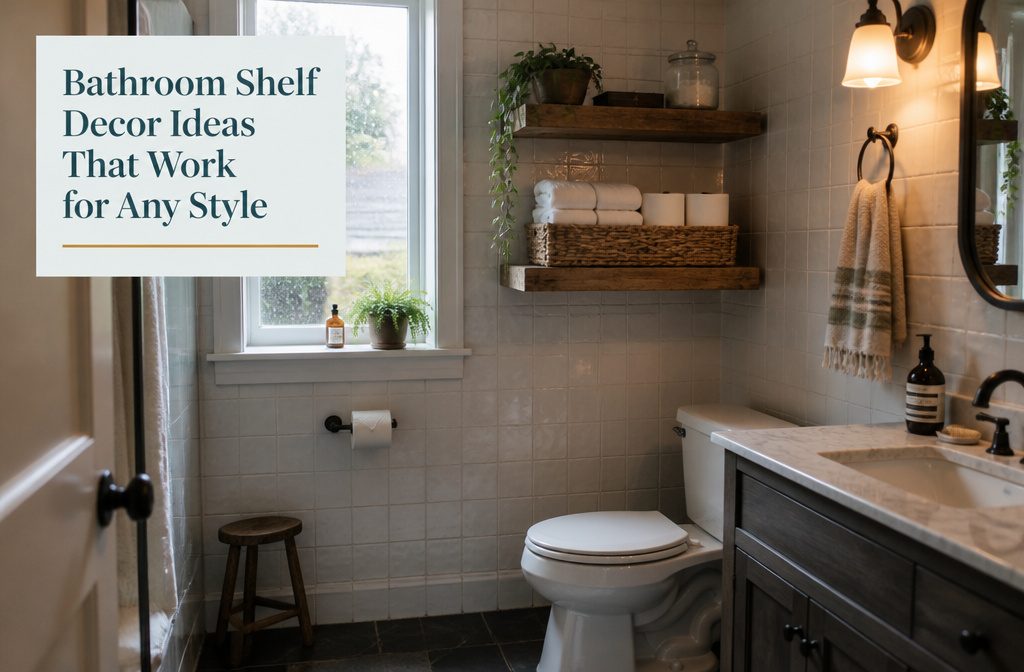
Bathroom shelves split between what you reach for daily and what sits there to soften the tile, and the right one depends on whether you need the storage more than the look.
If your bathroom runs short on drawer space, deeper shelves with baskets hold toilet paper and toiletries without the visual clutter of branded packaging left out in the open.
A floating shelf with iron-pipe brackets reads industrial against white tile, while a circular wire basket over the toilet keeps the farmhouse read intact. Spacing shelves 10 to 12 inches apart lets each display breathe instead of crowding into one busy wall.
1. Floating Shelves with Iron Pipe or Industrial Details
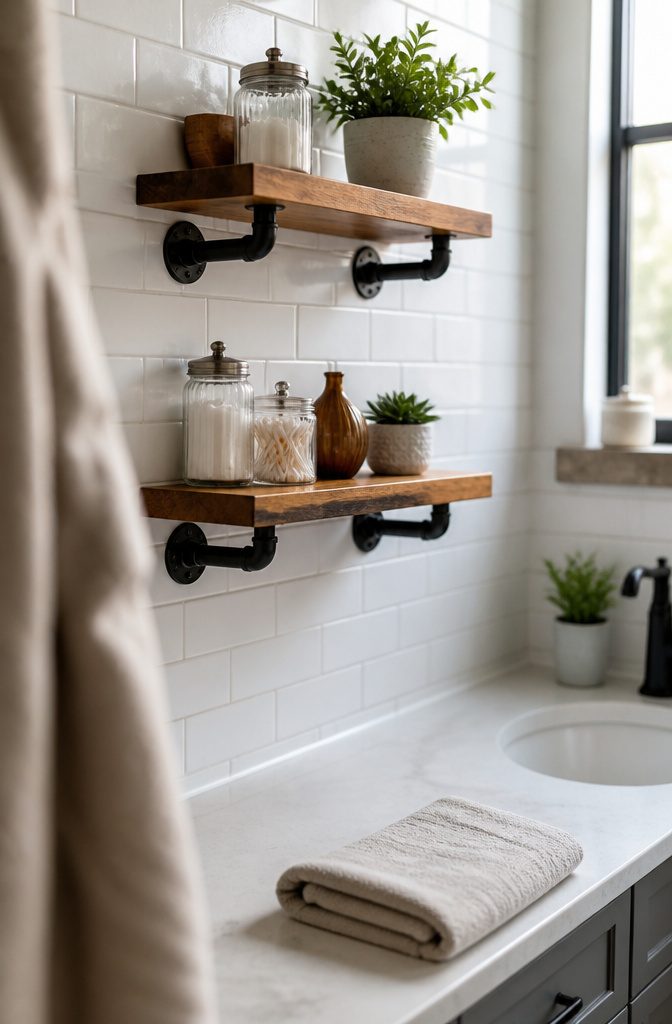
Iron-pipe brackets give floating shelves a harder edge than most bathroom hardware carries, and that contrast is the reason to use them.
The black metal sits clean against white tile or painted drywall, and the industrial look fits modern bathrooms better than it does traditional ones—though a farmhouse scheme can pull it off if the rest of the room already leans spare.
You can buy these shelves with the pipes attached to the wood or running separately as supports. The attached version reads more finished; the separated brackets make the structure visible, which some people want and others find too busy.
Sealed hardwood handles moisture better than MDF once the pipes are bolted through, and solid wood gives you more bearing surface where the hardware bites.
Glass canisters and small ceramic vases work well on pipe shelves because they echo the clean lines without fighting the metal. Plants soften the look if the industrial side tips too cold.
2. A Modern Shelf with Wire Detailing
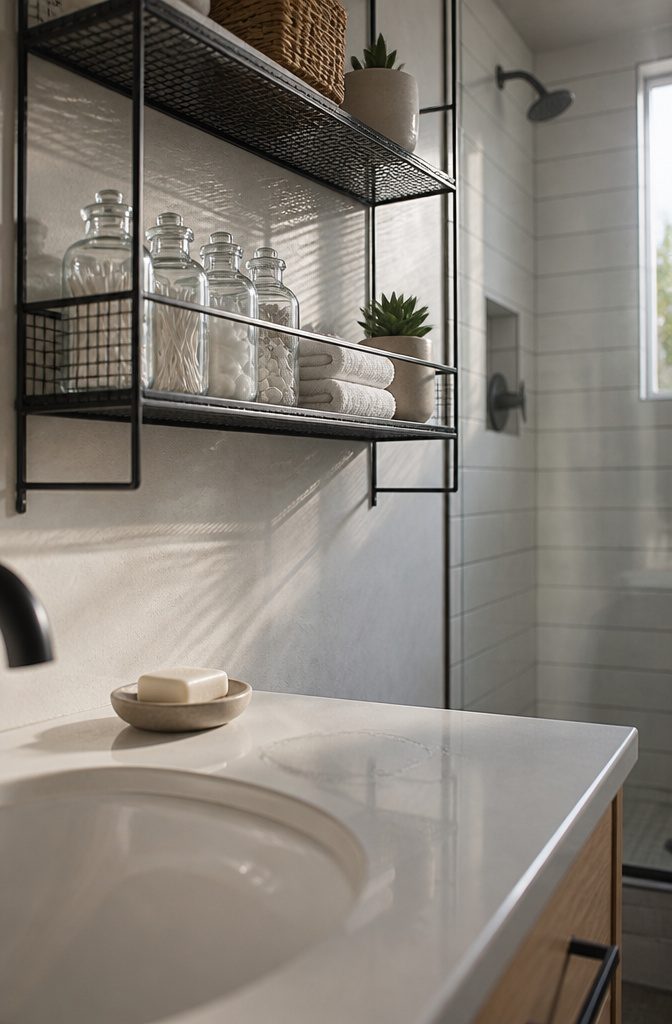
A shelf with wire or mesh panels brings a modern, industrial feel without closing off the wall behind it.
The openwork keeps things light—you see straight through to the tile or paint, so the shelf adds structure without blocking the room visually.
That transparency works especially well in a small bathroom where a solid wood shelf might feel heavy.
Wire shelving suits items with clean lines: glass apothecary jars, white folded towels, small potted succulents in ceramic planters. I’d skip anything too ornate or busy; the wire itself provides the texture, and simple shapes show better against it.
A single row of matching jars or a stack of two or three hand towels keeps the display from looking cluttered while letting the shelf’s structure do the styling work.
Black wire reads more industrial, brass or gold wire leans warmer and pairs well with marble or neutral tile.
Either way, the shelf stays true to a contemporary look as long as what sits on it is deliberate rather than crowded.
3. A Bamboo Tower with Linens Below and Canisters Above
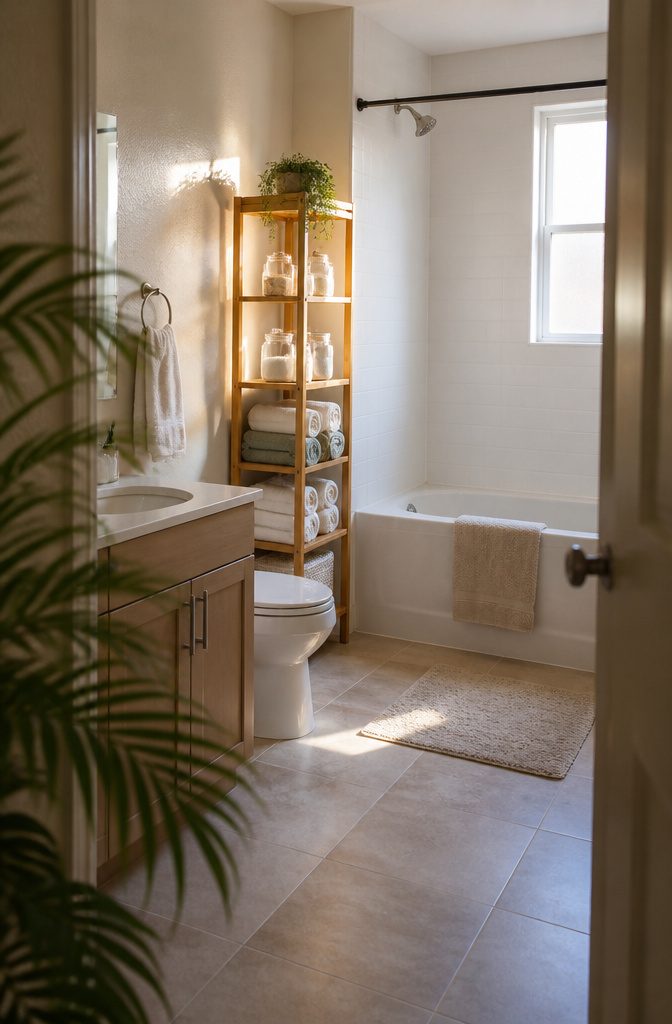
A freestanding bamboo tower splits the work between decorative and practical without drilling a single hole.
Lower shelves hold rolled towels and spare linens where they stay out of sight but close to hand. Upper shelves get the display treatment: canisters for cotton pads, a small plant, maybe a candle in a jar.
Sealed bamboo handles bathroom humidity well enough for most zones, though you’ll want to keep it out of the direct spray if your shower has no door.
The setup works particularly well in rentals where wall-mounted shelves are not an option, and the tower footprint is narrow enough to tuck beside a vanity or into the corner opposite the tub.
You can move it when you clean, and when you leave, it leaves with you.
4. An Over-Toilet Ladder Shelf for Renters
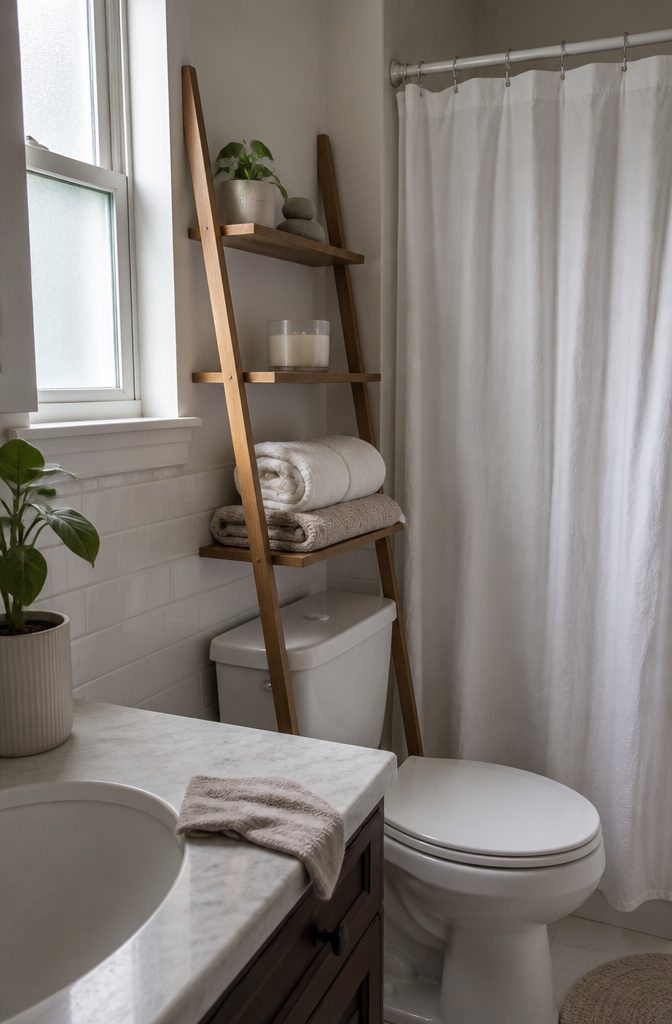
A ladder shelf leans against the wall above the toilet and stays put without a single screw — the answer if you rent or just don’t want to drill.
The frame sits at an angle, so it holds itself in place by weight rather than by brackets.
Rolled towels go on the lower tiers where you can reach them without stepping up.
The top shelf takes a candle, a small plant, or a few smooth stones if you want the spa look. Keep anything you use daily on the middle rungs; the very top is for things that sit still.
Ladders flex more than a mounted shelf, so don’t load them with heavy glass jars or stacks of books. A shelving stand with vertical supports handles weight better if storage matters more than the lean-in look.
5. A Circular Wall Shelf for a Farmhouse Look
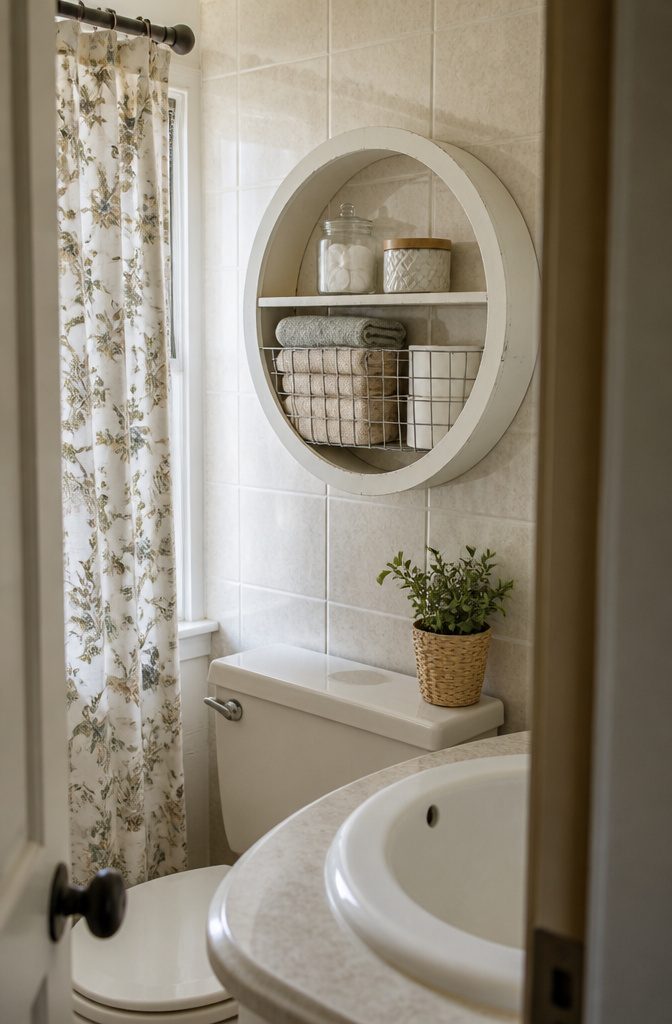
A circular wall shelf adds softness where most bathroom lines run straight—the sink edge, the mirror frame, the tile grout.
The curve sits better over a toilet tank than a rectangular shelf would, because it does not fight the toilet’s own rounded profile.
The farmhouse metal basket has become standard for a reason: it holds hand towels or spare rolls without looking clinical, and the wire construction keeps the look light. Pair it with small ceramic canisters for cotton rounds or bath salts.
A circular shelf does not give you much depth—most run six to eight inches—so stick to items under four inches tall or the whole arrangement tips forward visually.
White-painted wood or distressed metal keeps the farmhouse read clear. Stain or dark finishes pull it toward industrial instead.
6. Three Stacked Floating Shelves with Plants, Art, and a Wire Basket
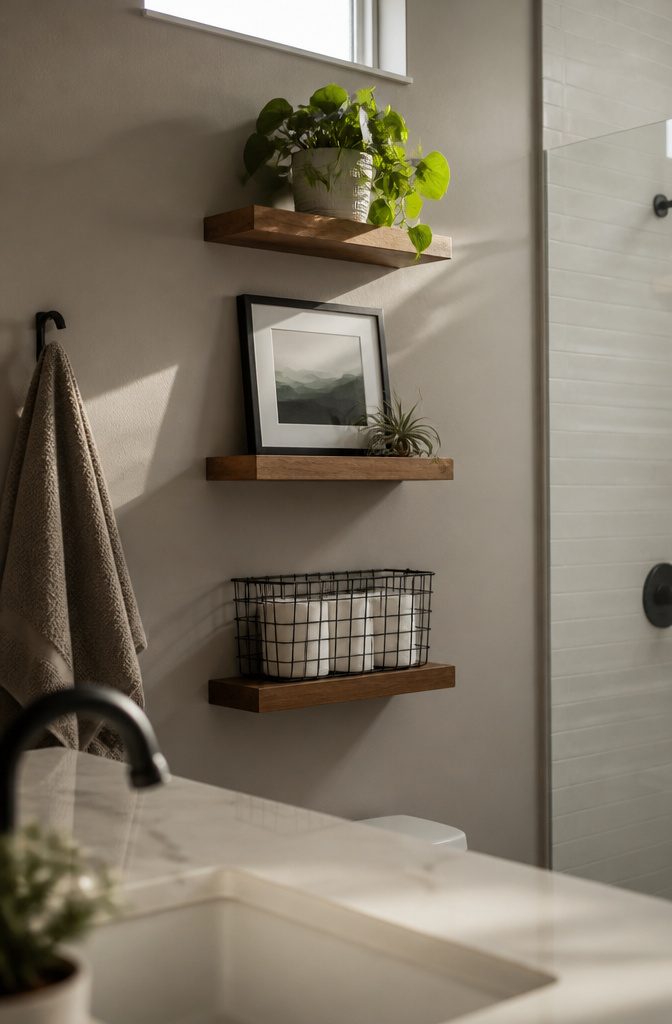
Three floating shelves stacked vertically give you room to mix function with style. I space mine 10–12 inches apart so each shelf reads as its own moment without the whole setup feeling crammed.
A small potted plant on the top shelf brings in something living, framed art on the middle one adds color or a pattern you want to repeat, and a wire basket on the bottom holds toilet rolls where you can actually reach them.
The variety across the three levels keeps your eye moving instead of landing on three identical vignettes, and the basket makes the practical stuff part of the look rather than something you’re trying to hide.
7. Light Wood Shelves with Vines or Other Greenery
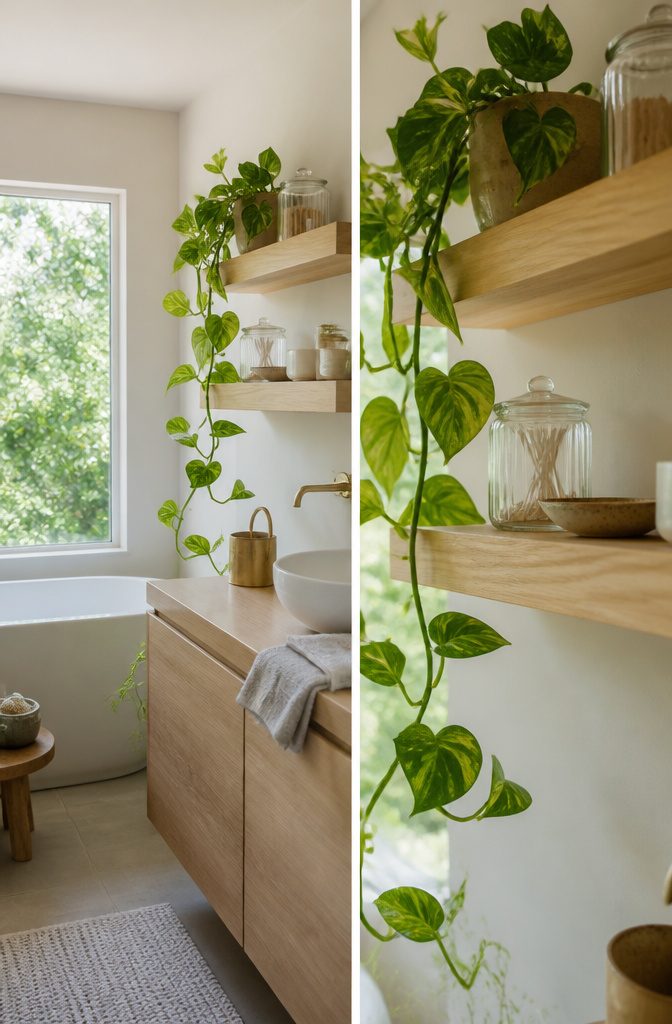
Light wood shelves paired with trailing vines bring movement to what might otherwise be a static display. The greenery softens hard edges—jars, trays, anything geometric—and adds height contrast when the stems spill down from the top shelf.
If your bathroom has a window, pothos trails beautifully from a shelf above the toilet and thrives in the humidity. Small ferns work just as well in steamy conditions.
A telephone plant is another solid choice: it needs the moisture but survives without direct sun, which solves the problem in a bathroom where the light comes from a skylight or sits too far from the window.
No natural light?
Go faux. A dying plant reads worse than no plant at all, and rotating a real one back to a bright room each week is more upkeep than most people maintain.
Water with a small can when you do use real plants. The shower spray isn’t enough control, and overwatering stains wooden shelves faster than steam ever will.
The lighter the wood, the bigger the space feels. In a small or dim bathroom, skip ash tones or anything darker—they close the room in rather than opening it up.
8. Custom-Bracket Shelves Paired with Small Seagrass Baskets
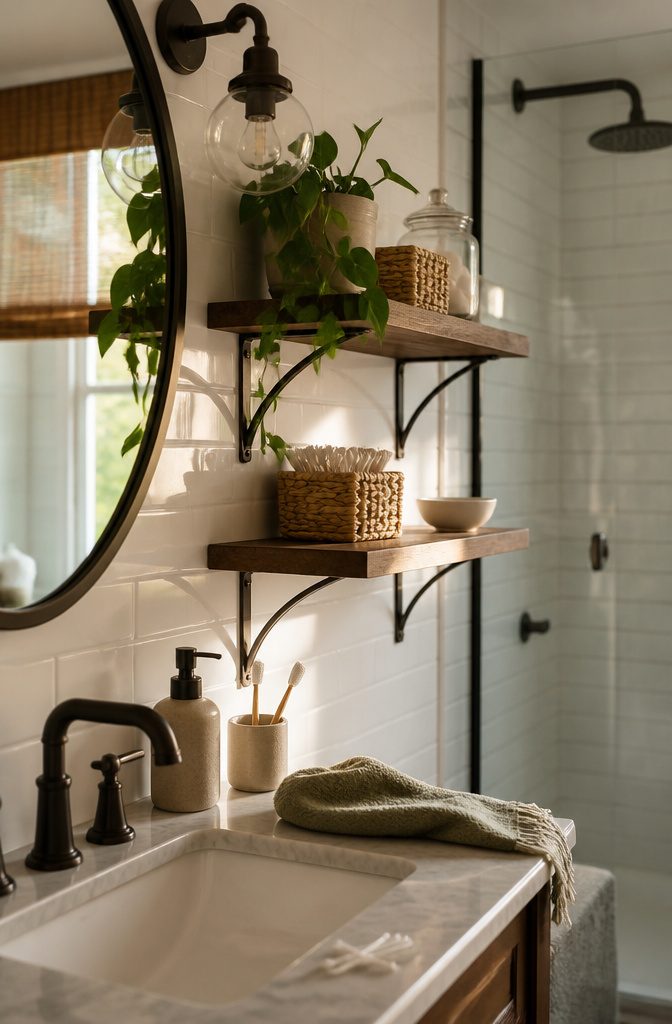
Wooden shelves with decorative brackets let you pick the bracket style—scrolled iron, matte black geometric, or simple L-brackets—and the wood finish separately.
That control matters when you’re matching existing fixtures or working around tile. I’ve seen oil-rubbed bronze brackets hold their own against white subway tile better than most all-in-one shelf kits manage.
Small seagrass baskets work on these shelves because the woven texture reads warmer than plastic bins but still keeps a clean line. Baskets corral cotton swabs, makeup, and feminine products without the visual clutter of ten separate items sitting out.
You lift one container when you dust instead of moving everything individually. If multiple people share the bathroom, a small label tucked inside each basket keeps things from migrating between them.
9. Thick Wood Shelves Paired with Pretty Canisters and a Vanity Tray
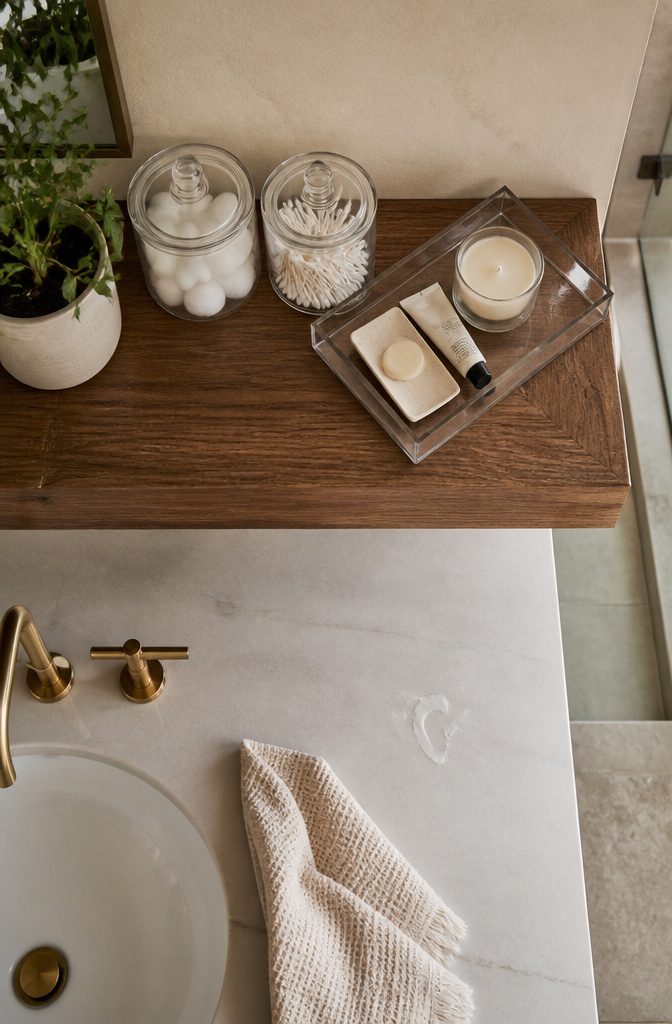
A thick wood shelf—two inches deep or more—sits on the wall with the weight of real furniture instead of disappearing like a thin floating bracket.
The substantial profile makes whatever you put on it look chosen rather than squeezed into leftover space.
Glass or ceramic canisters keep cotton balls and cotton swabs visible and tidy, which matters more than hiding them when the alternative is a half-open plastic bag shoved to the back.
Match the canisters so the pair reads as a set, not as two things you happened to own.
A vanity tray corrals soap, hand cream and a candle into one group instead of three separate items competing for attention.
Clear glass or acrylic lets the tray define the boundary without adding a new color or finish to work around.
10. A Single Floating Shelf with Artwork Above and Decorative Lighting
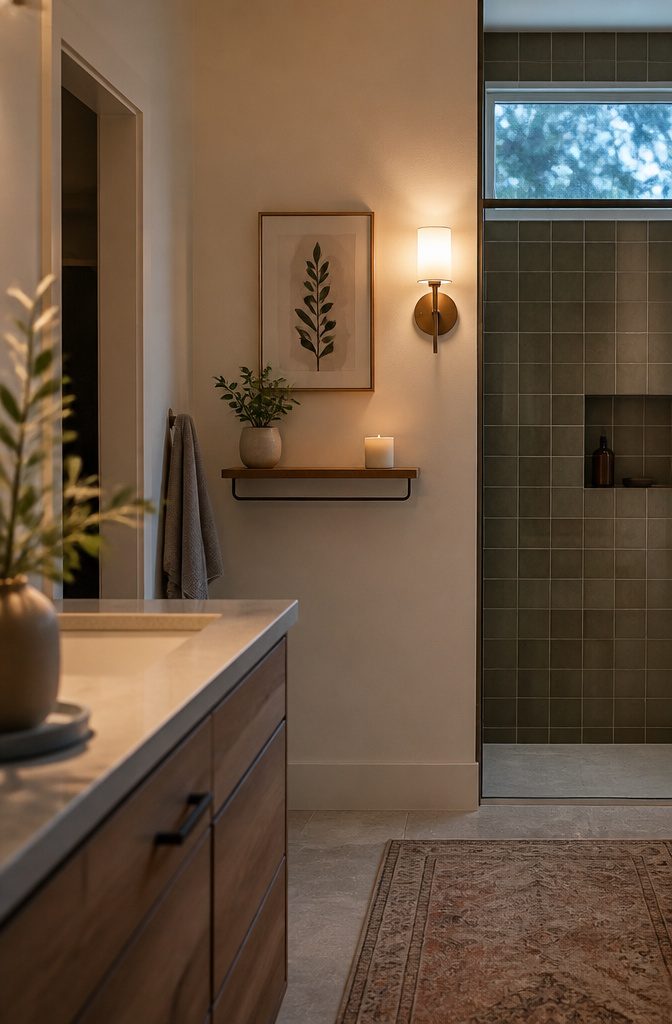
A single floating shelf paired with artwork and a sconce turns a blank wall into a focal point without covering it.
The shelf sits below the frame—often six to twelve inches of vertical space between them—and the sconce mounts to one side or directly above, casting light across both pieces.
The separation keeps each element readable instead of competing for attention.
The shelf itself holds very little: a small plant, a candle, or a single decorative object. More than that and the clean lines disappear.
Wood shelves with a metal bar underneath work well here because the bar adds a second visual layer without requiring a second shelf, and the hardware stays minimal enough that the art remains the anchor.
Swapping standard bathroom lighting for decorative sconces is inexpensive and changes the room more than most renters expect. The frame can be small—the sconce and shelf together create the scale.
11. Faux Greenery to Soften Bathroom Tile
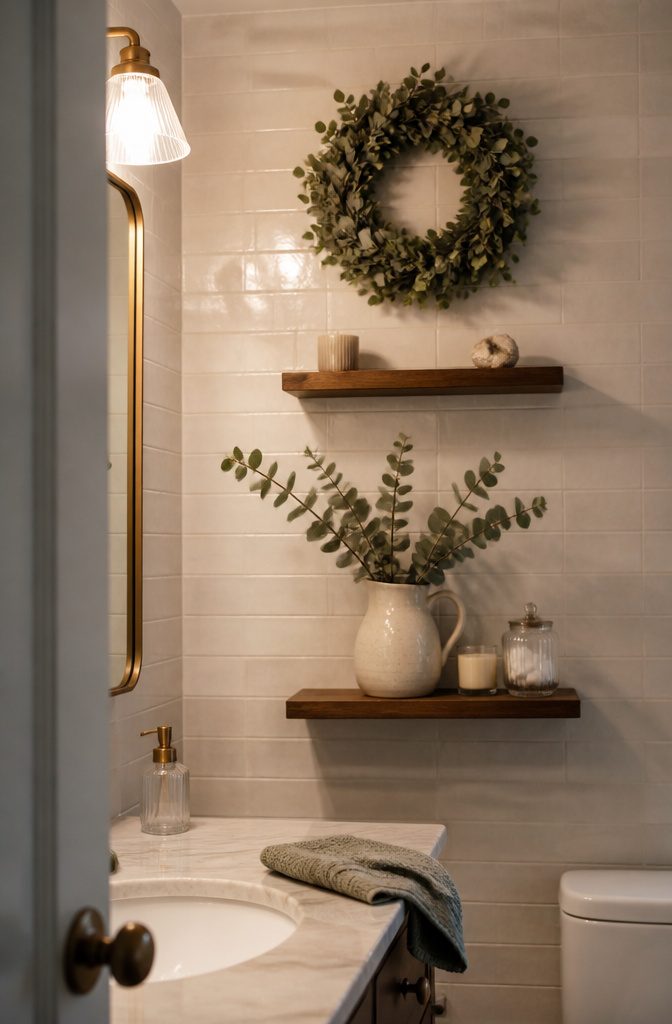
Faux plants soften the hard surfaces bathroom tile creates without needing a window.
A green wreath hung on the wall above shelves brings in color and a fresh vibe, and eucalyptus stems placed in a ceramic pitcher give an understated farmhouse look that works even in a windowless powder room.
Stack the stems loosely rather than cramming the pitcher—three or four is enough.
If you do have natural light, a telephone plant tolerates both humidity and low light better than most houseplants, so it survives where ferns and pothos might struggle.
But in a truly dim bathroom, faux greenery skips the weekly rotation back to a brighter room and never turns brown mid-display.
12. Farmhouse-Style Shelves with Stacked Baskets and a Wood Tray Stand
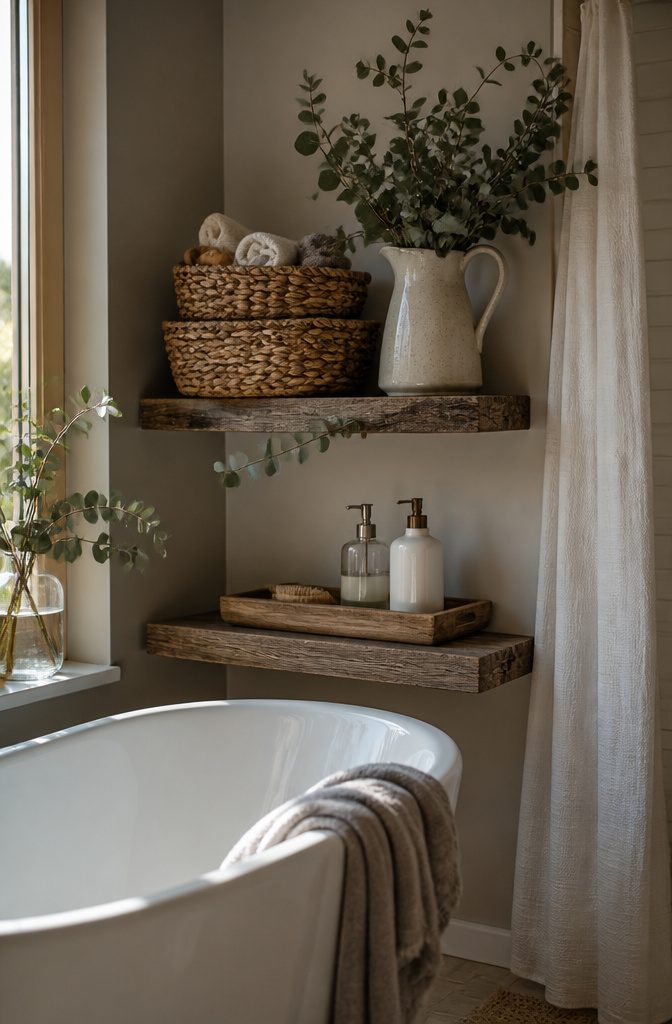
Stacked woven baskets give farmhouse shelves a lived-in feel without looking cluttered. I nest two or three on one shelf, leaving the texture visible instead of pushing them flush against the wall.
The baskets hold rolled hand towels on top, toiletries or backup soap below, so the display stays useful rather than purely decorative.
A small wood tray or stand anchors the setup on another shelf. I use it to corral hand soap and a bottle of lotion—the tray keeps daily-use items grouped instead of scattered across the surface.
The warm wood tone ties back to the woven baskets and reads as one cohesive material story rather than a collection of unrelated objects.
Faux eucalyptus stems in a ceramic pitcher finish the look. The soft gray-green breaks up all that neutral brown, and the pitcher keeps the stems upright without requiring a vase you have to refill.
The whole arrangement works because every piece does something: the baskets store, the tray organizes, the eucalyptus fills vertical space.
13. Boho Shelves with Plants, Art, a Candle, and Seagrass Baskets
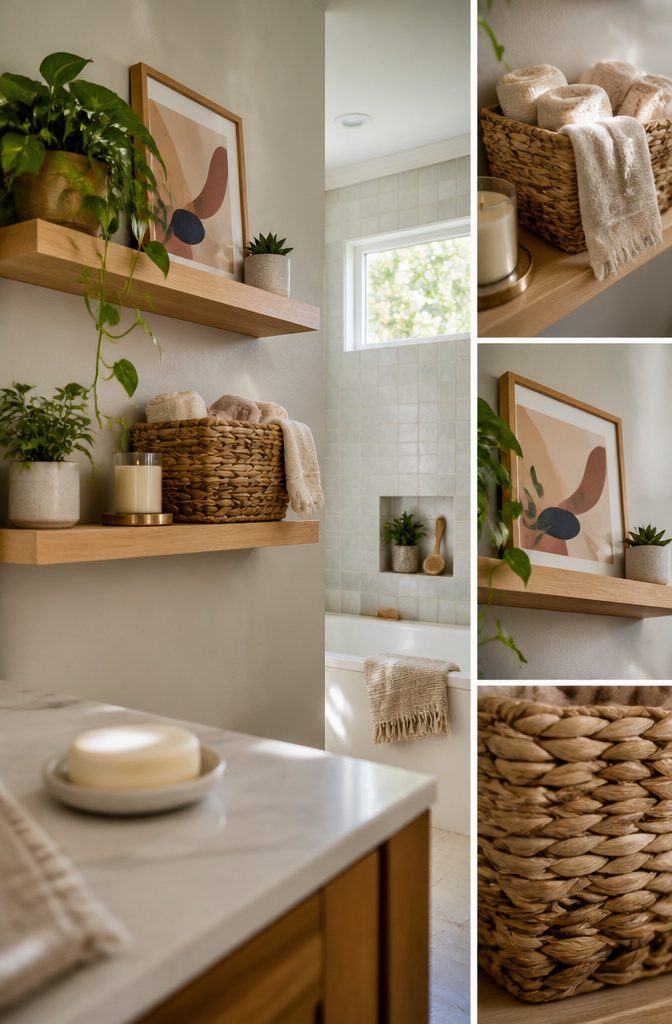
Boho decor thrives on the mix, and this shelf does exactly that: a plant sits beside framed art, a candle next to a seagrass basket, each piece bringing its own texture.
The seagrass baskets hold functional items like toilet paper or rolled washcloths, so the shelf stays useful while looking layered. Light wood shelves work best here—they let the varied materials stand out without fighting for attention.
I arrange the taller items toward the back and shorter ones forward, which keeps the display from blocking itself. A small succulent or trailing pothos adds the organic feel boho styling needs, and the candle brings warmth without clutter.
The art can be a simple print or a small sign; it anchors the arrangement and gives the eye a place to land. Fill the baskets so they look full—empty containers read as unfinished rather than minimal.
14. Baskets and Glass Canisters to Make Toilet Rolls and Cotton Pads Look Tidy
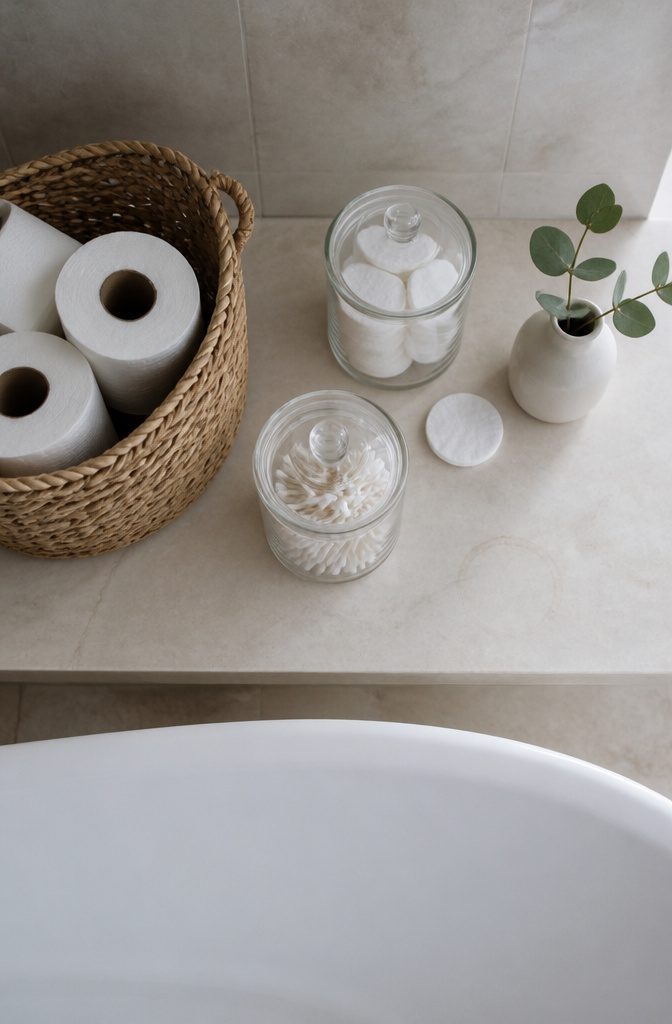
Toilet paper stacked loose on a shelf looks exactly like what it is: something you grabbed in bulk and forgot to put away. Matching baskets and glass canisters turn the same items into part of the room’s composition.
Woven baskets hold rolled toilet paper; glass jars with lids contain cotton pads, swabs, or bath salts. The containers themselves become the visual unit, not the branded packaging inside.
The functional items earn their place when they sit inside something that suits the rest of the shelf. A wicker basket next to a small vase and a candle reads as intentional.
A twelve-roll pack in its plastic wrap does not. The ⅓ functional, ⅓ decorative, ⅓ open space formula keeps the arrangement from tipping into clutter: one basket of necessities, one decorative object, and enough empty shelf that neither crowds the other.
Use Shelves for Both Storage and Decor
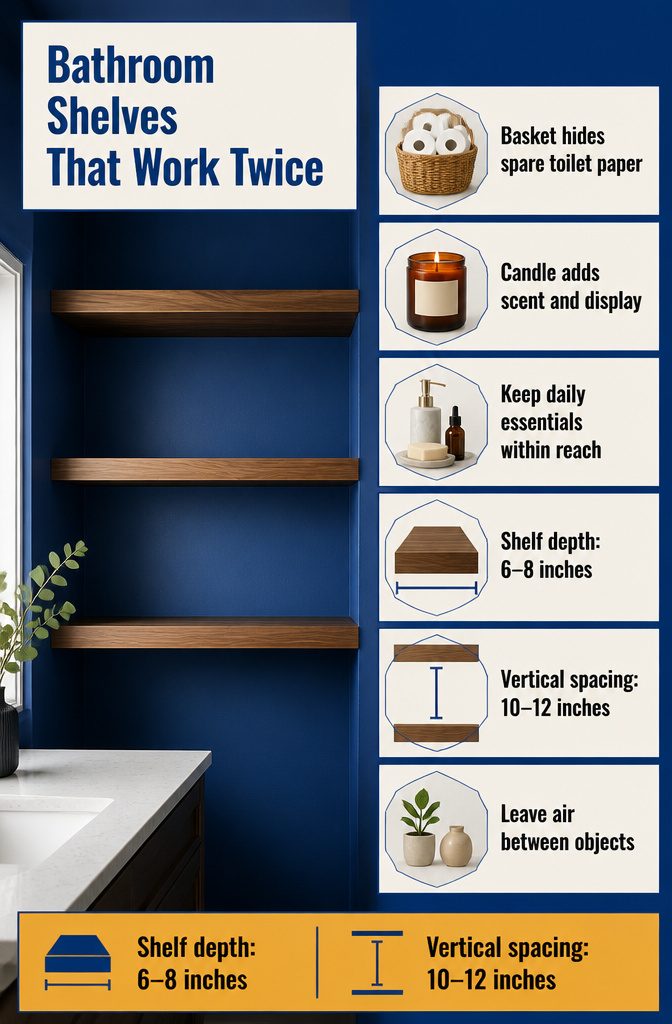
Bathroom shelves work hardest when the things sitting on them pull their weight twice: once as something you actually use, once as part of the display.
A basket holding spare toilet paper looks intentional; a pile of packaging does not. The same goes for a candle that smells good or towels folded to show their texture rather than shoved flat.
Keep what you use every day within reach, without letting it crowd out everything else. Choose deeper shelves—6 to 8 inches—for bottles and larger items, and leave 10 to 12 inches of vertical space between shelves so the whole arrangement can breathe.
Resist the urge to fill every inch; a little air between objects keeps the look calm and the function intact.
Frequently Asked Questions
Are floating shelves a good idea for bathrooms?
Yes.
They add vertical storage without taking up floor space, and sealed hardwood or metal versions handle bathroom humidity well. Floating shelves work best when you keep them uncluttered and choose materials that tolerate moisture.
Where should floating shelves be placed in a bathroom?
Above the toilet, beside or over the mirror, in unused corners, or over towel hooks. These spots keep shelves accessible for daily items while filling blank wall space.
How many floating shelves should a bathroom have?
One to three shelves, depending on your wall size and what you need to store. Stack 3 shelves vertically with 10–12 inches between them for a layered look, or use a single shelf above the toilet for a cleaner feel.
How deep should bathroom floating shelves be?
6 to 8 inches deep handles toiletries, small baskets, rolled towels and decorative objects without feeling bulky. Anything deeper can make a small bathroom feel cramped.
What should I put on bathroom floating shelves?
Mix functional items with decor: rolled towels, baskets holding toilet paper or toiletries, a small plant, a candle, or framed art. Use glass or ceramic canisters for cotton pads and swabs so they stay tidy but visible.
What materials are best for floating shelves in bathrooms?
Sealed hardwood, metal, or glass. Solid wood handles moisture better than MDF once sealed, and it gives you more bearing surface where the hardware attaches.
How do I stop my bathroom shelves from looking cluttered?
Keep only what you use or want to display, hide the rest in matching baskets, and leave visible surface space between items.
A small tray groups daily-use items like soap and lotion so they read as one unit instead of scattered objects.
How high should a shelf sit above the toilet?
6 to 12 inches above the tank works for most setups, but check that you can still lift the tank lid for repairs. Measure your own toilet first, then mount the shelf into studs with enough clearance that access stays easy.
Do candles and plants survive on a bathroom shelf?
Candles hold up fine as long as they sit away from direct shower spray. Plants need light: pothos or ferns work near a window, but in a windowless bathroom, faux greenery looks better than a dying real one.
Is open shelving still okay for small bathrooms in 2026?
Yes, but keep it to one or two shelves and store daily clutter behind closed doors. Open shelves work in small bathrooms because they lift items off the counter without adding visual weight the way closed cabinets do.