
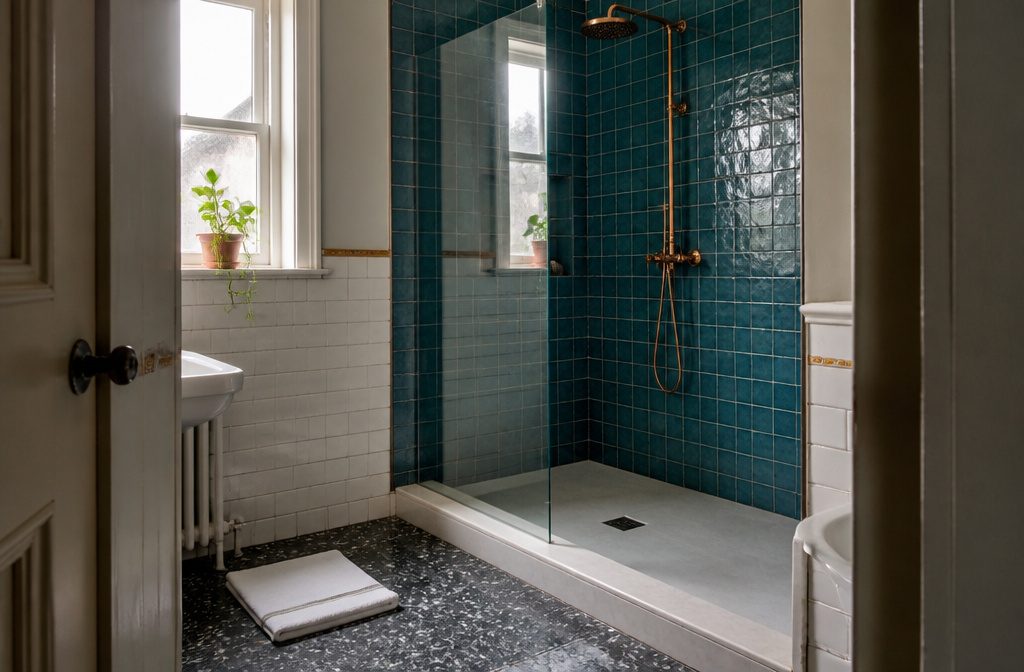
A bathroom remodel shower replaces your existing tub or stall with a new setup—walk-in enclosure, prefab unit, custom tile, or full wet-room layout.
The cost swings from $1,000 for a showerhead swap to $25,000 for a wet room, and the timeline depends on whether you’re installing prefab panels in two days or waiting weeks for tile work.
Re-Bath conversions take one to two days and can turn a tub into a walk-in shower without tearing the bathroom apart.
1. Walk-In Shower or Tub-to-Shower Conversion
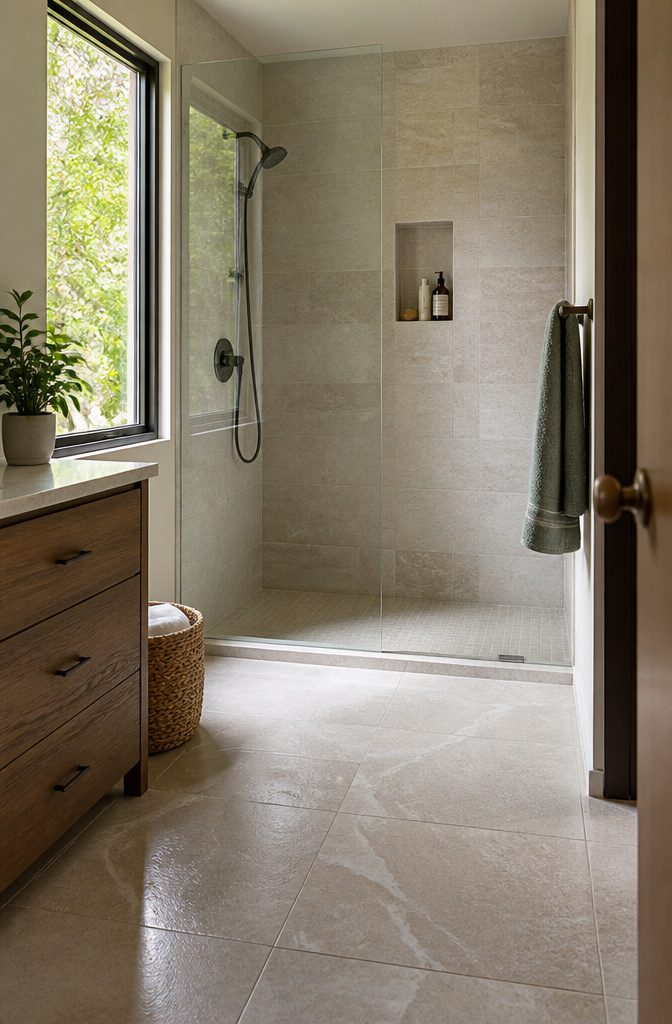
Removing the tub opens up square footage and drops the barrier between you and the shower floor.
A walk-in shower with low-threshold or curbless entry eliminates the need to lift your leg over a 14-inch tub wall, which matters immediately if mobility is already a concern and later if you plan to stay in the house as you age.
The floor sits nearly flush with the bathroom tile, or a threshold of 2 inches or less keeps water contained without creating a tripping edge.
Re-Bath conversions take 1–2 days depending on the size of the existing tub and the condition of the walls behind it.
You gain room to move, easier cleaning access, and a setup that works whether you need grab bars now or want the option to add them without tearing into tile later.
Curbless layouts require proper slope and waterproofing to keep water from migrating across the bathroom floor, so the subfloor and drain placement decide whether the option fits your structure without major rework.
2. Prefab Shower or Wall-Panel System
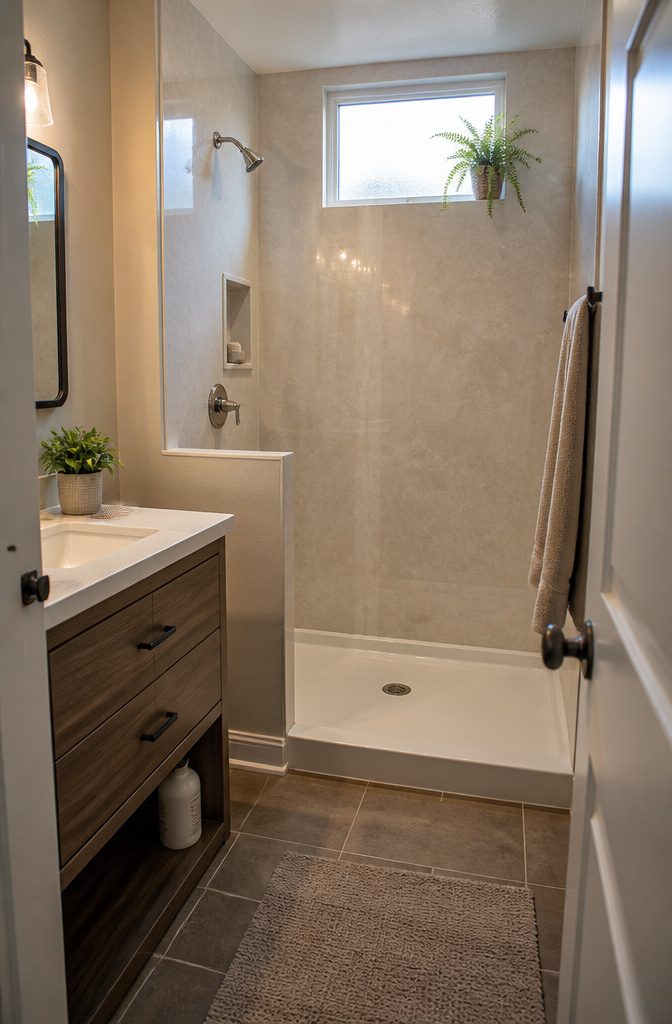
Manufactured shower units and wall-panel systems cut installation time to one or two days instead of the weeks a tile job needs.
The factory does the measuring and the seaming, and your contractor bolts the pieces together rather than setting each tile by hand.
Acrylic and fiberglass panels come in large sheets with minimal joints, so water has fewer places to work its way behind the surface.
Prefab units are also durable with watertight construction, and ideal for DIYers.
That watertight build matters more than it sounds like it does: no grout means no scrubbing mildew out of seams every few months, and the nonporous surface wipes down with whatever cleaner you already keep under the sink.
Re-Bath DuraBath acrylic comes in 14 colors that mimic marble, travertine, granite, and limestone, so the look is no longer the giveaway it used to be.
Full panel systems start around $1,000 to $3,000 installed, which makes this the cheapest way to redo a shower if tile is out of budget.
The tradeoff: scratches are harder to repair than with tile, and you are working within standard widths rather than custom dimensions. Check that the unit fits through your door before you order it.
3. Custom Tile or Natural Stone
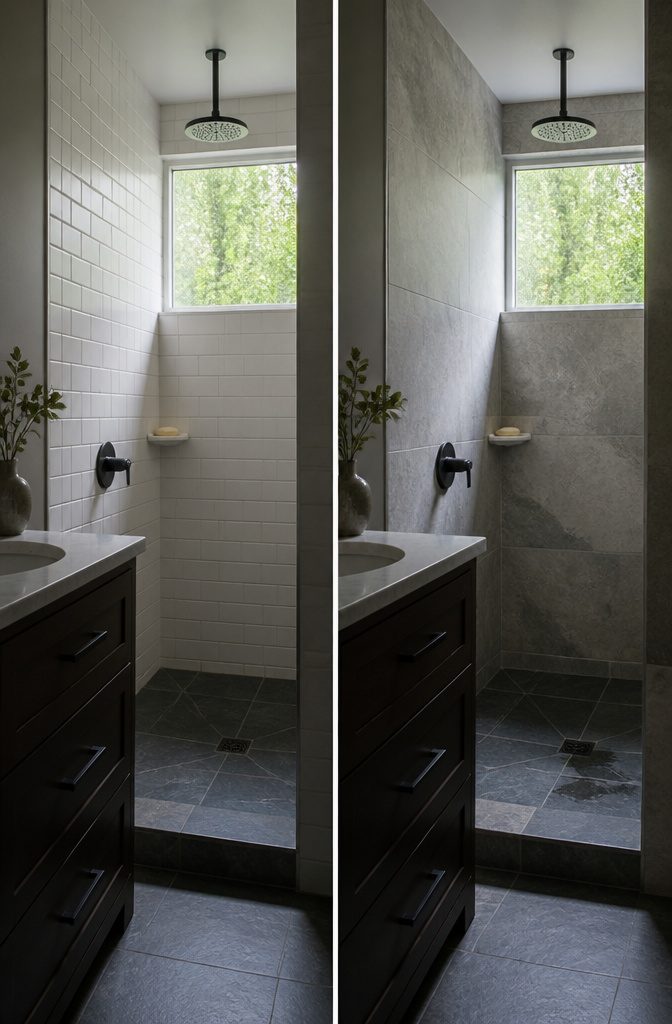
Tile and stone give you more design control than any prefab panel, but you’re responsible for the layout, grouting, and waterproofing instead of dropping in a ready-made system.
Large-format tiles—12×24 inches or bigger—cover more wall with fewer grout lines, which cuts cleaning time and makes a small shower feel larger.
Subway tile, usually 3×6 inches, brings the opposite effect: more grout, more traditional grid work, and a look that reads classic rather than minimal.
Natural stone pulls ahead on visual impact—marble veining, slate texture, travertine warmth—but it needs sealing every year or two to keep water and soap from staining the surface.
Skip the sealing schedule and the stone darkens in spots you can’t scrub out.
4. Shower Enclosure and Door Choices
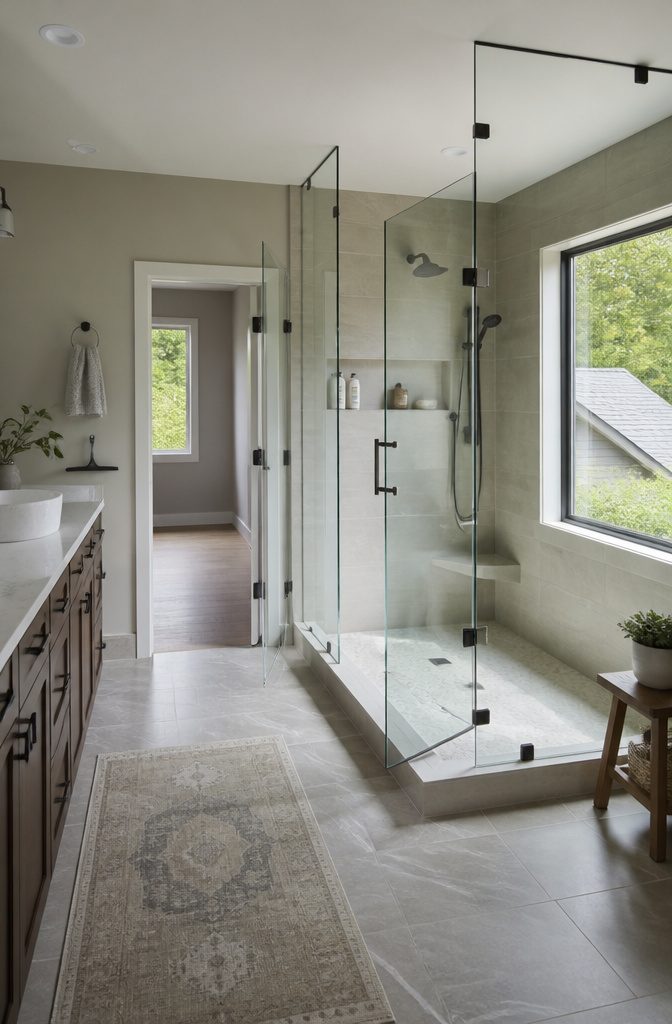
Frameless glass runs $800–$1,500 or higher and looks cleaner than any other door I’ve seen go into a shower remodel.
The glass is thicker, attaches directly to the wall with minimal hardware, and there are no metal frames collecting soap scum in the corners.
Light moves through the space instead of stopping at a frame line, and if you tiled the shower yourself, this is the door that shows the work off.
Framed doors cost $300–$1,200 and install easily, but the metal edge around the glass cuts into the look of the tile.
Sliding doors run $700–$2,000. They work, though one panel always blocks part of the opening even when the door is pushed aside, which makes a tight shower feel tighter.
French doors cost $900–$1,200, built to order, and they swing open completely so a small enclosure reads larger than it measures.
Frosted glass hides soap drips and water spots between cleanings; clear glass needs a squeegee after every shower or it shows everything.
5. Built-In Bench, Niche, or Storage
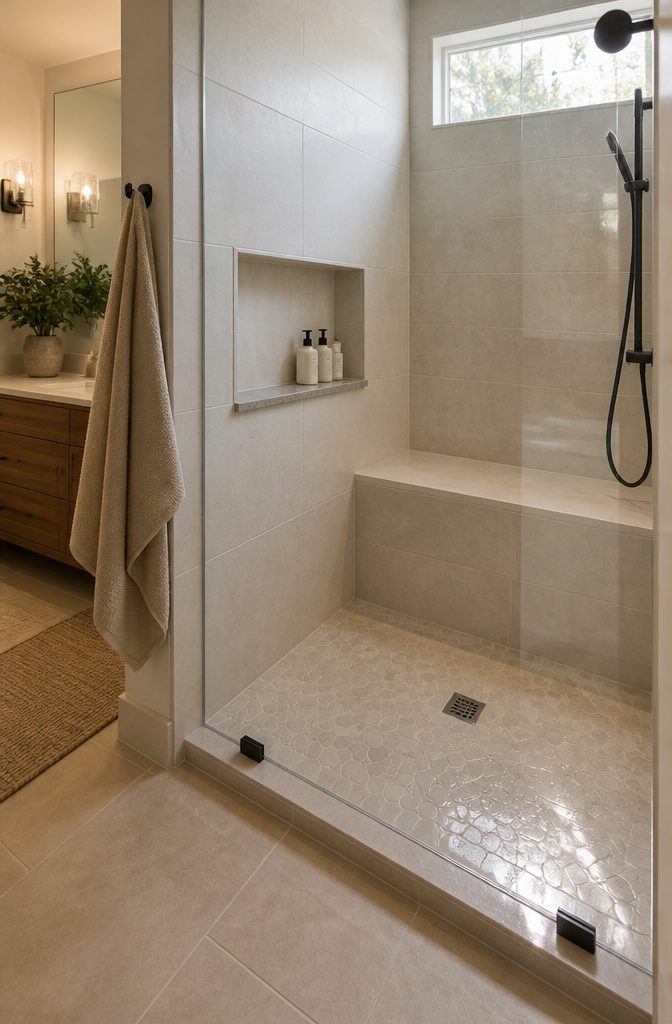
A built-in bench puts a seat where you need it most—when you’re shaving, when your legs give out halfway through washing your hair, or when standing through a whole shower isn’t an option.
Height matters more than you’d think: 17 to 19 inches from the floor keeps the bench low enough to step over but high enough that sitting down and standing back up don’t turn into a project.
If anyone in the house has trouble with balance or endurance, the bench stops being a nice-to-have and becomes the reason the shower works at all.
Built-in niches do one thing well: they keep shampoo bottles off the floor and out of the corner where they always seem to land.
A recessed shelf sits flush with the wall, so it doesn’t eat into the width of the shower or give you one more corner to scrape your elbow on.
Tile it to match the walls for a clean look, or use a contrasting material if you want the niche to stand out.
Both the bench and the niche need waterproofing behind them during construction, or you’ll end up with water sitting where it shouldn’t and rot you won’t see until it’s expensive.
6. Grab Bars, Slip-Resistant Surfaces, and Low-Threshold Entry
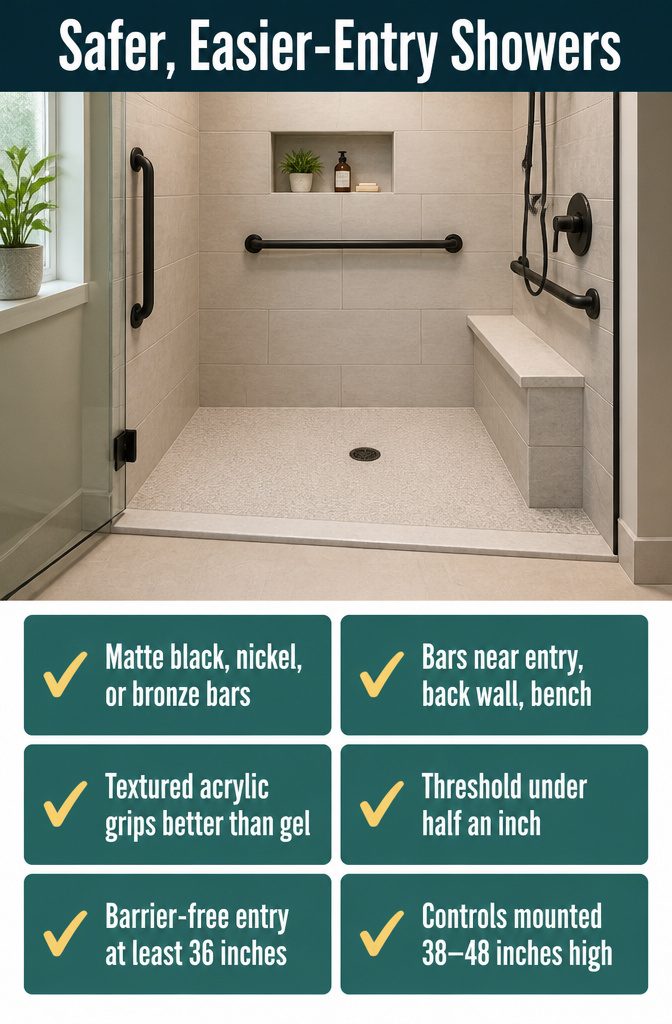
Grab bars no longer mean institutional chrome.
Modern bars come in matte black, brushed nickel, and oil-rubbed bronze finishes that blend with the rest of your hardware, and you can mount them near the entrance, along the back wall, and by a built-in bench without the bathroom reading like a hospital retrofit.
Slip-resistant shower bases—textured acrylic or stone-look surfaces with enough grip that you feel the difference barefoot—handle wet tile better than smooth gel coats.
A low-threshold or curbless entry keeps the transition under half an inch, which matters if you are rolling a wheelchair in or just tired of stubbing your toe on a 4-inch curb at six in the morning.
Barrier-free entries should measure at least 36 inches wide, and shower controls mounted 38–48 inches from the floor let you adjust temperature without bending or reaching overhead.
7. Rainfall or Multiple Showerheads
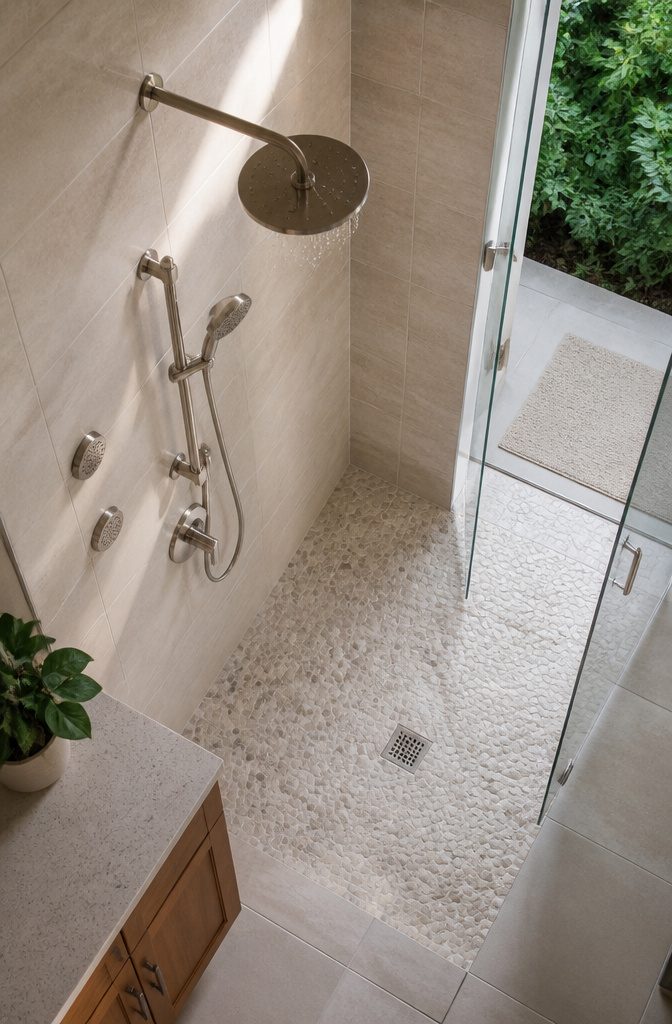
A rainfall head mounts on the ceiling or high on the wall and drops water straight down across your whole body.
The spray feels gentler than a standard head, closer to standing in warm rain than being hit by a jet. Most measure 8 to 12 inches across—larger models cover more area but need stronger pressure to keep the spray even.
Pair a rainfall head with a handheld sprayer so you can switch between a slow soak and a quick rinse, or add body jets at shoulder and hip height for water that hits exactly where you want it.
Multiple fixtures running at once need at least 50 PSI to maintain pressure. A plumber can test what your system delivers and suggest a pump or pressure-balancing valve if you’re coming up short.
8. Updated Fixtures and Finishes
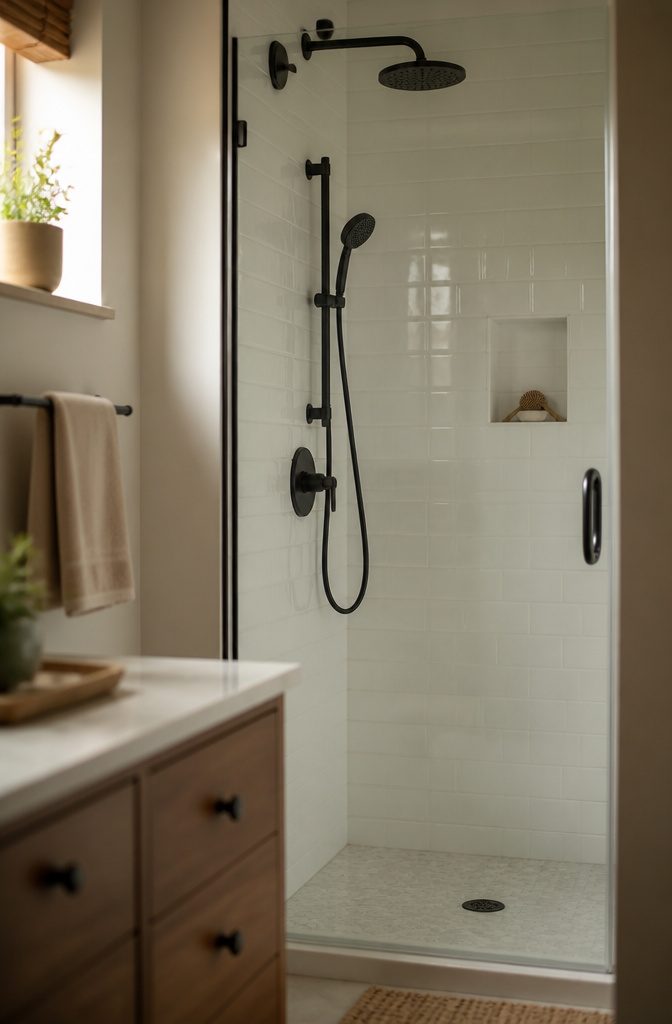
Swapping out hardware changes a shower faster and cheaper than any other update.
A new faucet, drain cover, and showerhead in matte black or brushed nickel replace chrome that dates the room, and the job fits in an afternoon for $200 to $800 depending on finish quality.
Matte black reads dramatic against white tile and hides fingerprints better than polished chrome. Brushed nickel runs warmer in tone, conceals water spots, and works in both traditional and modern bathrooms.
A handheld showerhead on a slide bar adds flexibility without tearing into walls.
You control where the spray hits, and it makes rinsing tile or washing a dog straightforward work. Gold, brass, and oil-rubbed bronze finishes are back in rotation if the rest of the bathroom can carry them.
Rose gold skews feminine; oil-rubbed bronze brings Old World weight. Match the new finish across towel bars and toilet paper holders so the room reads cohesive rather than scavenged.
9. Wet-Room Layout
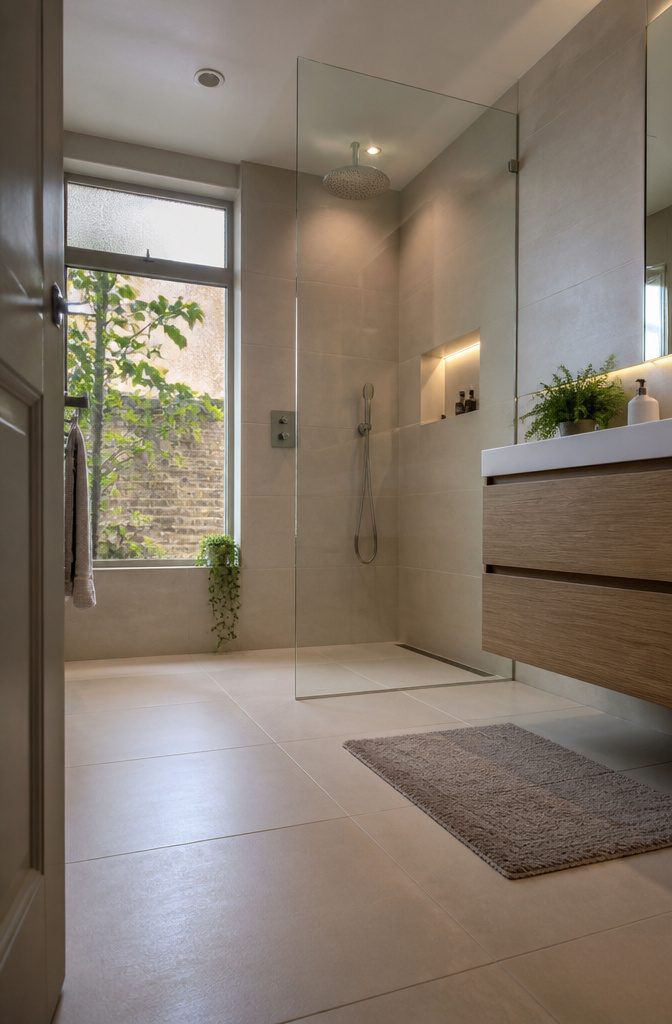
A wet-room shower pulls down every barrier: no curb, no threshold, just a continuous floor that slopes to a drain. The whole room is waterproofed—floor, walls, seams—so water can go anywhere without damage.
This setup works best in a small bathroom where a framed enclosure would close things in, and it solves the step problem for anyone who needs a completely level entry.
The waterproofing has to be perfect or you end up with leaks behind walls you cannot see.
A linear drain usually handles flow better than a center point in these layouts. You can add a glass panel to keep spray off the vanity without boxing the shower back in.
Professional installation runs $10,000 to $25,000 because of the membrane work and floor prep involved. It costs more than a standard pan-and-surround remodel, but the result is a bathroom that reads as one open space instead of divided zones.
What These Projects Cost
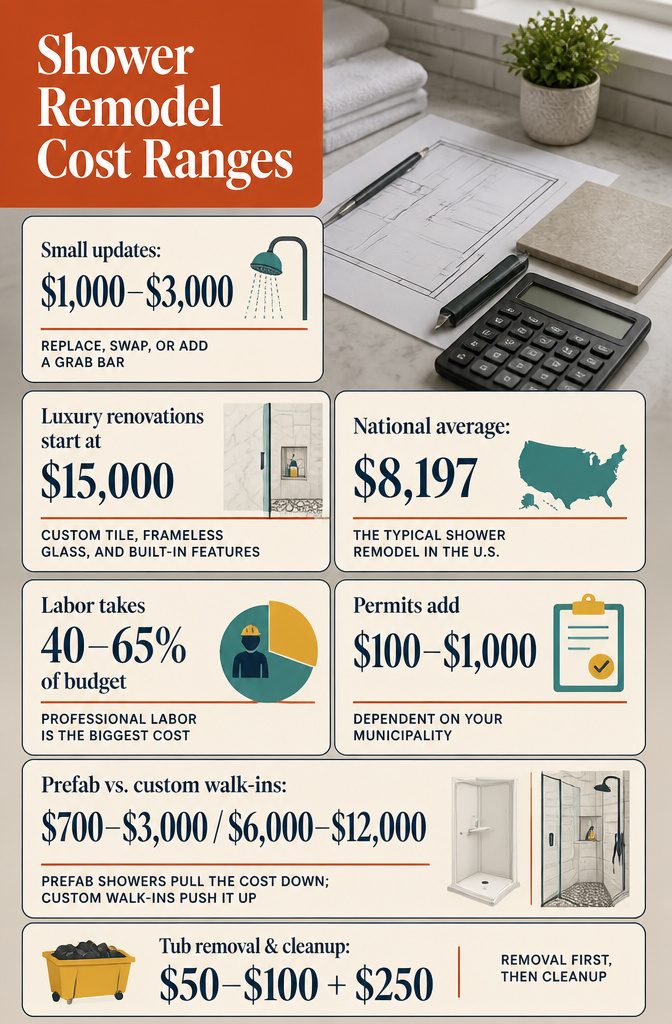
Small updates—replacing a showerhead, swapping fixtures, or adding a grab bar—run $1,000 to $3,000.
Mid-range projects land at $5,000 to $10,000, covering prefab enclosures or a straightforward tub-to-shower swap. Luxury renovations with custom tile, frameless glass, and built-in features start at $15,000 and climb quickly if you’re working with marble or natural stone.
The national average sits at $8,197, though prefab showers pull that down to $700 to $3,000 and custom walk-ins push it up to $6,000 to $12,000.
Labor takes 40 to 65 percent of the budget, and permits add $100 to $1,000 depending on your municipality. If you’re removing an old tub first, budget $50 to $100 for removal and another $250 for cleanup.
Installing the Shower
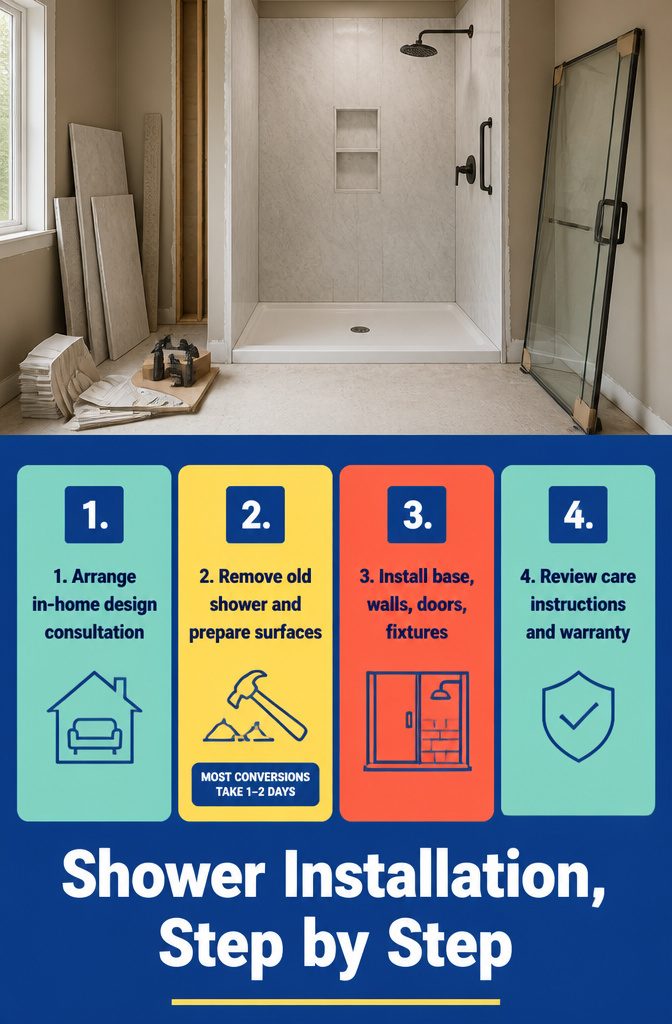
The process starts with a free in-home design consultation.
A consultant measures the space, shows material samples, and provides an exact quote valid for a full year. You choose wall textures, colors, faucet finishes, and glass door styles during this visit.
Removal and preparation come next. The team strips out the old tub or shower pan and preps surfaces for the new install.
Because materials are custom-manufactured to fit your space, most conversions take 1–2 days rather than weeks of gutting. Duration stretches if the scope is larger, materials are unusual, or hidden conditions like rot or outdated plumbing turn up behind the walls.
Professional installation follows. Local certified teams fit the new shower base, walls, doors, and fixtures with what they call surgical precision.
An adult should be home to let the crew in and walk through the finished work. If you’re there, they can adjust details like seat height to fit you exactly.
The company provides post-care instructions and warranty coverage once installation wraps.
Checking References, Licenses, and Estimates
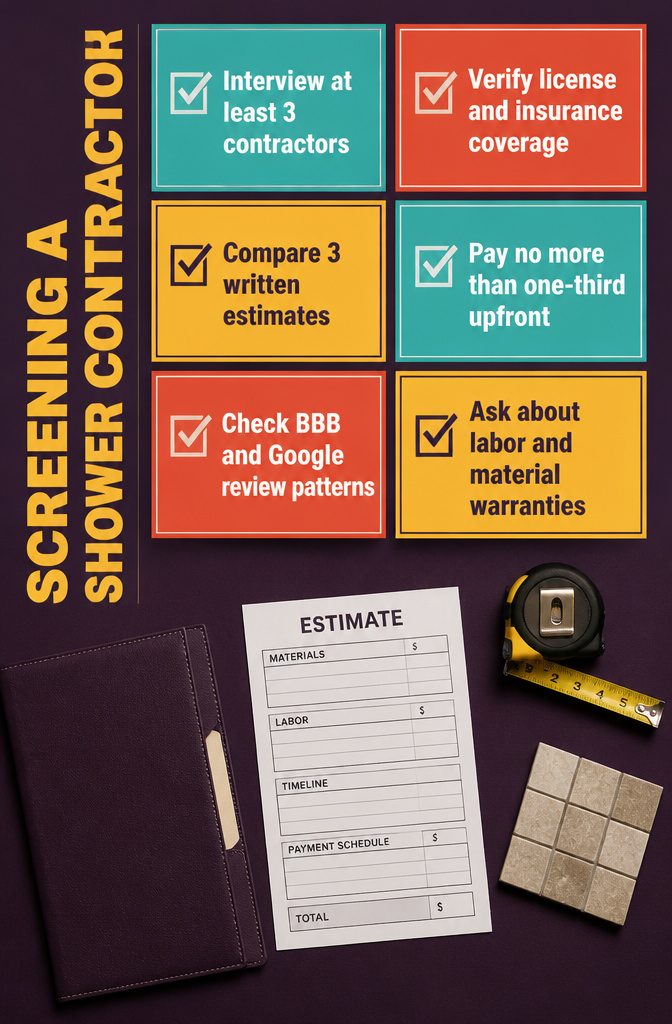
I interview at least 3 contractors before any bathroom project and ask each one the same set of questions: how many similar remodels they’ve completed in the past year, whether they handle plumbing and electrical in-house or subcontract it, and how they manage tile work if the design includes it.
I ask for references and photos of finished showers.
A contractor who hesitates on either one usually doesn’t make my short list. I verify the license number with the state board and confirm they carry liability insurance and workers’ compensation coverage.
If someone gets hurt on the job or a pipe bursts two weeks later, that coverage decides whether I’m protected or paying out of pocket.
I request written estimates that break out materials, labor, timeline, and payment schedule separately. Tile labor costs more per square foot than panel installation, and I want to see that difference spelled out.
I compare the 3 estimates for line items that seem unusually high or unusually low. A suspiciously cheap bid often means corners get cut or change orders pile up later.
I never pay more than a third up front. I check the Better Business Bureau and Google reviews for patterns, not one-off complaints.
I ask what warranty covers the labor and whether the materials come with their own guarantee. One manufacturer offers a 30-year warranty on acrylic wall systems, and that kind of backing matters when the alternative is hoping grout holds up.
Frequently Asked Questions
What’s the average cost of a bathroom shower remodel?
The national average is $8,197. Small updates like replacing a showerhead or adding a grab bar run $1,000 to $3,000, prefab enclosures land at $5,000 to $10,000, and custom walk-ins with tile and frameless glass start at $15,000.
Labor takes 40 to 65 percent of the budget, and permits add $100 to $1,000 depending on location.
What is a tub-to-shower conversion?
It replaces an existing bathtub with a walk-in shower fitted to the same footprint. The contractor removes the tub, adjusts plumbing, installs a new shower base and wall surround, and finishes with fixtures and doors.
Most conversions take 1 to 2 days depending on the size of the existing tub and the condition of the walls behind it.
How long does a tub-to-shower conversion take?
Most take 1 to 2 days.
Duration stretches if the scope is larger, materials are unusual, or hidden conditions like rot or outdated plumbing turn up behind the walls. Custom-manufactured materials and local certified teams avoid the weeks of gutting a traditional remodel requires.
What are the different types of bathroom showers?
Walk-in showers with low-threshold or curbless entry eliminate the tub wall for easier access. Prefab units and wall-panel systems install in 1 to 2 days with minimal seams.
Custom tile or natural stone offers more design control but requires grouting and annual sealing. Wet-room layouts pull down every barrier and waterproof the entire floor, creating one continuous space.
What safety and accessibility features are available for a shower remodel?
Grab bars in matte black, brushed nickel, and oil-rubbed bronze mount near the entrance, along the back wall, and by a built-in bench.
Slip-resistant shower bases with textured surfaces handle wet tile better than smooth finishes. Low-threshold or curbless entry keeps the transition under half an inch, and shower controls mounted 38 to 48 inches from the floor let you adjust temperature without bending.
Is a Bath Fitter worth the money?
Bath Fitter and similar services complete shower installations in 1 to 2 days without messy demolition by using custom-manufactured materials. Prefab systems start around $1,000 to $3,000 installed, which makes them the cheapest way to redo a shower if tile is out of budget.
The tradeoff: scratches are harder to repair than with tile, and you work within standard widths rather than custom dimensions.