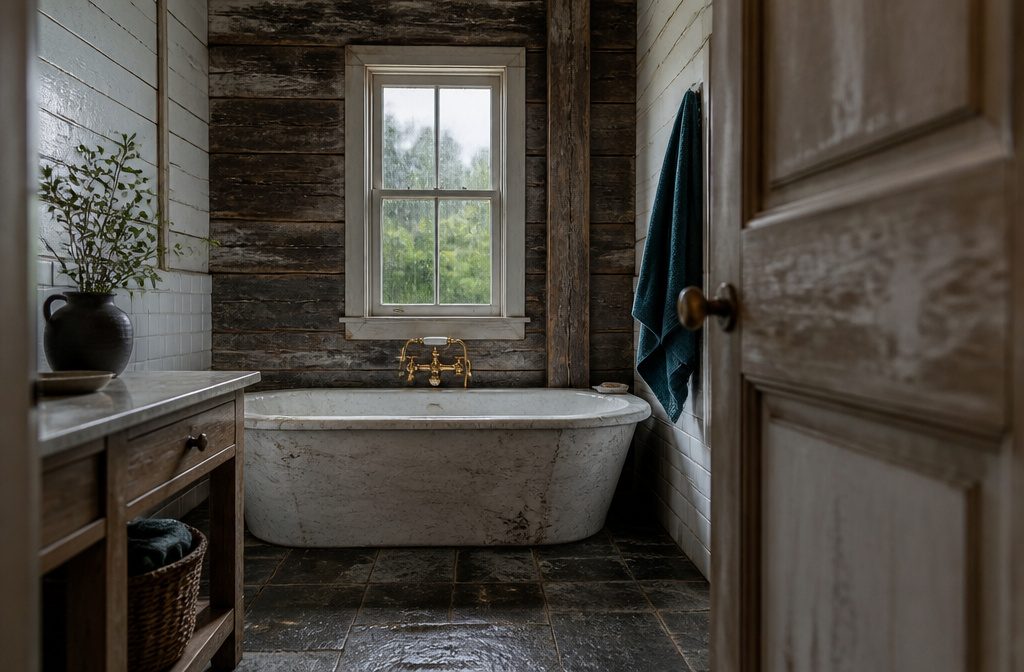
A rustic farmhouse bathroom runs from whitewashed shiplap and soft neutrals to reclaimed barn beams and dark accent walls, and the right combination depends on how much texture and age you want in the room versus how much light.
The style costs more when you use salvaged materials—reclaimed boat wood for a shower surround or a circa-1850 marble tub—but shiplap and subway tile deliver the look for less if the budget or the space can’t support antiques and architectural salvage.
1. Expose Ceiling Beams or Use Reclaimed Wood
Exposed ceiling beams are one of the fastest ways to make a bathroom read as farmhouse.
Light wood beams work in bright, airy spaces with high vaulted ceilings and large windows, where they add warmth without making the room feel heavy.
For a more dramatic look, reclaimed beams from old barns bring age and texture straight into the space, though the weight means installation takes a pulley system and a builder who knows what they are doing.
Reclaimed wood works on walls and floors too.
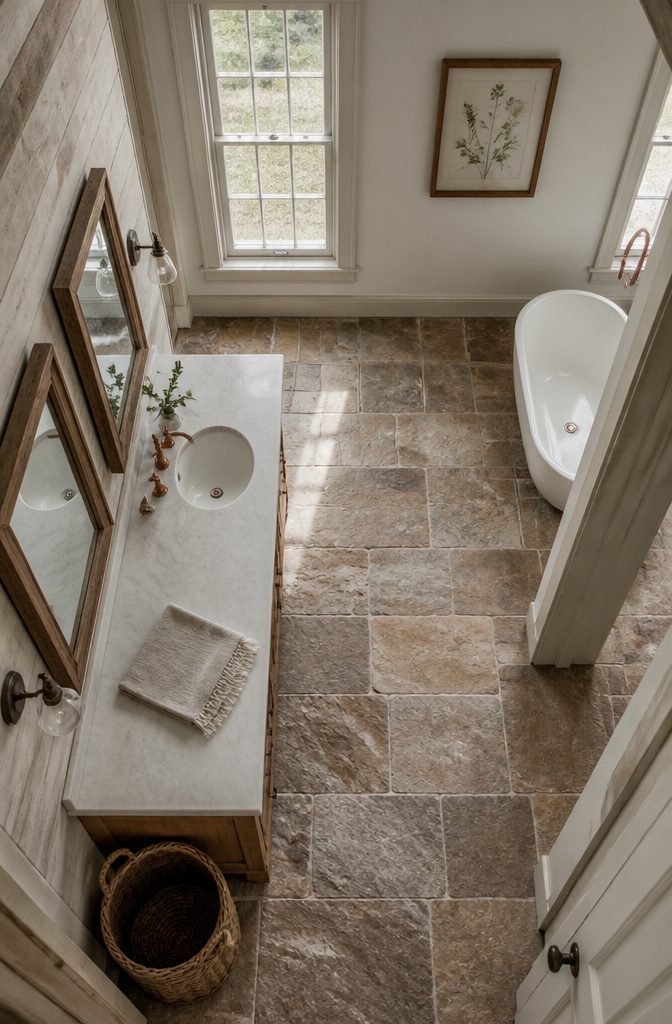
A powder room wall sheathed in whitewashed reclaimed wood picks up the rustic note without the structural work beams require, and rough-cut walnut limestone floors with a honed finish add the same lived-in character underfoot.
Aged brass or copper faucets in traditional shapes pull the look together once the wood is in place.
2. Add Shiplap or Beadboard Walls
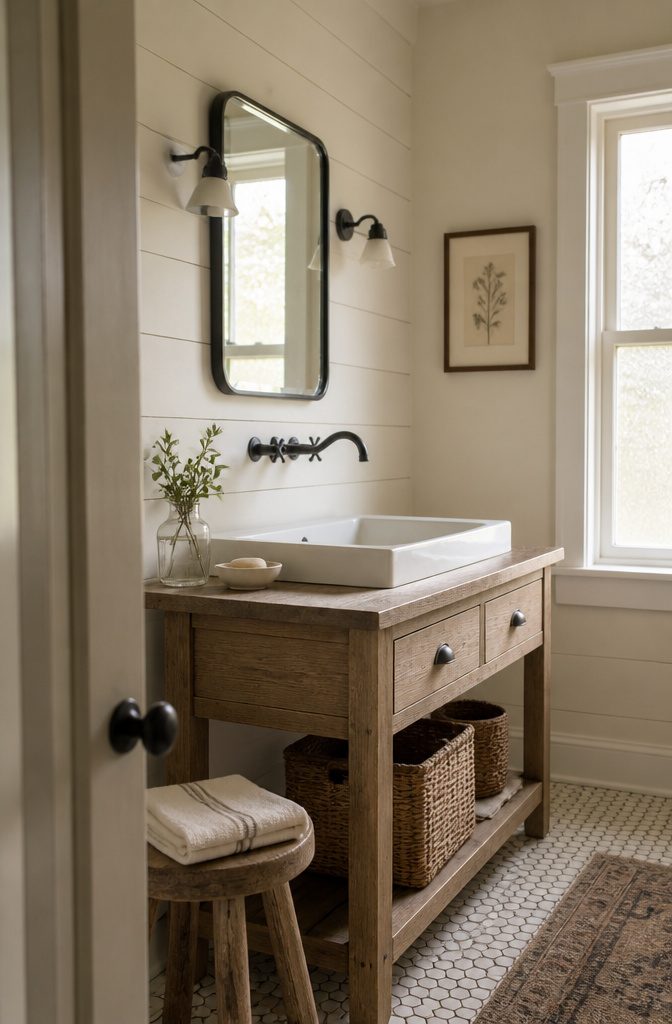
Shiplap runs horizontally across the wall in overlapping boards, while beadboard stands the panels up with a narrow groove between each one. Both give a bathroom that lined, textured look that reads farmhouse without needing much else in the room.
Paint them in ivory, misty gray, or muted sage to keep the space light and calm rather than leaning too rustic or dark.
The paneling works in a powder room as easily as a primary bath. Pair it with matte black hardware or sleek fixtures if you want the style to feel current instead of purely vintage.
The contrast between the soft wall treatment and sharper metal pulls the look forward without losing the warmth that makes farmhouse bathrooms feel different from all-tile spaces.
3. Choose a Wood Vanity or Repurpose Furniture
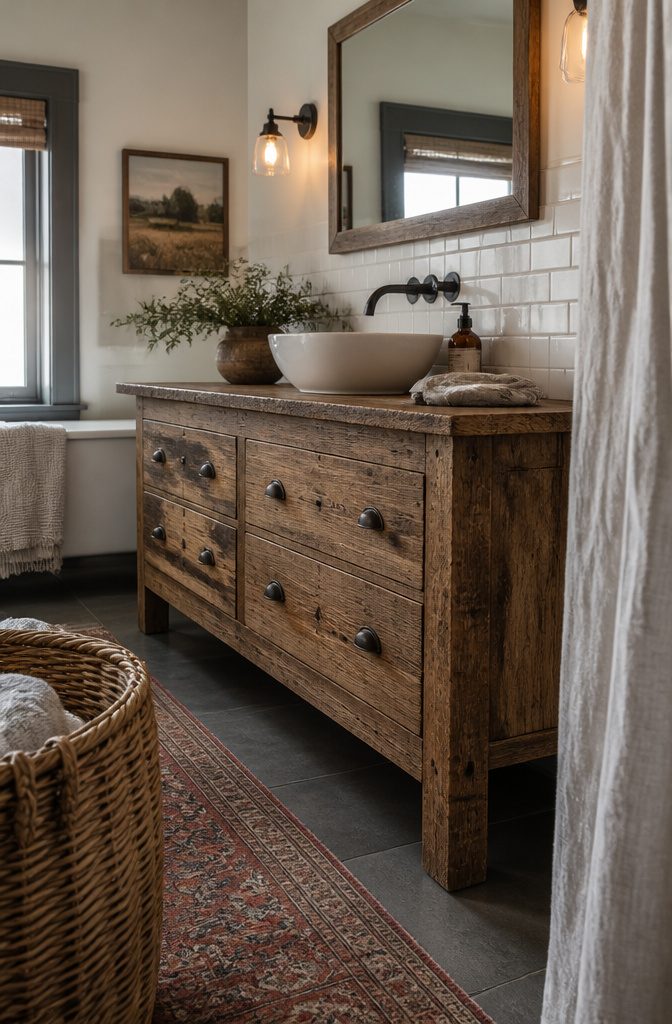
A wood vanity grounds a rustic farmhouse bathroom better than anything else you can put under the sink.
Natural grain softens white tile and matte black hardware without fighting them, and the warmth shows up whether you’re working with a spacious master bath or a narrow powder room.
Reclaimed wood carries the look furthest—beams sourced from old barns bring texture you can’t fake, and the heft of salvaged timber reads as permanent in a way new cabinetry never quite does.
Rough-cut walnut or distressed finishes work just as well if reclaimed isn’t an option.
An old dresser turned vanity solves two problems at once: you get the vintage character and you skip the builder-grade vanity aisle entirely.
An early 20th-century English vanity base or a 1930s shelf paired with a vessel sink delivers more personality than anything mass-produced, and the mismatched proportions—deeper than standard, taller or shorter depending on what you started with—give the room a collected look instead of a showroom set.
4. Use a Farmhouse or Soapstone Sink
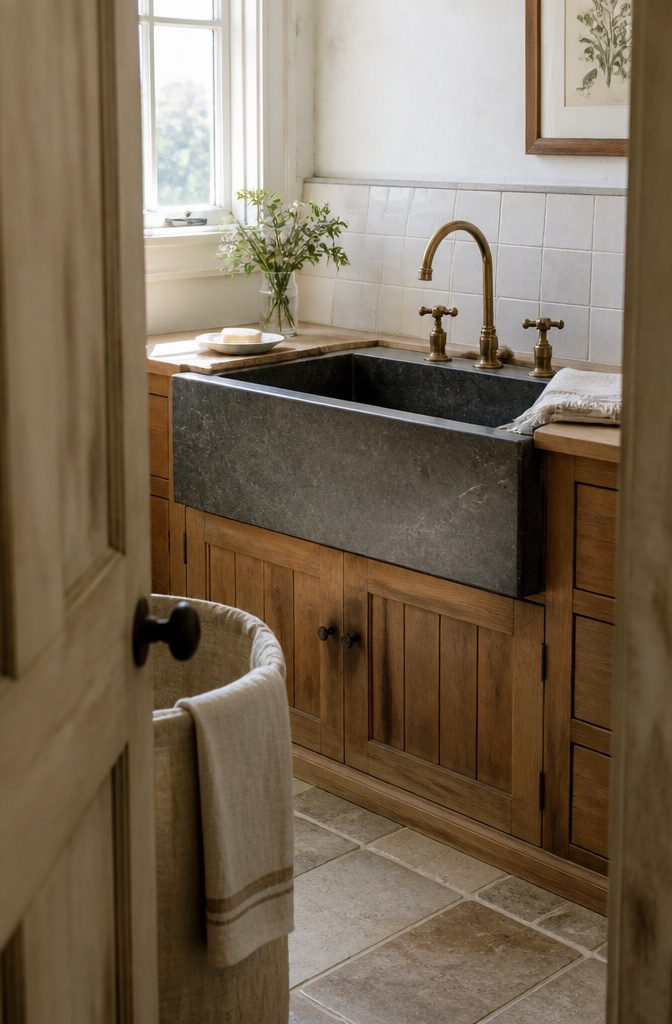
A farmhouse sink drops into a rustic bathroom with the weight of something that belongs there, especially when it is cut from soapstone.
The material resists stains and wears in rather than down, so a built-in soapstone sink delivers both the matte texture and the function a working bathroom needs.
The style pulls from actual farmhouses, where utility came first and the look followed.
Older examples show up in salvage: a 1940s sink carries the right proportions and the patina that new work has to wait years for. If you are building in, soapstone still reads as farmhouse without leaning into reproduction details.
The durability is real, the aesthetic sits comfortably next to wood and metal, and the sink becomes a fixed feature rather than something you swap out when trends shift.
5. Make a Claw-Foot or Freestanding Tub the Focal Point
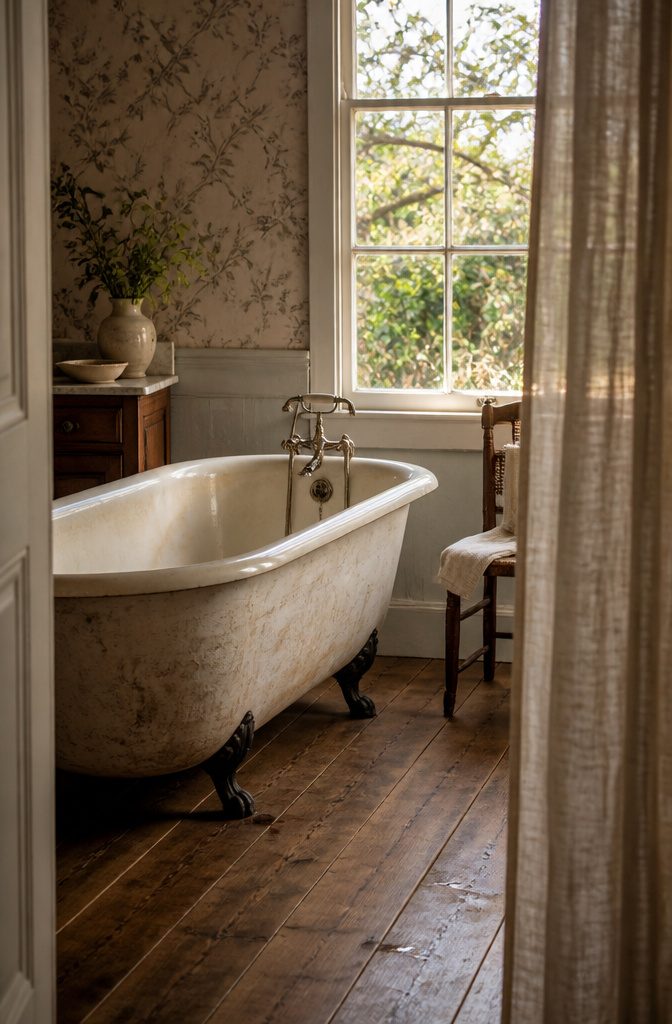
A claw-foot or freestanding tub claims the room the second you walk in, and it earns that attention.
The circa-1850 marble tub in one Connecticut master bath sits surrounded by period pieces — a Regency chair, an 18th-century French vanity — and still reads as the anchor.
Age helps. A well-worn claw-foot carries more character than polish, and pairing it with art or soft wallpaper keeps the look from feeling sterile.
In a California bath, a vintage claw-foot stands against Schumacher wallpaper and a black-and-white drawing by the home’s original owner, the softness of both letting the tub hold its ground without competing.
Fittings matter less than placement: set the tub where natural light hits it, or where it faces the best wall in the room, and the rest of the design can stay simple.
6. Create a Rustic Shower With Reclaimed Wood
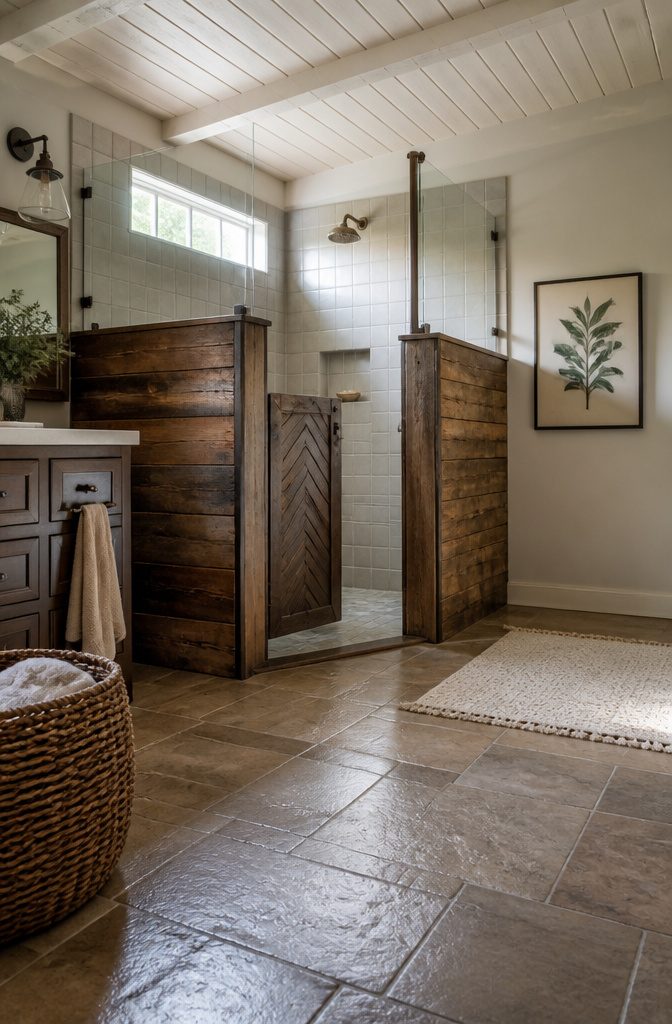
Reclaimed wood from old boats or barns lines the walls of a walk-in shower in ways that tile never could, bringing texture that looks weathered rather than installed yesterday.
Wrap double pony walls—the short dividers that separate the shower from the rest of the room—in salvaged wood planks to create a spa feeling that reads as outdoor without actually being open to the elements.
The grain and color variation in reclaimed boat wood from Southeast Asia runs deep enough that no two sections match, and a herringbone barn door stained to echo that same texture ties the shower enclosure to the rest of the space.
Handmade tiles with uneven edges work when reclaimed wood does not fit the layout or the budget.
Matte porcelain made to look like salvaged planks gives you the warmth of wood with none of the maintenance concerns that come from standing water, and textured subway tile in a shower niche or along the back wall adds the imperfect, handcrafted look without requiring you to seal or refinish anything.
7. Use Rustic or Patterned Floor Tile
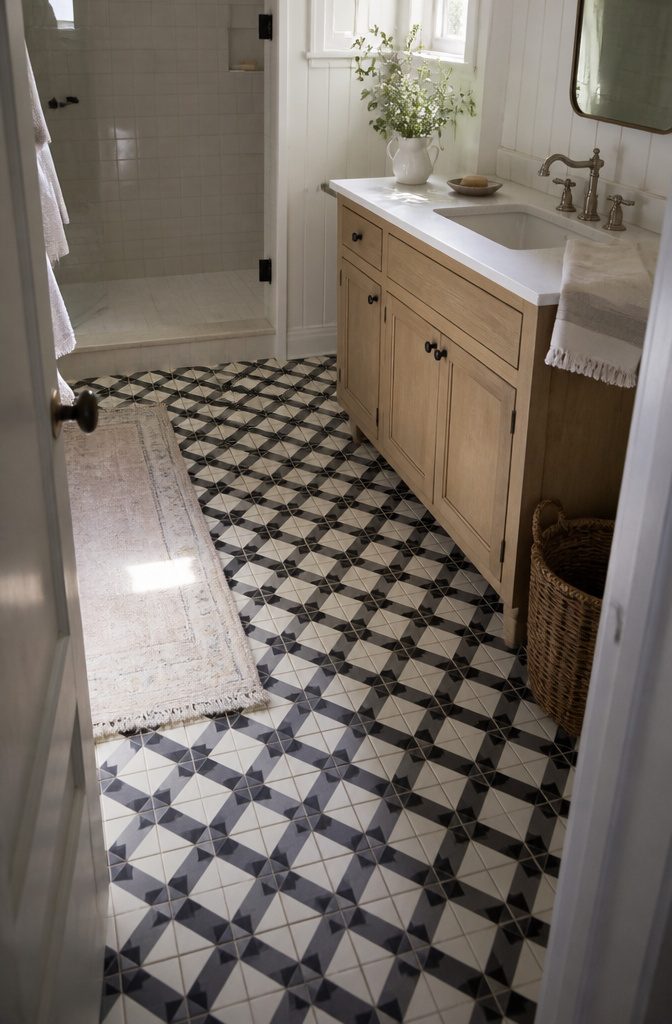
Patterned floor tile pulls the vintage feel through the whole room, and black-and-white geometric patterns hit hardest — they read farmhouse without looking dated.
Encaustic tile from the 19th century shows up in higher-end renovations; Michael Trapp sources Spanish examples that pair well with modern fixtures if you want that collected-over-time look.
The pattern does the work, so you can keep walls and cabinetry simple.
Rustic tile in terracotta or unglazed stone works if the pattern route feels too formal. The texture matters more than the color: a matte finish with visible variation in tone keeps the floor from looking too polished.
Either choice holds up better than wood in a bathroom, and both give you a surface that looks better with age rather than worse.
8. Use Subway Tile, Shiplap, or Wood as a Backsplash
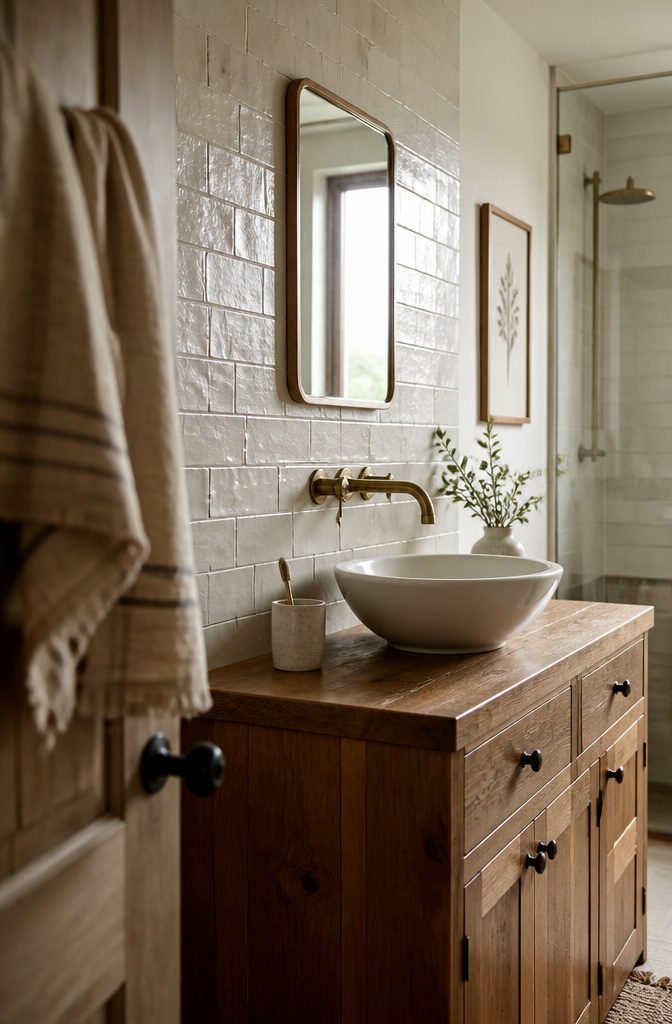
The backsplash behind your sink anchors the whole design, and subway tile, shiplap, wainscoting, and wood paneling cover the four most-used modern farmhouse choices.
Subway tile is compatible with nearly any vanity and sink style, and the range of sizes and colors lets you stay neutral or push harder into pattern.
Shiplap works in shower and sink areas because it costs less than tile and installs quickly, though it needs sealing if water hits it directly.
Wainscoting brings a vintage farmhouse look when you want something cleaner than full-wall wood, and a wooden paneled backsplash reads warm and minimal if you are layering other rustic finishes elsewhere in the room.
For handmade or textured tiles, look for subway shapes with uneven edges or matte porcelain that mimics reclaimed wood.
The subtle imperfection adds authenticity without the upkeep of real barn siding, and the tile holds up to moisture better than most wood options.
Use them in a shower niche or behind the vanity for visual texture that still feels cohesive with the rest of the space.
9. Add Handmade or Textured Tile
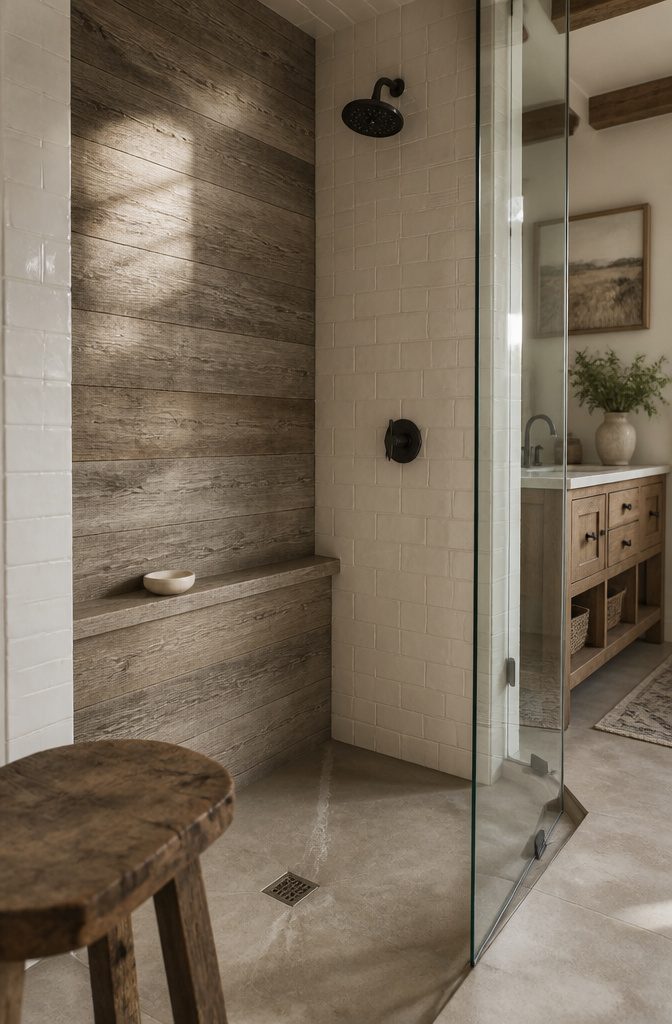
Handmade tile carries visible irregularities — edges that don’t quite line up, surfaces with slight dips — that machine-made tile deliberately erases.
Subway tiles with uneven, handcrafted edges give you that imperfect charm without announcing themselves, while matte porcelain tiles that mimic reclaimed wood add warmth through texture rather than color alone.
Both read as deliberate rather than worn, which keeps the space from tipping into full rustic territory.
I’d run textured tile in a shower niche or as a backsplash behind the sink rather than across every surface.
A single wall of it anchors the room; four walls of it competes with everything else you’re trying to add. The unevenness catches light differently than flat tile does, so it holds attention even in a neutral palette.
10. Use Stone for Counters, Floors, or Walls
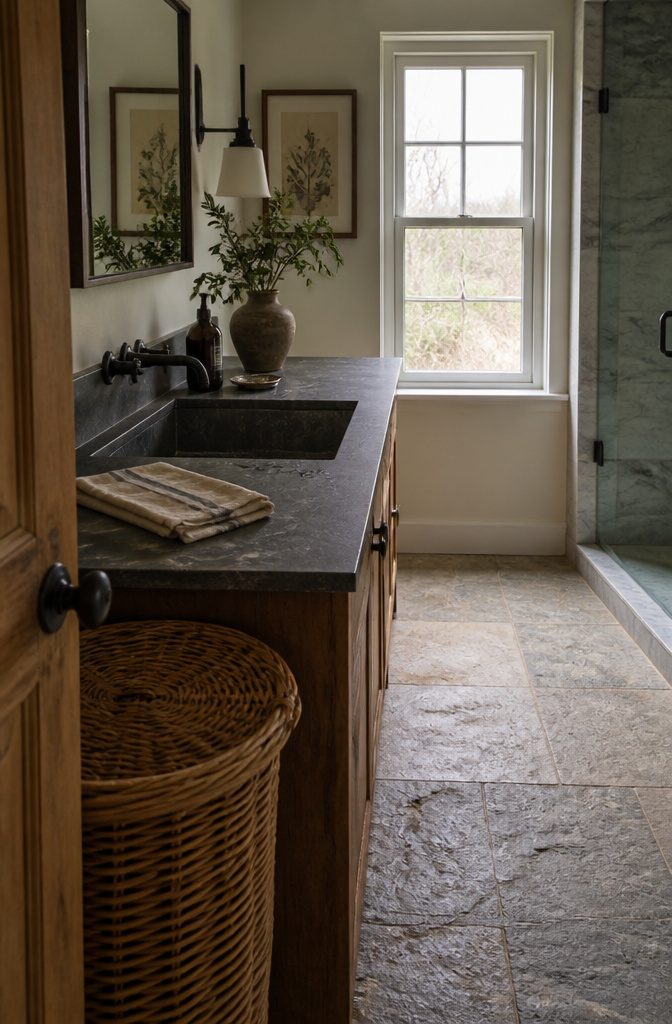
Natural stone adds weight and texture that laminate never will.
Marble brings soft veining and a polished surface that catches light—white or gray marble works on a vanity top or as a shower surround, and it pairs cleanly with wood or black hardware.
Soapstone runs darker and softer to the touch, with a matte finish that resists stains and holds up to water without sealing.
I’ve seen it used as a built-in sink and as a counter, and both read as purposeful rather than showy. Limestone in a rough-cut or honed finish works underfoot where you want something less slick than polished tile.
All three cost more than ceramic, but they last and they age without looking worn—the veining shifts as you move through the room, and that movement is what makes stone worth the price difference.
11. Choose Light, Soft, or Neutral Colors
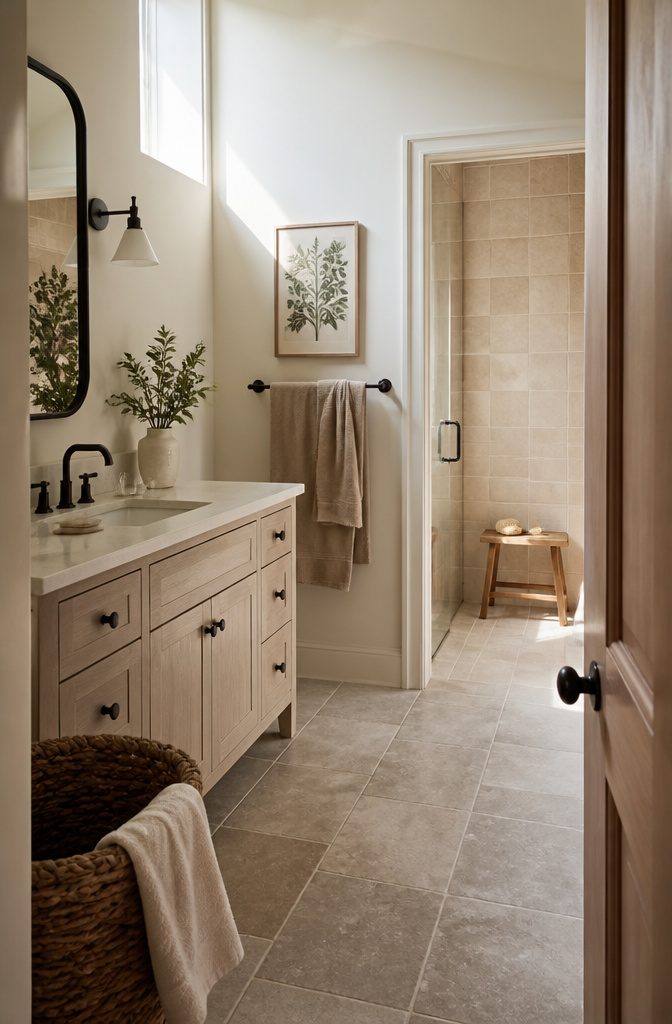
White, warm gray, and soft shades of blue, green, or beige give a rustic farmhouse bathroom the bright, calm look the style is known for.
The palette keeps the space feeling open without reading cold—creamy whites and taupes work especially well in smaller bathrooms where you need light to bounce around.
Warm gray anchors the room if white feels too stark, and light greens or blues add just enough color to keep things from looking flat.
Layering matters more than the color itself. A soft neutral base lets wood vanities, black fixtures, and textured tile stand out without competing, and the depth comes from pairing matte and natural finishes rather than adding more paint colors.
Beige and cream work well on floors if you want the airy feeling without going full white, and light gray creates subtle contrast in a bathroom that’s mostly pale wood and linen.
12. Use Dark Hues or Black Accents for Contrast
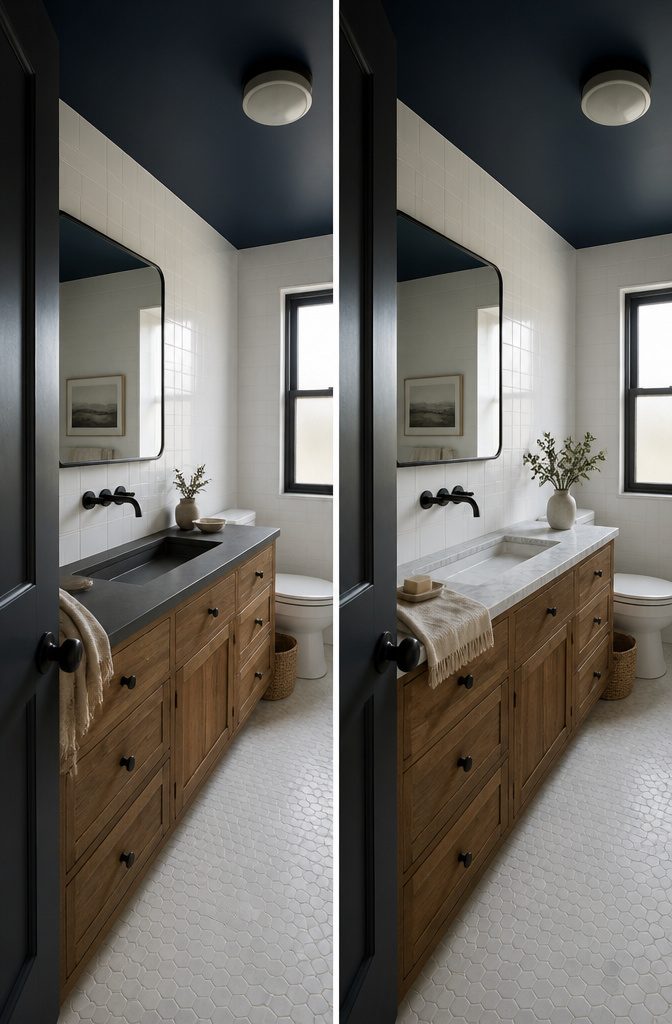
Lighter palettes dominate the style, but dark walls or black accents create contrast that makes white fixtures and natural wood stand out harder.
Lindsay Gerber used deep color in a Sonoma bathroom and describes the effect as immediate: saturated walls in a small space wrap the room in mood rather than bounce light around it.
The dark backdrop lets texture show—a white sink against charcoal reads sculptural, and rough wood against navy pulls the eye more than the same wood against beige.
Black works as hardware, mirror frames, or a single accent wall if painting the whole room feels like too much commitment.
Stiffkey Blue by Farrow & Ball appears on a ceiling in an East Hampton bath, paired with white tile and metal fittings, and the contrast between the dark plane overhead and bright vertical surfaces changes how the room feels without requiring you to repaint everything.
The approach works best when something pale sits next to the dark—all one tone loses the point.
13. Add Rustic, Industrial, or Barn-Style Lighting
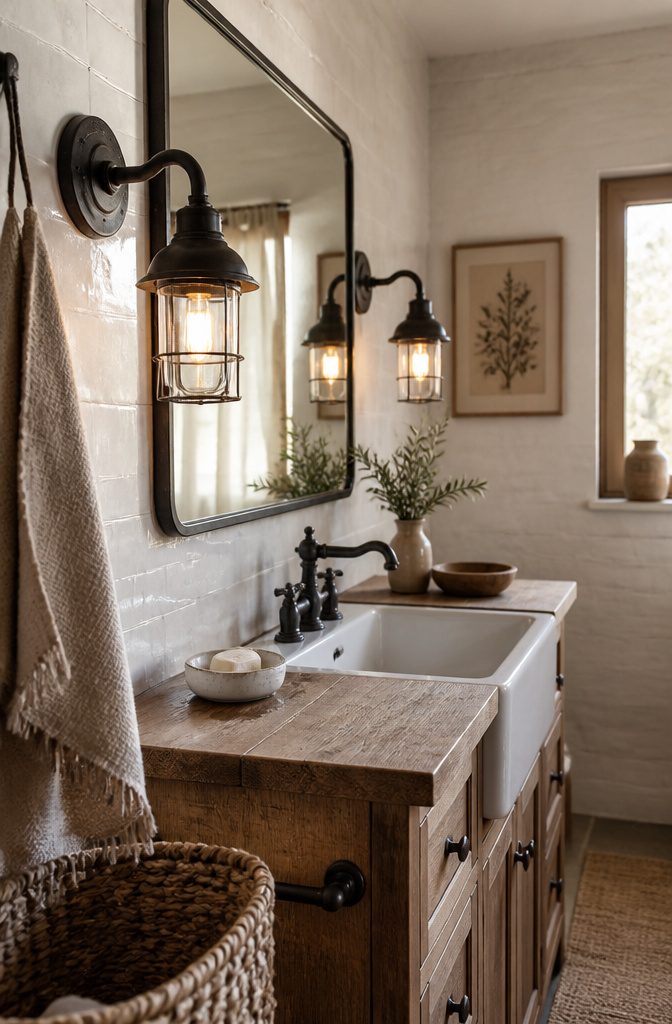
Sconces modeled on early factory lights and caged pendants finish a rustic bathroom without softening the edges.
I like reproductions of 20th-century metal sconces with exposed hardware—the kind designer Whitney Ray mounted high in a North Carolina project to clear head height while keeping an interesting side profile.
The dual-tone finish added depth against wood without going full aged brass.
Black metal sconces and weathered brass fixtures work over vanities or flanking mirrors, especially where you’ve already committed to matte black faucets or cabinet pulls.
Barn-style pendants bring the same vintage weight but need ceiling height to hang without crowding the space. Caged glass keeps the industrial read legible while diffusing enough light that the fixture doesn’t throw hard shadows across tile or wood walls.
The style suits both small powder rooms and larger master baths, but scale the fixture to the wall—a heavy lantern sconce overwhelms a narrow vanity, and a spindly cage disappears next to a double sink.
Function decides placement more than symmetry does; if one sconce lights the mirror and the other would land over the toilet, mount just the one.
14. Use Metal Hardware in Black, Brass, Copper, or Chrome
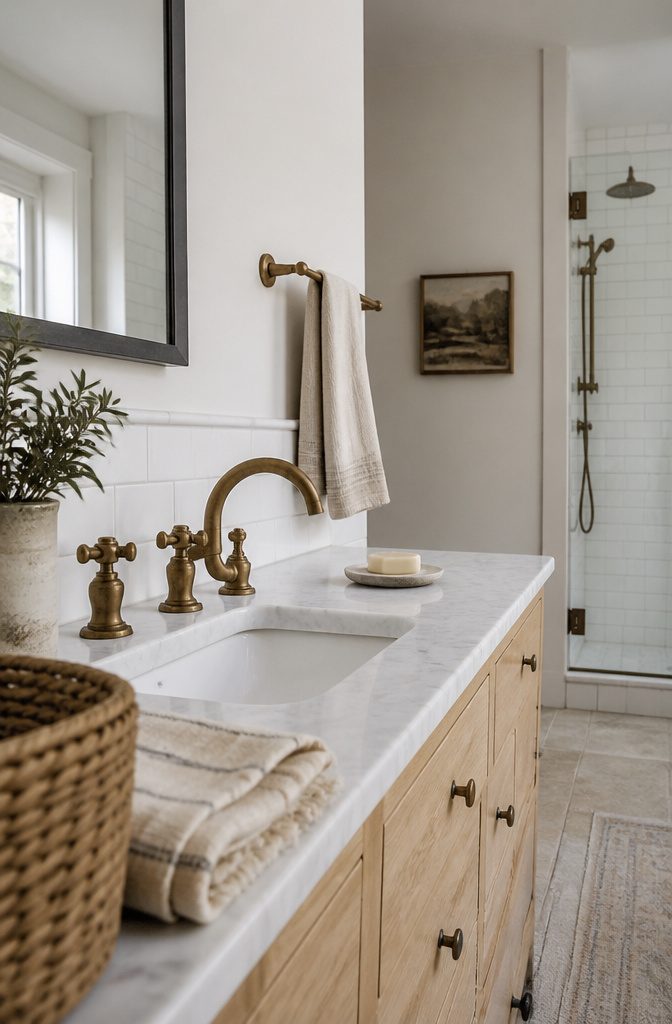
Metal finishes set the temperature of the room before anything else does.
Black fittings pull the space toward industrial; brass and copper warm it back toward vintage farmhouse. Chrome sits in between, clean enough to work in a bathroom that leans contemporary but still traditional in profile.
Aged brass or copper faucets ground the rustic side, especially when the rest of the room carries wood or stone.
The patina reads as intentional wear rather than shine, and that keeps the finish from fighting exposed beams or reclaimed vanities.
If the bathroom already runs neutral and you want warmth without adding another wood tone, brass cabinet hardware and towel bars do it without crowding the palette.
Black metal shows up most often in lighting—sconces with exposed hardware or caged fixtures that nod to barn or factory origins. The same finish works on drawer pulls and shower frames when you want contrast instead of warmth.
Chrome handles on a white shaker vanity bring in a contemporary edge without losing the farmhouse line, and they stay clean-looking longer in a high-use bathroom where oil from hands shows on warmer metals.
15. Add Vintage or Antique Furniture and Decor
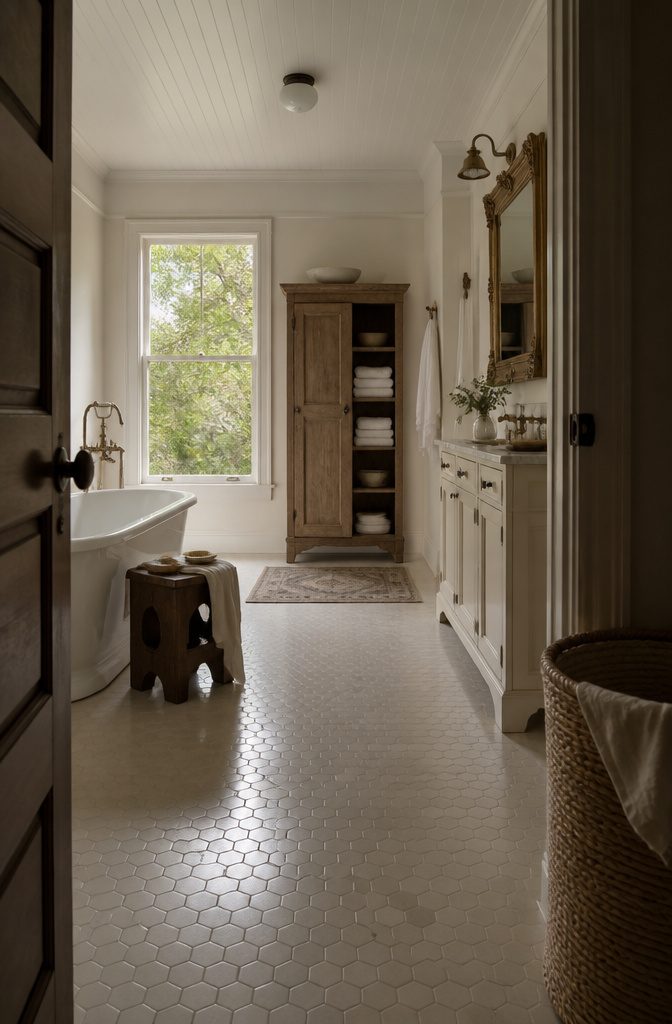
Vintage pieces layer in the kind of character that new finishes alone can’t deliver.
An 18th-century wardrobe holds towels and toiletries with more presence than a stock linen cabinet, and an antique Chinese stool pulled up to the tub or tucked under a window reads as furniture, not just function.
The worn edges and patina matter more than the era—what counts is that the piece looks like it had a life before this room.
Paintings and mirrors carry the same weight. A circa-1730 giltwood mirror or an 1890s English hunting scene grounds a white-walled bath in something older than the house itself.
Pair reclaimed cast-iron with brass fixtures that show their age, or hang sconces that could have come from a barn.
The friction between the old pieces and the clean tile or fresh paint is what makes the room feel collected rather than decorated.
Shop locally when you can—regional antiques tend to fit the house better than imports that reference someone else’s history.
Frequently Asked Questions
What is the best color for a farmhouse bathroom?
White, warm gray, and soft shades of blue, green, or beige work best.
These light neutrals keep the space bright and open while letting wood vanities and black fixtures stand out. Dark walls or black accents create contrast when you want a moodier look.
What elements should a farmhouse bathroom have?
Exposed beams, shiplap or beadboard walls, a wood vanity, and a farmhouse sink anchor the style.
Add a claw-foot tub if you have the space, subway tile or reclaimed wood as a backsplash, and metal hardware in black, brass, or copper. Vintage furniture and rustic lighting finish the look.
How do I make my bathroom look farmhouse?
Start with wood floors or reclaimed wood on the walls, then add shiplap paneling or exposed ceiling beams.
Install traditional faucets in aged brass or copper, and choose a wood vanity or repurpose an old dresser. Patterned floor tile and vintage decor bring in the final layer of character.
Can you mix modern and farmhouse in a bathroom?
Yes.
Pair shiplap or beadboard with matte black hardware for a current look, or use sleek fixtures against soft neutral walls. The contrast between textured wood and sharper metal keeps the style warm without feeling purely vintage.
What is the difference between rustic and farmhouse?
Rustic leans heavier into rough, weathered textures like reclaimed barn wood and aged finishes, while farmhouse blends that warmth with cleaner lines and brighter neutrals.
Modern farmhouse takes it further by using refined materials and more intentional minimalism alongside the natural texture.