
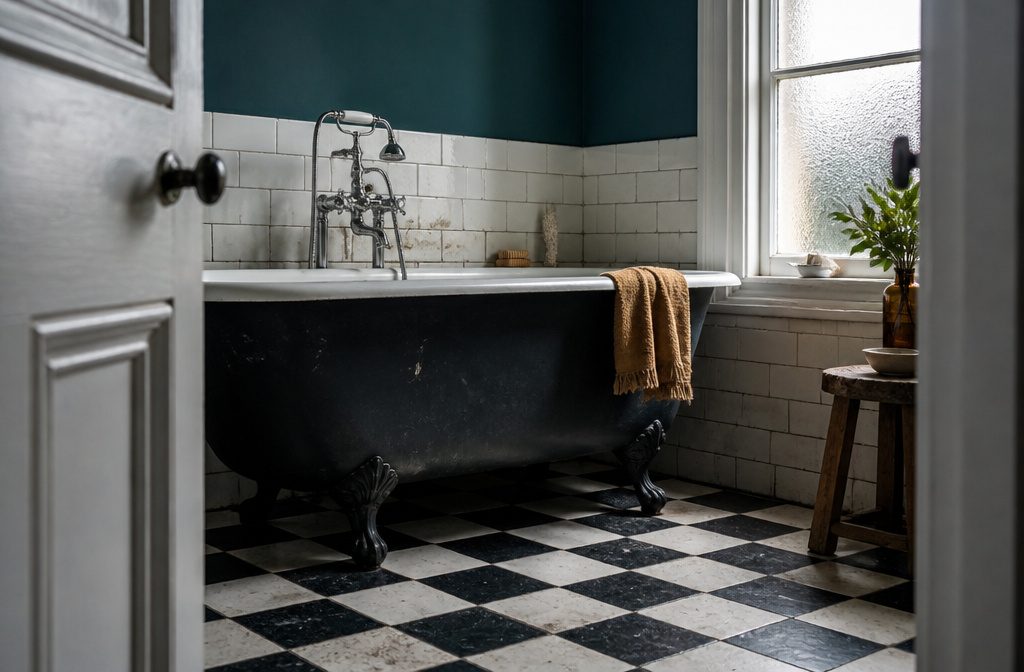
A black-and-white bathroom works at any budget—subway tile and vinyl checkerboard both deliver the graphic punch you’re after—but the decision that matters is how much contrast you can live with daily.
Dark floors read more forgiving than dark walls in a small space, and anything shiny, from polished marble to matte black faucets, will show water spots faster than you expect.
1. Checkerboard or Diamond-Pattern Floor
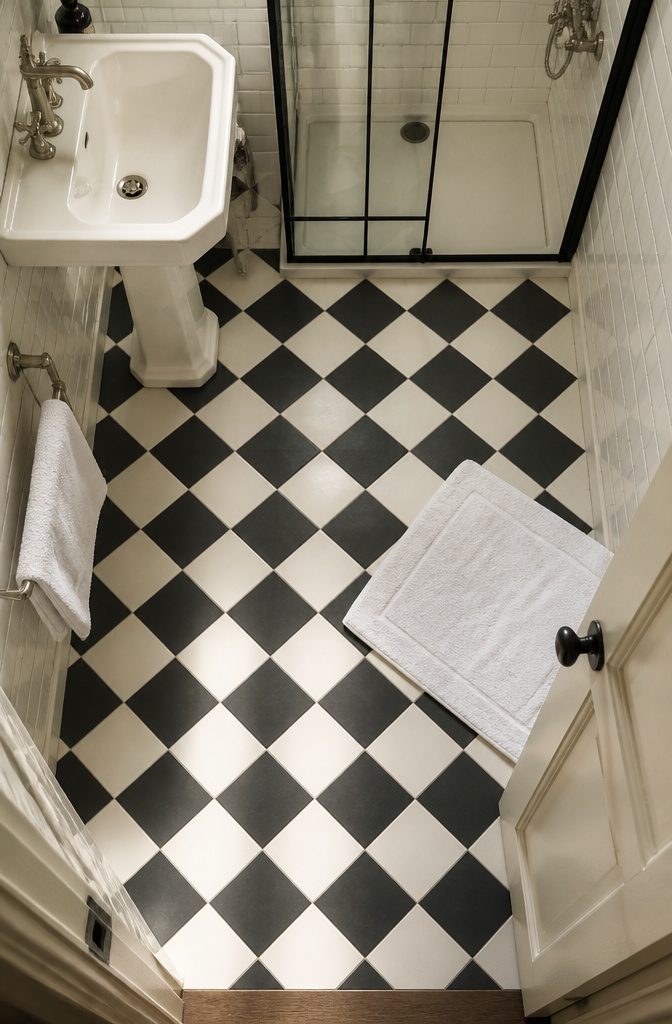
A checkerboard floor pulls the eye down and locks the whole room into place.
Ceramic and porcelain are the straightforward choices, but vinyl and linoleum both give you the same graphic punch at a lower price and easier install if you’re doing this yourself. Stone runs higher but wears longer.
Lay the tiles at a 45-degree angle if you want the pattern to feel less static.
The diagonal lines move your eye across the room instead of stopping it at the grid, and they make a narrow bathroom read wider than it is.
The floor becomes the focal point, so the walls need to stay quiet.
White subway tile or a flat painted surface gives the pattern room to work without competing for attention. A bold floor only lands when everything around it steps back.
Recommended Products

Nexus Vinyl Tiles: Refresh your home for a low cost and no hassle with the Nexus Vinyl Floor Tiles. Our tiles can be used in any room in your home including the kitchen, dining room, bedrooms, bathrooms, foyers, and basements. No messy glue or adhesives needed. Includes 20 vinyl tiles.

PARMA DESIGN - Black tones and the parma pattern bring distinctive style and personality to your space.
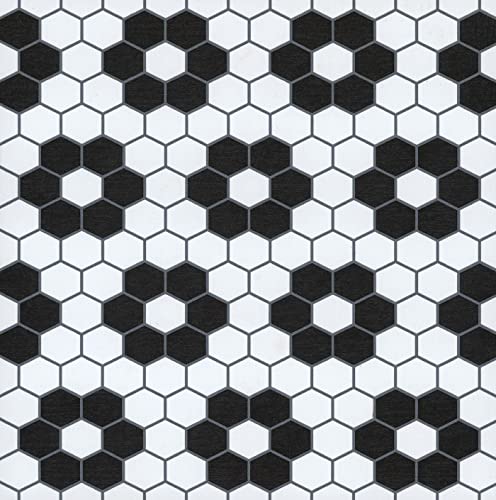
BISCOTTO DESIGN - Black tones and the biscotto pattern bring distinctive style and personality to your space.
2. Dark Floor With Light Walls, or the Reverse
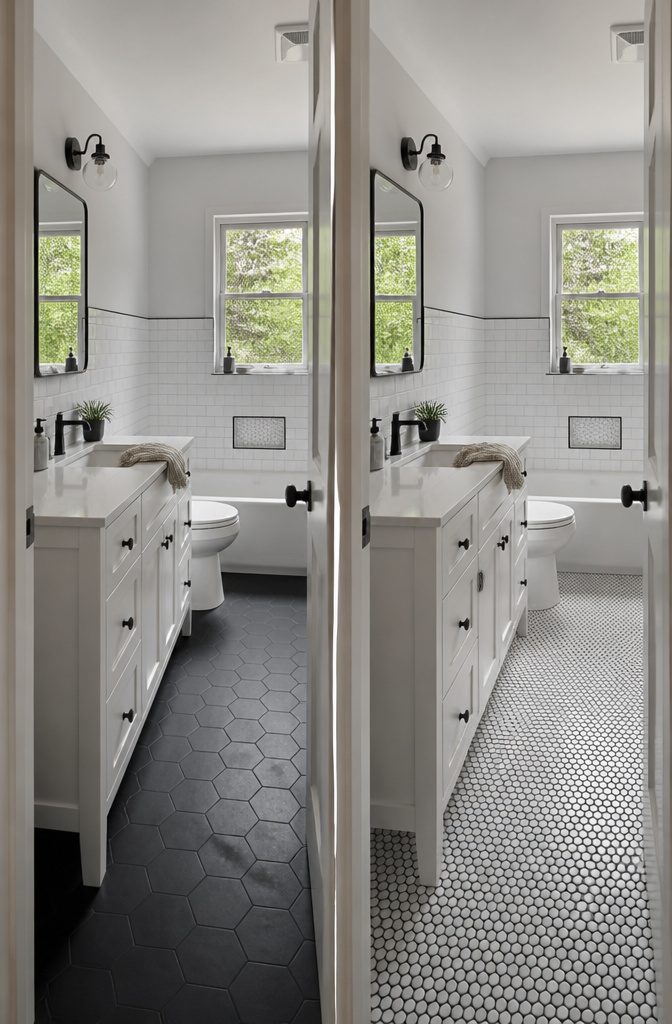
A dark floor paired with light walls keeps the space grounded without closing it in—the contrast lets you read both surfaces clearly, and the ceiling stays bright.
You can reverse it and run dark walls above a light floor if the room has strong natural light or enough mirror surface to bounce what comes in; the drama scales up, but so does the need for brightness from somewhere else.
Neither arrangement is wrong by default. The floor-dark version holds more rooms steady, particularly smaller ones where too much white reads as clinical rather than open.
A black tile floor against white subway tile or painted beadboard gives you the monochrome scheme without the visual weight sitting at eye level, and accessories stay easy to pick because the walls work as neutral territory.
The reversed setup—light floors, dark walls—works when the bathroom is large enough that the walls do not press in, or when a window or skylight feeds enough daylight to keep the space from feeling enclosed.
Marble or light stone underfoot with black paneling or tile on the walls leans formal, and you will want white fixtures and plenty of reflective surface to balance it.
That version reads more committed; the floor-dark approach leaves more room to adjust.
Recommended Products
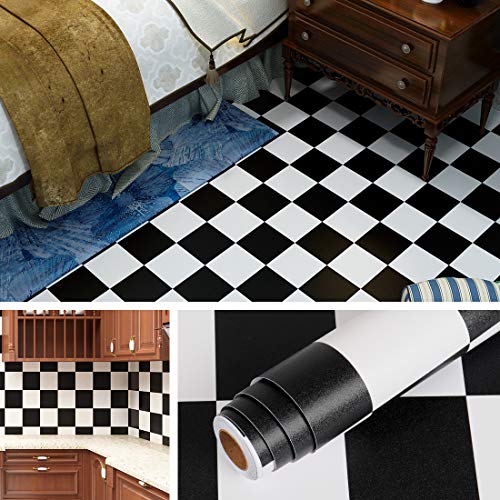
🏠Details: 15.8x78.8 Inch,3.8x3.8 inch per checkered, total 8.65 sq.ft (40cmX2m). Self adhesive. Made of durable vinyl. Checkered black and white contact paper peel and stick waterproof. Oil proof. Fully removable.

Peel and Stick Floor Tiles 12x12 for Instant Floor Transformation: No grout, glue, adhesive, or special tools required. Simply clean the surface, peel off the backing, and press each self adhesive stick on tile firmly into place for a fast and durable floor upgrade in under an hour.

Nexus Vinyl Tiles: Refresh your home for a low cost and no hassle with the Nexus Vinyl Floor Tiles. Our tiles can be used in any room in your home including the kitchen, dining room, bedrooms, bathrooms, foyers, and basements. No messy glue or adhesives needed. Includes 20 vinyl tiles.
3. Black Accents on a Light Base
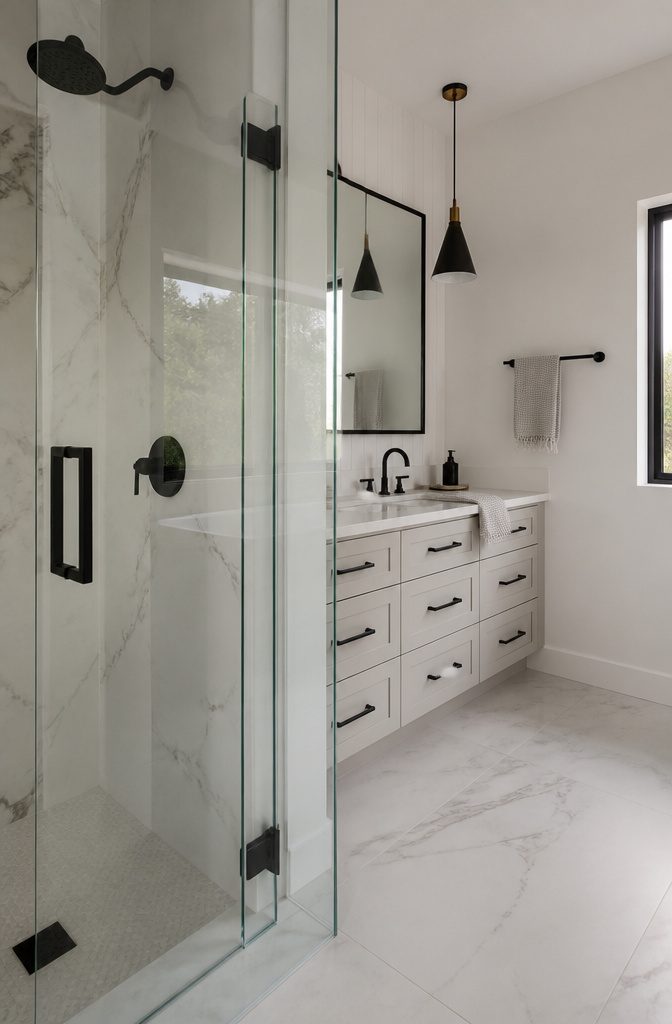
A black faucet, mirror frame, or set of cabinet pulls can give a white bathroom the structure it needs without committing to a dark wall or floor.
The pattern shows up in fixtures, hardware, lighting, and towel rails — anywhere the black sits against white long enough for the eye to register it.
Repeating the same finish in three or four spots ties the room together: black faucets pair with black cabinet handles and a black-framed mirror, and the repetition reads as intentional rather than random.
Black fixtures show water spots, dust, and soap residue more readily than lighter finishes, so expect to wipe them down regularly with a soft cloth. Matte black hides streaks better than polished, but neither stays spotless on its own.
Definition shifts: a white marble shower gains depth when the hardware and border trim are black, and a frameless glass enclosure looks sharper when the showerhead and valve are matte rather than chrome.
A black vanity or a black soapstone sink anchors a white-tiled bathroom without closing it in, and black pendant lights with brass fittings bring contrast to the ceiling plane where it is least expected.
The approach works because the black amounts stay small and the white does most of the covering.
Recommended Products

[AUTOMATIC ON/OFF]: Build-in dusk to dawn sensor, automatically turns on only when ambient lighting becomes insufficient

Adjustable Lighting: 14ft long string of light boards with an adhesive pad on each light board base. The light brightness can be adjustable from the smart touch switch from 10% to 100%.

🧻 Strong cleaning power-The electric toilet brush can clean more efficiently than a normal toilet brush, equipped with a brush head that can rotate at high speed, up to 300 revolutions per minute(When cleaning stubborn stains, applying excessive force to the toilet brush head can cause the motor to temporarily stop working. Pressing the switch again can restore its function. The working torque of this electric toilet brush is limited. When cleaning stubborn stains, please use a detergent first, or use other mechanical tools.)
4. Black-and-White Patterned, Geometric, or Mosaic Tile
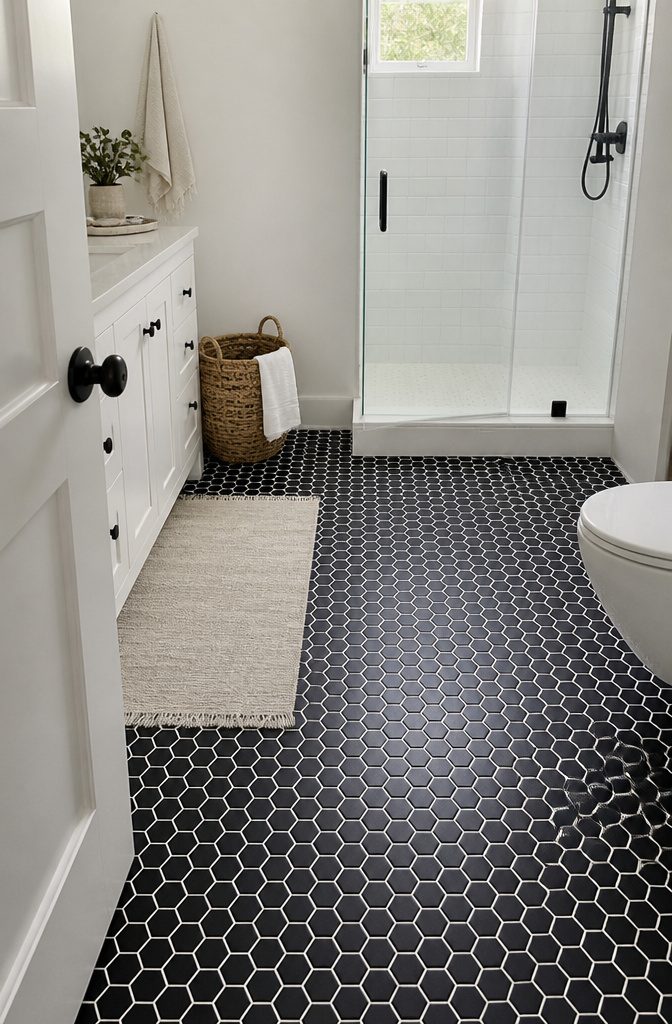
Patterned tile puts energy into the space without color. A geometric mosaic on the floor anchors a small bathroom and makes it feel larger — the pattern draws the eye across the room instead of stopping at the walls.
Pebble tile works the same way: small, irregular shapes in black and white read as texture from a few feet back, which softens the hard lines most bathrooms are made of.
White grout between black tiles defines each piece and keeps the floor from going flat. Matte finishes hold up better in wet areas than gloss, and mosaic sheets go down faster than individual tiles if you’re working on a weekend.
Checkerboard gets most of the attention, but a detailed geometric — hexagons, stars, or a Moroccan encaustic pattern — gives you the same contrast with more movement. The pattern does the work; the rest of the room can stay simple.
5. Subway Tile
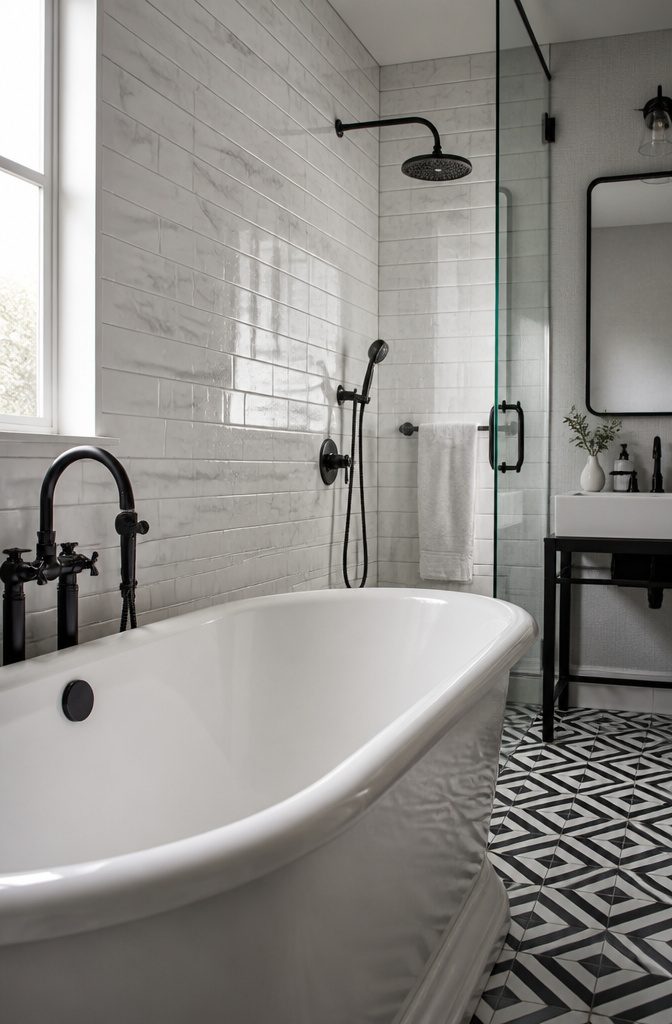
Alpina White Polished Subway Marble Tiles measure 2 3/4 by 5 1/2 inches and give you the cleanest backdrop a black-and-white bathroom can ask for.
The polished finish catches light without competing with bolder patterns elsewhere, so if you’re planning a geometric floor or a statement mirror wall, white subway tile holds the rest of the room steady.
I’d pick marble over ceramic here when the budget allows it—the veining keeps the wall from reading flat, and the polished surface wipes down faster than a matte one after steam builds up.
Stick with a tight grout line in matching white or pale gray to keep the grid crisp.
6. Marble or Other Stone
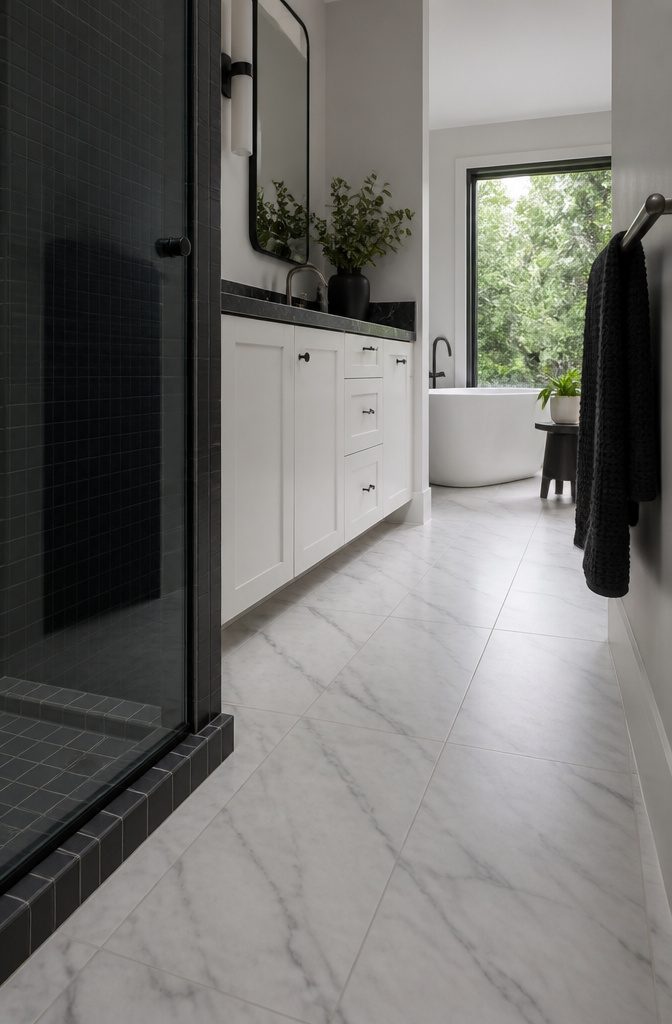
Carrara marble flooring brings gray veining through a white base that bridges the black-and-white palette without landing on either extreme.
The pattern works whether you use large-format tiles like the 12-by-24-inch Alpina White or Bella White honed marble, or smaller 12-by-12-inch Calacatta Gold squares that show tighter repeats of the vein.
Honed finishes skip the high shine and read quieter in a small room.
Black marble reverses the play: Arabescato Corchia runs heavy black veins on white, tight enough to anchor a feature wall behind a tub without needing anything else on that surface.
For floors, pair gray marble with a black tile shower so the transition doesn’t jump. The stone itself lasts, and the veining gives you the pattern without grout lines to scrub.
Budget matters here—if you can’t run marble everywhere, a black marble countertop around the basin still delivers contrast in an all-white room and costs less than tiling a wall.
7. Hexagon Tile
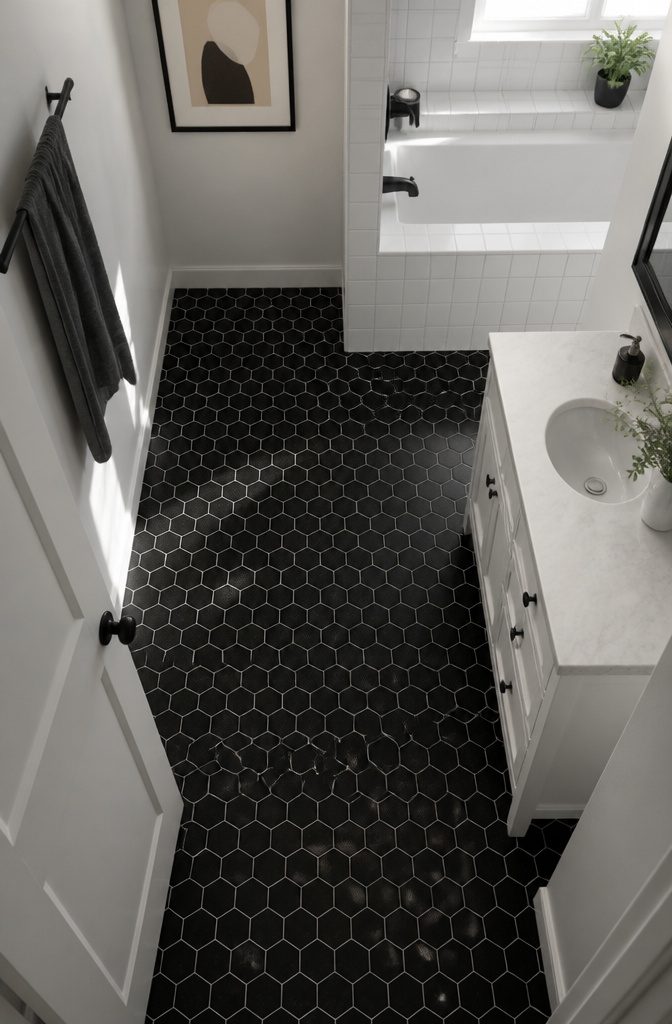
Hexagon tile gives you a graphic surface without pattern complexity—the shape does the work.
Black Polished Hexagon Glass Mosaics come in 11¾ by 11½ inch sheets, while Empiezo Polished Hexagon Marble Mosaics run 12 by 12 inches, both landing in mosaic scale rather than large-format tile.
Black hexagon flooring adds depth in small bathrooms because the cell edges create visual texture that doesn’t read as busy.
You can run it monochromatic or alternate black and white tiles for a higher-contrast result—the second approach pulls in art deco styling without committing to a full vintage scheme.
Large hexagons skew contemporary; small ones read trendier and layer well against square tile on the tub surround or shower wall.
Matte black holds up better to soap scum visibility than polished, though polished marble reflects more light if the room runs dim.
8. Herringbone Tile
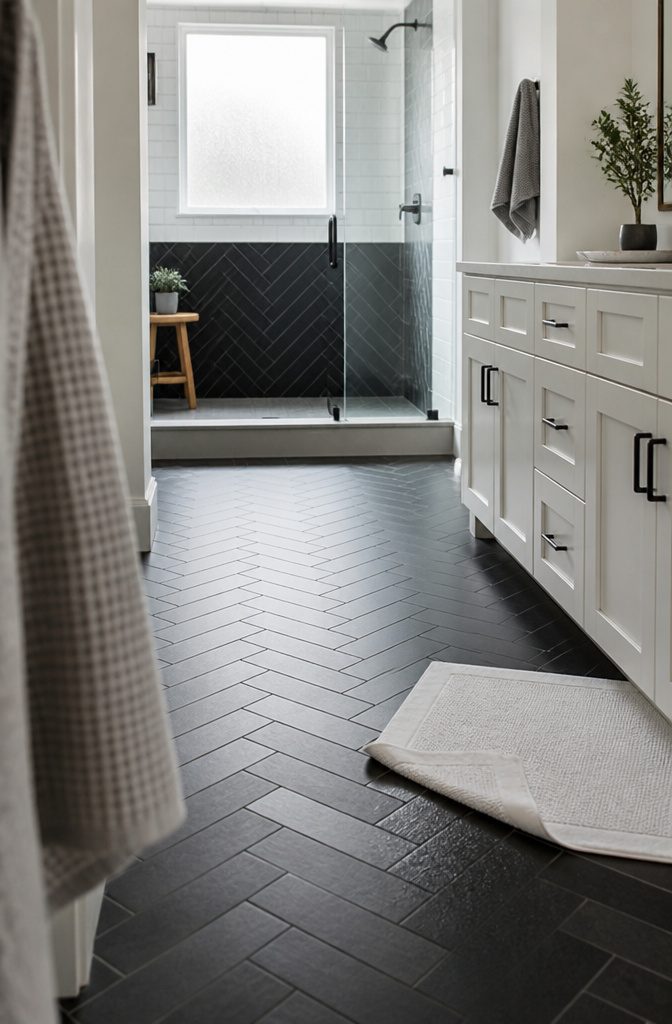
The arrangement adds movement without noise. Herringbone runs at a diagonal, so the eye follows the zigzag instead of landing on a grid, and in a small bathroom that pattern reads as texture rather than as something competing for attention.
A slate-look porcelain tile in black softens the contrast—the surface has enough variation that the herringbone stays visible but the overall effect leans quieter than a pure black tile would.
It works on floors and as a shower surround, and the same tile can run both places if you want the pattern to carry through the room.
The scale matters: a narrow plank in herringbone fills more joints than a wide one, so the grout lines show up and the pattern gets busier; stick to a 3-inch width or wider if you want the herringbone to stay subtle.
9. Vintage or Art Deco Details
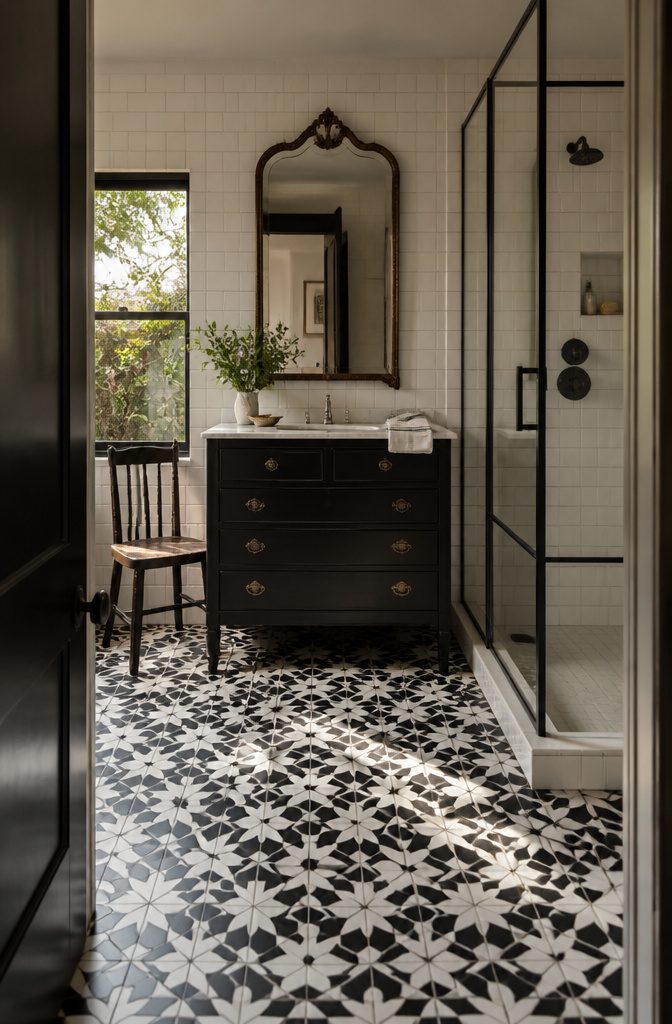
Encaustic cement tile brings the retro weight a black-and-white floor needs when you want something closer to Art Deco than minimalist.
The Handmade Flecha, Stella, and Ingot patterns are all 8 by 8 inches, honed finish, and each locks into a geometric repeat that reads vintage without feeling like a reproduction.
I prefer pairing them with plain white subway tile on the walls so the floor gets the attention it earned, and the contrast keeps the room from tilting too ornate.
Black-and-white wallpaper works if the floor stays simple, and adding black-framed shower glass or a painted vintage dresser as storage ties the decades together without making the room feel like a museum.
One standout piece does more than filling every corner—an ornate mirror or a wooden chair painted black connects to the palette and stops before clutter starts.
10. A Third Color
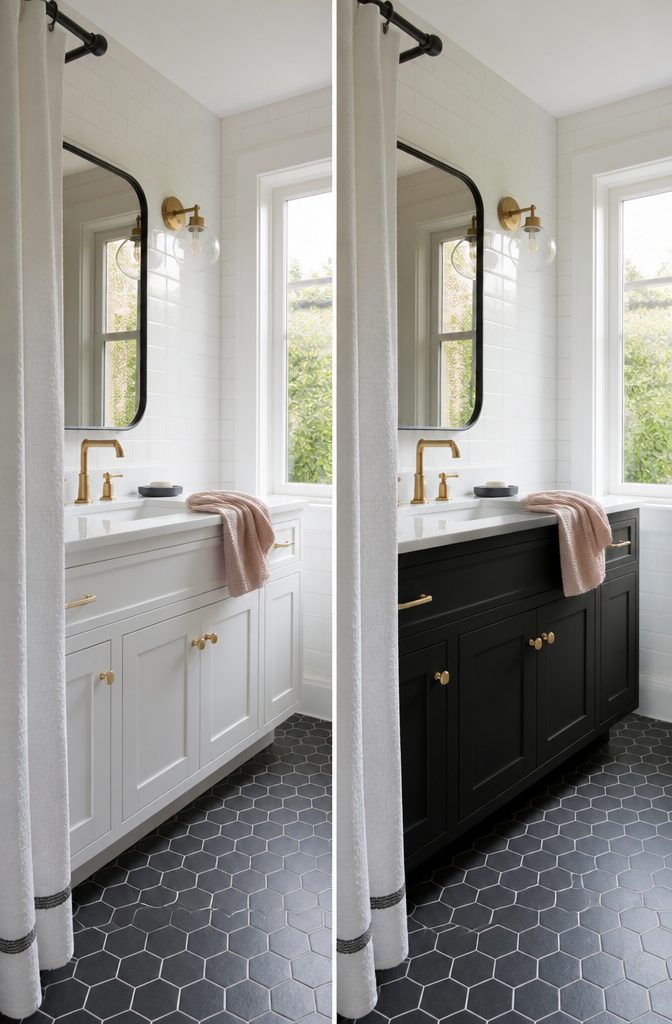
Gray works if you want to soften the line between black and white without losing the graphic punch.
It reads as neutral in most light, so white subway tile with charcoal grout or a pale gray floor keeps the monochrome idea intact while giving the eye somewhere to rest.
Red and pink warm the scheme up fast—a terracotta rug or blush hand towels pull the palette toward lived-in rather than clinical.
If you’re wanting to keep things classic with an updated black and white bathroom, I love mixing in a touch of gold in the hardware, the lighting, artwork, and towels.
Gold-toned faucets and cabinet pulls add warmth without color, which matters if you’re renting and can’t repaint.
Blue and green push cooler: teal towels or an emerald bath mat bring in enough saturation to register as color but still read as clean.
Canary yellow is the boldest of the bunch—one or two pieces, not a whole wall.
11. A Black or Contrasting Bathtub
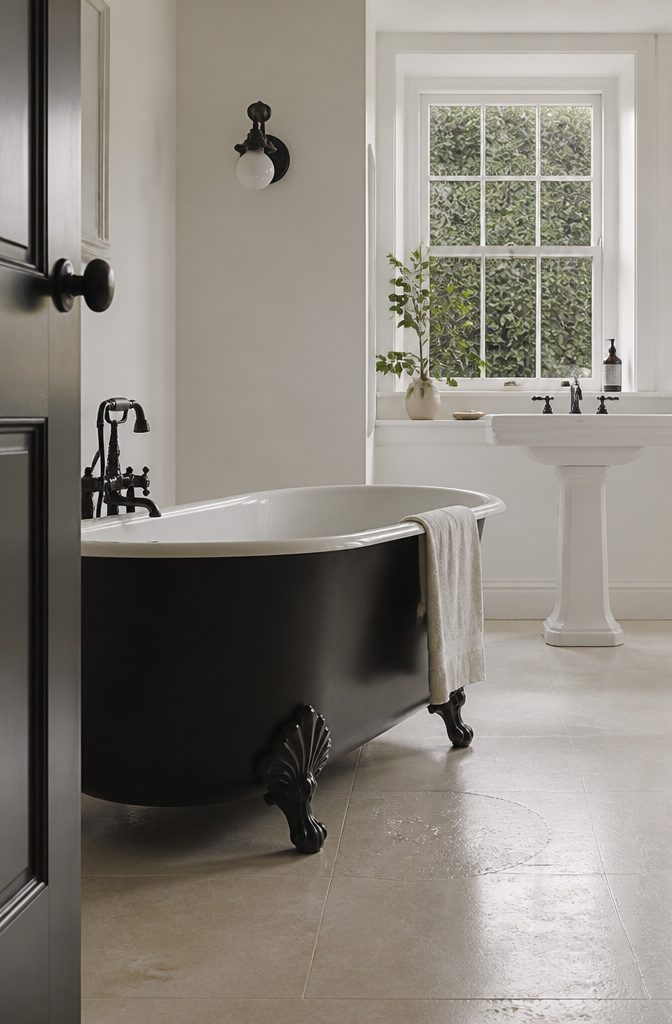
A freestanding tub with a black exterior works best when the room has space to let it sit away from the wall.
The dark shell reads as furniture rather than fixture, and against white tile or painted walls the shape gets full attention.
Black clawfoot tubs follow the same logic but carry more traditional weight—the curve of the feet and the metallic detailing make them sculptural even in a small footprint.
If the tub is inset, the surround does the work instead.
White enamel paired with black tile or black-painted paneling pulls focus without needing a specialty product. The contrast sits at the edge rather than in the tub itself, and the look stays clean without custom ordering anything.
A clawfoot tub against black walls flips the palette and puts white in the spotlight, which softens the scheme where an all-dark surround would close it in.
12. Black Walls or an All-Black Shower
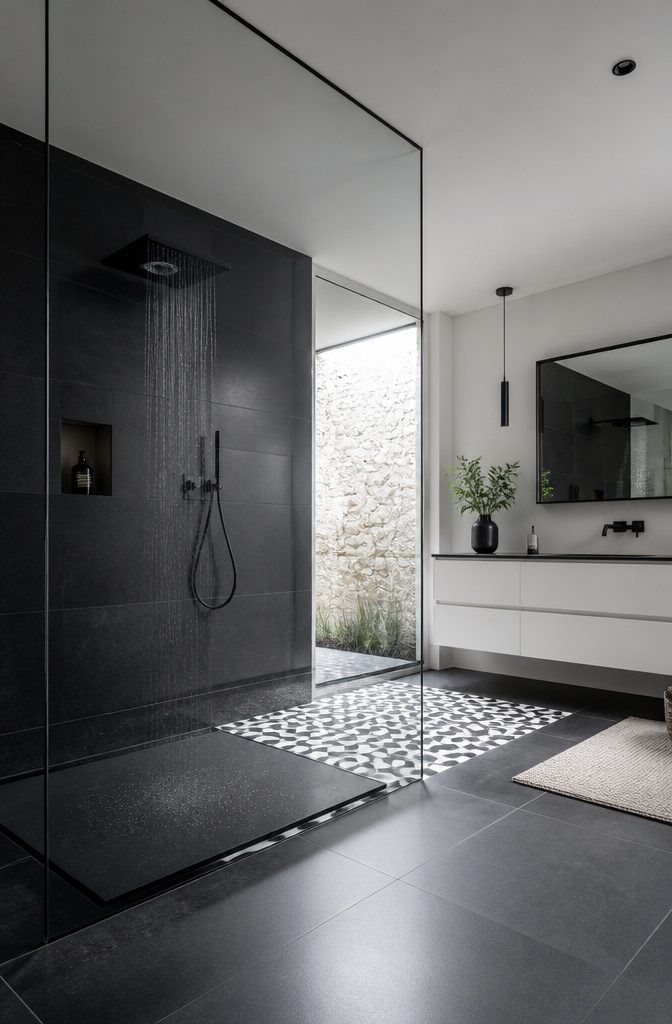
An all-black shower works when you break up the weight with glass and texture.
Frameless glass keeps sight lines open and stops the space feeling closed in, while a waterfall shower head adds a focal point without fighting the dark palette.
The floor is where you pull in contrast—mix black and white tiles underfoot to lift the room and give the eye something bright to land on.
For the walls, large-format black porcelain gives you the look of natural stone at half the maintenance.
Atelier Black Lappato Concrete Look Porcelain Tiles come in 12 by 24 inches and 18 by 36 inches, and the lappato finish catches light without reading as glossy.
Bigger tiles mean fewer grout lines to scrub, which matters in a wet room where every seam collects soap scum.
Black walls read modern, not heavy, when you treat the shower as one unbroken plane.
Hardware should disappear—matte black blends in, chrome or brass would pull focus you don’t want. The move is minimal: dark tile, clear glass, one good fixture, and pattern saved for the floor.
13. Natural and Organic Details
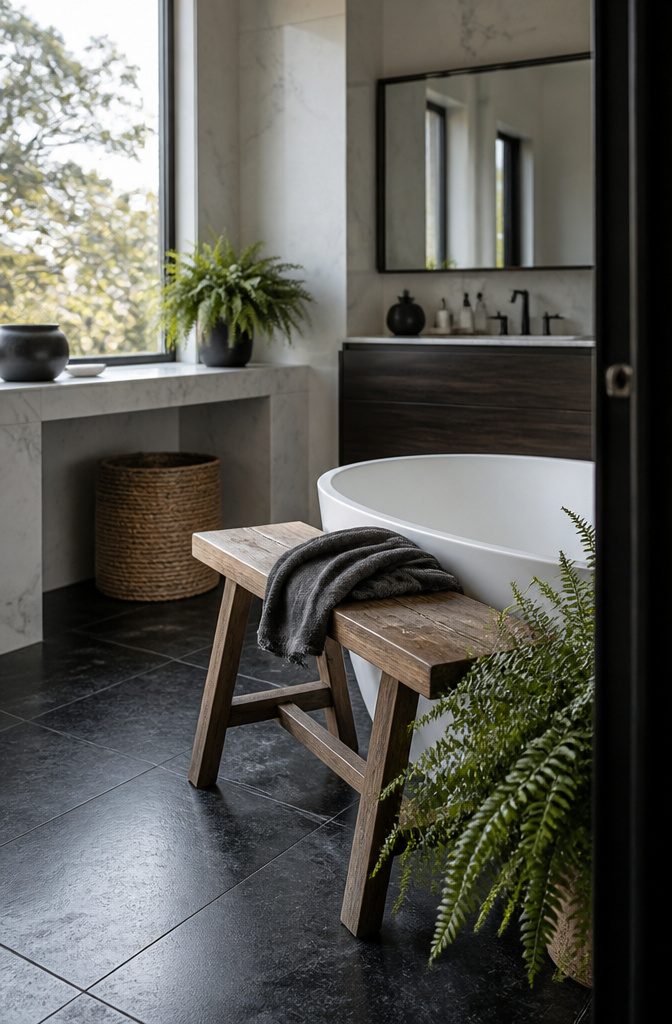
Wood pulls the sharpness out of a black-and-white scheme without competing for attention.
A wooden bench, ladder-back chair, or vanity with a natural finish adds warmth where the palette runs cold, and wood pairs well with ceramics and stone because all three carry weight without pattern.
Deep-toned wood trim holds up even against dark floors if the room gets enough natural light — a large window or mirrored surfaces keep it from closing in.
Plants follow the same logic.
Ferns and lilies handle bathroom humidity and break up the geometry with something alive. Woven baskets and hampers add texture at floor level, where tile often runs uninterrupted, and they’re functional enough to justify the space they take.
Natural stone brings contrast within the monochrome range itself. Veined black marble behind a freestanding tub or white stone countertops layer durability with visual interest, and pairing honed stone with polished slabs adds depth you don’t get from paint.
Slate-look porcelain in a herringbone pattern softens the high-contrast look if full marble sits outside the budget.
14. Penny Tile
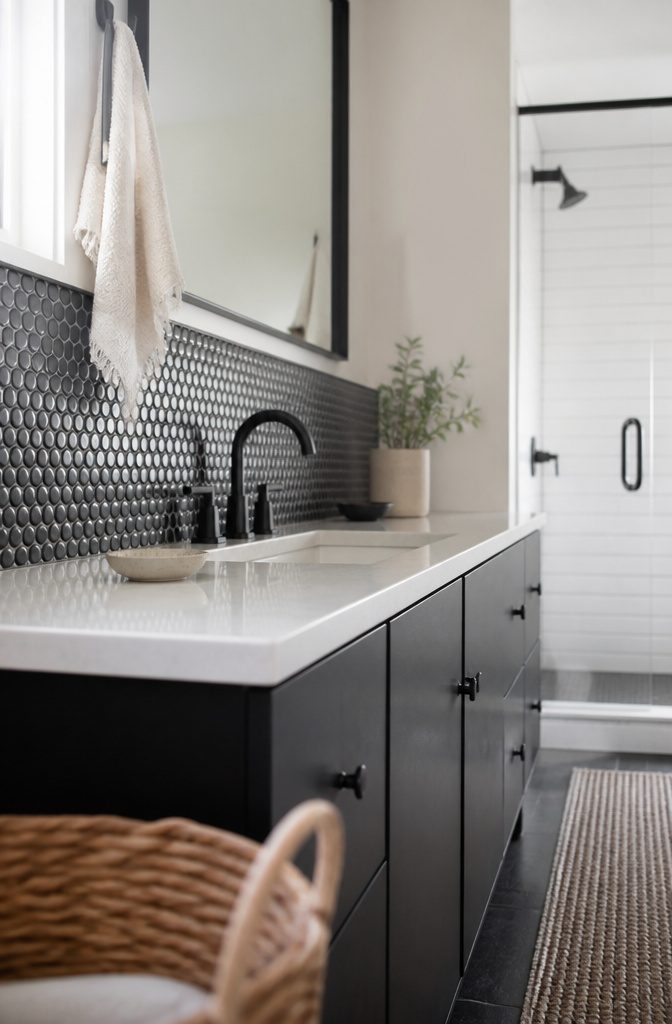
Penny tile’s small circular mosaics give you a less formal grid, whether you run them across the floor, up a wall, or behind the vanity as a backsplash.
The round format softens the look compared to square tile without losing the crispness that black and white deliver.
Black Tumbled Penny Round Marble Mosaics measure 11 1/4 by 11 3/4 inches per sheet and bring contrast when you pair them with a lighter floor or countertop.
Bella White Honed Penny Round Marble Mosaics come in the same sheet size and work the opposite way, keeping walls pale while a darker fixture or floor anchors the room.
Both options install like any mosaic sheet, which makes them manageable for a weekend project if you’ve tiled before.
15. Coordinated Mixed Surfaces
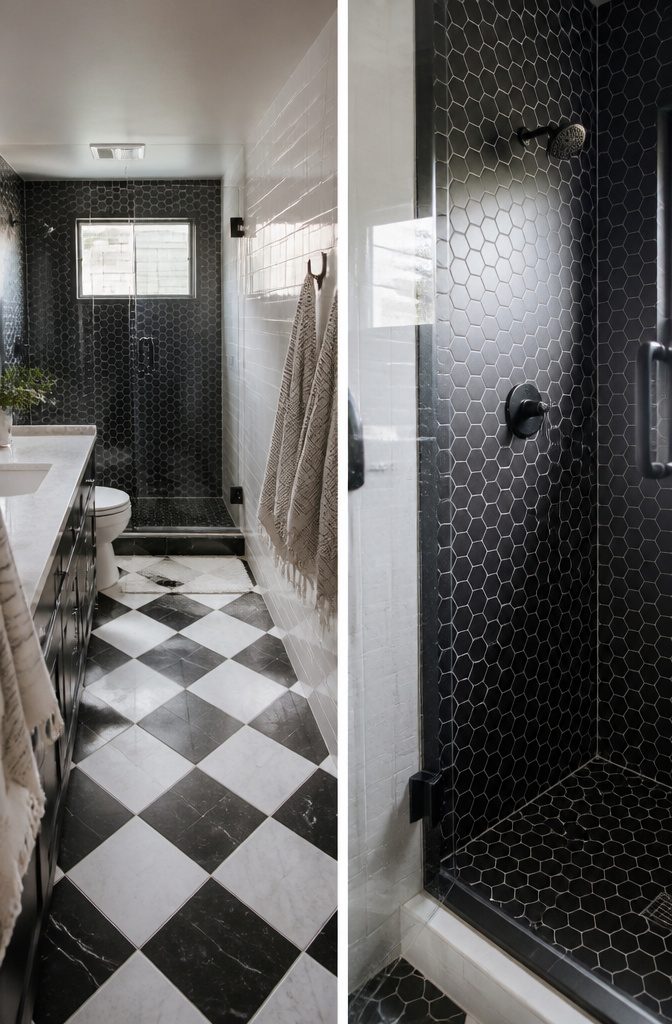
Different tiles link up when they share a finish or a light-to-dark range.
A walk-in shower with glossy off-white wall tile and glossy floor tile in the same value reads as one surface even when the shapes differ, because the sheen and the color do the connecting.
The eye follows what is continuous, not what is identical.
Carrying a pattern from wall to floor works the same way. Hexagons in black on both planes give you a graphic through-line; the joints and the color hold the room together without needing matched grout or identical tile size.
If you want a third tone in the mix, mid-grey pulls the contrast down and keeps the geometry readable — in towels, in accessories, anywhere the eye lands between the black and white.
White subway tile on one wall and black subway on another only holds if the floor ties them back together, and a diamond-pattern floor in both colors does that.
The alternating shapes give the eye somewhere to rest between the opposing walls. All-white fixtures cool the contrast further and keep the space from reading as a checkerboard on every surface.
Frequently Asked Questions
Is black and white a good color scheme for a small bathroom?
Yes. Keep white on most large surfaces like walls and the ceiling to hold the space open, then bring in black through fixtures, tile accents, or hardware for definition.
The contrast gives a small bathroom structure without making it feel closed in.
How can I make a black and white bathroom feel warmer?
Add wood, woven baskets, plants, or brass and gold-toned hardware. These materials soften the sharp contrast between black and white without introducing color, and warm lighting helps as well.
Are black bathroom fixtures difficult to maintain?
Black fixtures show water spots, dust, and soap residue more readily than lighter finishes, so you’ll need to wipe them down regularly with a soft cloth. Matte black hides streaks better than polished.
Should bathroom floors be darker than the walls?
There’s no fixed rule. A dark floor with light walls keeps the space grounded without closing it in, which works well in smaller bathrooms.
You can reverse it if the room has strong natural light or enough reflective surface to balance the weight of dark walls.
What colors go with a black and white bathroom?
Gray softens the line between black and white without breaking the monochrome scheme. Gold-toned hardware adds warmth, while terracotta, blush, teal, emerald, and canary yellow bring in enough saturation to register as color but still read as clean.
How can I add personality to a monochrome bathroom?
Bring in patterned or geometric tile, a bold mirror frame, or a freestanding tub with a black exterior. Wood furniture, woven storage, and plants also break up the geometry without competing with the black-and-white palette.