
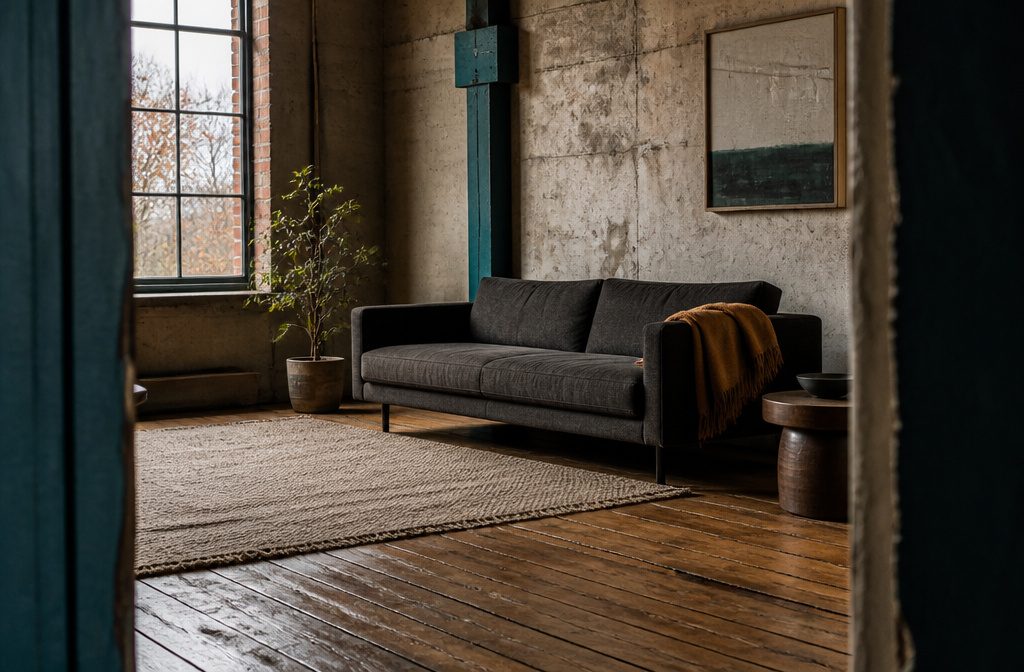
Modern living rooms can run from industrial lofts with exposed concrete to Scandinavian layouts built on wool and hemp, and the choice between them comes down to which materials you already own or are willing to commit to across the next three furniture purchases.
The restraint that defines the style costs nothing, but mixing styles to avoid it costs more effort than it saves.
Most of these ideas work whether the room is 120 square feet or twice that, though a 72-inch sofa matters more in the smaller case and furniture on six-inch legs shows enough floor to make a narrow space read wider.
1. Choose a Style Direction and Use It Consistently
A modern style gives you materials, forms and colors that hold together without needing you to curate every piece.
Mid-century modern uses wood frames, angled legs and low-slung profiles—pair the Grand Repos Lounge Chair with a Cherner Coffee Table and the room looks deliberate.
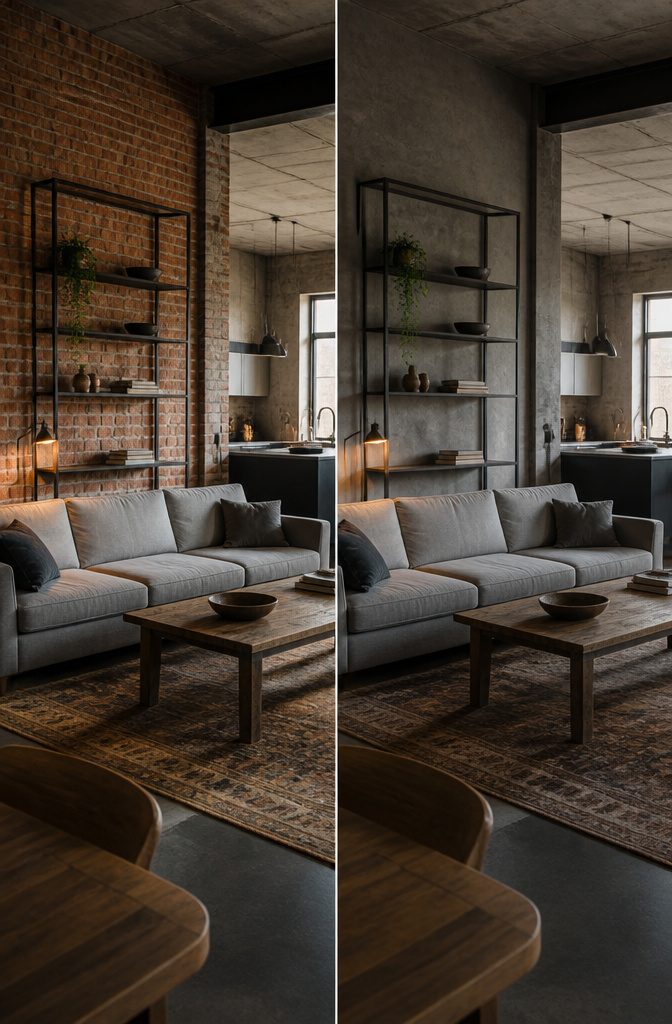
Industrial works with exposed brick, concrete and metal, often keeping the bones of older buildings visible rather than hiding them.
Scandinavian and farmhouse modern both lean on natural textures like wool and hemp, which the Tres Vegetal Rug handles in a single weave. Mediterranean brings dark walnut, white upholstery and blue accents tied to southern Europe.
Urban modern pulls from contemporary, minimalist and industrial design at once, mixing concrete, wood and geometric shapes in open layouts. Pick one and let it decide the next three furniture choices—mixing styles costs more effort than it saves.
2. Keep the Design Restrained and Functional
Modern design rests on restraint. The furniture carries simple shapes, flat or gently curved surfaces, and legs that stay thin rather than turned or carved.
A sofa earns its place by seating people comfortably, not by announcing itself with tufting or skirts. A coffee table in solid oak or black metal holds what you set on it and adds one material, not three.
Each piece does a job, and ornament is replaced by proportion and the honesty of wood, metal, stone, leather, and wool.
This is not the same as emptying the room.
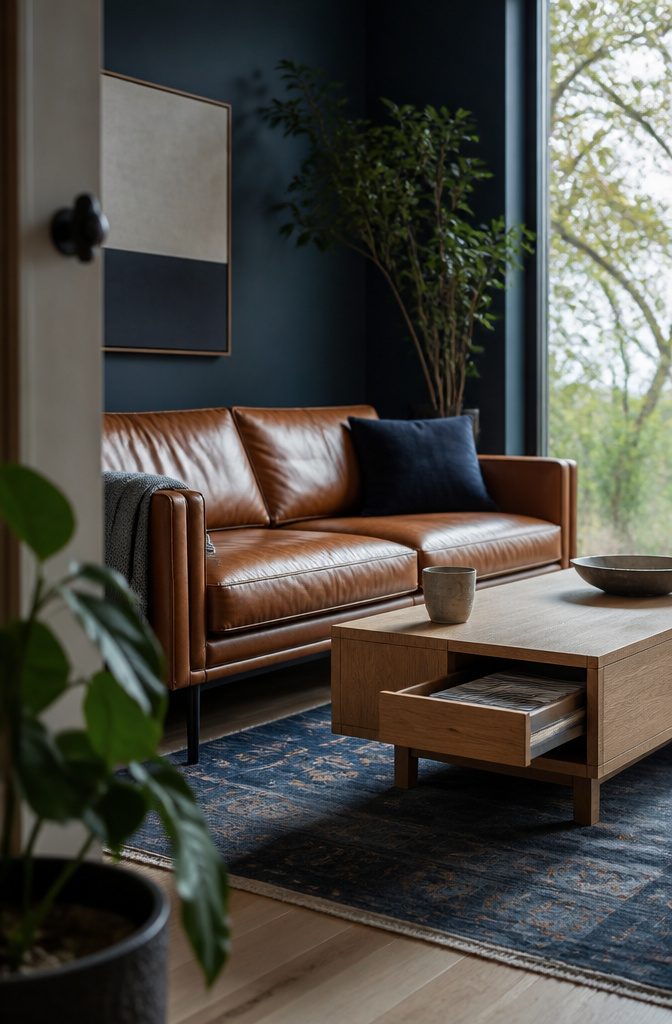
A modern living room can hold a deep navy wall, a cognac leather sofa, and a patterned rug and still read as current, as long as the shapes stay clean and the space is not crowded.
Function leads form in this approach, and that often means choosing furniture with more than one role: a coffee table that stores remotes and magazines, a modular sofa that reconfigures when the room’s use shifts.
The result supports openness and calm without feeling cold or underfurnished.
3. Use Color Deliberately
Neutrals still anchor most modern rooms, but the way they’re used has shifted.
Benjamin Moore Swiss Coffee or Pale Oak on walls keeps the room light without the stark feel of pure white, and layering beige, gray, and white across surfaces gives depth without pattern.
Sherwin-Williams Agreeable Gray works the same way in north-facing rooms where cooler light turns whites dingy.
Color blocking—painting one wall or zone in a bold shade while leaving the rest neutral—adds energy without overwhelming the room.
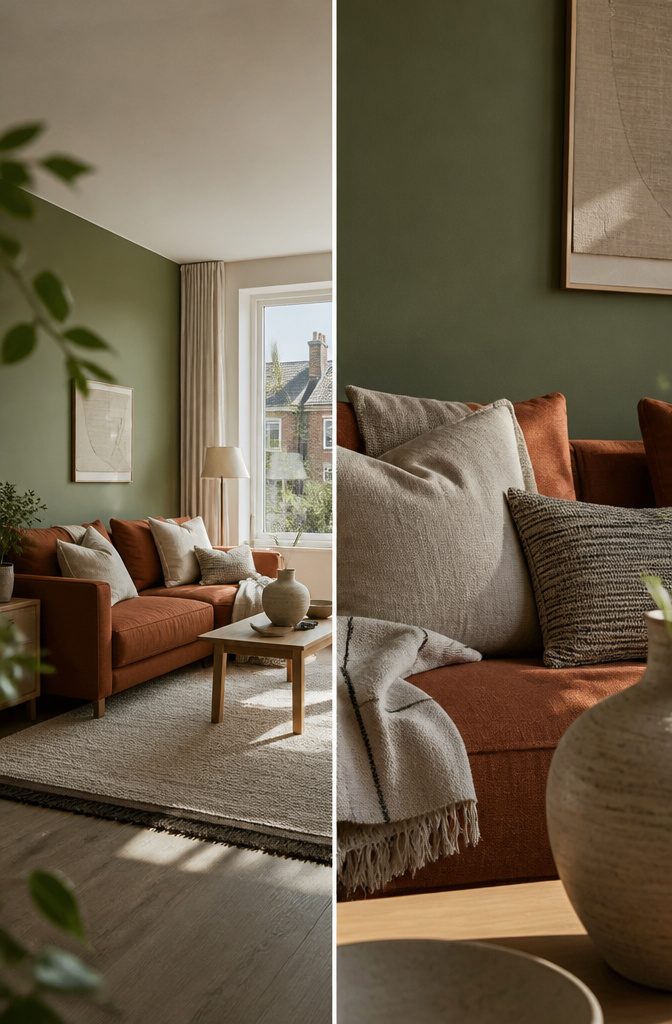
Sherwin-Williams Evergreen Fog reads as a soft neutral in daylight and darkens at night, and it pairs well with rust or camel upholstery.
For small or dim rooms, a color drench works better: Benjamin Moore Hale Navy on walls, trim, and doors, with the ceiling two shades lighter, makes the darkness intentional rather than accidental.
Red wine tones showed up as a 2025 trend, especially in glossy finishes or velvet. Oxblood lacquer on walls with matching fabric on the ceiling creates a moody, enveloping space.
Cool blues and grays remain popular because they feel modern without being cold, particularly when layered with texture and an unexpected warm accent like terra cotta or deep red.
4. Add Warmth and Texture With Materials
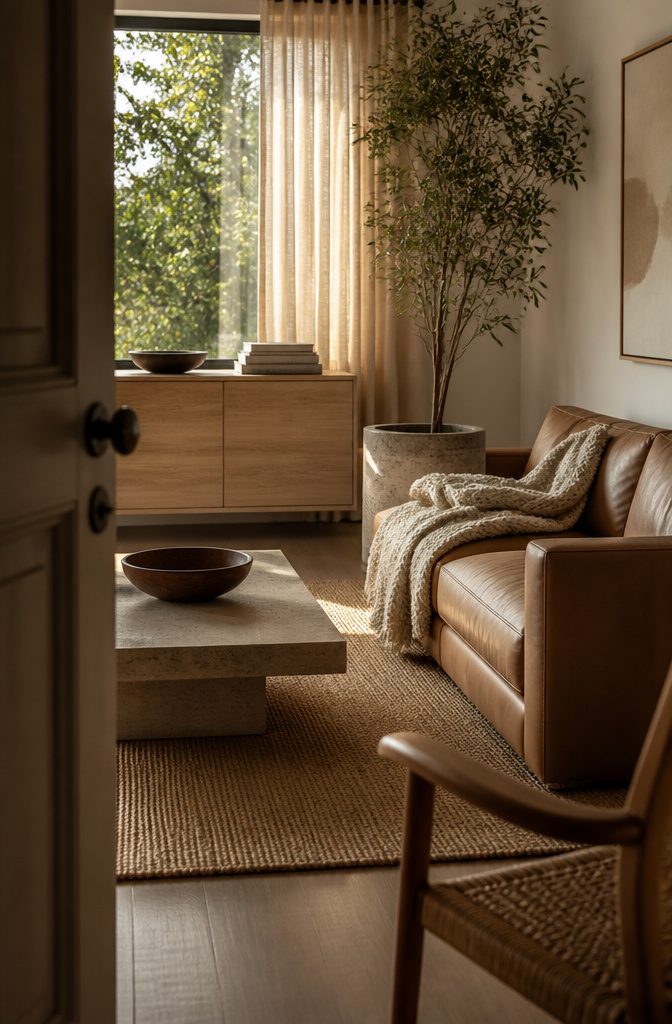
Wood brings warmth to a modern living room in a way paint alone cannot. A walnut coffee table or white oak credenza softens the room immediately, and the grain reads as detail even when the form stays simple.
I lean toward medium and light woods — they work with most wall colors and do not darken a small space the way espresso finishes can.
Stone and concrete add weight without feeling heavy. A polished marble side table or rough concrete planter grounds the room and plays well against upholstered pieces.
The contrast between smooth leather on a sofa and a chunky wool throw is the kind of layering that makes a restrained room feel lived in rather than staged.
Woven pieces fill in texture where you need it. A jute rug under the coffee table, linen curtains at the window, or a rattan accent chair all register as tactile before the room tips into cold.
I add one or two woven elements per room and let the rest stay smooth.
5. Balance Curves With Straight Lines
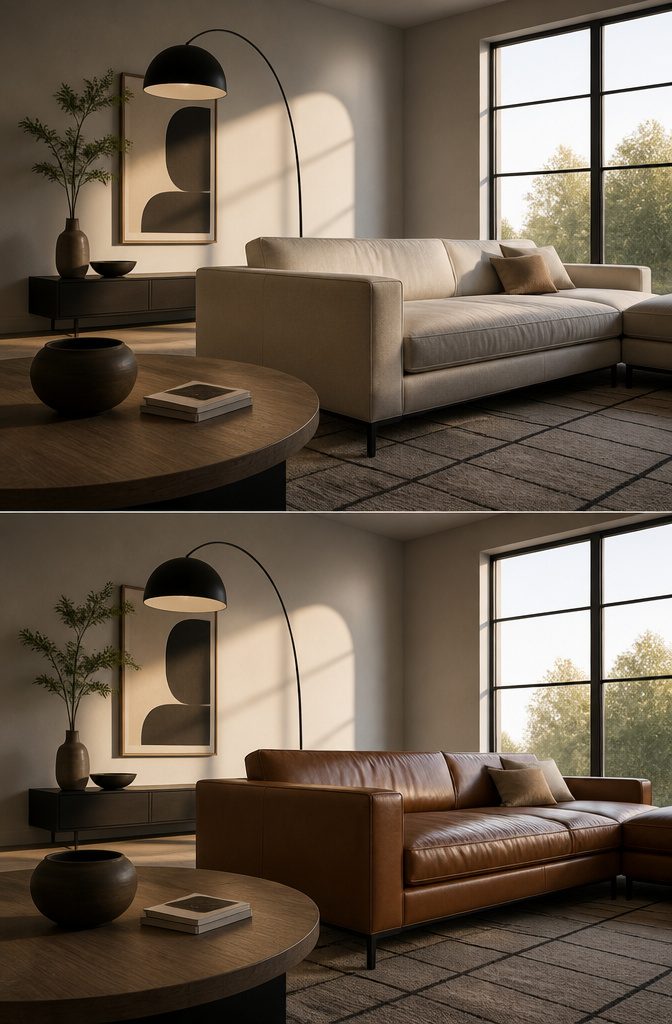
Curves soften a modern living room filled with straight edges and add contrast that keeps the space from feeling flat.
An angled sofa reads sharper against round side tables or a curved floor lamp, and the mix makes each piece register more clearly — the sofa’s geometry stands out, the curves feel deliberate rather than default.
The room holds more visual interest when every straight line has a curve somewhere nearby to balance it.
That contrast also lets other rectangular elements, like framed art or a window grid, hold attention instead of disappearing into the background. The straight pieces anchor the layout; the curves keep it from feeling rigid.
A curved sectional or a set of round stools works the same way in reverse: the soft shapes take the lead, and a few clean-lined tables or shelves give the eye a place to rest.
The balance matters more than which shape dominates.
6. Keep Furniture Low or Raised on Visible Legs
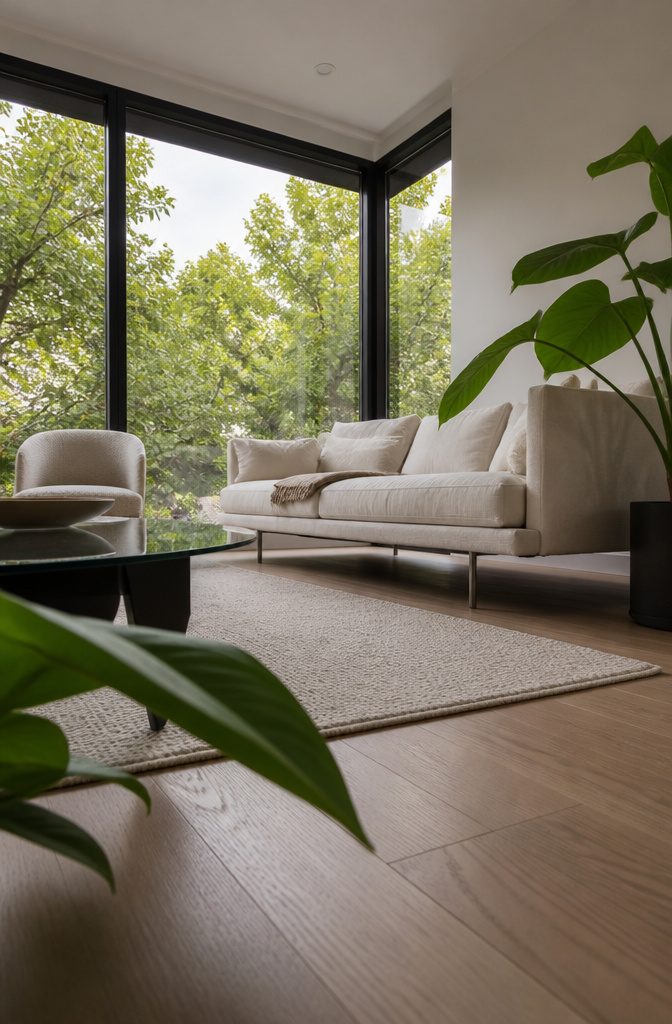
Low furniture keeps the room open the way tall furniture never will.
A sofa at standard height blocks sight lines across the room; the same sofa dropped to 28 or 30 inches leaves wall and window visible above it, and a room that shows more wall reads larger than one where the furniture cuts the view.
Pieces raised six inches off the floor on visible legs do the same work from below: more floor showing means more space the eye can measure, and that measurement matters more than the furniture’s actual footprint.
The difference shows fastest in small rooms.
A 75-inch sofa on metal legs, a round glass coffee table, and an armless chair seat four people in 150 square feet without the room feeling packed, because the floor stays visible and walkways stay clear.
Low-profile pieces paired with floor cushions take that further if the room skews casual, though the cushions themselves add bulk you have to store somewhere when guests leave.
Rooms with large windows gain the most from low furniture, because the architecture stays the focus and light moves through the space uninterrupted.
That works when the windows are worth showing; in a room where the view is a parking lot, furniture height stops mattering and other details take over.
7. Layer Lighting for Atmosphere and Function
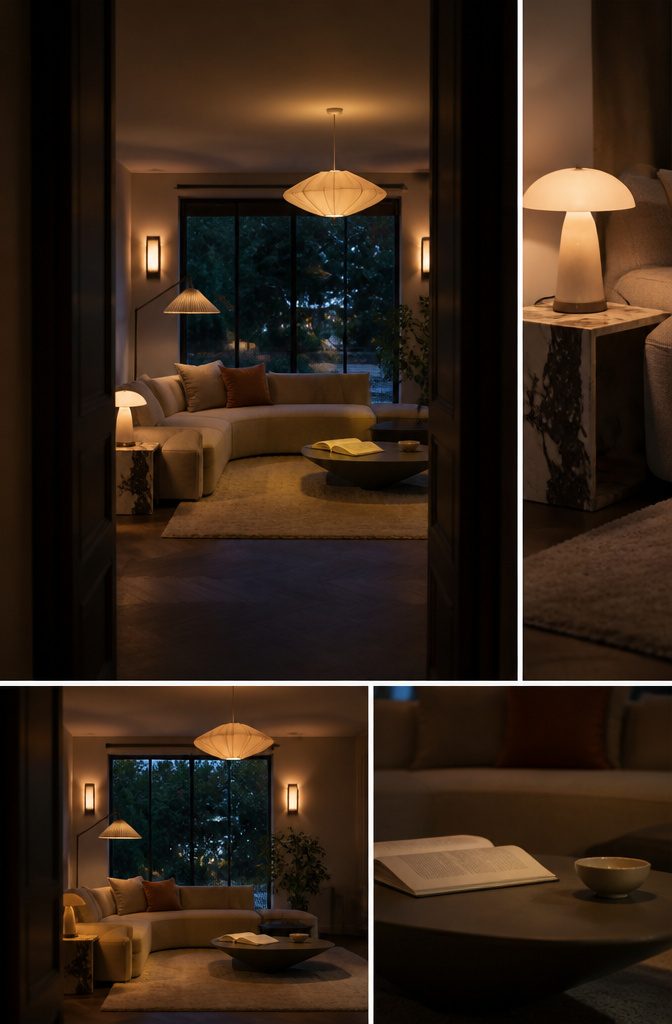
A reading lamp behind the sofa, a table lamp at arm’s reach, and a pair of wall sconces mounted 60 to 66 inches from the floor give you enough light to read by and enough variety to set a mood.
Plug the tallest lamp into the switched outlet so the wall switch still does something useful, then put the rest on dimmers or smart plugs.
That way you can bring the room down for a film or up for cleaning without walking the circuit.
Use 2700K bulbs across all of them. Warmer than that and the room reads orange; cooler pushes into the blue hospital register, and anything marked daylight will flatten the space entirely.
I have yet to see a 4000K bulb that looked right in a living room at night.
Overhead fixtures still matter. A chandelier or sculptural pendant draws the eye up and fills the centre of the room, which three lamps around the edges will not do on their own.
Recessed lights work if they are lighting something specific rather than marching down the ceiling in rows. The fixture is where you can afford to make a statement; the bulbs inside it are where you cannot.
8. Use Mirrors to Brighten and Enlarge the Room
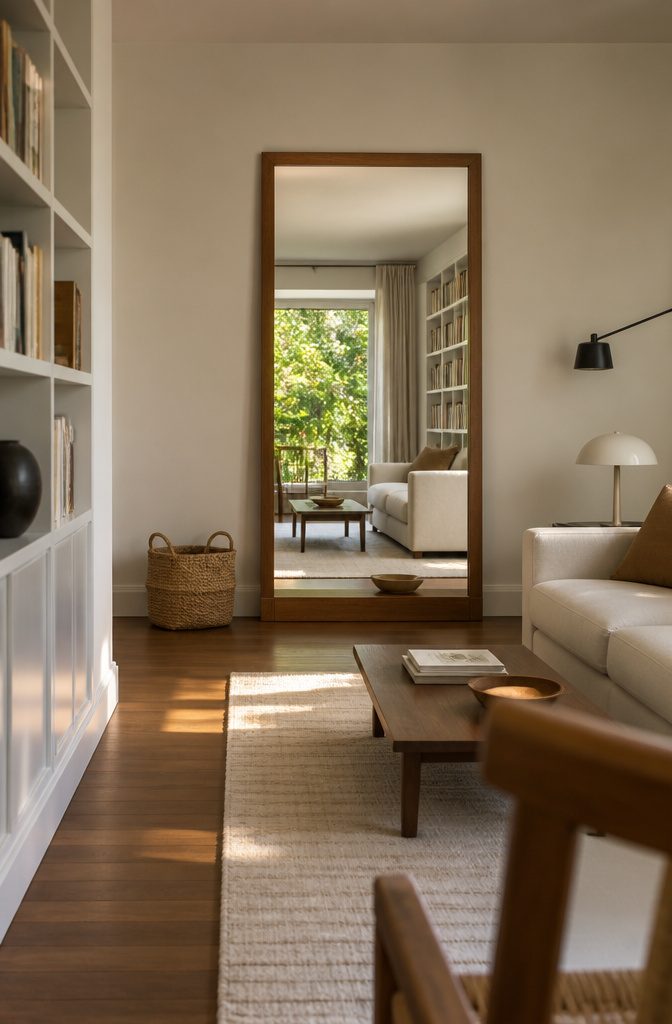
A large mirror doubles what light you already have and makes a narrow room feel twice as wide.
I place mine opposite a window when the layout allows it — the reflection pulls daylight deeper into the space than the window alone can reach.
Floor-length designs work better than small decorative ones because the larger surface catches more of the room and more of the light.
Mirrored walls go further.
One approach sets a full mirror into a recess or alcove with a wooden grid overtop; the grid breaks up the reflection so the mirror reads as architecture rather than decoration, and a shallow shelf at the base keeps it functional.
The reflection picks up whatever sits across from it — a staircase, a bookshelf, the opposing wall — and the room gains depth without losing floor space to furniture.
A statement mirror at least five feet tall does most of the same work for £698 or less, and you can move it when the lease ends.
9. Use Rugs to Define Areas and Add Softness
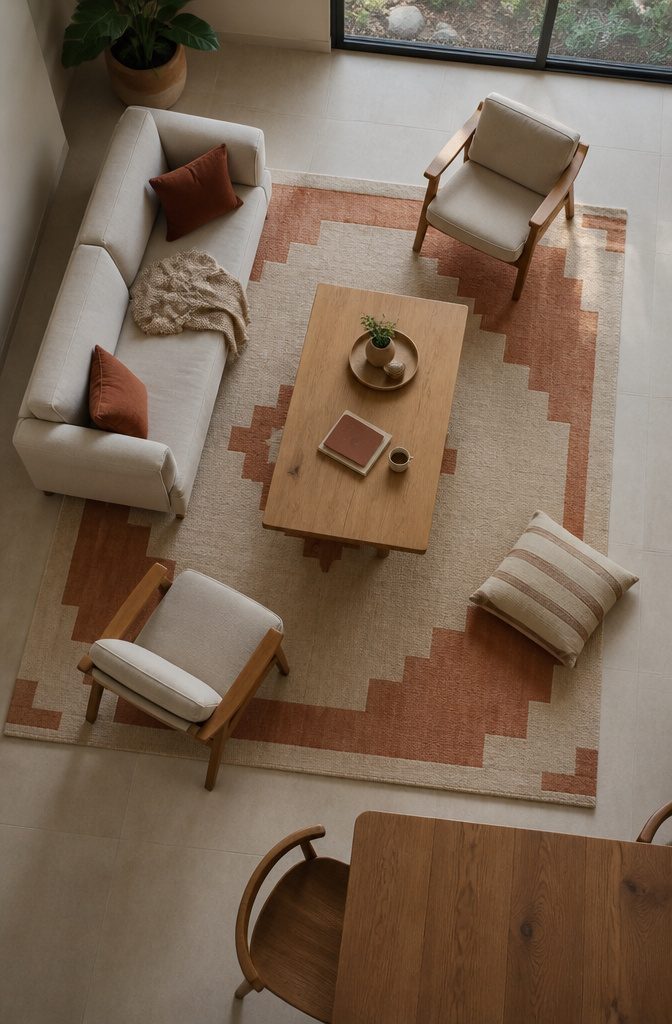
An 8 by 10 foot rug is the minimum size in most living rooms—it lets at least the front legs of every seat rest on the rug, which pulls the furniture together into a cohesive zone instead of leaving pieces scattered.
Larger rooms need larger rugs; go up to 9 by 12 or 10 by 14 if the space allows, because a rug that stops short of the seating reads as undersized.
Flat-weave or low-pile rugs suit modern rooms better than deep shag.
Solid colors and geometric patterns both work; the pattern can carry the room if the sofa and walls stay plain. Wool adds weight and texture, jute brings warmth, and synthetic options hold up to traffic without the price.
The rug adds softness underfoot and connects individual pieces of furniture into one legible arrangement. In a room with hard floors and clean-lined furniture, that layer of texture makes the difference between stark and comfortable.
10. Make the Room Multifunctional
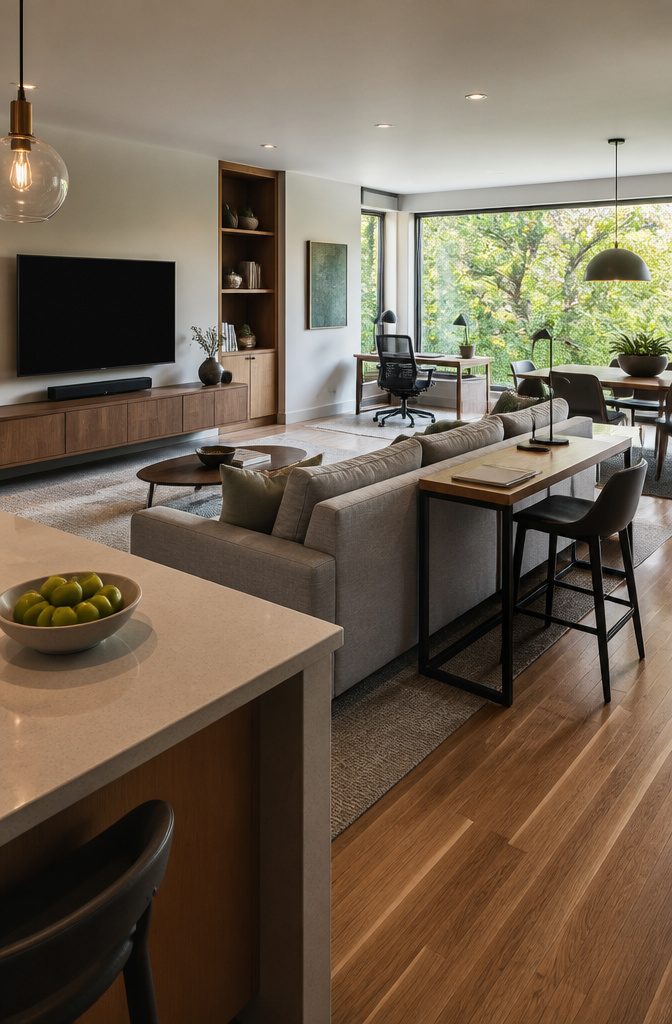
A dual-aspect sofa positioned in the center of the room can watch television on one side while the other wraps toward a window seat or workspace.
That single piece eliminates the need to choose between screen time and conversation, and it turns a one-dimensional layout into a room that engages every corner.
The custom route costs more upfront, but modular sectionals offer the same wraparound flexibility at a fraction of the price if you plan the configuration before you buy.
Modern living rooms absorb home offices, reading nooks, and kitchens into a single open area, so the furniture has to support more than one activity without looking chaotic.
An L-shaped sectional divides the room into a media zone and a work zone without walls.
A console table behind the sofa creates a standing desk or a serving surface depending on the hour. Making each zone feel intentional rather than accidental comes down to rugs, lighting, and sightlines more than furniture alone.
11. Arrange Seating to Support Conversation
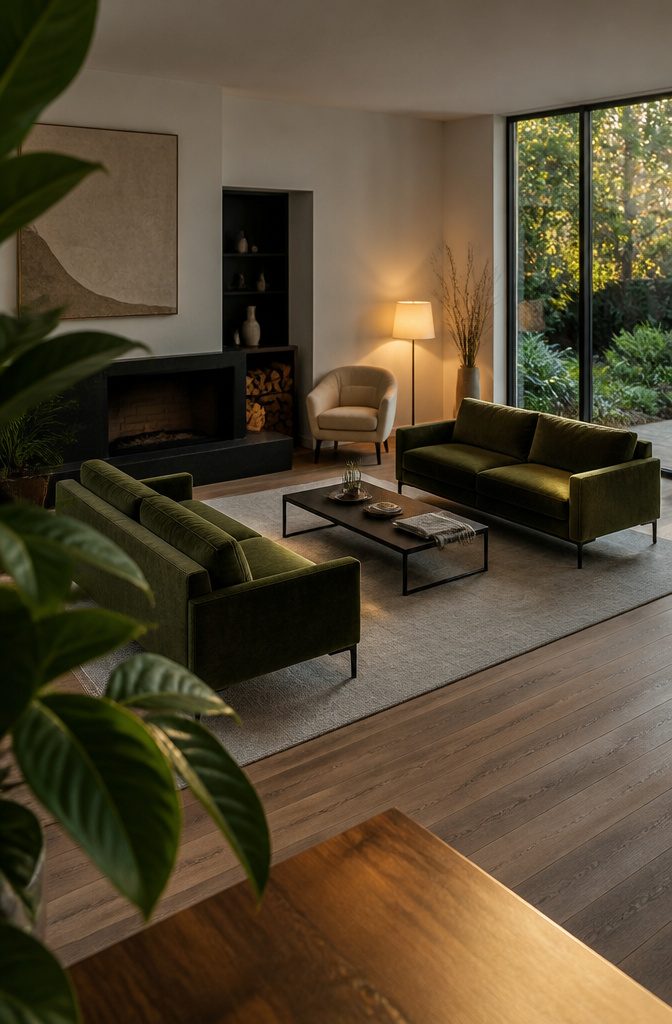
A layout that turns people toward each other instead of the TV makes the room feel like a gathering space first.
Two loveseats facing across a coffee table work when the room gets used for talking more than screening — leave 30 to 36 inches of walkway at each end so traffic can pass without squeezing behind someone mid-conversation.
Rust or olive velvet on both pieces keeps it from reading cold.
Curves pull people in without boxing them into a rigid square. A sofa that arcs inward anchors the seating zone and makes the center of the room the natural spot to sit, while still letting movement flow around the edges.
The shape does the work; you don’t need to add chairs in a ring to make it obvious this is where people talk.
Cozy corners with a chair angled toward the sofa give an extra seat that doesn’t crowd the main arrangement but still faces in.
Layer a floor lamp behind it and the corner becomes the spot someone claims when the room fills up.
12. Personalize the Room With Art and Objects
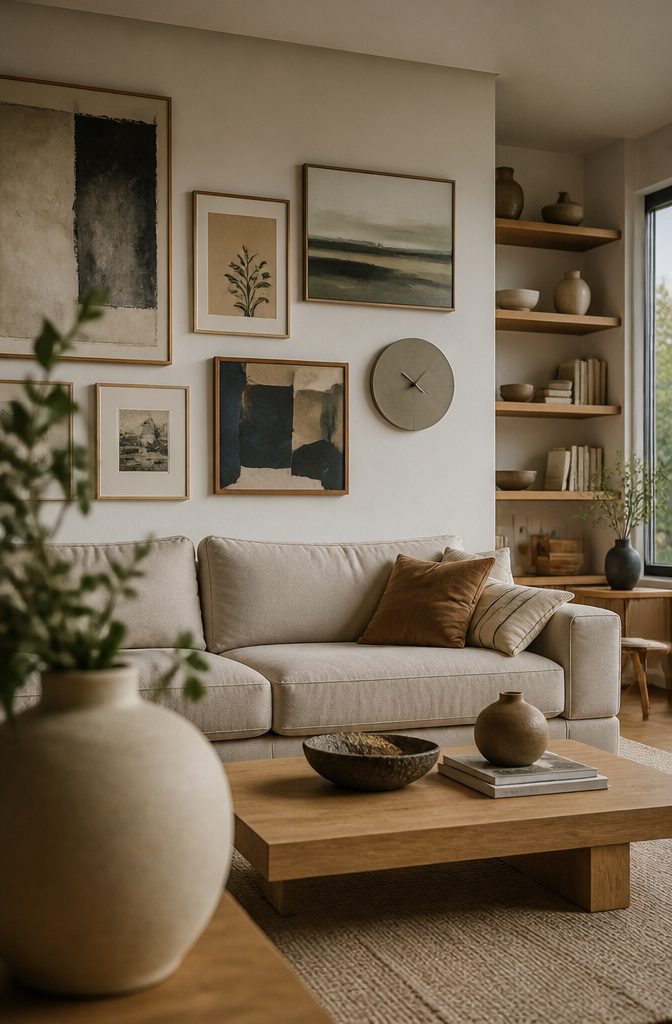
Artwork and books make a modern living room feel like yours rather than a furniture showroom.
A framed print or painting above the sofa creates a focal point on an empty wall, and a gallery arrangement balances the horizontal line of the furniture without crowding it.
Choose pieces that mean something to you: a photograph from a trip, a print you kept coming back to, work from a local artist.
The room reads as lived-in when the art reflects actual taste rather than matching the throw pillows.
Built-in shelves and bookcases hold the rest. Fill them with favorite books, small sculptures, vases, and objects you’ve collected over time.
These layers add visual interest to a wall and start conversations without any effort on your part. A distinctive wall clock—functional and decorative at once—works the same way.
This is about putting what matters to you where you see it daily, not curation for its own sake. That shift from styled to inhabited is what personalizes a modern space.
13. Use Storage and Shelving to Reduce Clutter
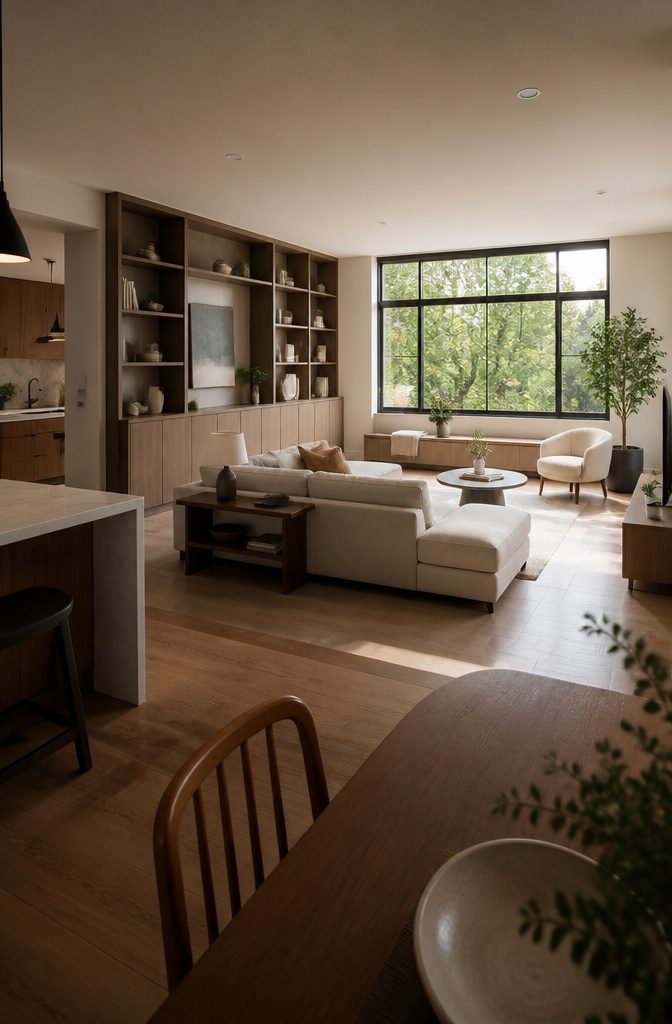
Built-in shelving and cabinets clear surfaces without closing off sight lines, which matters most when the living room shares space with a kitchen or dining area.
A floor-to-ceiling unit along one wall stores books and displays a few objects while keeping the middle of the room open.
Open shelving works the same way behind a sofa: it defines where the seating area ends without putting up a solid barrier, and you can use the back of the unit as a bar or a surface for lighting.
A dual-aspect sofa placed away from the walls serves two zones at once — one side faces the television, the other wraps toward a window seat or conversation area — so a single piece of furniture does the work of two separate arrangements.
Under-window benches with lift-up storage replace a second sofa and a cabinet, especially in smaller rooms where floor space decides how much seating you can fit.
14. Adapt Furniture and Layout to the Room’s Size
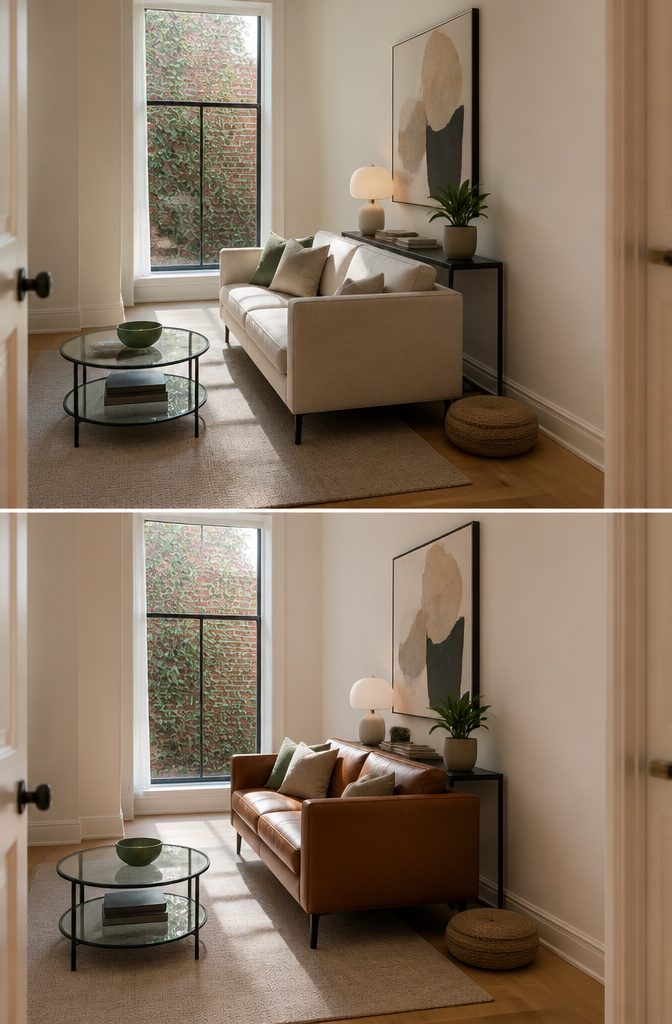
A 72- to 80-inch sofa fits a room under 150 square feet without forcing you sideways past the armrest.
In those same tight rooms, I pull sectionals 18 inches from the wall rather than shoving them into corners — the gap makes the floor read larger than furniture pushed to every edge.
Furniture on six-inch legs shows more floor than skirted pieces, and a round glass coffee table removes the corners that catch shins when you’re weaving between a sofa and a console.
High ceilings win on light but lose on coziness if you leave the upper half empty. A large sectional placed under the tallest point fills vertical space and pulls the ceiling height down to a scale that feels grounded.
Vaulted ceilings in a 21-by-16-foot room, like the one an owner posted about on Reddit, benefit from oversized wall art hung high enough to acknowledge the height without marooning it halfway up.
The airiness stays; the room just stops reading as a gymnasium with a sofa in it.
What Modern Means in a Living Room
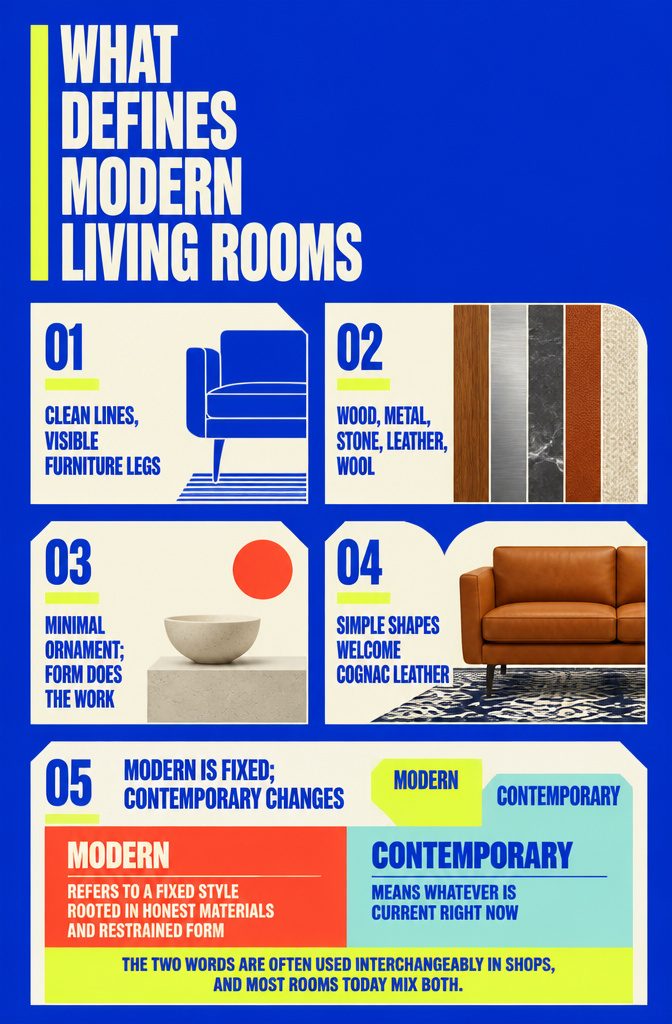
Modern living-room style is built on clean lines, furniture raised on visible legs, and a short list of natural materials: wood, metal, stone, leather, and wool. Ornament is minimal; the shape of a piece does the work instead.
The palette can run from warm whites such as Benjamin Moore Swiss Coffee through soft greige and muted green such as Sherwin-Williams Evergreen Fog to deep shades like Hale Navy or Urbane Bronze.
A cognac leather sofa and a patterned rug fit the style as easily as a white one does, provided the shapes stay simple and the room is not crowded.
Modern refers to a fixed style rooted in honest materials and restrained form.
Contemporary means whatever is current right now. The two words are often used interchangeably in shops, and most rooms today mix both.
Frequently Asked Questions
What is a modern living room style?
A modern living room uses clean lines, furniture raised on visible legs, and a short list of natural materials like wood, metal, stone, leather, and wool. Ornament is minimal; the shape of each piece does the work instead.
The palette can run from warm whites through soft greige and muted green to deep shades like navy or bronze, as long as the shapes stay simple and the room is not crowded.
How can you make a living room more modern?
Start by choosing furniture with simple shapes and visible legs rather than turned or carved details.
Use natural materials like wood, metal, and stone in restrained forms, and keep the palette to neutrals with one or two bold accents. Each piece should do a job rather than announce itself with ornament.
What colors work best in a modern living room?
Warm whites like Benjamin Moore Swiss Coffee or Pale Oak anchor most modern rooms, often layered with beige, gray, or soft greige.
Bold shades like Sherwin-Williams Evergreen Fog, Benjamin Moore Hale Navy, or oxblood work when used deliberately on one wall or zone while the rest stays neutral. Cool walls pair well with warm wood or cognac leather to balance the palette.
What size rug should I use in a modern living room?
An 8 by 10 foot rug is the minimum size in most living rooms, letting at least the front legs of every seat rest on the rug to pull the furniture together.
Larger rooms need larger rugs, up to 9 by 12 or 10 by 14 if the space allows, because a rug that stops short of the seating reads as undersized.
How do I make my modern living room feel cozy with rugs?
Choose textured, soft rugs in warm neutrals like jute or chunky wool rather than flat synthetics. Layer a thick throw or floor cushions on top if the room runs casual.
The contrast between a smooth leather sofa and a woven rug is the kind of layering that makes a restrained room feel lived in rather than staged.
Is modern the same as contemporary in a living room?
Not quite.
Modern refers to a fixed style rooted in honest materials and restrained form, while contemporary means whatever is current right now. The two words are often used interchangeably in shops, and most rooms today mix both.
How do you decorate a modern living room on a budget?
Put most of the budget into the sofa frame and a rug large enough for the seating, then paint the walls yourself and save on side tables, pillows, and art.
Paint is the cheapest way to change the look of a modern room completely, and replaceable accessories cost less than furniture you will regret in 2 years.