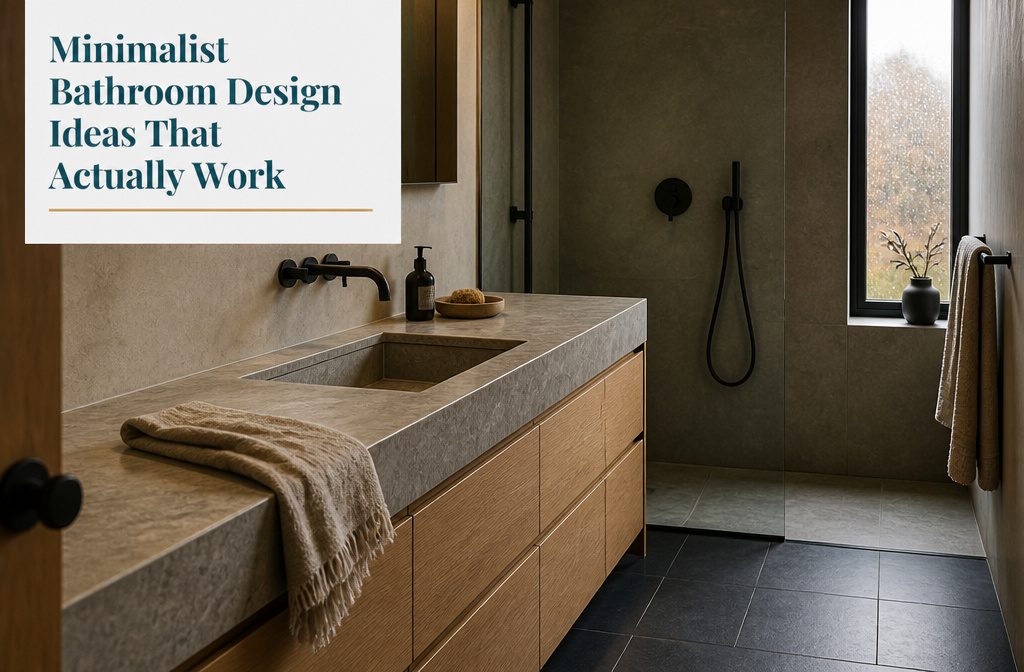
Minimalist bathrooms range from bare white boxes to warm wood-and-stone spaces, and the version that works is the one where you can actually live—storage that hides clutter instead of eliminating it, and materials that feel grounded instead of cold.
Maintenance is where it gets hard.
Polished marble stains, chrome shows fingerprints, and small tile means scrubbing grout lines every week. Quartzite and large-format porcelain cut that work in half, and matte black faucets stay clean between wipes where polished finishes never do.
1. Keep a Restrained Color Palette
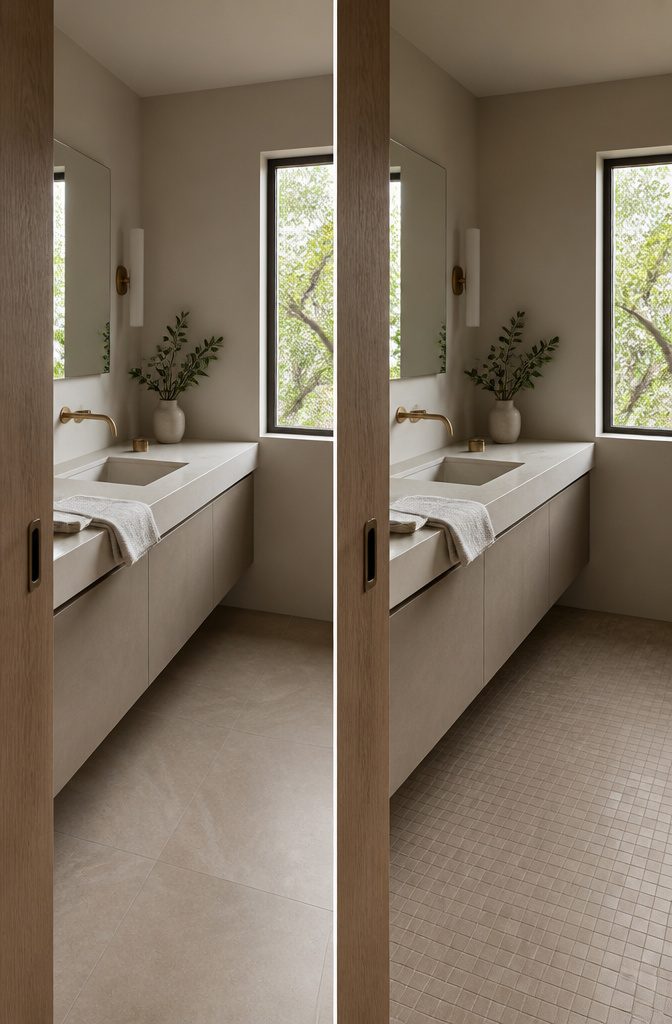
A monochromatic scheme in white, gray, or beige gives you the calm foundation minimalist design needs.
The palette itself prevents clutter — when everything sits in the same tonal family, the room reads as one continuous surface rather than a collection of competing parts.
All-white with matte tile, glossy fixtures, and stone brings in enough variation to hold your attention without breaking the visual quiet.
Warm neutrals — greige, taupe, cream, sand — have pulled ahead of cool grays in the last two years.
Pair them with natural wood or brushed gold fixtures and the space feels inviting instead of sterile. Monochromatic does not mean flat.
An all-gray bathroom gains depth when you move from light gray walls to a medium gray vanity to a dark gray floor, each shade distinct enough to register but close enough to hold the scheme together.
Black-and-white contrast works when you need sharpness without color.
A white shower with a black shower head, or a white vanity with matte black accessories, gives you focal points that stay minimal. The palette limits itself, so each choice counts more.
Recommended Products

Elegant Waterfall Design – This round bathroom faucet 3 hole features a wide waterfall spout with scientifically calculated tilt angle to deliver optimal water flow while minimizing splashing
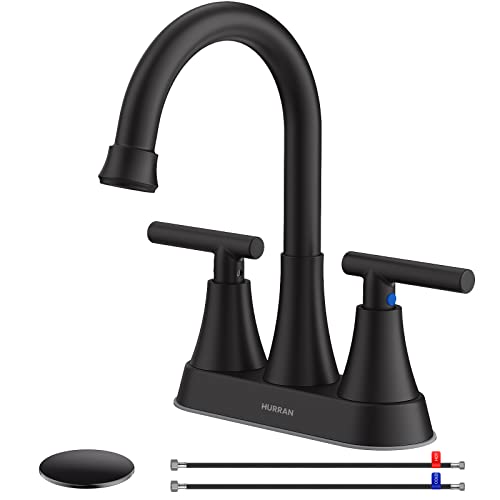
UNIQUE PATENTED DESIGN 4 INCH BATHROOM FAUCETS: Bathroom sink faucet body constructed from stainless steel, meets lead-free standards. 2 pcs H/C 24-in bathroom faucet water supply lines. Matching-finish pop-up bathroom sink drain with overflow and built-in strainer, easy for daily cleaning.

Elegant Waterfall Design: This 4 inch bathroom faucet features a waterfall spout with scientifically calculated tilt angle, features integrated filtration - splashproof, noiseless, water saving
2. Clear Clutter and Keep Styling Spare
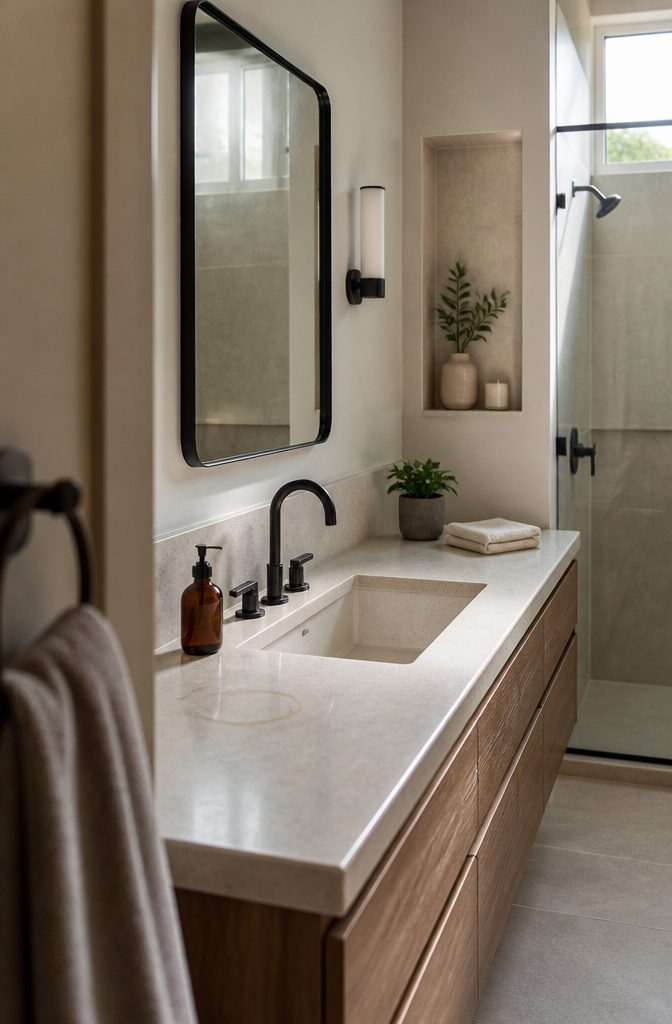
I pull everything off the counter before I decide what goes back. The standard here is tight: if you don’t use it daily, it doesn’t live out in the open.
A soap dispenser, a hand towel, maybe a small plant — that’s the ceiling. The rest goes into drawers, a medicine cabinet, or a tile niche in the shower sized to hold exactly what you keep in there.
Styling gets the same edit.
Leave gaps between whatever you do put on a shelf — a candle, a folded towel, one small vase. The space between objects does more than the objects themselves.
Overloading a shelf, even with beautiful things, pulls the room back toward clutter. A single framed mirror and a bar of matte black hardware read cleaner than three decorative trays and a row of apothecary jars.
I go through what’s visible every few weeks and pull anything that’s drifted out from storage. It takes five minutes, and it’s the only way the look holds.
Recommended Products

Exact-Size Honesty: Measures exactly 11-7/8 in. square — plan grout lines and layout cuts around the true size, not the nominal 12x12.

Comes with a Box of 5 Sheets Real Porcelain Pebble Tiles. NOT peel and stick fake tiles. Colors blue brown and beige.

3. Plan Storage That Hides Everyday Items
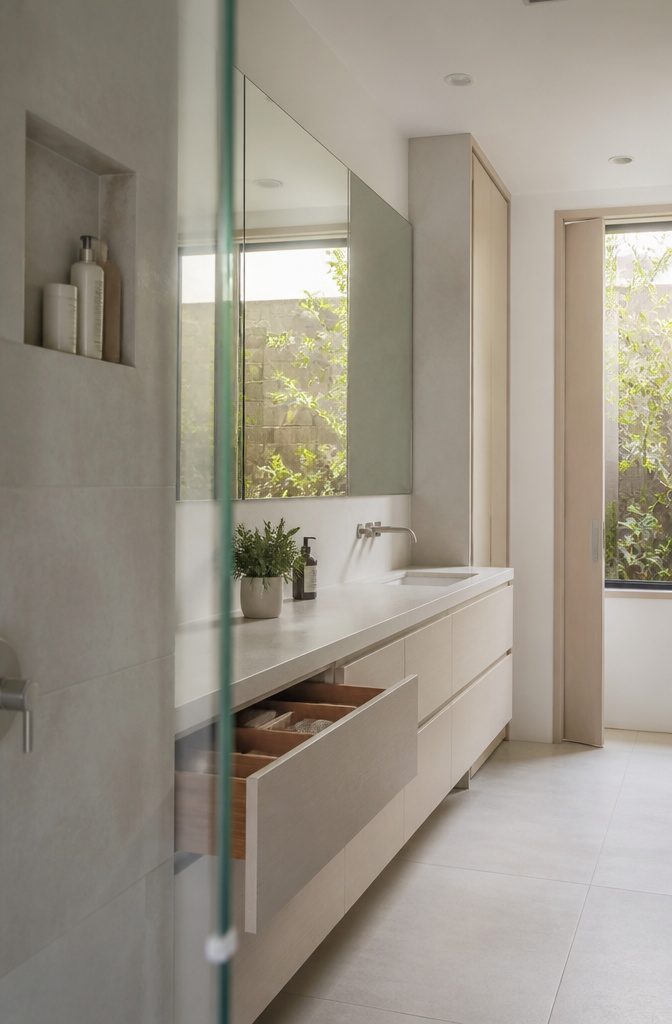
Recessed medicine cabinets and handle-free vanity drawers hold what you need without breaking the room’s clean lines.
I size shower niches to the bottles I actually use—one shelf at shoulder height beats three small ones—and fit drawer dividers before anything goes inside.
A 25-piece organizer set keeps makeup, razors, and hair ties separated so mornings don’t turn into a hunt.
Storage mirrors work if counter space is tight. The mirror sits where it belongs anyway, and the cabinet behind it holds daily contact lenses, tweezers, and the serum you reach for every night.
What you don’t use daily goes in a basket under the sink or in a linen closet down the hall, not on display.
Built-in cabinetry that sits flush with the wall reads cleaner than freestanding units. Custom millwork costs more but disappears into the room.
You want a counter with nothing on it except soap and maybe one plant—visible clutter kills a minimalist look faster than the wrong faucet—and enough hidden storage that you’re not rationing shelf space.
Recommended Products

【Beveled Aluminum Frame】Experience TokeShimi 14 x 18 medicine cabinet with precision beveled edges that amplify light and depth. Framed in durable aluminum engineered to be 65% lighter than wood, this corrosion-resistant, moisture-proof mirror cabinet installs effortlessly and outlasts traditional frames
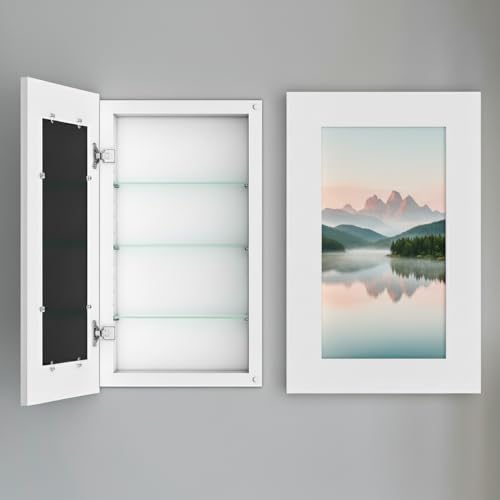
HIDDEN IN PLAIN SIGHT: Hang art, not another mirror. The door of this recessed bathroom cabinet is a real picture frame, so guests see a print on the wall while prescriptions, razors, and skincare stay tucked away. A medicine cabinet without mirror that reads as elegant decor instead of storage, and keeps daily essentials discreetly out of reach of curious kids and visitors.

【Beveled Aluminum Frame】Experience TokeShimi 14 x 24 medicine cabinet with precision beveled edges that amplify light and depth. Framed in durable aluminum engineered to be 65% lighter than wood, this corrosion-resistant, moisture-proof mirror cabinet installs effortlessly and outlasts traditional frames
4. Choose Simple, Streamlined Fixtures and Forms
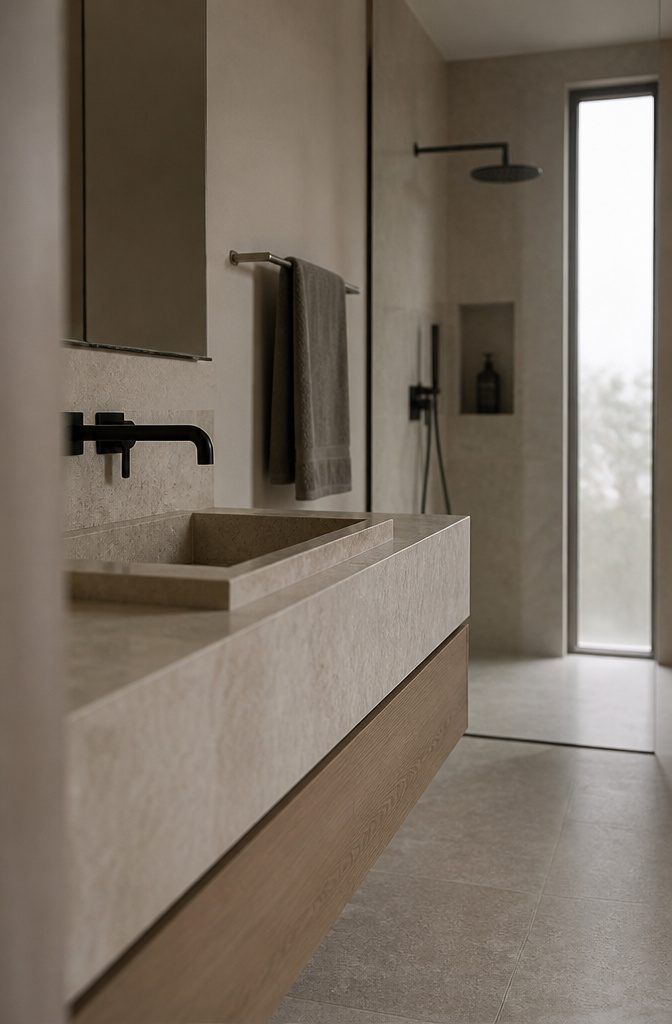
Fixtures with simple geometry and minimal detail keep the look uncluttered. Wall-mounted faucets, floating vanities, and frameless glass panels strip away the visual noise that makes a bathroom feel busy.
Arne Jacobsen’s 1968 fixtures for Vola still read as modern because the forms are clean lines with no embellishment—the same principle holds whether you choose polished nickel, chrome, or matte black.
Matte finishes hide water spots and fingerprints better than polished ones, so matte black or brushed nickel stays looking clean between wipes.
Polished chrome and nickel work when you want reflective surfaces to bounce light around a small space, but they show every mark. You spend more time cleaning in exchange for more light bouncing around the room.
Streamlined doesn’t mean cold. A wall-mounted faucet paired with a simple rectangular basin creates the uncluttered aesthetic without looking sterile, especially when the material itself—stone, wood, honest surfaces—brings warmth.
The fixture shape stays simple; the material does the work of making the room feel grounded.
5. Add Natural Materials and Texture for Warmth
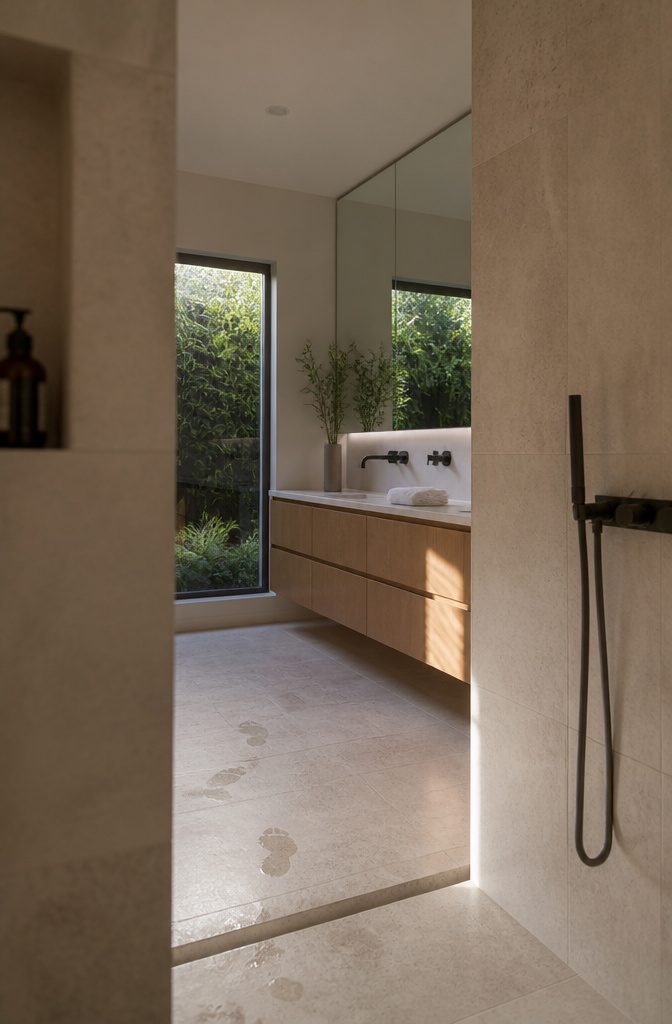
Wood and stone soften a minimalist scheme without adding ornament.
Teak, bamboo, and white oak work as vanity fronts, floating shelves, or accent walls. Walnut brings a darker warmth.
Reclaimed wood adds character if you want it, and cedar planks can line a custom tub for a Japanese-inspired look. For flooring or surfaces that take water directly, wood-look porcelain tile gives the aesthetic without moisture worries.
Stone adds texture the same way. Marble and travertine appear as flooring, backsplashes, or carried up a shower wall.
Limestone works as large-format tile on floors and vanities. Slate and concrete create a cooler industrial contrast against warm wood.
One way to do this is to nod to natural materials, using marble or stoneware, to warm up the space and introduce texture without being ‘too much’.
Pair one warm material with one cool. Too many tones or natural elements at once pulls the design away from minimalist and into something else.
6. Use Glass, Mirrors, or Open Shower Arrangements
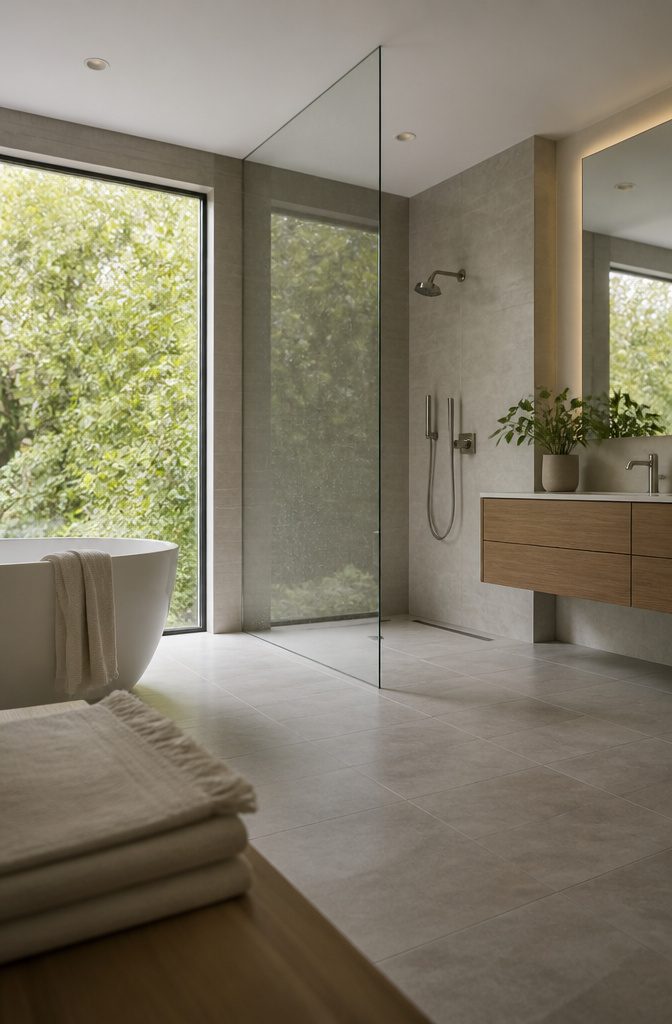
Glass shower enclosures pull off something drywall and tile cannot: they let the room read as one unbroken volume instead of carving it into zones.
A frameless panel from floor to ceiling is the cleanest version, and when you can skip the door entirely—a fixed panel next to a curbless entry—you lose the last visual interruption.
The slope runs ¼ inch per foot toward a linear drain, which means the engineering has to happen before the tile goes down, but the result is a continuous floor plane that makes even a 5×8 bath feel twice its size.
Mirrors do the predictable thing—bounce light, double the width—but a large frameless mirror also erases the wall behind your vanity, which matters more than the reflection itself.
In wet rooms where glass stops short of enclosing the shower completely, a single panel traps enough heat and spray without blocking sightlines to the tile or the window beyond.
7. Make Lighting and Natural Light Part of the Design
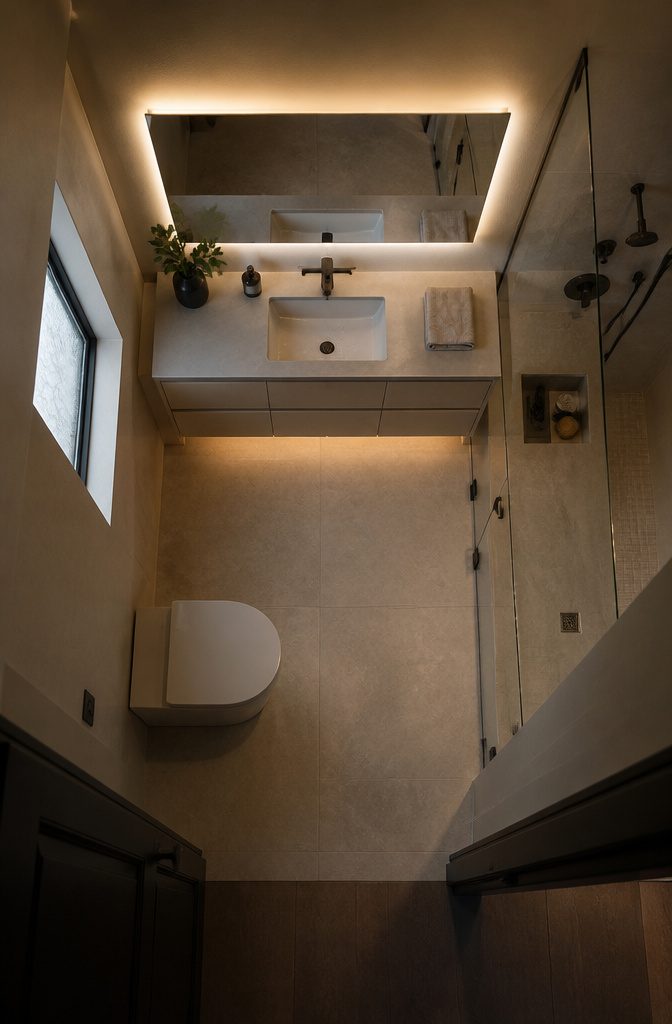
Natural light does most of the work when you can get it. Large windows or a skylight flood the room with sun, cut down on fixtures, and open up the space without adding anything to it.
Where that is not an option, recessed ceiling lights keep the hardware out of sight, and wall sconces mounted beside the mirror provide task lighting without hanging into the room.
Illuminated mirrors handle both jobs at once. LED backlighting built into the mirror frame gives you bright, even light for grooming and adds a soft glow at night, all without a separate fixture breaking up the wall.
Some models include dimmer controls and adjustable color temperature—warm light in the morning, brighter and cooler when you need detail work.
For a clean sconce option, the Lighting Forest Modern Wall Sconce ($89.99) comes in black, coffee, or white and mounts flush to save counter space.
LED strips tucked under a floating vanity add ambient light low to the floor and work as gentle nighttime navigation without flipping on overhead lights.
8. Use Simple, Unified Tile or Surface Treatments
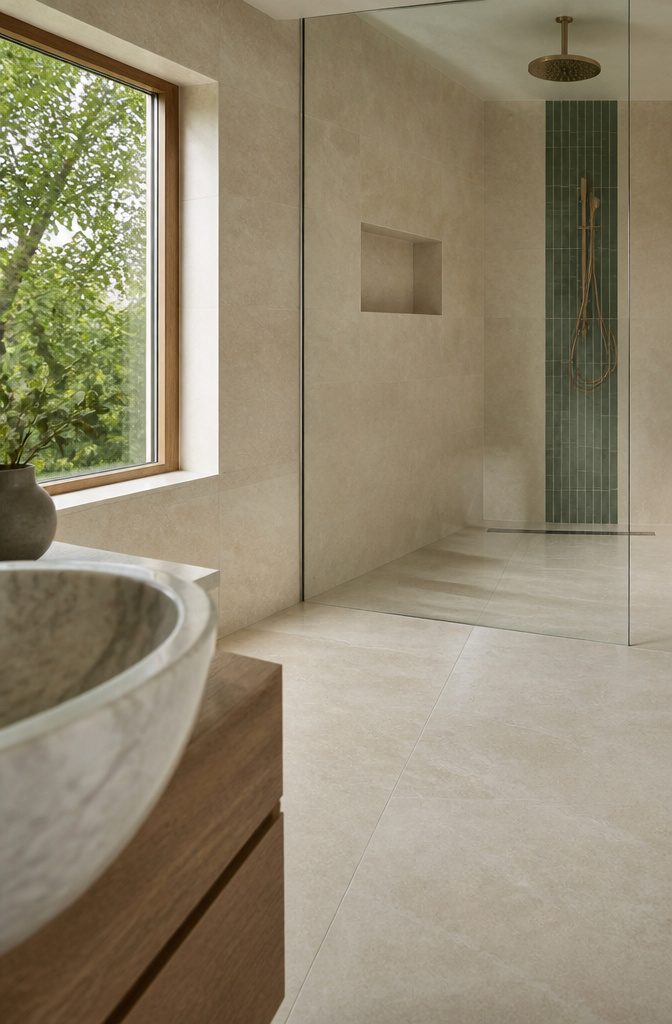
Visual continuity starts with the surface, and large-format porcelain tile delivers it faster than anything else.
Sizes like 24 × 48, 32 × 32, or 48 × 96 inches mean fewer grout lines, cleaner walls, and less to scrub later. Many of these tiles mimic natural stone or concrete without the cost, and they work on floors, walls, and shower surrounds equally well.
Run the same tile from the floor straight into the shower instead of switching at the threshold.
That unbroken plane reads as more space, and matching the grout color across the room keeps the effect intact. Limit yourself to three materials total if you want the look to hold.
Selected contrast still belongs. A stack of green tile on one wall or black hexagonal floor tile adds character without fragmenting the room, and sand-colored glass tile in the shower brings texture and subtle shine.
Ceramic tile in all-white square format stays fresh, especially with contrasting grout that turns the grid into a feature rather than background.
9. Choose Accessories and Decor Selectively
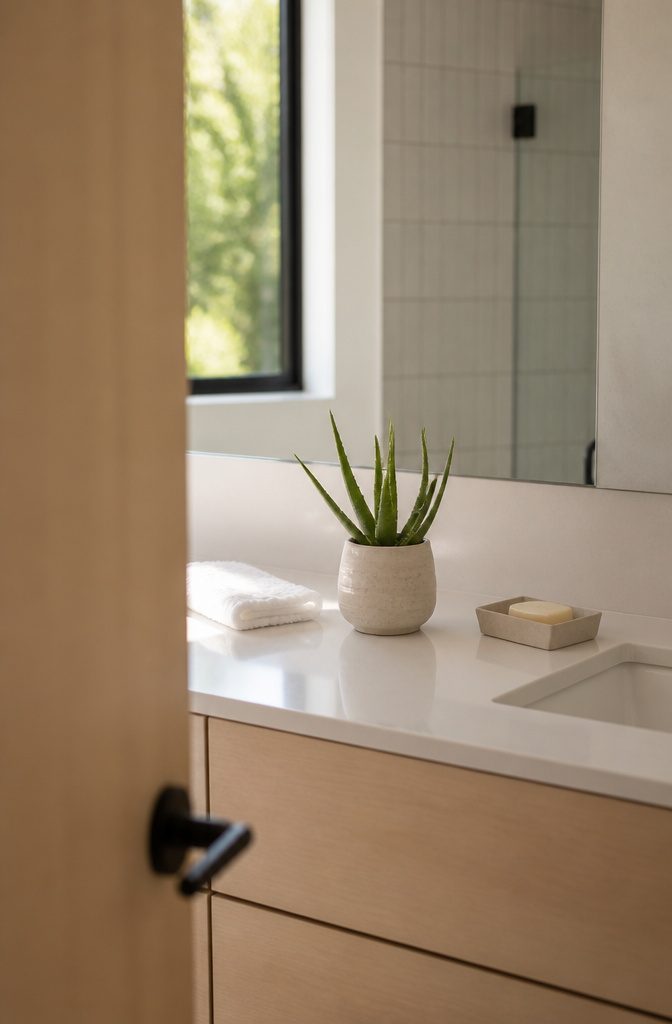
A small aloe vera or snake plant keeps the look clean while adding just enough life to break up hard surfaces.
I’d put it in something simple — the Zara Home Ceramic Vase works at $49.90 because the unfinished texture reads as intentional rather than decorative. A Manzanita branch in that same vase gives you height and sculptural weight without fussiness.
Artwork can work if it’s one piece and the frame stays minimal, but I’d skip it if the room already has strong tile or a statement mirror doing that job.
The Urban Outfitters Terrazzo Soap Dish at $34 adds pattern in a way that still feels restrained — angular, functional, grounded. Organic cotton towels in white or a single muted tone stay true to the material-first approach.
The line sits where a second item starts to compete for attention.
One plant, one small accent, maybe a piece of art. Past that, the pared-back intention collapses into regular decor, and the room loses the clarity that made it feel minimalist in the first place.
10. Use Floating or Wall-Mounted Elements
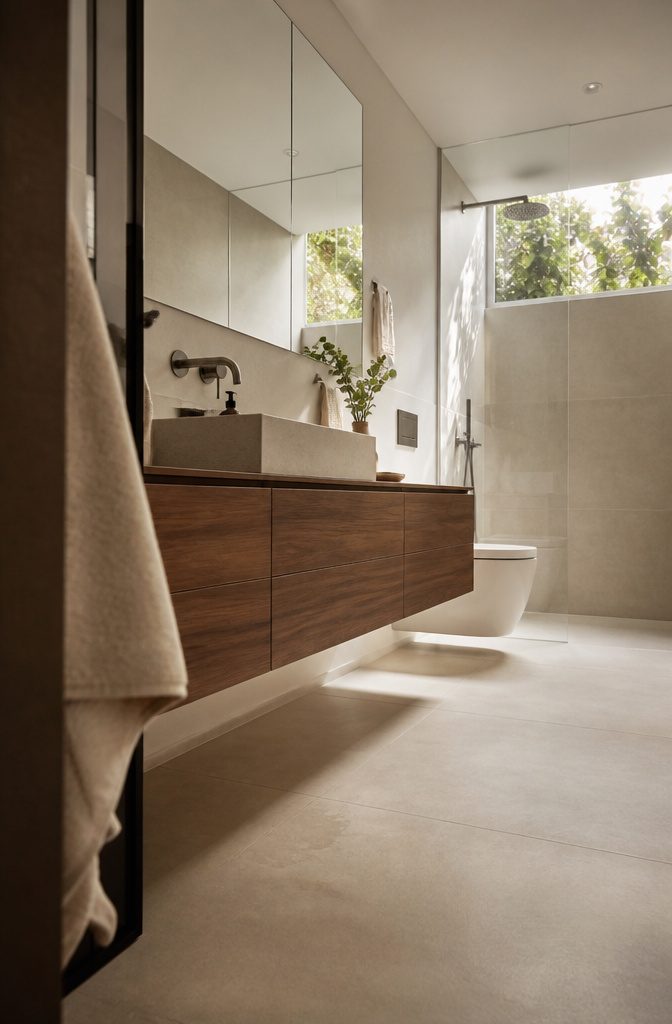
Floating vanities open the floor beneath and make a bathroom feel lighter and larger immediately.
A 48–60 inch wall-mounted vanity sits high enough to clean underneath but low enough to use comfortably, and the exposed floor reads as bonus space even when the square footage stays the same.
Flat-front drawers with push-to-open hardware keep the face smooth, and materials like walnut, white oak, or matte lacquer blend minimalist form with warmth.
Wall-mounted toilets push the same principle further. A wall-hung toilet saves 6–10 inches compared to a floor-mount model, and the tank hides inside the wall so all you see is the bowl.
The look stays clean, the floor stays open, and sweeping underneath becomes possible for the first time.
Wall-mounted sinks follow the same logic: a slim basin fixed to the wall with no cabinet below keeps sightlines uninterrupted and reinforces the floating effect that defines a minimalist bathroom.
11. Add Limited Contrast or a Focal Detail
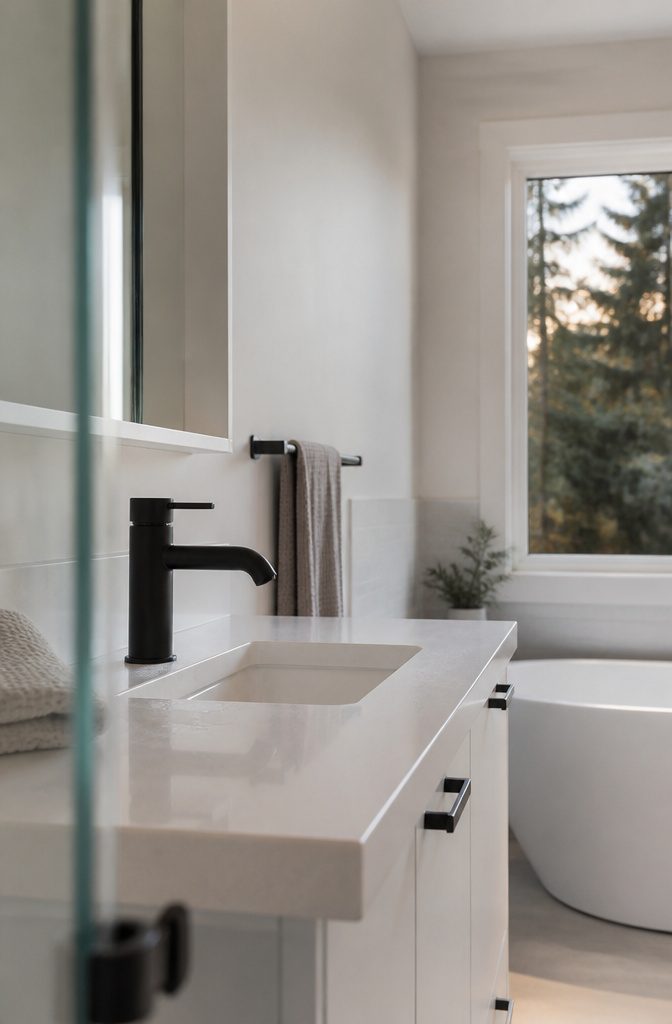
A single standout finish or fixture keeps the room from reading as generic.
Matte black faucets give the sharpest contrast against white tile and hide water spots better than polished chrome. Brushed gold or brushed nickel bring warmth without the glare, and both stay cleaner than a high-shine surface.
A solid brass bowl sink on a plain white base shifts the whole composition without adding clutter. The Hansgrohe Raindance Connect showerhead works the same way—one deliberate choice that anchors the space.
If you’re working with a tub instead, float it in front of a window and leave the rest of the room spare. The tub becomes the hero piece, and nothing else needs to compete.
Coordinated hardware matters more than you’d expect. Match the faucet, towel bar, and cabinet pulls in the same finish, and the restraint reads as intentional rather than empty.
12. Keep Surfaces Easy to Maintain
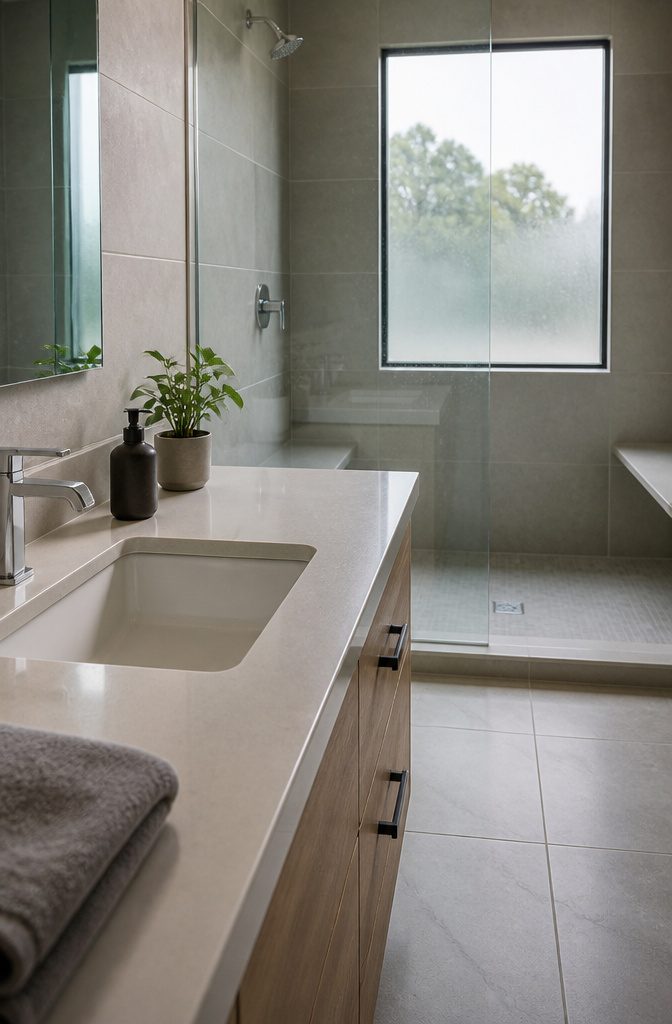
Durable finishes cut the time you spend wiping down surfaces.
Quartzite, quartz, stone, and ceramic tile need less work than marble, which stains and etches unless you seal it regularly. Large-format tile means fewer grout lines to scrub, and matte surfaces hide water spots better than polished ones.
Frameless glass has fewer edges where soap builds up. A bare counter is faster to clean than one crowded with bottles — you wipe straight across instead of picking things up and setting them down again.
Maintenance goes beyond the weekly wipe. Go through storage every few weeks and pull out anything that has been sitting unused.
If a product hasn’t been opened in a month, it probably doesn’t need to be there. Regular checks keep the space from drifting back toward clutter, and a bathroom that stays uncluttered stays easier to clean.
How Small Bathrooms Change the Approach
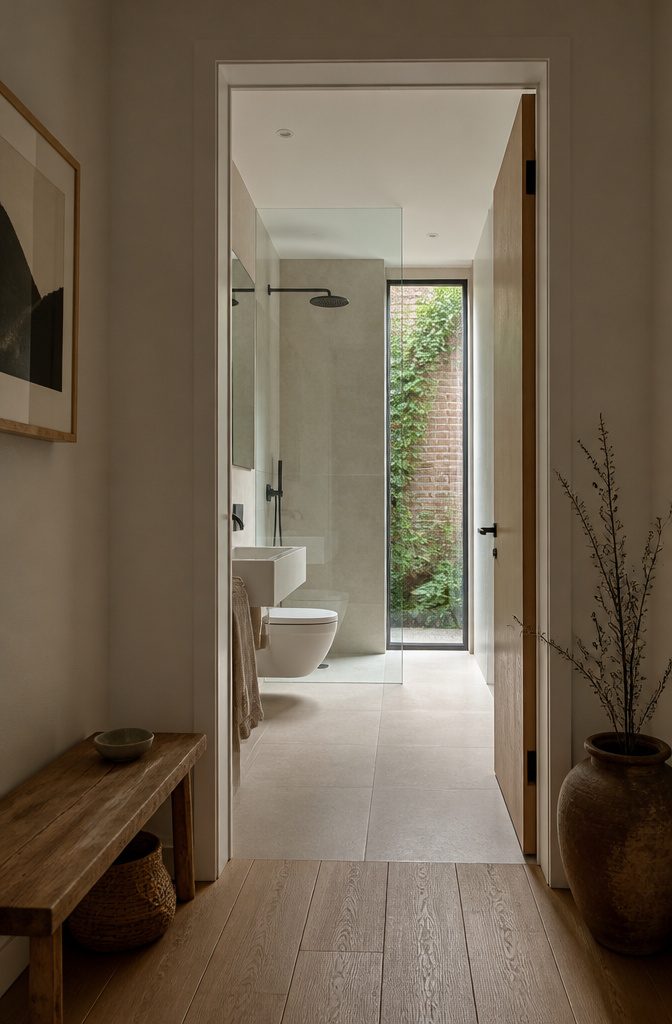
Small bathrooms—anything under 50 square feet—need fixtures that don’t fight for floor space.
Wall-mounted sinks and toilets keep the footprint open, and a frameless glass shower enclosure eliminates the visual barrier a curtain or framed door would add. You want to avoid anything that chops the room into separate zones.
Mirrors help, especially large frameless ones that reflect light back into the space.
Run the same floor tile straight through the shower instead of switching materials at the threshold; that unbroken line makes the room read as bigger than it is.
Match your metal finishes across the faucet, towel bar, and showerhead so nothing pulls the eye in competing directions.
Storage still matters, but bulky cabinets work against you.
A recessed medicine cabinet or a narrow over-sink shelf holds what you need without eating into the room. Skip the freestanding tower and the stacked bins—small bathrooms can’t absorb that much furniture and still feel minimal.
What Minimalist Means Here
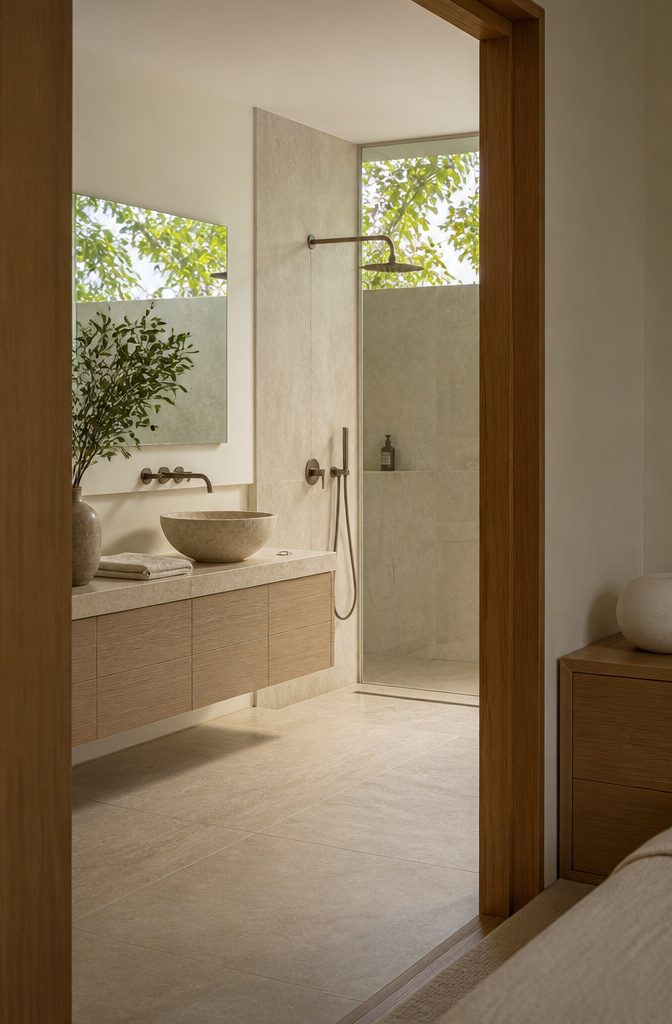
Minimalist bathroom design strips out what the room doesn’t need so the parts that matter — the sink, the shower, the counter you actually use — work without fighting for attention.
It’s not about forcing yourself into a cold white box. It means pulling back visual noise until the space reads clearly, which makes daily routines easier and the room calmer to stand in.
The approach borrows from different schools.
Japanese design leans on natural materials and uncluttered surfaces. Scandinavian style adds light wood tones and a soft neutral palette.
Industrial minimalism brings exposed pipes, concrete, and metal but keeps the forms simple and the color scheme tight. What they share is a resistance to decoration that doesn’t earn its place and a preference for clean lines over fussy detail.
Minimalist isn’t the same as modern, though they overlap. Modern describes a period and a set of materials; minimalist describes how much you put in a room and how hard each piece has to justify itself.
Frequently Asked Questions
How can I declutter my small bathroom to make it minimalist?
Keep only what you use daily on the counter: soap dispenser, hand towel, maybe a plant.
Store everything else in drawers, a medicine cabinet, or shower niches. Go through visible items every few weeks and move anything that’s drifted out back into hidden storage.
How do I choose a color palette for my minimalist small bathroom?
Start with a monochromatic base in white, gray, beige, or warm neutrals like greige and taupe. Stay within the same tonal family so the room reads as one continuous surface rather than competing parts.
You can add restrained color through a single accessory like a vase or bath mat, but avoid busy patterns that fragment the space.