
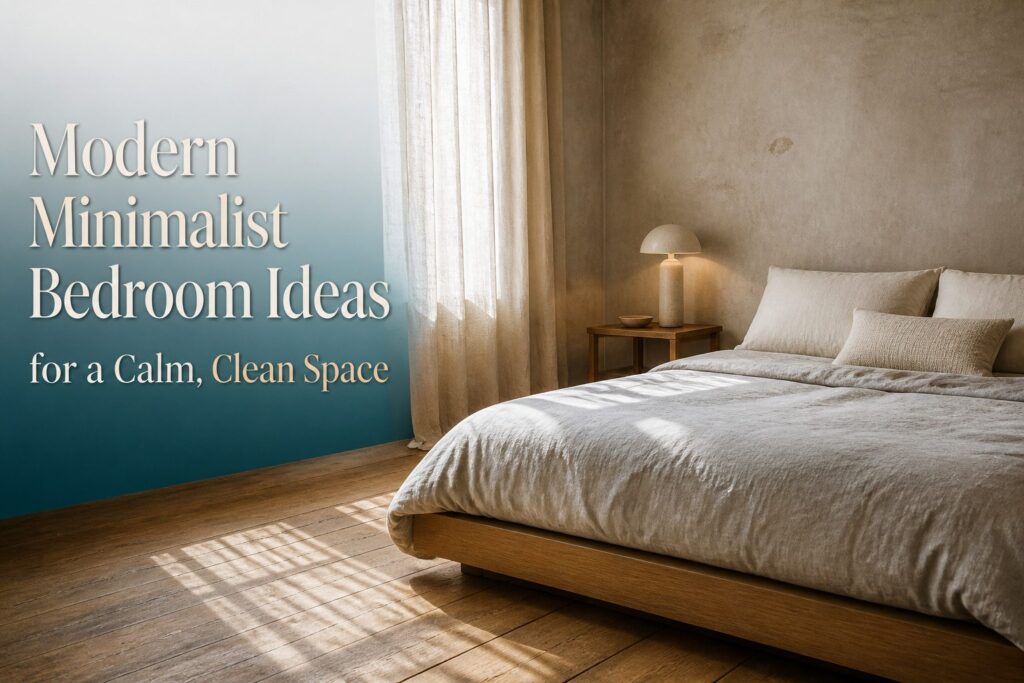
A modern minimalist bedroom works only when the restraint is warm, not clinical. The shift away from stark ice-white gallery walls toward softer greiges and alabaster means the same spare furniture now reads as calm rather than cold.
The deciding factor is usually the bed: keep the frame under 12 inches high, let the oak grain show, and the room opens upward instead of closing in.
1. Neutral Color Palette
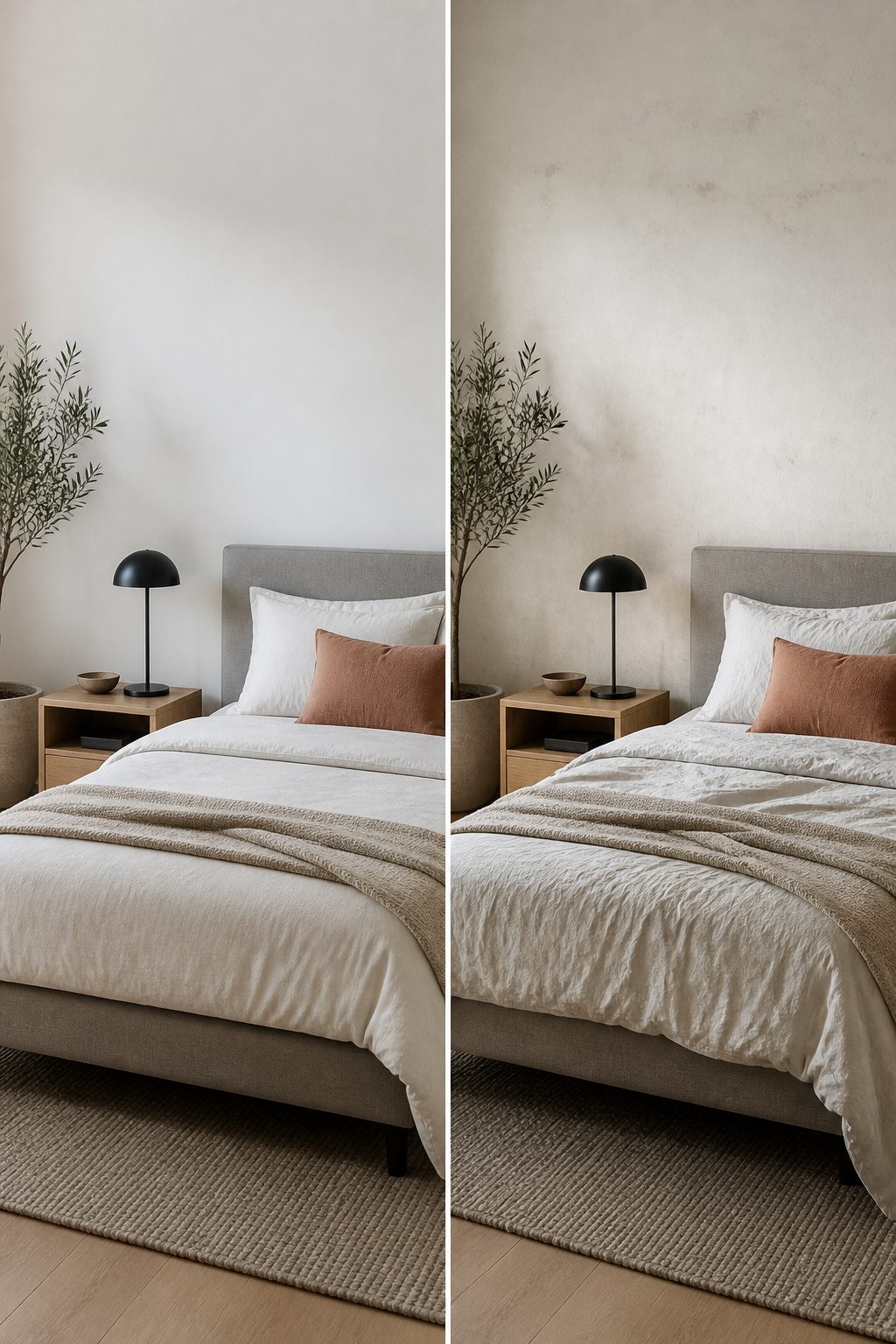
Warm whites, soft greys, and earthy tones like taupe or sand form the base for a modern minimalist bedroom.
These colors promote a serene, spacious feel because they recede visually and let the room breathe, whereas saturated colors advance and shrink the space.
For walls, I would pick warm whites or alabaster over stark white every time. The shift toward softer minimalism with warmer colors means the old ice-white gallery look now reads as cold rather than calm.
On textiles, soft greys and greige add depth without introducing a second strong color. Earthy tones like sand or clay work best in small doses, through pillows or a rug, to keep the palette restrained.
Matte black works as a sharp accent, though I would use it sparingly in a bedroom.
Natural light wood tones, oak or ash, provide the warmth that keeps a neutral room from feeling sterile. Stick to a monochromatic or analogous scheme where color creates calm, not excitement.
2. Low-Profile Bed Frames
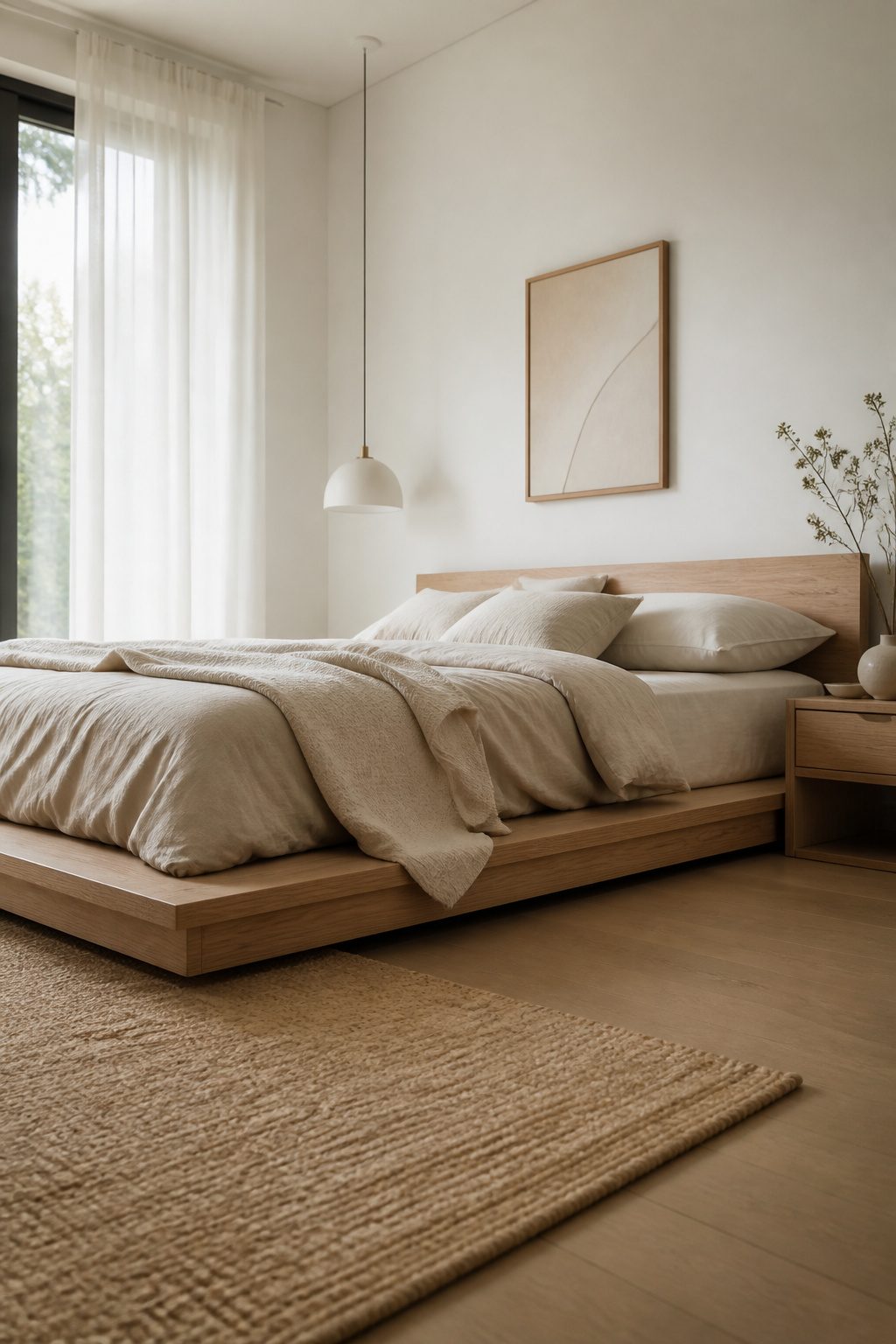
A low-profile bed frame keeps the visual plane close to the floor, which makes the ceiling feel higher and the whole room feel more open.
Most platform styles sit under 12 inches in height, and that low silhouette is what stops the bed from dominating the space the way a tall four-poster or an ornate headboard would.
Solid wood in a light oak or ash finish works well here because the grain adds subtle texture without breaking the clean lines.
An upholstered frame in a neutral linen or felt can soften the room, though I would skip anything with tufting or nailhead trim that reads as busy detail.
Metal frames are the most affordable and hold their shape, but I would only choose one with a simple rectangular profile and no scrollwork.
The real advantage is how little the frame asks for in return. Skip the dust ruffle, skip the box spring most of the time, and let the mattress itself become the visual focus.
Pair it with bedding in crisp white or a soft neutral, and the bed recedes exactly where a minimalist bedroom needs it to.
3. Clutter-Free Nightstands
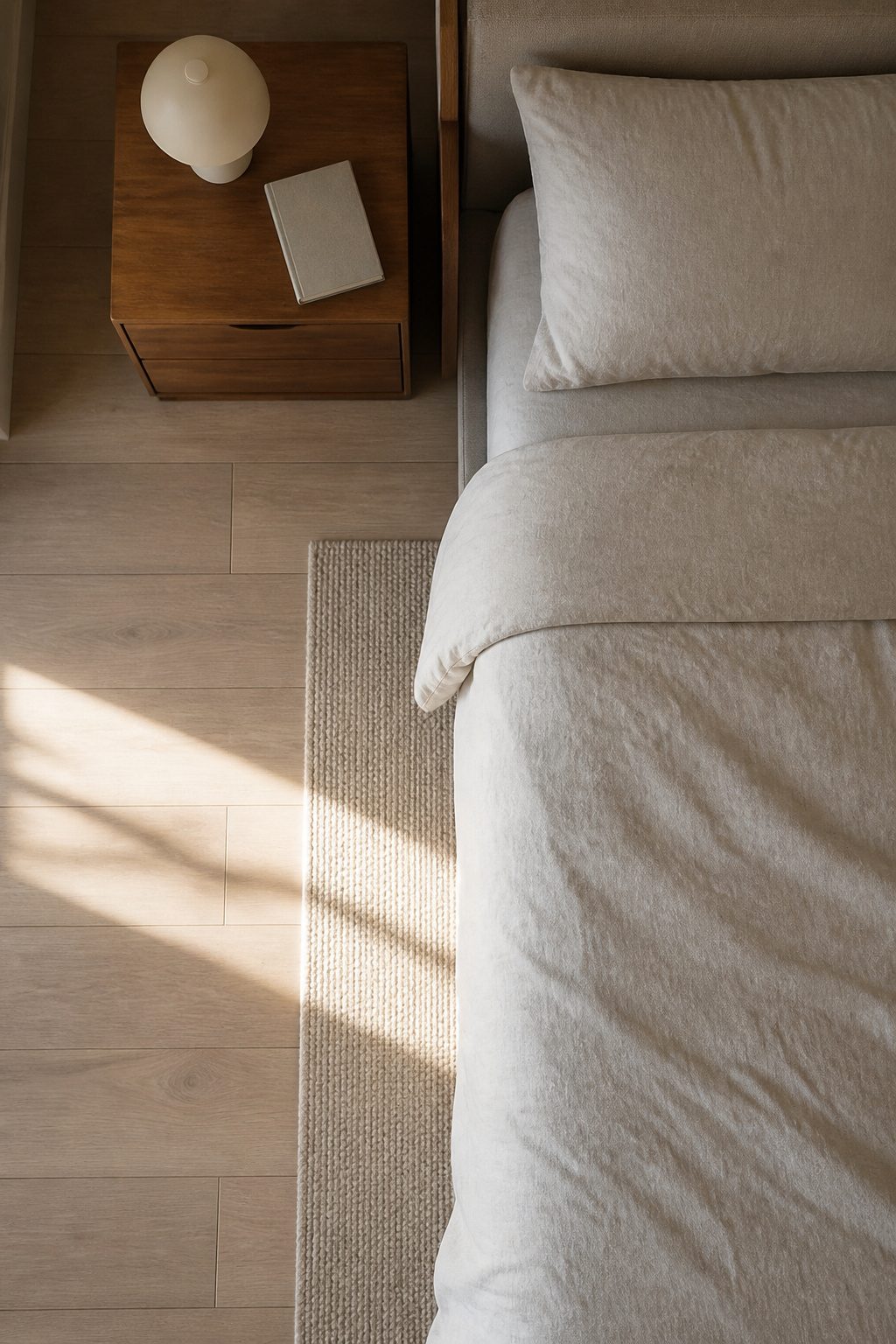
The nightstand is where a modern minimalist bedroom lives or dies, because it sits at eye level the moment you open your eyes.
A surface that holds only a lamp and perhaps a small book keeps that first sight calm. Everything else, the phone included, belongs in a drawer or across the room.
Clean lines matter more than the specific material. I look for a simple box or shelf, just large enough for the book and the lamp, with no hardware shouting for attention.
Integrated or floating nightstands keep the floor clear and add to the sense of space, though a well-chosen legged piece works if the visual weight stays low.
One nightstand or two is a real choice in a minimalist room. A single piece beside the bed feels quieter and works fine for a solo sleeper.
Matching nightstands on both sides give symmetry, which carries its own kind of calm. I would skip the second one in a smaller room and add it only when the wall has the length to breathe.
Phones and chargers are the practical test. A drawer with hidden storage handles the cable; a small tray inside corrals the phone itself.
If the nightstand has no drawer, I would run the charger to a plug behind the headboard and keep the device out of arm’s reach. Keep the surface clear without making it a daily fight.
4. Built-In Storage Solutions
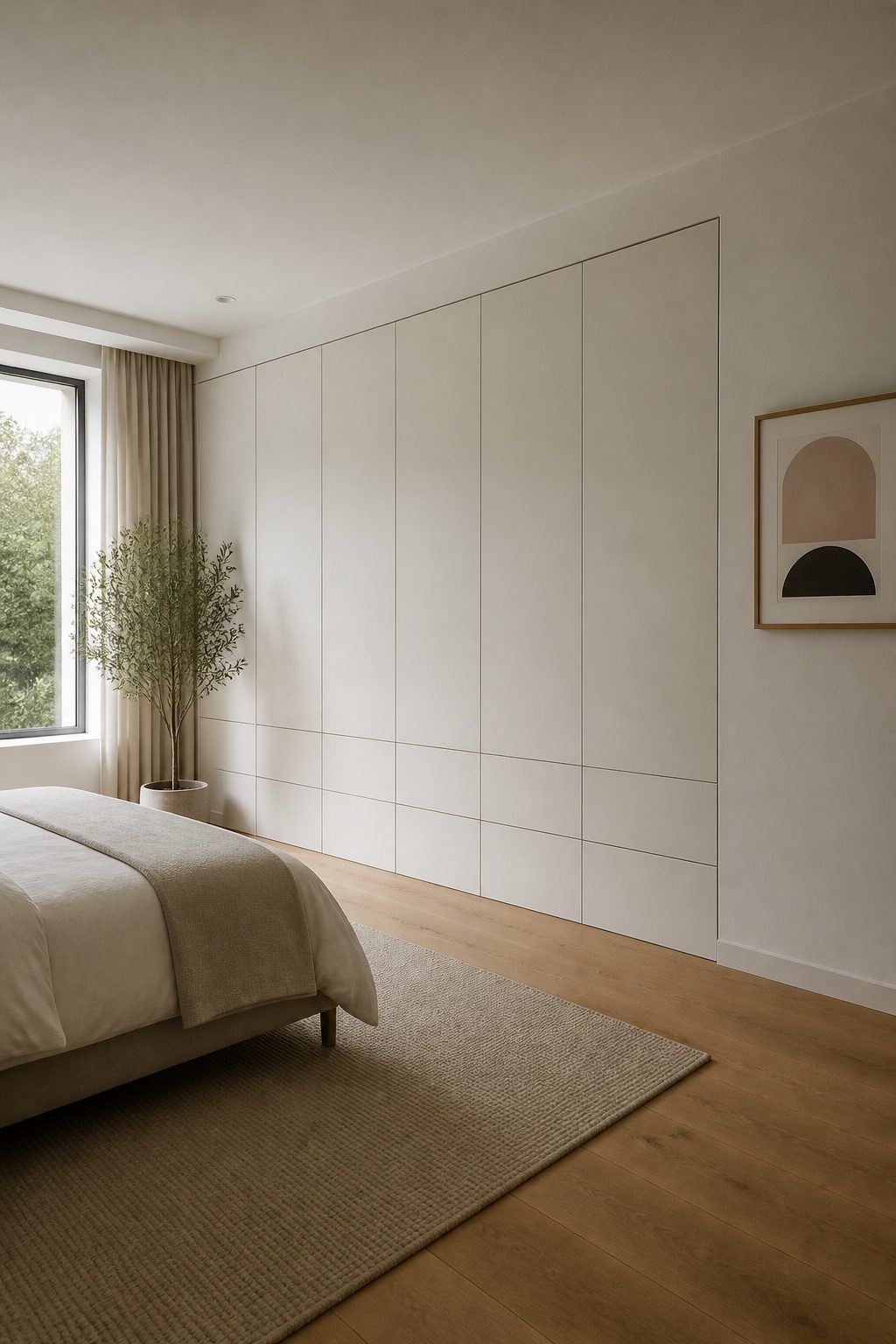
Wall-mounted storage keeps the floor plane open, which matters more in a small bedroom than most people realize.
A floor-to-ceiling run of handleless wardrobes that matches your wall color erases itself visually; the room reads as larger because your eye travels uninterrupted. Freestanding dressers and armoires break that flow and add corners where dust collects.
Floating shelves work in a minimalist bedroom only if you use them sparingly.
Two or three staggered shelves above a desk or beside the bed hold a book and a small plant, nothing more. Once you start stacking, you have created open-faced clutter, which defeats the purpose.
Custom built-ins are the ideal, but the IKEA Pax system can get you most of the way there for a fraction of the cost.
Modify it with scribe molding to trim the gaps, paint the frames to match your walls, and swap standard handles for push-latch or recessed pulls. Done well, it reads as built-in from across the room.
I would skip the glass doors entirely; even frosted panels catch light and call attention to themselves. Solid fronts that disappear are what make this storage minimalist rather than merely modern.
5. Minimalist Lighting Fixtures
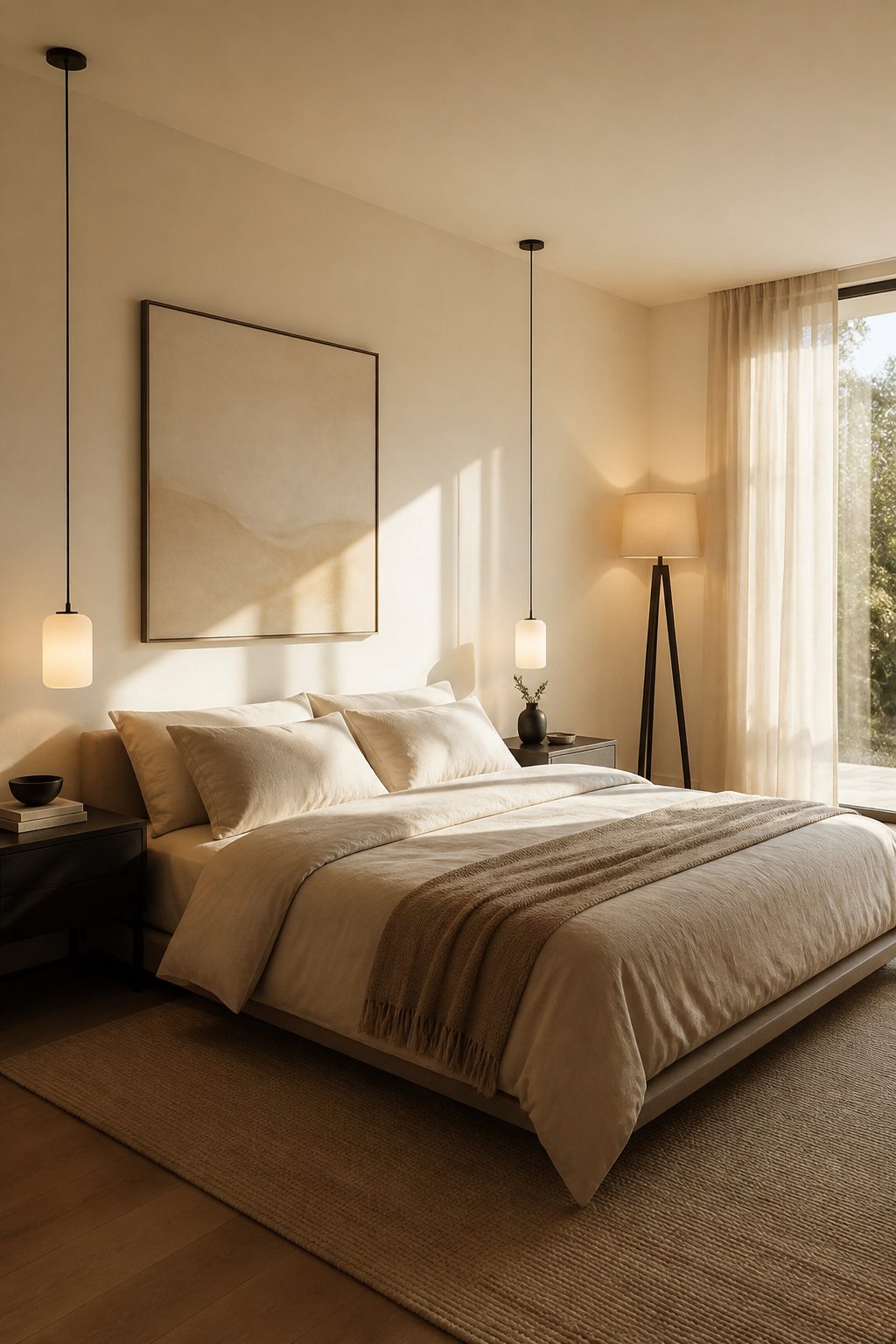
Harsh overhead lighting is the fastest way to undo a calm minimalist bedroom. I would skip the central ceiling fixture entirely and build a layered scheme from three heights instead.
Pendant lights hung low over each nightstand give you task light for reading without cluttering the surface. Wall sconces do the same job while keeping tables completely clear, which matters more than most people expect until they try it.
For bulbs, 2700K is the temperature that reads as warm rather than clinical; anything cooler fights the relaxed mood you are after.
Dimmable fixtures are non-negotiable in my view, because a minimalist room needs to shift from functional at 7 p.m. to restful by 10.
If I had to choose one source to add last, it would be a sculptural floor lamp in a corner, grazing light up the wall rather than pouring it down.
The cost of that layering is usually three modest fixtures instead of one expensive chandelier, and the result feels more considered, not less.
6. Natural Materials for Warmth
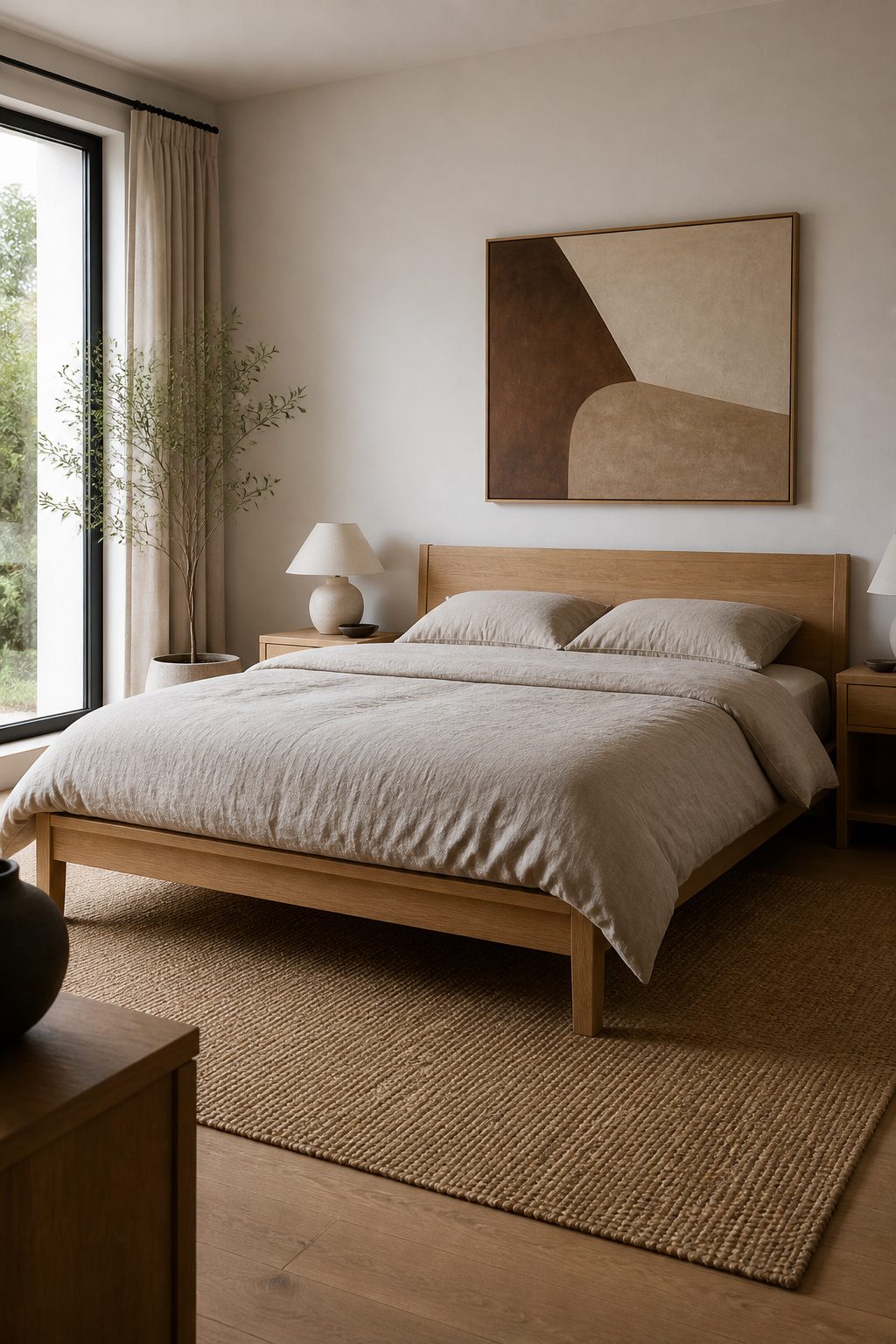
The fastest way to turn a modern minimalist bedroom cold is to strip out every texture and let paint and drywall do all the work.
I keep three natural materials in rotation, each in a specific role. Raw or light oak belongs on frames and accents, the pieces that anchor the room without shouting.
A slatted oak headboard or a simple platform bed in unstained maple reads as structure, not decoration, and the grain gives your eye something to rest on without adding clutter.
Linen covers the bedding layer that shows, duvet and shams both, because the slubby weave catches light differently than cotton and keeps the bed from looking like a hotel display.
Cotton takes the sheets, the part that actually touches skin, since it washes softer and holds up to the rotation a bed in real use demands.
This pairing comes straight from Scandinavian practice, where clean lines and bright walls are standard but never allowed to feel clinical. Let one or two materials carry the warmth rather than mixing in every natural finish you find.
A wool or jute rug underfoot completes it, but I would stop there. Three textures in a bedroom is enough; beyond that, the calm you’re after starts to fray.
7. Simple Bedding Layers
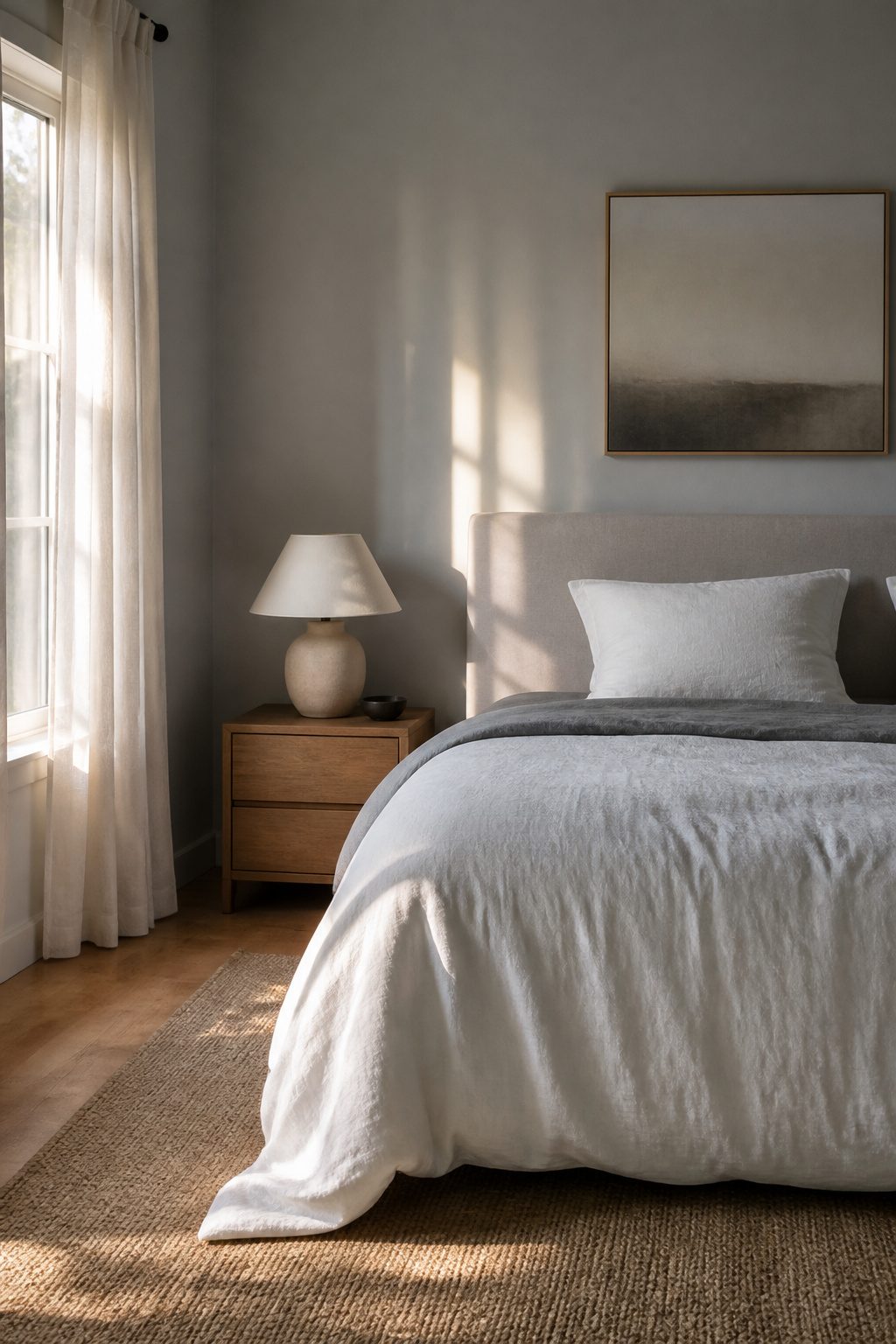
Solid bedding reads calmer than patterned, which is why I start with a fitted sheet and a top sheet in a tone that matches the wall, then pull a duvet cover over the insert.
The top sheet is optional; skipping it leaves the bed easier to straighten in the morning and keeps the stack flatter.
A linen duvet cover in white, cream, or soft grey is the most versatile choice because it shifts with the light and works across seasons without fighting whatever else sits in the room.
One pillow or two, same case color, and the bed looks finished without any pattern competing for attention.
8. Hidden Storage Under the Bed
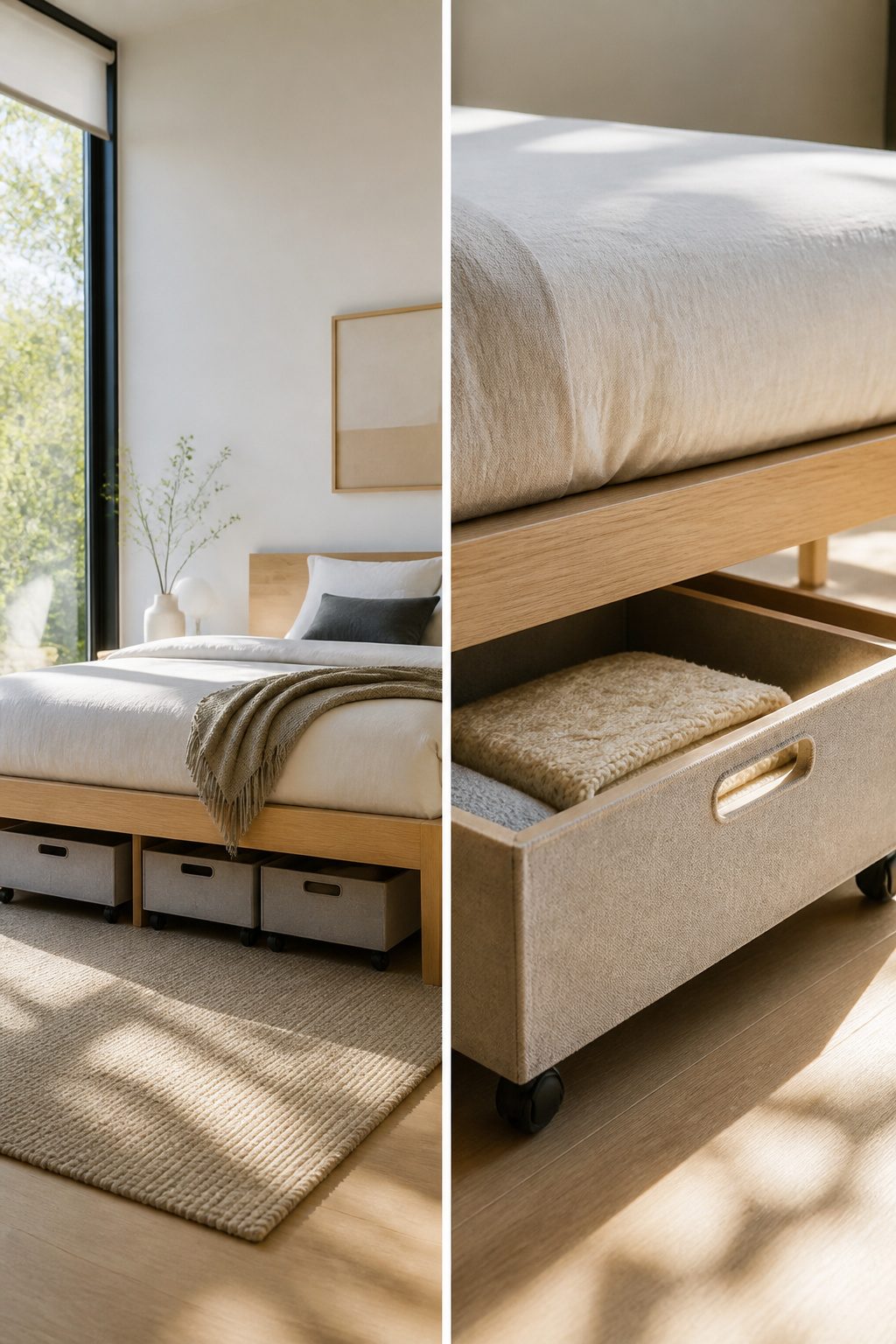
The space beneath a bed is dead real estate in most bedrooms, and in a modern minimalist bedroom that gap stands out even more.
At least 6 inches of clearance is the floor where storage starts to work; anything less and you’re just shoving thin items into a dust trap.
For actual flat bins or drawers on casters, 12 inches of height is what you need to store folded clothes, spare bedding, or off-season shoes without fighting the frame every time.
Platform beds with integrated drawers cost more upfront but save the headache of matching aftermarket pieces to your frame. The drawer faces line up flush, and the hardware is already sized to clear the legs.
If you’re adding storage to a bed you already own, measure the exact span between the legs before you buy bins; a set that looks right online can wedge tight against a center support rail and refuse to roll.
I would skip the fabric-sided collapsible bins for under-bed use.
They sag, they catch on casters, and they read as temporary in a room built on clean lines. Rigid plastic or plywood-front drawers roll easier and keep their shape when full.
For renters, the add-on route wins: you take the storage with you when the lease ends, and you are not married to one bed frame to keep your system intact.
9. Clean Wall Design
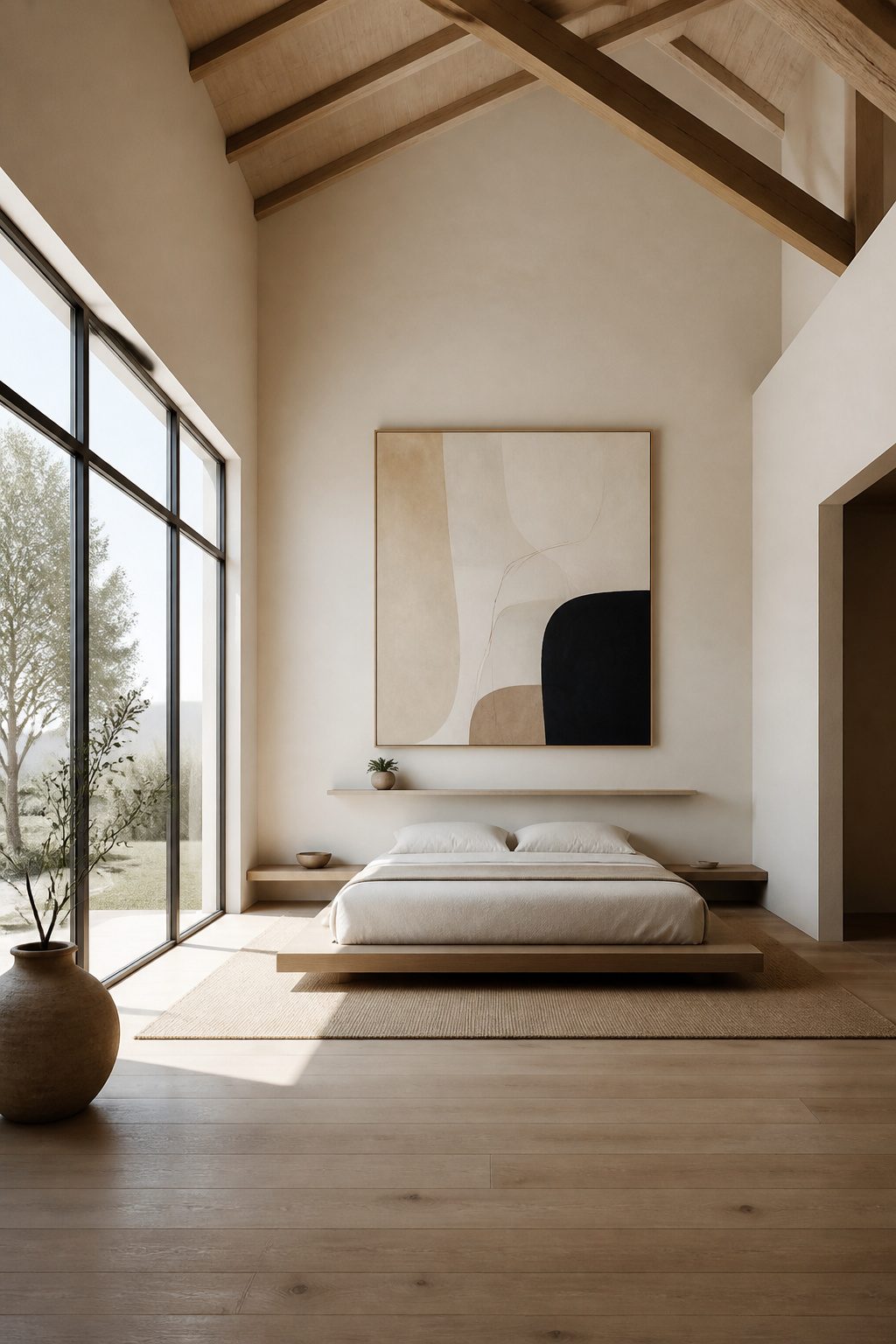
Walls in a modern minimalist bedroom work best when they step back and let the room breathe.
I keep decor to one large piece, or at most a very spare grouping of two to three, never a scattered gallery. A single oversized abstract, a monochrome photograph, or a simple geometric print anchors the eye without crowding it.
Some bedrooms benefit from one accent wall behind the bed; others read cleaner with bare walls all around.
The choice depends on whether the architecture already gives you something to look at, like a window or a strong headboard shape. When the wall itself is the statement, I leave it empty and let negative space do the work.
Paint finish matters more than color here. Matte or eggshell is the right call; glossy catches light and breaks the calm surface that minimalism needs.
The slight texture of eggshell still hides wall imperfections better than flat matte, so I tend toward that middle ground unless the drywall is already perfect.
10. Symmetry for Visual Calm
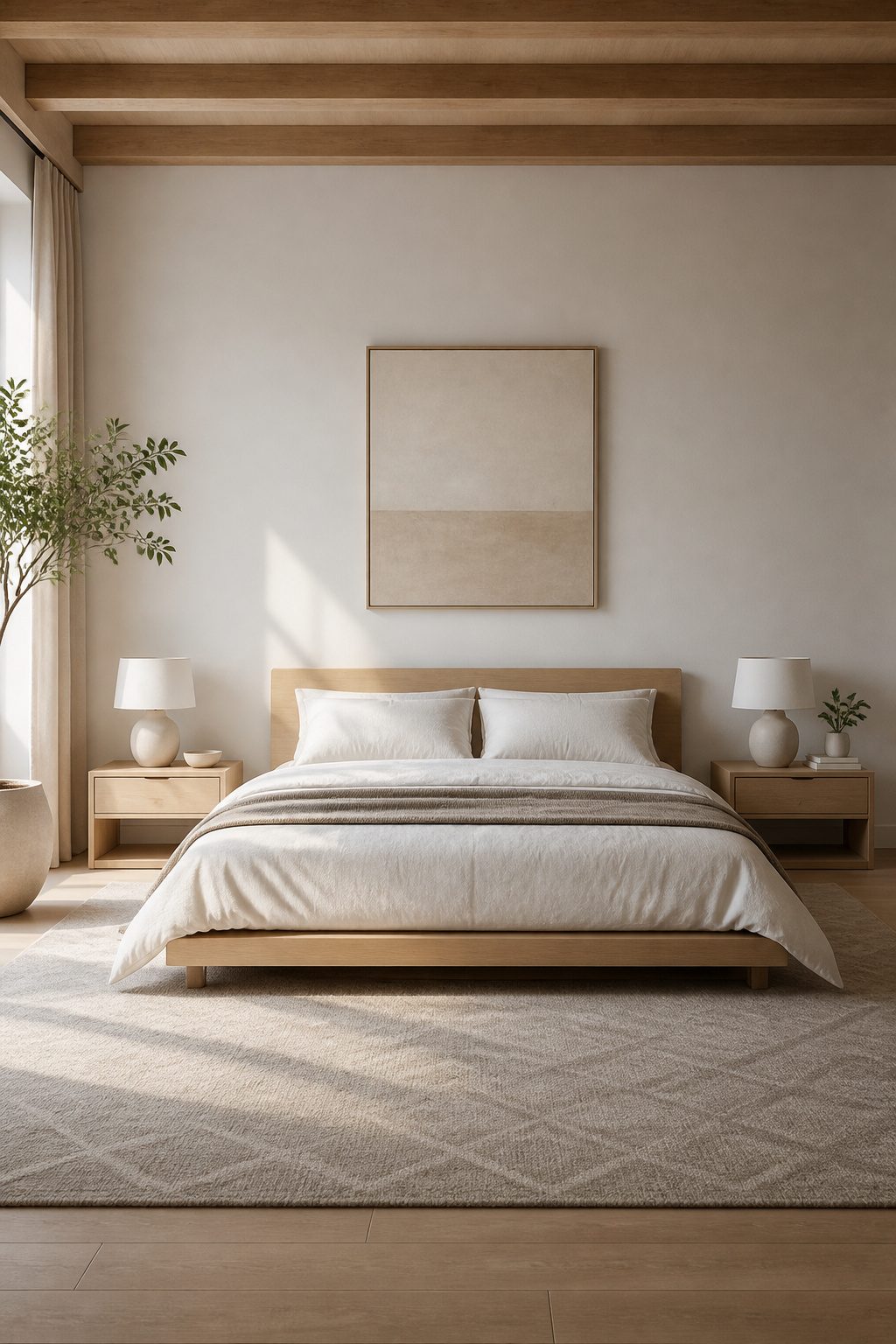
Matching nightstands with identical lamps on each side of the bed is the pairing that matters most for a modern minimalist bedroom. The repetition quiets the room.
Your eye registers the balance once and stops hunting for the next thing to compare, which is exactly what you want before sleep. I would skip matching the bedding or the art above; that tips into hotel room territory fast.
Asymmetry still has its place. One pendant over the bed paired with a sconce on the opposite wall can work if the visual weight evens out.
The pendant draws the eye up, the sconce keeps the wall from feeling blank, and neither side competes with the other.
I would only do this if the ceiling height gives you at least a foot of clearance above the pendant shade, otherwise the imbalance starts to feel like a mistake.
Better sleep quality is what you actually get.
Symmetry reduces visual stimulation by giving your brain fewer edges, heights, and colors to process. In a room meant for rest, less to process means faster to rest.
I keep my own nightstand to a lamp, a single book, and nothing that blinks or reflects. Clear surfaces reduce visual stress, and matching surfaces do it twice over.
11. Minimal Window Treatments
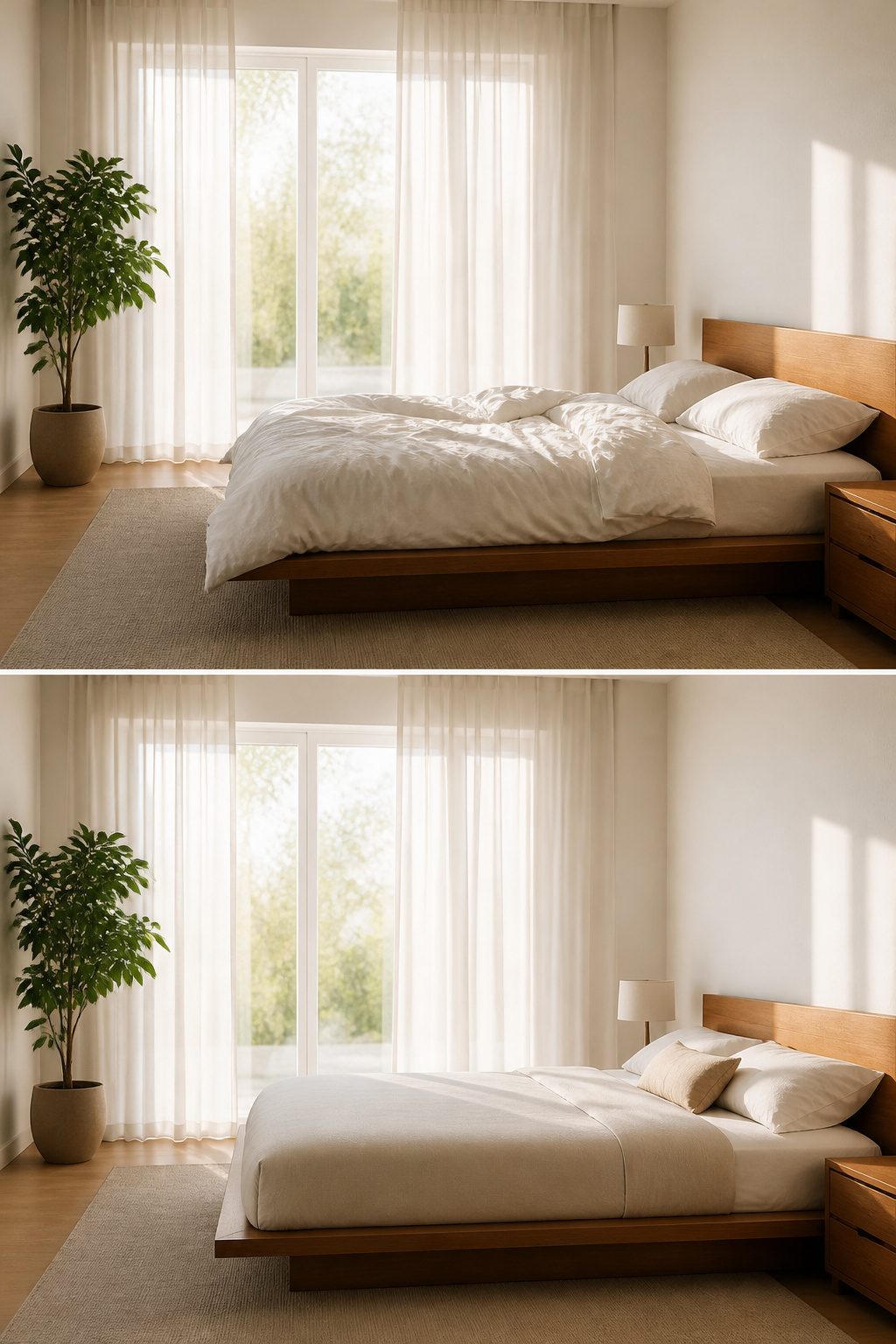
Sheer curtains or simple blinds filter light without adding visual weight to a modern minimalist bedroom.
I would skip heavy drapes entirely; they pool on the floor and frame the window like theater curtains, which contradicts the clean lines this look depends on.
Linen sheers, solar shades, or bare windows with privacy film are the three routes that work. Linen sheers give the softest light diffusion and read as barely there when they match the wall color.
Solar shades block glare while preserving the view, which matters if your bedroom faces east and you are trying to sleep past sunrise.
Privacy film is the cheapest fix for street-level windows and eliminates the need for any fabric at all.
Mount the rod 6 inches above the frame and wider than the window on both sides. The extra height stretches the wall visually and keeps the glass looking like the main event, not the treatment.
I would rather spend the hardware budget on a clean aluminum track than on decorative finials that draw the eye away from the light itself.
12. Thoughtful Accent Pieces
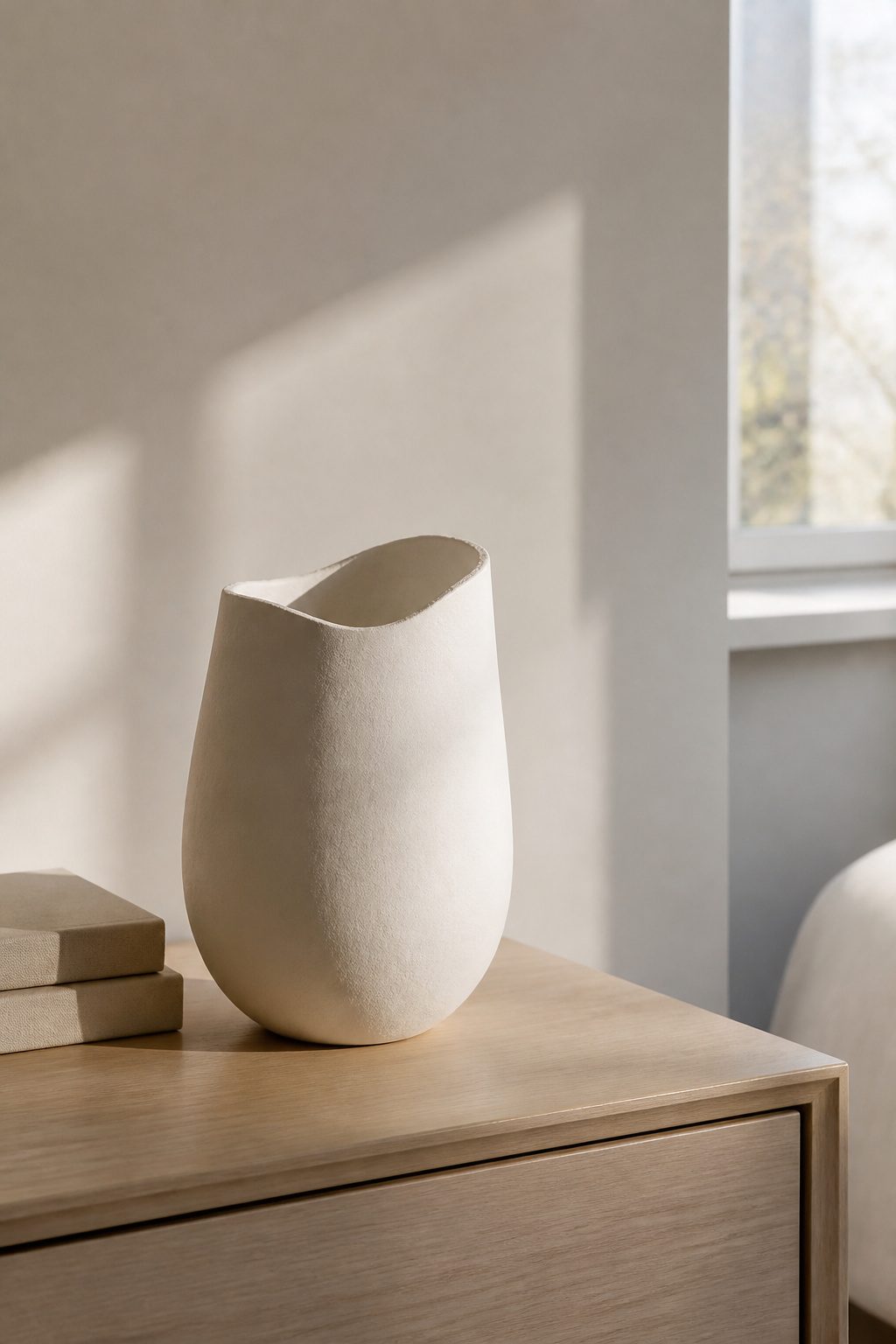
A single ceramic vase on a dresser top carries more weight than a shelf of knickknacks ever could.
The shape matters more than the price tag: a matte white vessel with an uneven rim, or a small stack of two books with a cover color that picks up the wall tone.
I would skip anything that reads as "decor," the mass-produced objects bought to fill space rather than hold it.
The found object route works best when the finding was real. A smooth stone from a creek bed, a piece of driftwood dried for weeks, a pinecone stripped to its fibrous core.
These carry the slight irregularity that factory pieces lack, and in a modern minimalist bedroom that restraint is exactly what matters.
The rule that keeps it from sliding back toward clutter is simple: remove one item for every item you place. A new vase means the old one goes to storage, not to another surface.
Rotate seasonally if you want, but never accumulate. The negative space around the object does as much work as the object itself, giving the eye somewhere to rest and the room its sense of calm.
Softer Minimalism and Rounded Shapes
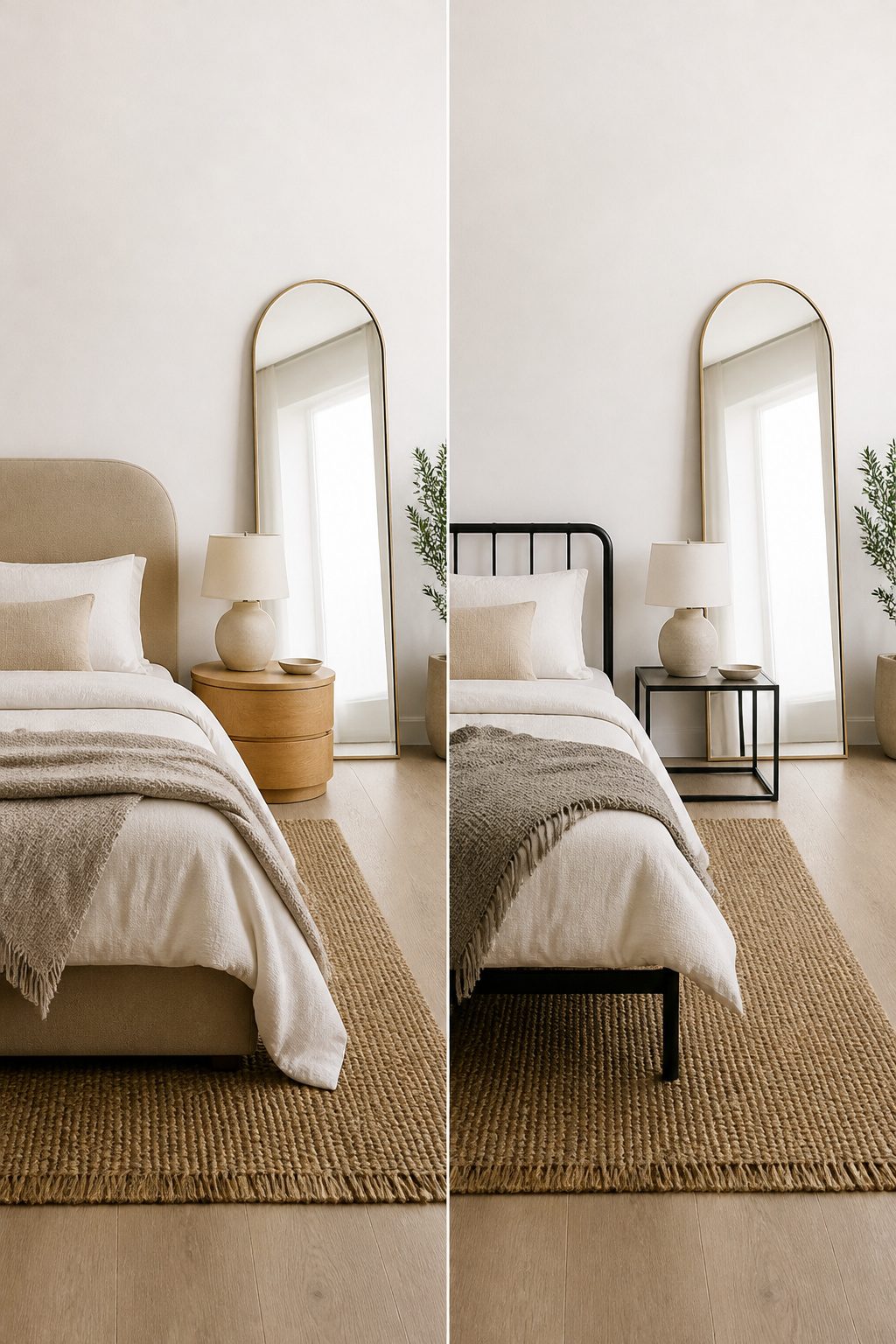
Strict minimalism can feel like a showroom, which is why the softer version has taken hold. Curved furniture and rounded edges keep the pared-back look but lose the coldness.
An arched mirror above the dresser, a rounded headboard, or a circular side table adds comfort without adding clutter. The shapes do the warming, so the palette can stay neutral and the count of objects stays low.
Renters get particular value here. A rounded headboard slips against the wall without the sharp silhouette that reads as severe.
An arched mirror leans or hangs without anchoring, and moves with you. These pieces feel approachable, grounded yet sleek, like a stone plinth in a quiet gallery.
The balance matters. One or two curves per room is enough; more than that and the softness itself becomes the noise.
I would start with the mirror, since it catches light and opens the space, then add a rounded nightstand if the room still feels rigid.
Keep the tones understated: sand, clay, or soft brown against the curve, not competing with it.
A single arched shape does more than three small curved accessories scattered around, which read as trying too hard. It is still minimal, just minimal with somewhere comfortable to land.
Scandinavian Influence on Modern Minimalism
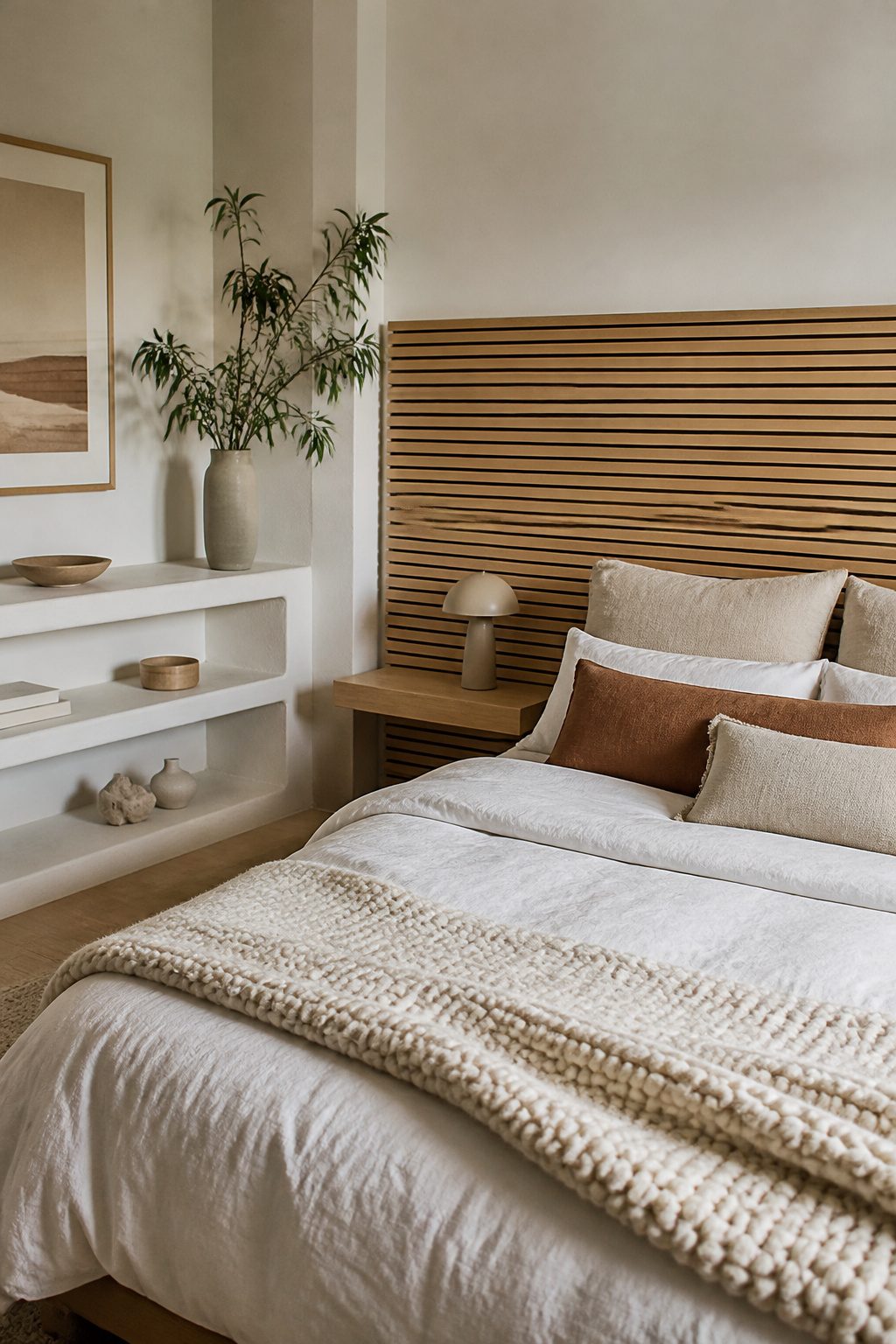
Scandinavian design keeps modern minimalism from turning cold. The principle is straightforward: clean lines paired with soft, slubby textiles so the room stays livable.
Hygge, the Danish idea of comfortable conviviality, arrives through texture rather than clutter. Think woven throws, nubby linen bedding, or a single chunky knit at the foot of the bed.
Light wood tones do the heavy lifting.
A wall-to-wall maple slatted headboard, like the integrated one designer Abbie Naber used in her own primary bedroom, adds warmth without breaking the spare silhouette. The natural grain keeps the space from feeling sterile against bright white walls.
Functional beauty means every piece earns its place.
Deep shelving with a bullnose edge stores what you actually use and softens the visual line. Earth tones help here too.
Sand, clay, and soft browns on pillows or rugs replace stark white with something gentler. Pair those with light wood furniture and the palette stays coherent.
A single tall plant in a sleek pot, or a few smaller ones on a shelf, brings in the last element.
The green contrasts the neutrals, and the organic shapes of leaves soften the room’s geometry without adding noise. The result is minimalism you can sleep in, not just look at.
Budget Starter Plan
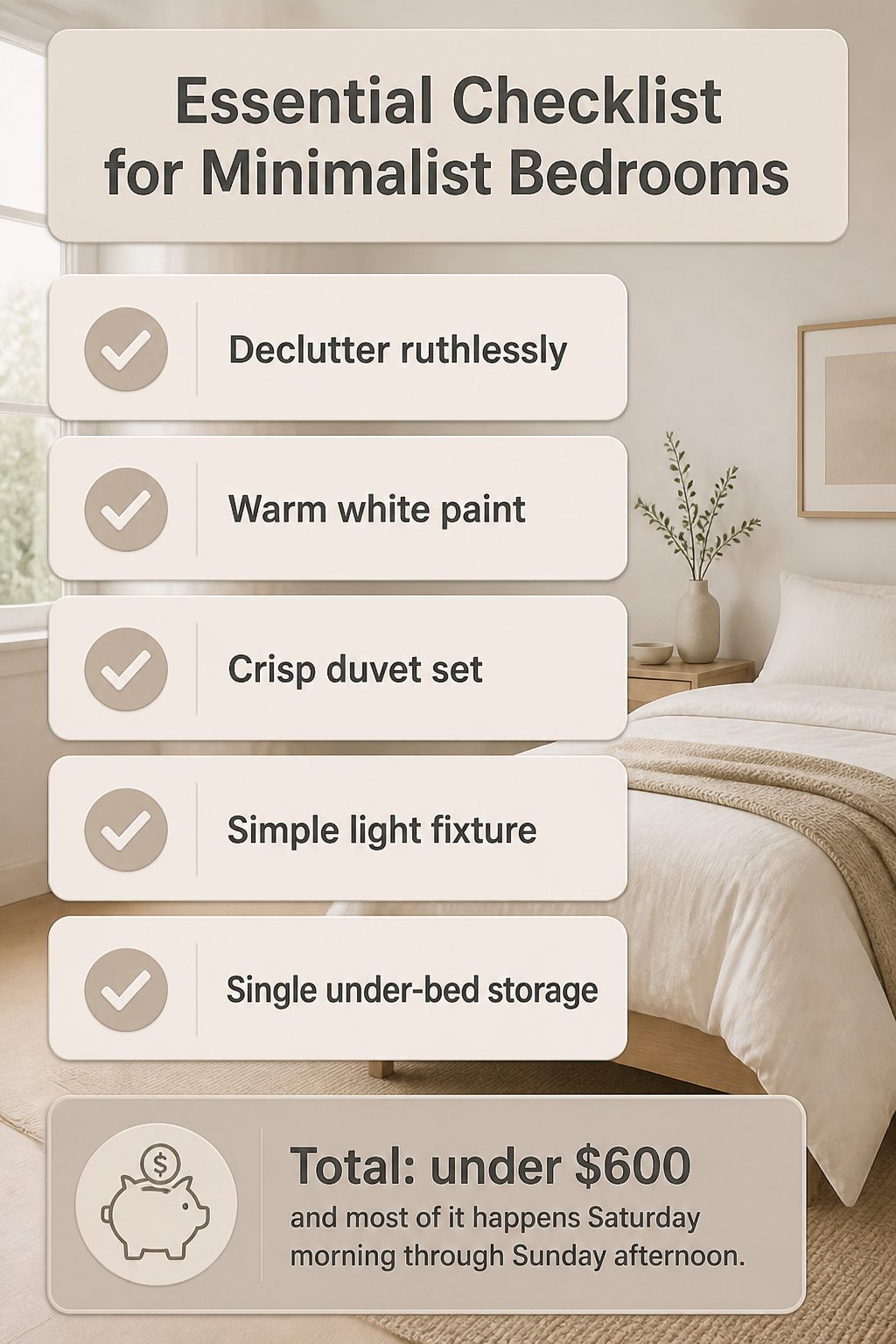
- Declutter first, and do it ruthlessly. Pull everything out, sort into keep, donate, and store elsewhere, then put back only what you need for sleep. This step costs nothing and the visual relief it gives you is half the transformation.
- Paint walls and ceiling in one warm white or soft greige. A gallon of decent paint runs $35–50, primer another $20, plus rollers and tape; budget $80–150 total. I would skip accent walls in a minimalist room, one quiet color carries the whole space better.
- New bedding is where the room starts to feel finished. A crisp white or oatmeal duvet set, two sleeping pillows, and one lightweight throw runs $150–300 depending on whether you catch a sale. I would spend here before almost anything else because you see and feel it every day.
- Swap the overhead for a simple flush-mount or a single pendant with a dimmer. $100–200 covers the fixture and an electrician-free install if you stick with a replacement in the same junction box. Light temperature matters: 2700K reads warm, 3000K reads clean, and I would not go cooler than that in a bedroom.
- One storage piece last: a single under-bed bin on casters, or a narrow wall-mounted shelf if floor space is tight. $40–80, and only buy it after living in the painted, lit, decluttered room for a week so you know what you actually reach for.
Total lands under $600, and most of it happens Saturday morning through Sunday afternoon.
Frequently Asked Questions
What makes a minimalist bedroom work?
A modern minimalist bedroom works by reducing visual noise through clean, uncluttered surfaces and intentional design choices.
Warm whites, soft greys, and earthy tones form a base that recedes visually and lets the room breathe. Matching nightstands with identical lamps create symmetry that quiets the room, and keeping surfaces clear of phones and clutter supports better sleep.
How do I start designing a minimalist bedroom?
Begin by decluttering ruthlessly: pull everything out, sort into keep, donate, and store elsewhere, then put back only what you need for sleep.
Paint walls and ceiling in one warm white or soft greige. A gallon of decent paint runs $35–50, primer another $20, plus rollers and tape; budget $80–150 total.
What furniture is essential for a minimalist bedroom?
Essential furniture includes a low-profile bed frame sitting under 12 inches in height, one or two clutter-free nightstands, and built-in or wall-mounted storage that keeps the floor plane open.
Solid wood in light oak or ash adds subtle texture without breaking clean lines. Skip bulky, oversized pieces and look for integrated storage that disappears visually.
Can I create a minimalist bedroom on a budget?
Yes.
The starter plan lands under $600: declutter first for free, paint for $80–150, add a crisp white or oatmeal duvet set for $150–300, swap the overhead for a simple flush-mount or pendant with a dimmer for $100–200, and finish with one storage piece like an under-bed bin on casters for $40–80.
Most of it happens over a single weekend.
How to design a minimalist bedroom?
Focus on a neutral color palette of warm whites and soft greys, choose low-profile furniture with clean lines, layer lighting from three heights with 2700K bulbs, and use natural materials like linen and light oak for warmth.
Keep walls spare with one large piece or bare negative space, and maintain symmetry with matching nightstands and lamps.
What’s in style for bedrooms?
Softer minimalism with warmer colors and rounded shapes is current, moving away from stark ice-white gallery looks.
Curved headboards, arched mirrors, and slubby textiles like linen add comfort without clutter. Scandinavian influence brings hygge through texture rather than clutter, with light wood tones and earthy accents like sand and clay.