

Bathroom mirrors run from $30 frameless rectangles to $800 backlit statements, but the right one depends on whether you’re solving a layout problem or filling a blank wall.
A mirror hung from the ceiling works when the plumbing sits in the middle of the room; a medicine cabinet solves storage in a bathroom short on square footage.
Oversized mirrors double the apparent depth of a small bathroom more than any other single change, and a pivoting bracket means one mirror works for everyone in the house without anyone crouching or standing on tiptoe.
1. Two Mirrors Over a Double Vanity
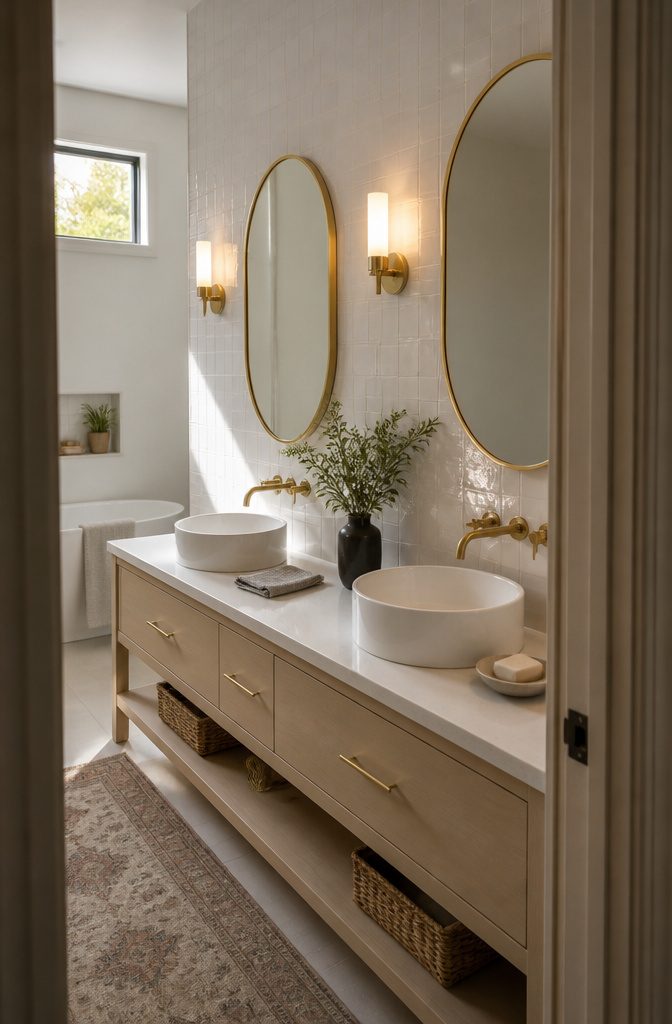
Two separate mirrors over a double vanity give each person their own reflection without overlap.
No one leans into someone else’s view when you’re both at the sink in the morning, and the gap between mirrors opens up wall space for a third sconce exactly where makeup needs it.
The symmetry reads as intentional rather than matched-set boring when you carry a shape through the rest of the room.
Oval mirrors work over round basins; rectangular frames echo a medicine cabinet on the opposite wall. Black frames ground a light vanity, brass warms up white tile, and frameless keeps a small bathroom from feeling chopped into pieces.
Two mirrors cost more than one wide span, but they let you hang each one at the height its user actually needs instead of splitting the difference.
2. One Wide Mirror Over a Double Vanity
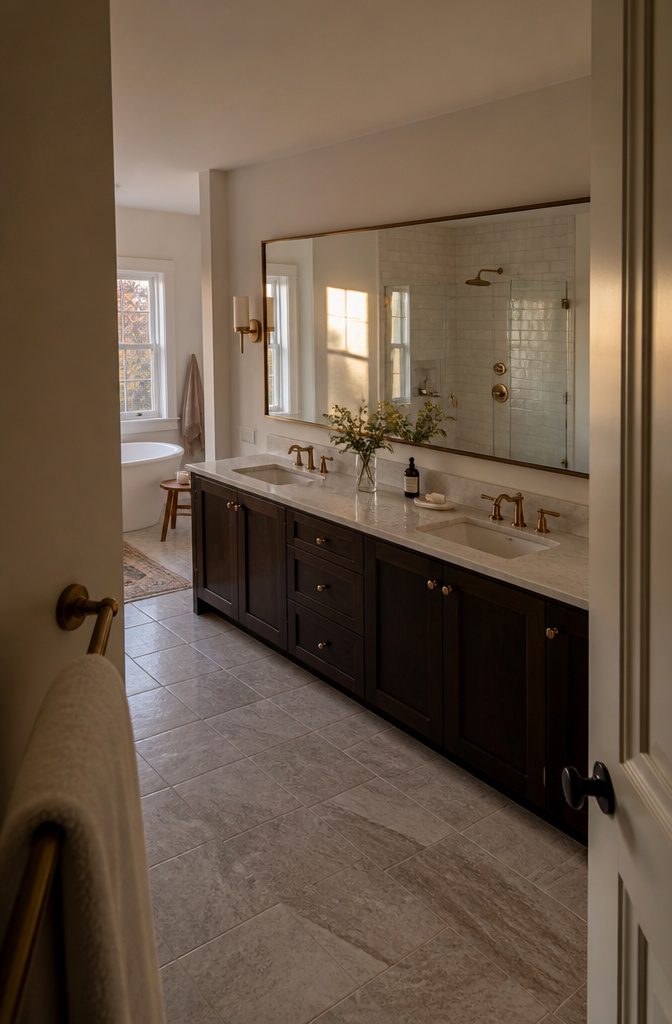
A single mirror that runs the full width of a double vanity keeps the wall unified instead of breaking it into halves.
The look works best when you want the countertop to read as one continuous surface rather than two separate stations, and it opens up storage if the mirror fronts a cabinet—twice the hidden space behind one piece of glass instead of splitting it between two smaller doors.
The frame becomes more visible when it spans that much wall, so a simple profile in brass or bronze highlights tile and fixture finishes without competing.
Dark cabinetry below makes a slim metal frame stand out; if the vanity is light or the tile busy, a frameless edge disappears and lets the mirror do its job without adding another layer.
This setup loses one advantage: you can’t angle two mirrors toward the sinks the way separate pieces allow, so someone standing at the far left edge sees straight ahead rather than slightly inward.
That trade matters less in a narrow bathroom where you’re always close to center, and more in a wide primary bath where the sinks sit four feet apart.
3. Oversized or Full-Wall Mirror
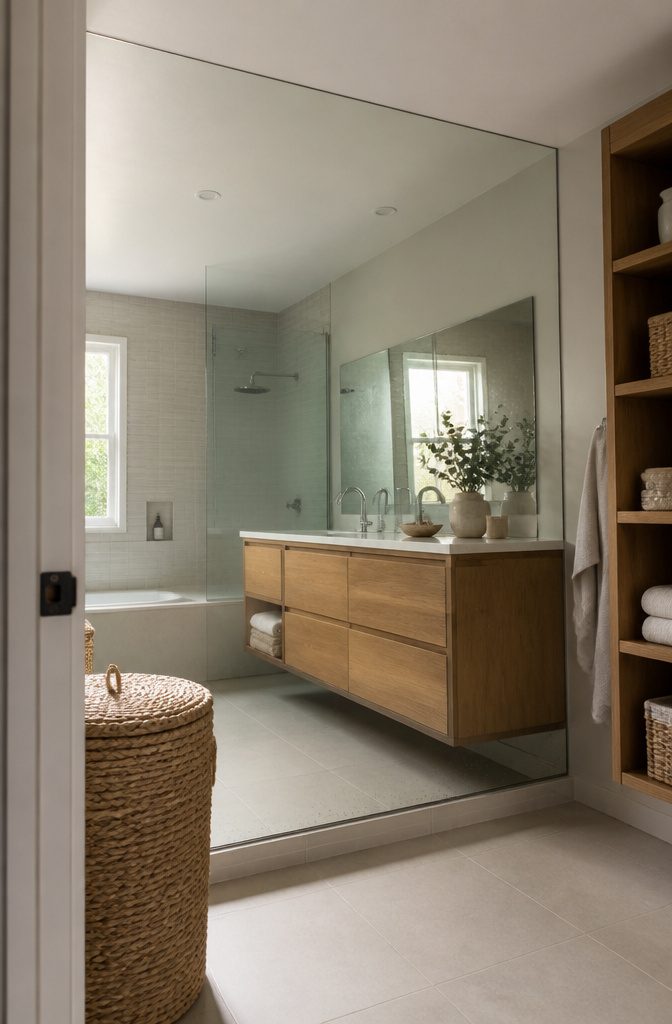
A mirror that covers most of one wall opens up a small bathroom more than any other single change.
The reflective surface doubles the apparent depth of the room, and because the mirror spans nearly the full width or height, it reflects light from every angle instead of creating a framed window of brightness.
That continuous surface reads as more space rather than as decoration.
Floor-to-ceiling installations work best when the mirror runs the full height without a gap at the counter or ceiling line.
The unbroken plane makes the wall disappear. You can also cover a wall using multiple smaller mirrors arranged edge to edge, which gives you the same expansive effect while breaking up the cost and making installation less nerve-wracking.
Frameless edges keep the look clean and let the reflection do the work without a visual border pulling attention back to the mirror itself.
The catch: large mirrors show every smudge and water spot, so placement matters. Keep them away from the direct spray zone of the shower if you want to avoid constant wiping.
4. Frameless Mirror
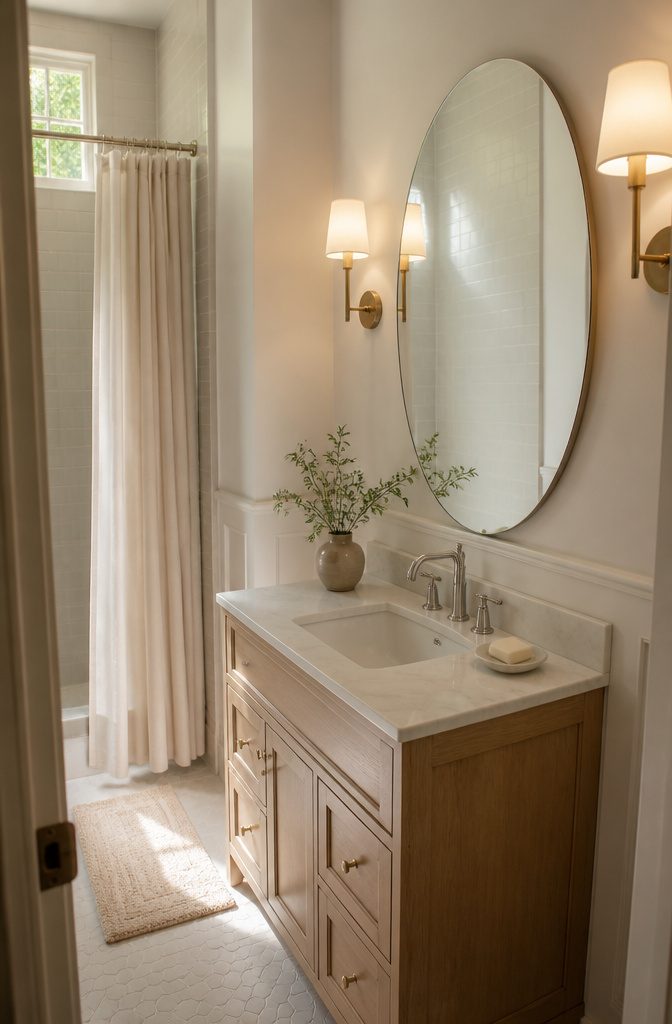
A mirror without a frame sits flush against the wall and reads as pure reflection.
The edge is polished or beveled — nothing else interrupts the glass — so the look stays minimal and the room feels larger because there is no border breaking up the vertical plane.
This works best in small bathrooms where a chunky frame would crowd the wall, and in modern or minimalist spaces where any extra detail fights the style.
The mirror can hang vertically or horizontally and comes in rectangular, round, or oval shapes, so you are not locked into one proportion.
Frameless mirrors pair well with contrasting hardware. White molding along the edge finishes the look without adding bulk, and mixing finishes — polished nickel faucets with brass sconces or cabinet pulls — keeps the mirror from reading as bland.
A light wood vanity softens the effect if the room tips too stark.
The style is timeless enough that it does not date a bathroom the way a statement frame can, and it works across aesthetics: modern, traditional, even farmhouse-inspired if the rest of the room carries that weight.
5. Backlit or LED Mirror
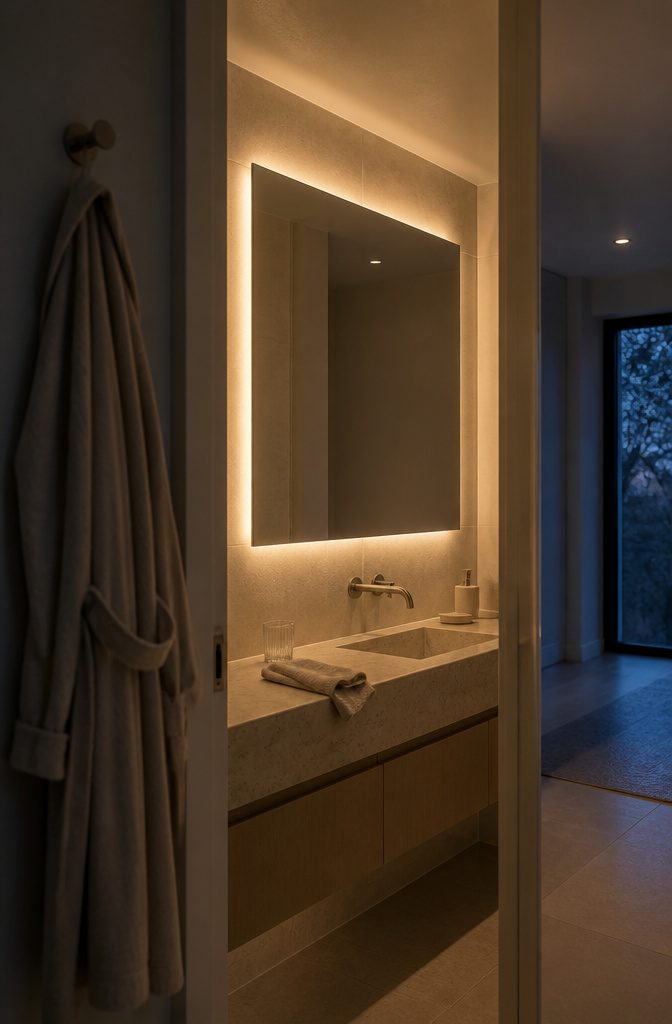
A backlit mirror puts LED strips behind the glass or around its edges, so the light spills onto the wall rather than shining straight at you.
The result is soft, even illumination across your face without the shadows an overhead fixture drops under your eyes and jaw.
Look for warm white around 2700K to 3000K if the room leans cozy, or neutral white near 4000K when you need color accuracy for makeup.
The glow also works as a nightlight.
Several backlit mirrors let you dim the LEDs down to a level that is enough to find the sink at 3am without fully waking yourself up, and the soft pool of light on the wall reads more like candlelight than a bathroom fixture left on.
6. Hanging or Suspended Mirror
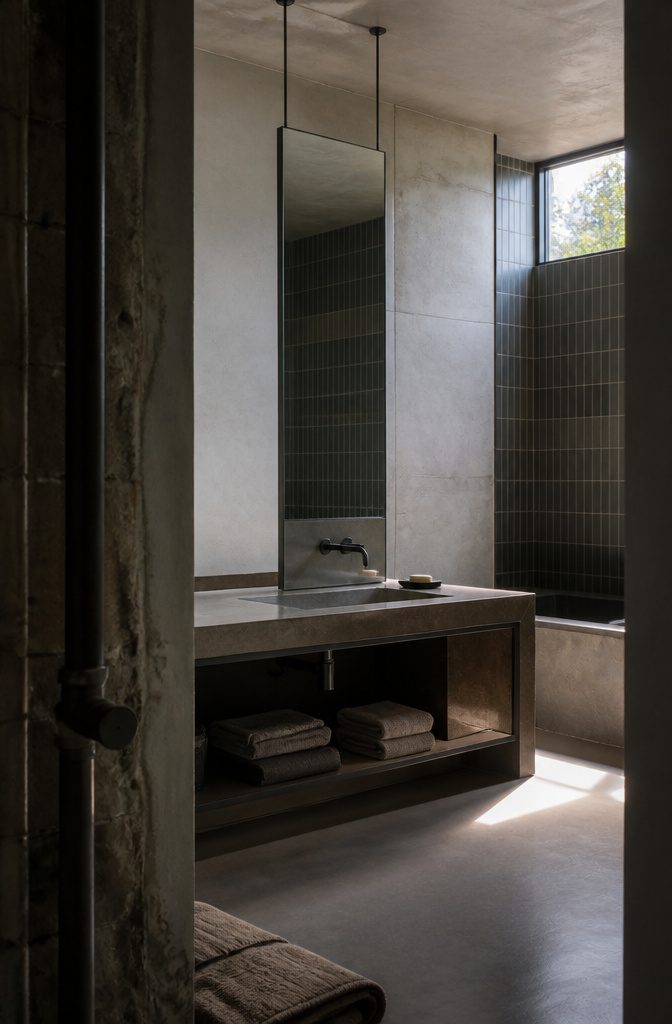
A mirror hung from rope, wire, or cable keeps the vanity off the wall when the layout calls for it — apartments carved out of old buildings sometimes leave you with plumbing in the middle of the room, and suspending the mirror from the ceiling solves that without losing function.
The look works in industrial, minimalist, contemporary, and eclectic bathrooms, and you can match the support to the style: thick rope for a nautical feel, thin cable for something cleaner and more modern.
The mounting has to be done right.
A professional should handle the installation to make sure both the mirror and the hardware stay secure under weight. Custom sizing usually follows, since standard mirrors rarely fit the proportions of a centered vanity, and that adds cost.
The setup gives you more layout flexibility and can create a sense of separation in a large bathroom, but it can also make a small room feel tighter if the mirror takes up too much visual space.
7. Pivoting or Hinged Mirror
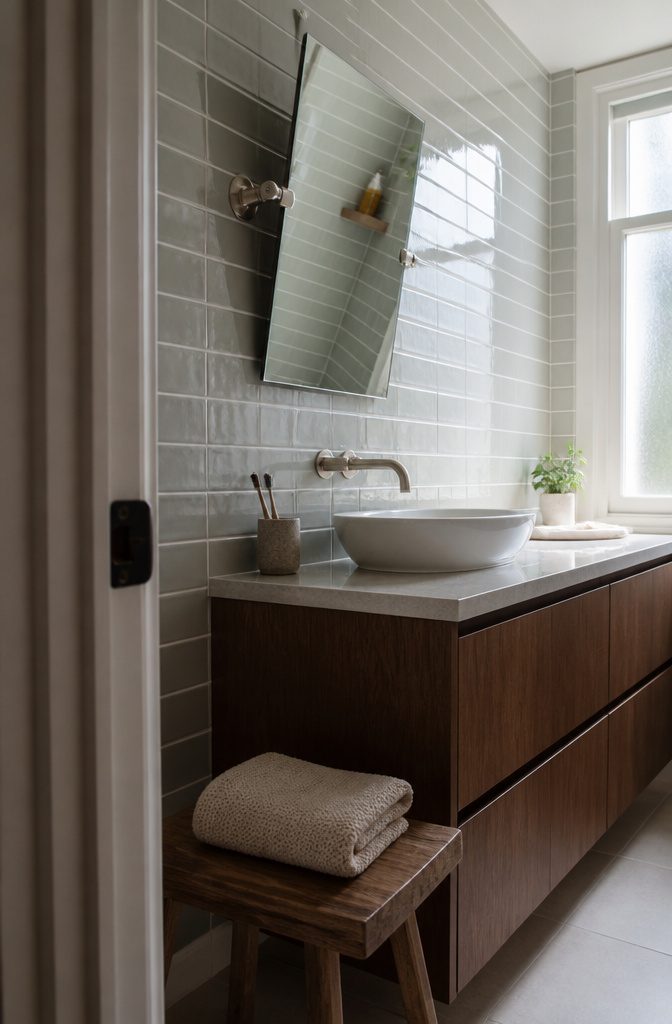
A pivoting mirror tilts forward or back on wall-mounted brackets, which solves the height problem when one person needs to see their collar and another needs a full view of their hair.
The tilt adjusts in seconds, so a single mirror works for everyone in the house without anyone crouching or standing on tiptoe. Kids’ bathrooms benefit twice: the angle changes as they grow, and you skip the upgrade cycle.
The hardware sits a few inches off the wall, which opens space for tile or another finished surface to run partway up behind the mirror instead of stopping at the vanity.
That added layer gives the wall more finish than paint alone.
Weight is the deciding factor. Cheap brackets sag under a heavy mirror, and a mirror that tips too far forward looks wrong even when it stays attached.
Read reviews before buying online, and if you’re in a store, test the pivot action—the hardware should feel solid, not loose or flimsy. A sturdy bracket costs more up front but holds the mirror steady for years.
8. Medicine-Cabinet Mirror
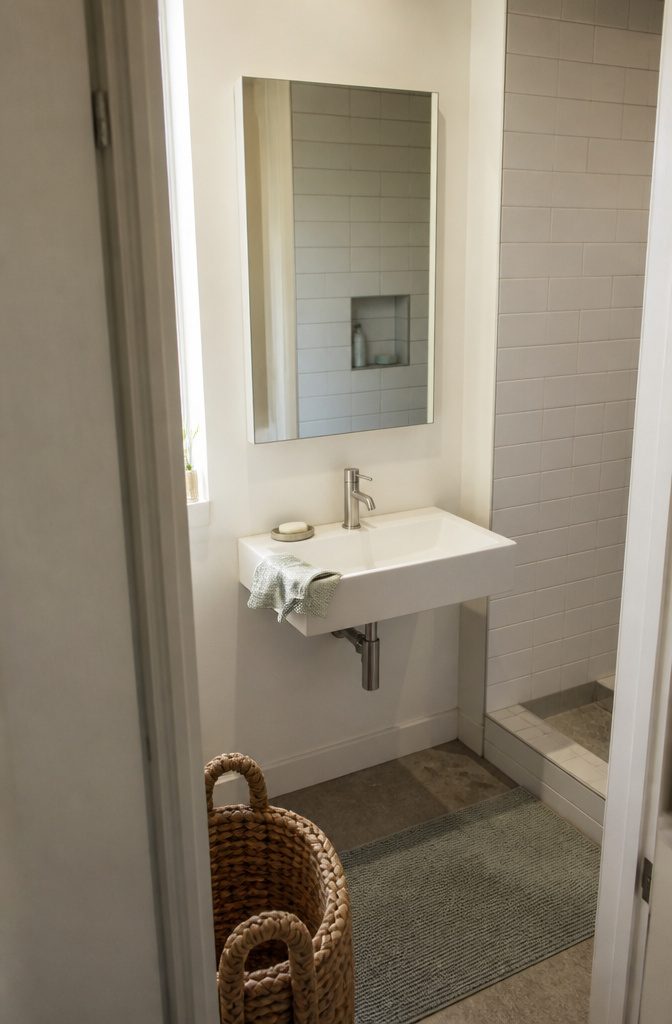
A medicine cabinet puts a mirror on the front of recessed or surface-mounted storage, and in a bathroom short on square footage that solves two problems with one fixture.
You get the reflective surface you need above the sink and a hidden compartment for toothpaste, prescriptions, and whatever else clutters the counter.
Recessed cabinets sit flush with the wall and steal no floor space; surface-mounted versions add a few inches of depth but install faster when you can’t cut into the wall.
The style range runs from frameless contemporary boxes to wood-framed cabinets that read more farmhouse, so matching the cabinet to the room takes the same attention you would give a standalone mirror.
Small bathrooms benefit most — the storage keeps daily-use items within arm’s reach without adding shelves or baskets that make the room feel tighter.
9. Mirrors in Front of a Window
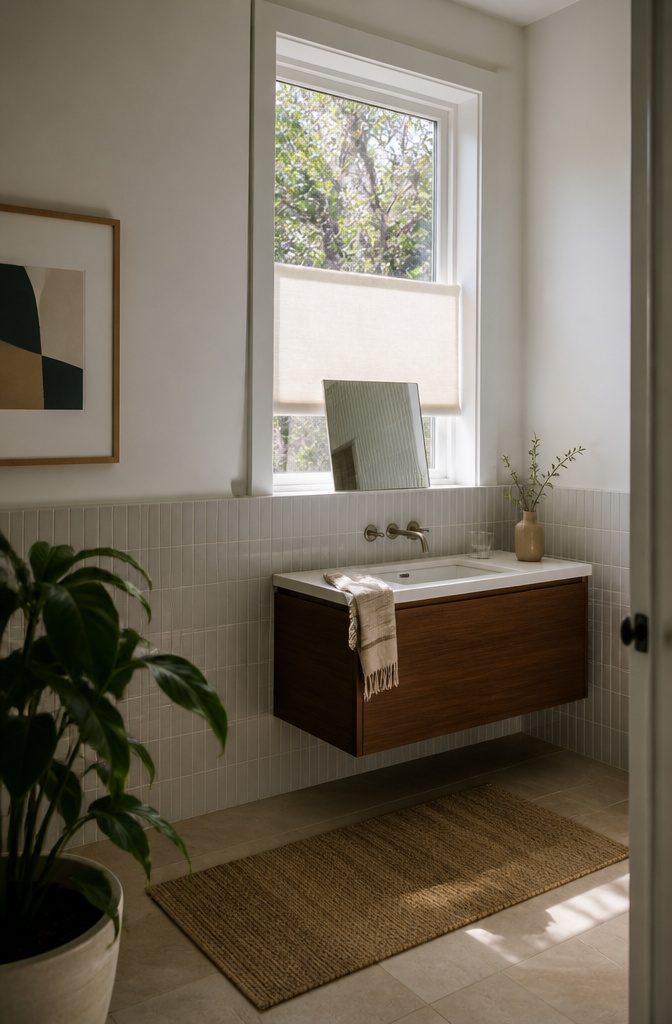
I ran this setup once in a powder room that had a single casement window centered over the sink — no wall beside it, just window on both sides of the fixture.
The mirror went on the sill, angled slightly back, and a simple roller shade pulled to the midpoint gave me privacy without killing all the light.
It worked because the window was narrow enough that the mirror still gave me a usable reflection without sitting too far forward.
The approach solves a layout problem more than it creates a style moment.
If your sink backs up to a window and you need a mirror somewhere, this puts it where you actually use it instead of off to the side where you’d have to lean.
The curtain or shade at mid-height keeps passersby from seeing straight in while you’re at the sink, but you keep the upper half of the window open for daylight.
A retractable wall-mount mirror is the other route when the window takes up the whole wall. It swings out when you need it and folds back flat when you don’t, so the window stays unobstructed most of the time.
That setup works better in a room where the mirror is occasional — putting on makeup, shaving — rather than something you glance at every time you wash your hands.
10. Multiple Mirrors or a Mirror Gallery
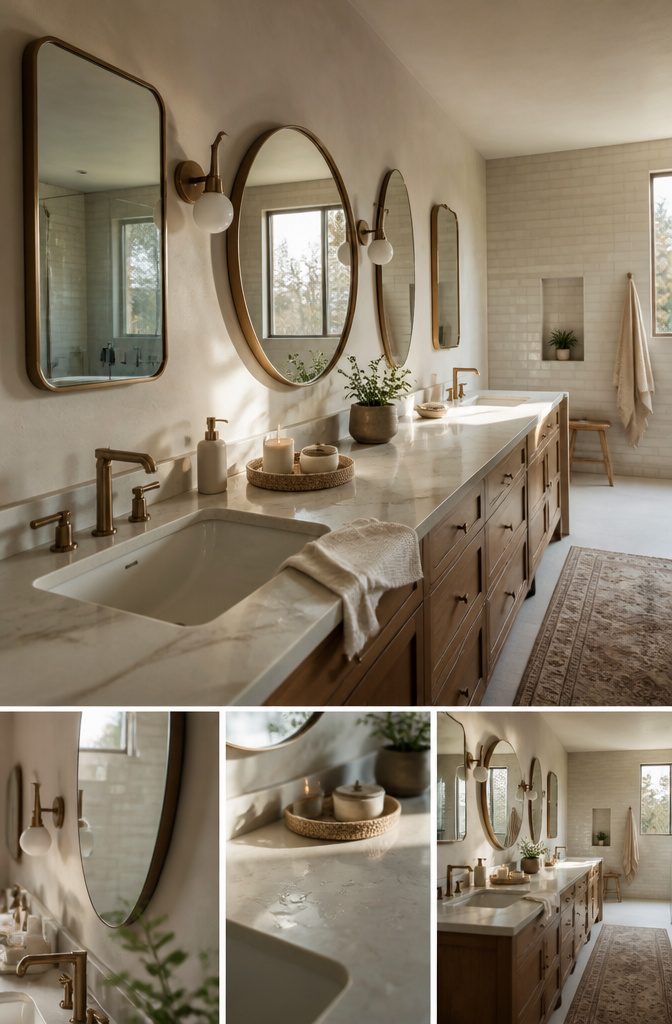
I arrange three or four mirrors in different shapes above a long vanity or across a blank wall, varying the frames so they feel collected rather than matchy.
A round mirror next to a rectangle or an arched frame beside an oval adds more visual interest than repeating the same shape, and the gaps between them break up what would otherwise read as one heavy block.
Placing the largest mirror directly over the sink keeps the practical part covered while the smaller pieces fill out the wall.
Each mirror needs to hit a stud or go in with proper anchors rated for the weight, since drywall alone won’t hold multiple frames over time.
I use a level and a paper template to mark the layout before drilling—getting the spacing even by eye rarely works, and patching misplaced holes in tile is harder than taking an extra five minutes up front.
11. Round or Circle Mirror
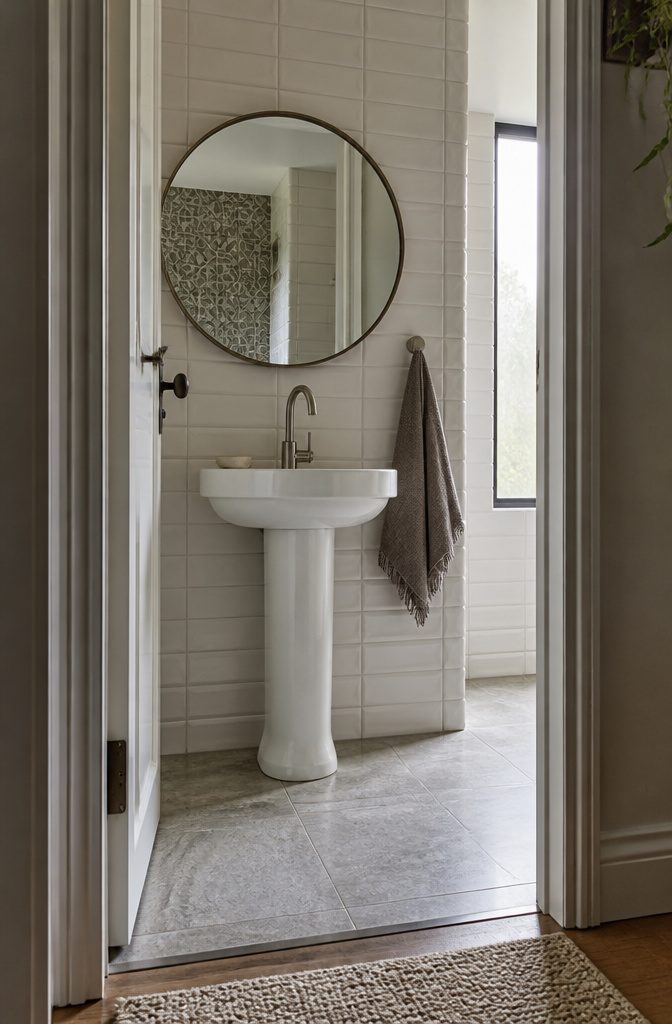
A round mirror breaks up the straight lines that most bathrooms are built from — tile grids, door frames, vanity edges — and that softening effect makes the hardest-working room in the house feel a little less clinical.
The shape pulls attention without shouting for it, which is why it works over a single sink when the vanity is centered on the wall and you want something that reads as intentional rather than leftover.
Round mirrors sit best in spaces that already have some geometric variety: a pedestal sink, an angled ceiling, or fixtures that aren’t all squared off.
In a bathroom where every other surface is a right angle, a circle becomes the only curve in the room, and that contrast does the work a statement frame would otherwise have to do.
12. Oval Mirror
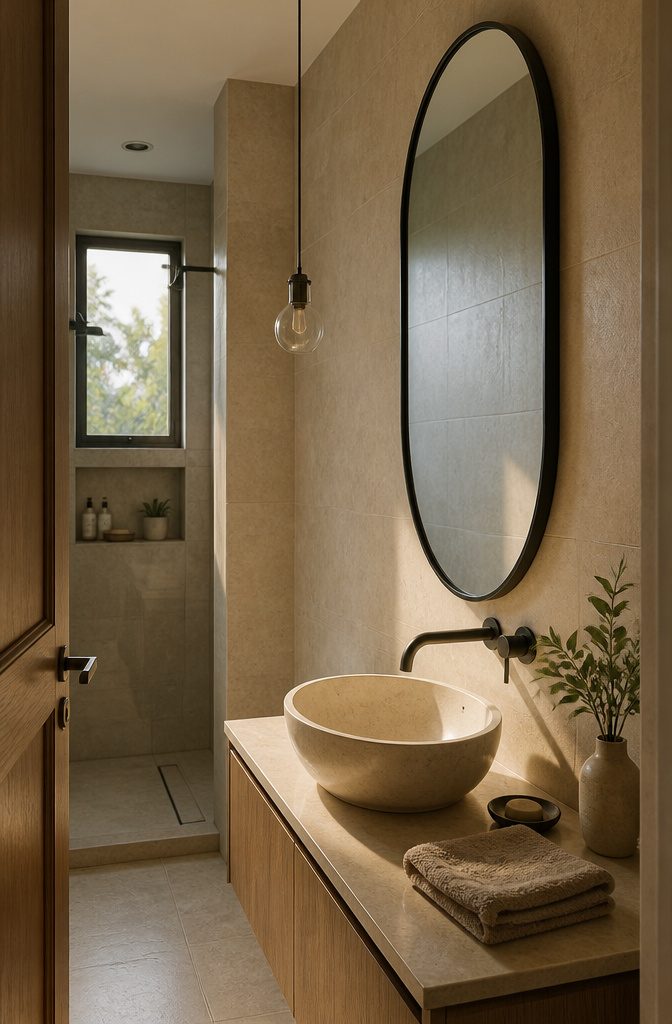
An oval mirror runs taller and narrower than a rectangle, which makes it fit above a slim vanity or in a powder room where you don’t have much horizontal wall to give.
The vertical shape gives you a full reflection without sprawling sideways, and the soft curve keeps the room from feeling boxy when you’re already working with tight dimensions.
Pairs work well over double sinks. The repeated oval shape ties the setup together, especially when the basins or other fixtures are rounded — you’re reinforcing a motif rather than mixing competing geometries.
A tall pill shape with a thin frame echoes a stone trough sink or a vessel bowl without copying it outright, which is how you layer curves without the room reading cluttered.
The difference from a circle matters when the wall is narrow. A circle asks for clearance on all sides; an oval uses that same width but stretches upward, so you get more mirror where it counts.
13. Arched Mirror
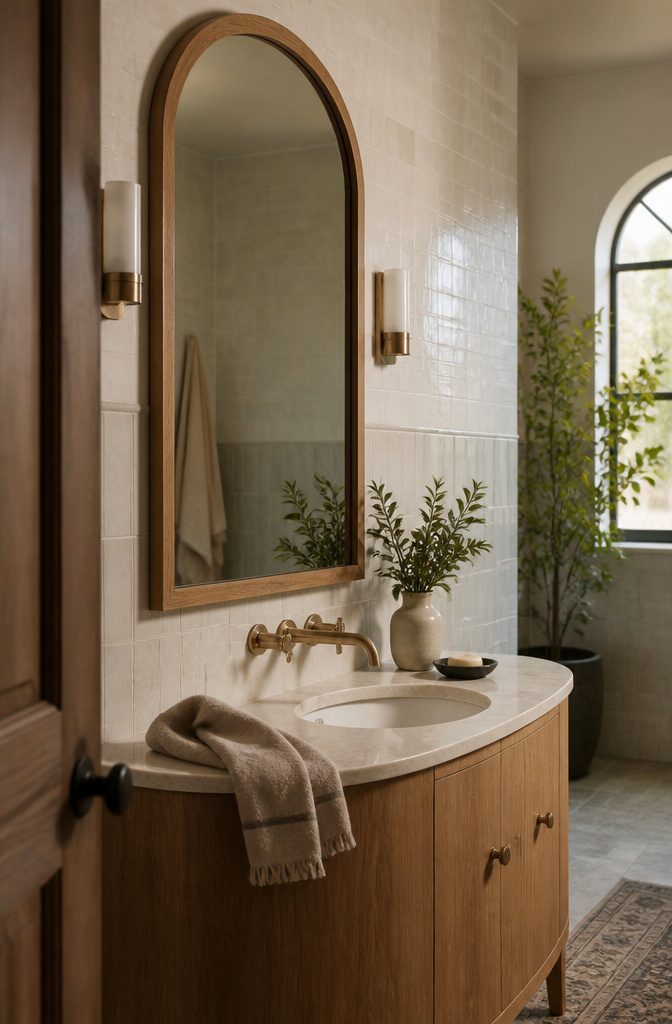
I added an arched mirror in my last bathroom and found it worked best when the arch echoed another curve in the room — a window line, a doorway, even the radius on the vanity edge.
Without that repetition, the arch reads ornate in a room full of right angles.
The curved top adds softness where most bathrooms skew hard and clinical. Frames range from plain wood to elaborate metalwork, and you can layer materials if the room calls for it.
Traditional and classical bathrooms pull arched mirrors in naturally, but a simple version — just the curve, minimal frame — fits contemporary spaces too, especially if you’re not ready for the wavy, asymmetrical mirrors that lean fully modern.
The arch splits the difference: curves without commitment to free-form.
Check the width against your vanity before you mount it. An arch that’s too narrow looks tacked on; one that extends past the counter pulls the eye sideways and balances better.
14. Unusual, Asymmetrical, or Sculptural Mirror
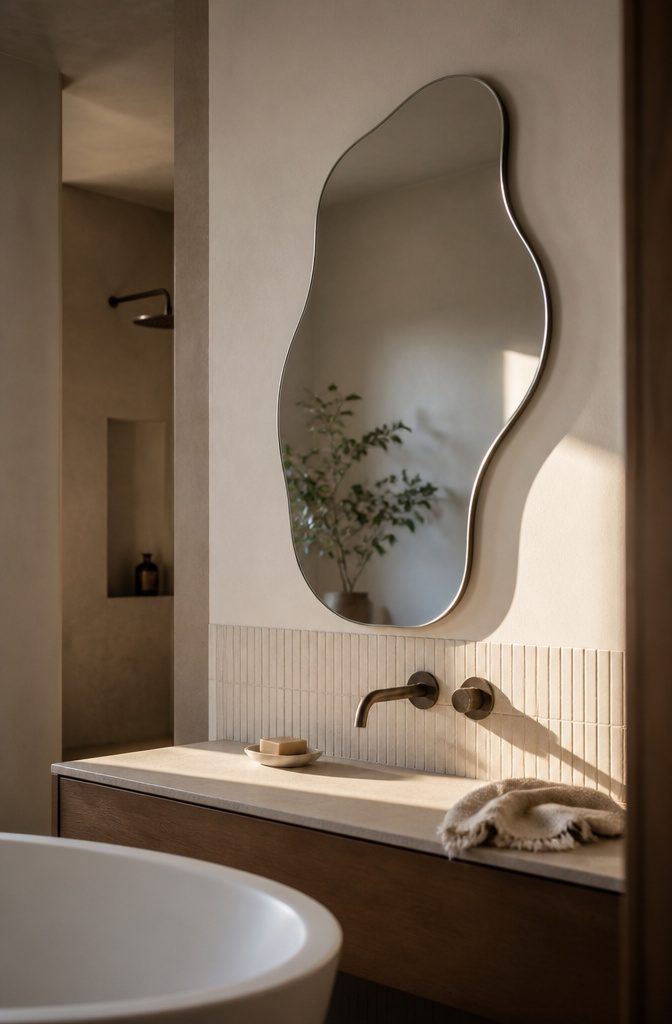
An asymmetrical or sculptural mirror—pentagon, hexagon, wave, or abstract blob—turns the mirror into the focal point rather than background hardware.
The shape itself does the work, so you can skip extra accessories that would otherwise clutter a small bathroom.
These work best when the rest of the room stays simple. Plain plaster or a single tile pattern gives the unusual outline room to register; busy tile or patterned wallpaper competes with it, and neither wins.
If your walls already carry a lot of detail, a rectangle or oval makes more sense.
Geometric mirrors with sharp edges read contemporary. Wavy or scalloped outlines soften the hard angles typical in bathrooms and lean modern without going cold.
An asymmetrical mirror can follow the curve of your countertop if the shapes echo each other, or it can sit alone as the one piece that breaks the grid.
If a freeform shape feels like too much, an arched or curved-top mirror gives you the same softened look without committing to the full wave.
15. Framed Mirror Matched to the Room
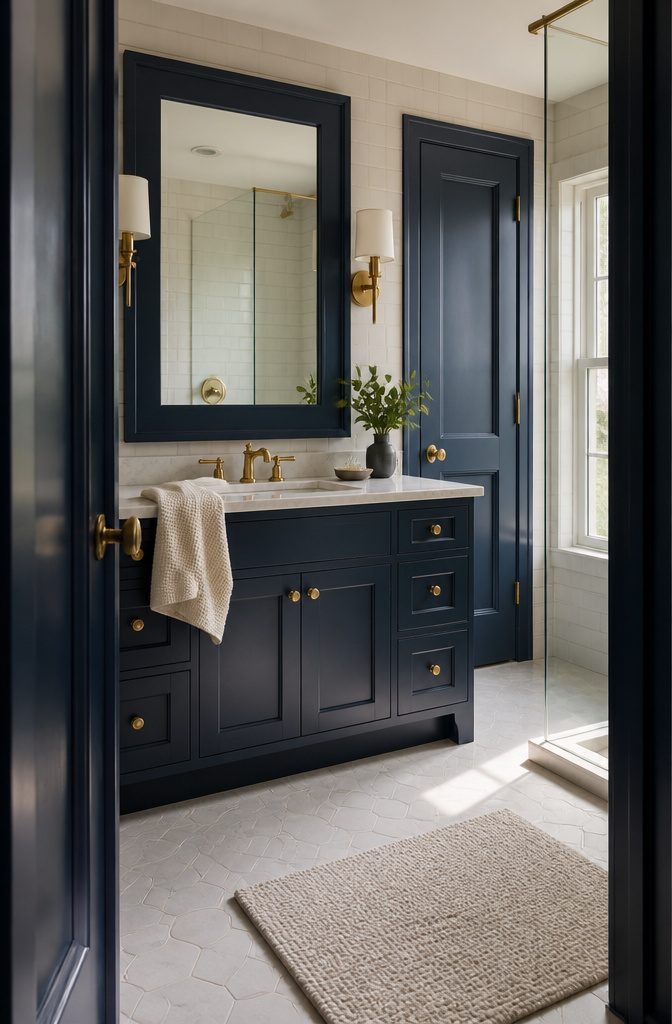
Matching the frame to the room’s existing finishes keeps the mirror from floating like an afterthought.
In one bathroom I looked at, the mirror frame, vanity, and door were all painted the same navy — the result was a pulled-together look where the mirror felt built-in rather than hung.
Painting the frame in the same color as your molding or cabinetry ties everything together and makes the space feel intentional.
If you go that route, keep one element in contrast. Light fixtures in brass or chrome break up a monochrome scheme without fighting it.
The frame-to-wall match also works in reverse: a frame painted the exact wall color stretches the room visually, especially in a small powder room where you want the mirror to recede rather than announce itself.
The frame is still there for structure, but it reads as part of the architecture instead of decor.
Frequently Asked Questions
How can Ideal House help me choose a bathroom mirror size?
The AI scales mirror options directly in a photo of your space so you can judge proportion before buying.
You can test a double vanity mirror setup or see how a large mirror looks over a small vanity, which removes the guesswork from sizing.
This eliminates the risk of ordering a mirror that turns out too big or too small for the wall.
Can I see what a backlit bathroom mirror design looks like in my room?
Yes. The tool simulates the ambient glow of integrated lighting in your uploaded photo, so you can see how the backlit mirror will illuminate the space and change the mood.
This is one of the most popular features for bathrooms where lighting layering matters.
Does this tool offer mirror ideas for small bathrooms?
Yes. Small bathrooms and powder rooms benefit most from the tool because you can test whether a large mirror expands the space or if a minimalist option works better in tight dimensions.
You can compare options quickly to maximize both style and function in a compact area.
Are there different styles available, like frameless or black frames?
The library includes frameless mirrors and black-framed options, plus other contemporary styles. You can compare a sleek frameless mirror against a black frame to see which one matches your fixtures and aesthetic.
Is this just for modern bathroom mirror ideas, or can I find other styles?
The library covers modern and contemporary designs as well as classic, rustic, and industrial styles. The full range covers every style, so you can find a mirror that fits your home’s decor, whatever direction it leans.