
Black kitchen cabinets are painted or stained cabinetry finished in a deep, light-absorbing tone that reads as a deliberate design choice rather than a default.
Black shows every fingerprint, water spot, and scratch, and any chip opens straight to a pale substrate that screams against the surrounding darkness.
Designer Monica Rivas balanced this heaviness in a Las Vegas project by pairing blackened wood lower cabinets with brown walnut uppers against crisp white walls, a combination that kept the look rich without closing the room in.
Aesthetic Appeal
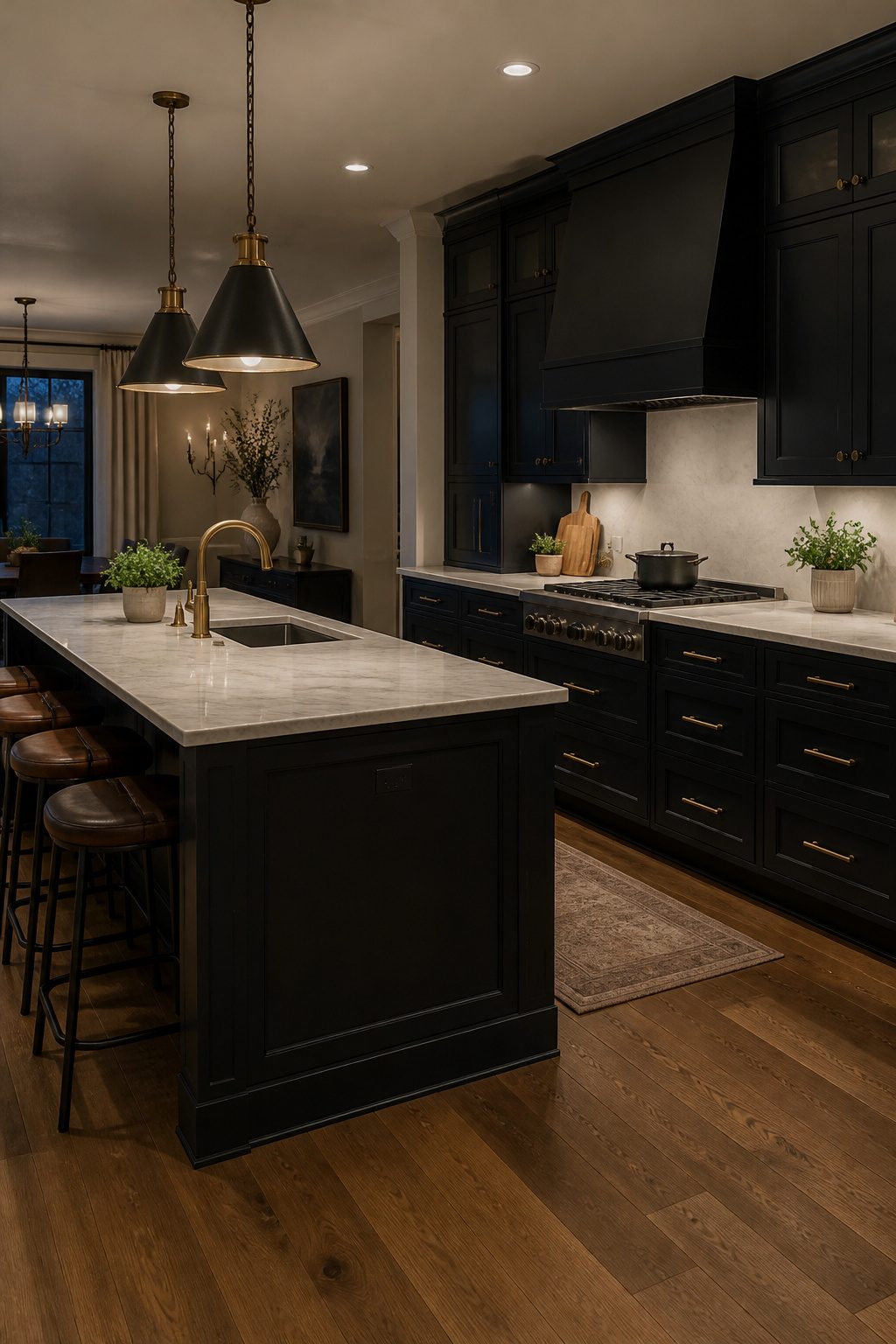
Black cabinetry reads as a choice someone made, not a default they settled for.
That intentionality is what separates a finished kitchen from a builder-grade afterthought. The finish carries a weight that grounds the room, and in low evening light it takes on an edge that white or wood tones simply do not deliver.
The mood shifts with the hour. Morning light keeps the look crisp and gallery-like; after dark, with a few candles lit, the same cabinets turn dramatic and almost theatrical.
That range is why black photographs so well for resale listings and social feeds alike: the camera picks up the contrast and the depth without needing a styled vignette around every corner.
Designers who track these decisions report that aesthetic appeal is the top reason homeowners choose black.
It signals custom work and an upscale eye even when the cabinet boxes themselves are standard. Black makes the rest of the kitchen work harder; it will not hide a cheap countertop or careless hardware.
Recommended Products

【Ample Storage Space】This versatile kitchen pantry cabinet features 4 adjustable shelves and an extra-large drawer, offering generous storage for dishes, cookware, spices, and dry goods—keeping your kitchen perfectly organized. The charming barn doors include 8 built-in compartments, ideal for storing bottles, seasonings, and frequently used items, maximizing every inch of storage space for ultimate kitchen efficiency

⭐【Clutter-to-Calm in Seconds】With 2 spacious drawers to stash away odds and ends, wide tabletop and 2 open shelves for showcasing your decor, and roomy bottom cabinet for larger items, this farmhouse storage cabinet meet to your various storage needs. You can absolutely end the chaos with this tall cabinet and enjoy a clutter-free home.

Dimensions of Knobs: The cabinet knobs are about 1.18 inches (30 mm) in diameter and 7/8 inches (22 mm) in height. Each knob comes with two screw sizes: a shorter one at M4*0.78 inches (20 mm) and a longer one at M4*1.75 inches (45 mm)(longer screws are packed in the bottom of the box)
Versatility in Design
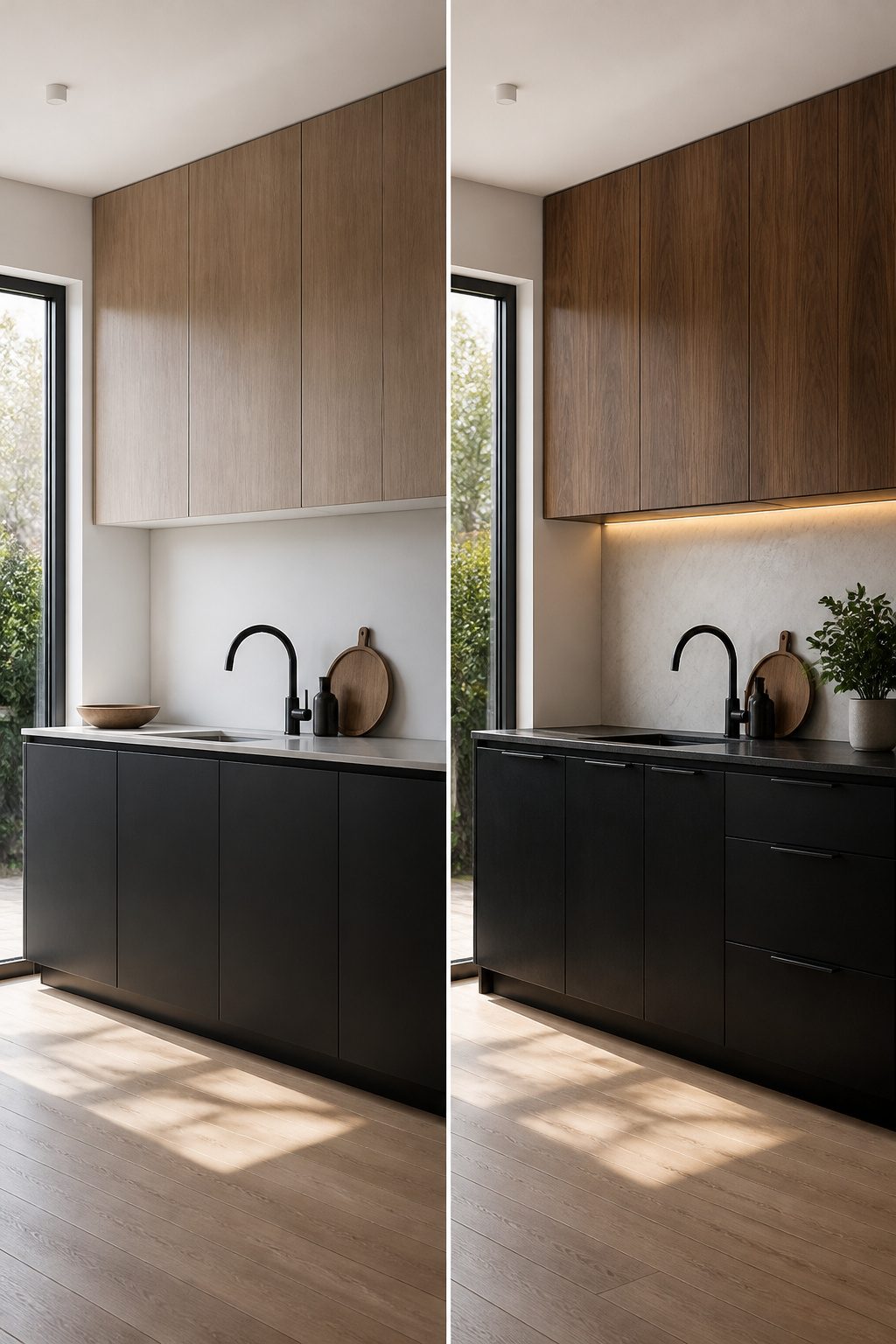
Black kitchen cabinets earn their place when the pairing is deliberate.
The eye needs somewhere to rest from the darkness, which is why a dual-tone mix of black lower cabinets with natural wood uppers works better than walls of solid black.
Designer Monica Rivas pulled this off in a Las Vegas project with brown walnuts and blackened wood against crisp white walls, and the result stayed rich without closing in.
The hardware and countertops decide the personality. Brass against black adds warmth most metals do not; marble or quartz in white against the cabinets keeps the contrast sharp rather than muddy.
I tend to skip jewel tones like emerald green unless the kitchen gets strong natural light, because deep color plus deep cabinet risks the cave effect.
Open shelving in natural wood helps by breaking up the mass and introducing texture that flat panel doors alone cannot carry.
Where the cabinets run floor to ceiling, the balance tips toward heaviness.
The better play is to treat black as the anchor, not the whole story. Let it ground the room, then layer in lighter materials where they actually function, not as decoration.
Recommended Products

【What is in package】: You will receive 6 pieces of cabinet handles with 12 pcs standard mounting(1-in) screws and 12 pcs breakaway mounting(1.77-in) screws; Applied to cabinet door thickness:11/16 to 1-3/5 inch

Exclusive design: This color blocked handle comes in two options: black gold and black silver. You will be surprised to find that small changes like these handles can change the atmosphere of your house.

Exclusive design: This color blocked handle comes in two options: black gold and black silver. You will be surprised to find that small changes like these handles can change the atmosphere of your house.
Timelessness
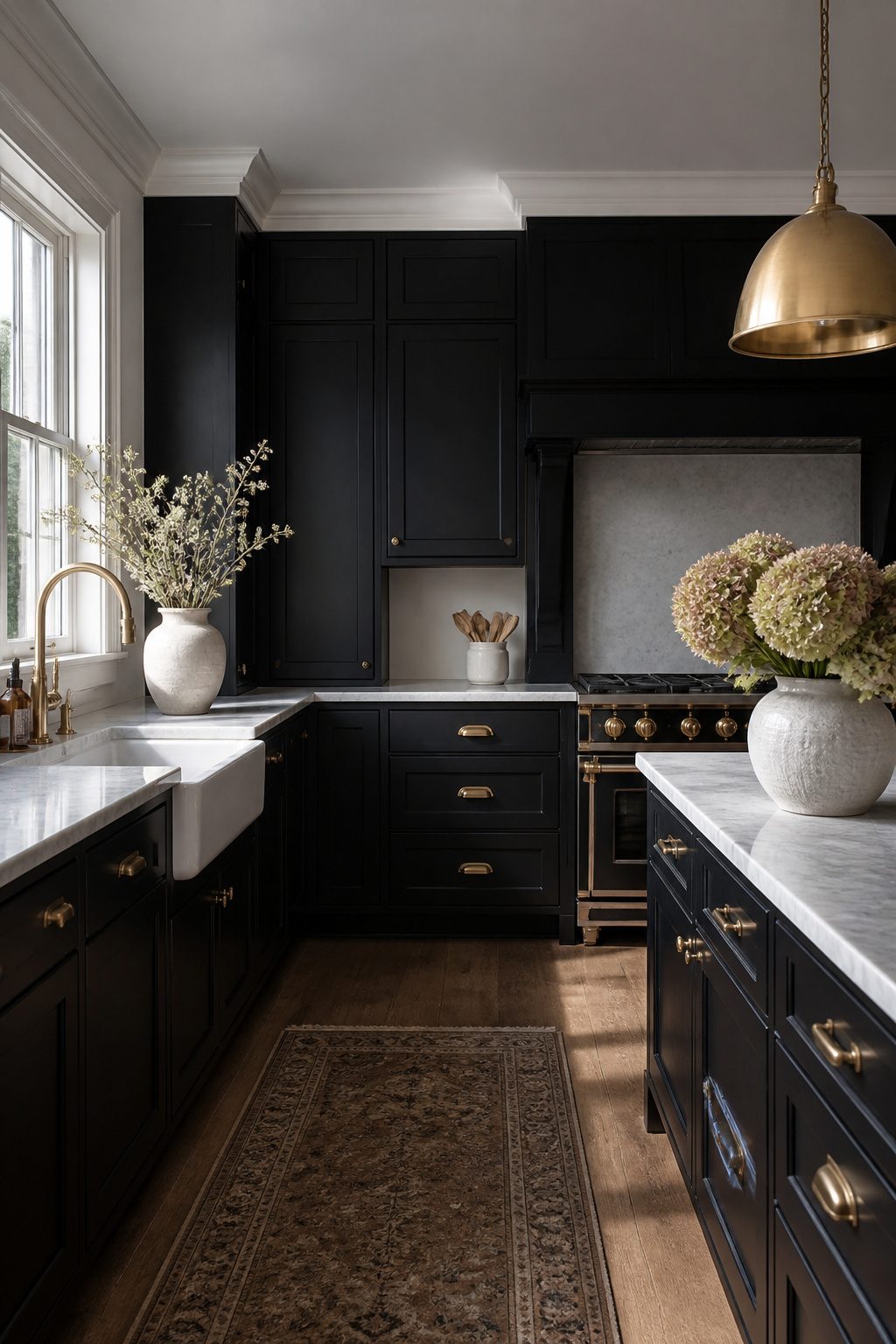
Black functions as a true neutral, not a trend color riding a wave. That difference is why a black cabinet installed in 2015 still reads as current in 2025, while the gray kitchens that dominated the 2010s already signal their era.
Gray was pitched as the new neutral, but it carried enough color temperature and saturation to become dated.
The warm gray of 2012 looks as fixed to its moment as the cool gray of 2018. Oak before it carried the same problem: the golden honey tone that filled 1990s kitchens is now shorthand for that decade.
Black avoids this because it does not register as a color choice in the same way. It absorbs rather than reflects, which lets other elements in the room carry the sensory weight.
A black cabinet pair with brass hardware reads completely different from the same cabinet with matte nickel, and neither pairing locks the black itself to a year. Lauren Farrell, head of interior design at Pacaso, puts it this way:
"Black kitchen cabinets are a surprisingly welcome choice due to the way they effortlessly create a statement while maintaining an air of timelessness."
Her own projects use the deep hue as a deliberate background, not a feature element. That exactly describes what makes the choice durable.
The statement happens, but it happens to be replaceable. Hardware swaps out in an afternoon.
Wall color shifts without clashing. The cabinet itself stays neutral through those changes.
Recommended Products

Provide round-the-clock customer care, responding to any product issues via email within 24 hours.

【Product Size】:Center-to-Center=5 inch(128mm); Length=5.3 inch(136mm);Projection=1.3 inch(34mm);

Stylish & Versatile Design: Transform your kitchen cabinets, dresser drawers, and furniture with the sleek and modern look of Franklin Brass Francisco handles. Perfect for any home improvement project, these cabinet pulls add a touch of modern elegance with their Matte Black finish.
High Maintenance
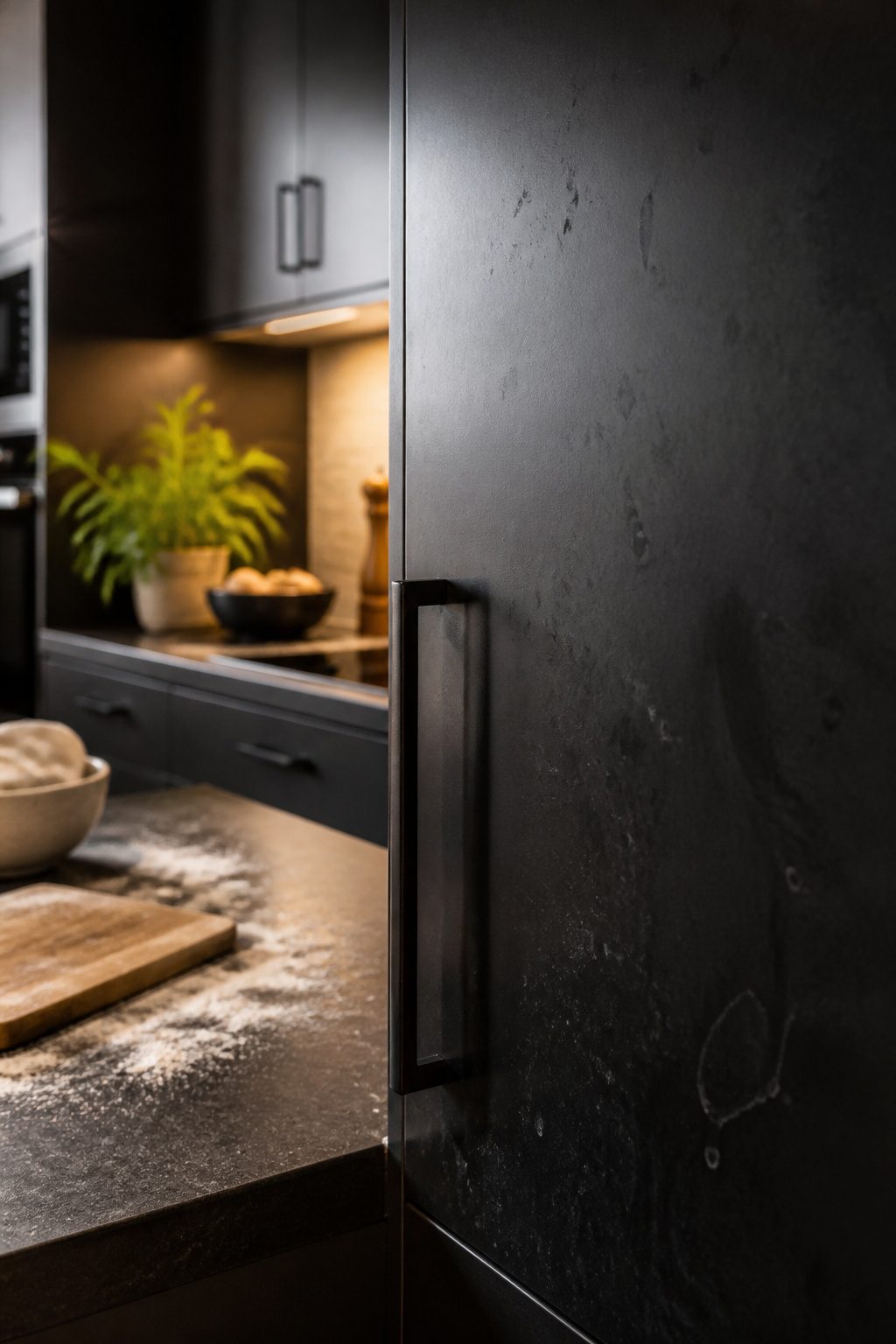
Black shows everything.
Skin oils leave faint arcs where you pulled the drawer, water spots ring the sink base after rinsing vegetables, flour dust settles pale on the island front, and if you have a dog, nose prints appear at knee height by the treat jar.
Matte finishes hide more than gloss, but only by degrees: the same particles still sit on the surface, just without the mirror reflection that turns a smudge into a flashlight.
Mid-tone colors, even dark grays, break up the contrast enough that a day’s worth of living does not announce itself from across the room.
Black demands that you notice, which is the trade-off that sends most homeowners toward charcoal or navy instead.
I think the choice comes down to who does the wiping and how often they are willing to do it; a household that cleans as it goes manages black fine, but one that lets Saturday morning arrive first will spend that morning frustrated.
Recommended Products
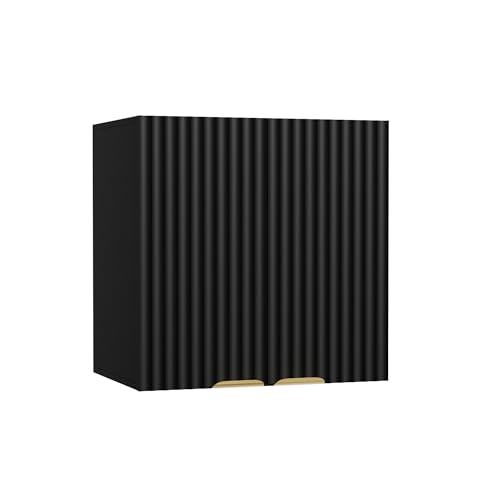
【Elegant Fluted Design】: This bathroom wall cabinet showcases vertical fluted panels that create a sophisticated, textured look. This piece effortlessly complements any decor style from traditional farmhouse to modern furniture, making it a versatile addition to your home

FITS 1/2" THICK PANELS. This plastic sliding door track system works with 1/2" thick wood panels. Perfect for sliding showcase doors, bookcases, cabinets, reptile tanks, honeycomb panels and more.

Compact Size: Sized at 7.9"D x 14.6"W x 31.5"H, this small storage cabinet for the bathroom offers tons of storage yet takes up little space. It's ideal for tight areas in the bathroom .Let your home say goodbye to clutter and become neat and sophisticated in seconds!
Durability Issues
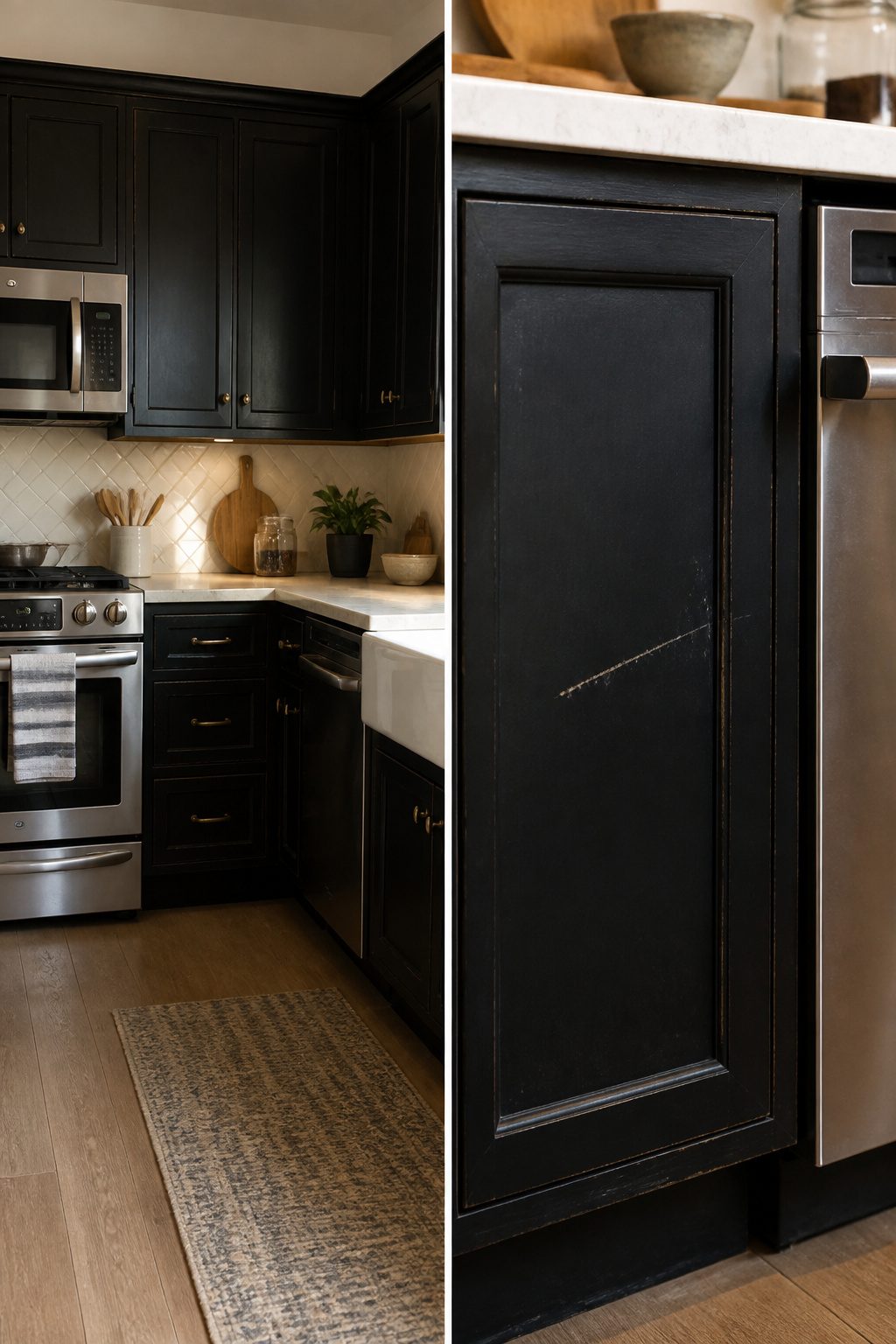
Black paint and thermofoil share a single weakness on cabinets: any chip or scratch opens a window straight to the substrate underneath, and that light-colored core screams against the surrounding darkness.
On a white or pale gray cabinet, the same damage hides in plain sight. On black, the contrast turns a fingernail nick into a headline.
The repair problem runs deeper than visibility. Touch-up paint on black rarely matches the original film thickness or sheen, so the patch catches light differently and reads as a scar.
Painted MDF fares worst; once the face is breached, the fuzzy brown core soaks up moisture and swells, and there is no grain structure to sand back to.
Painted hardwood offers slightly more forgiveness because the substrate itself is solid, but you are still working with an opaque coating that shows every brush mark.
Black-stained oak, by contrast, carries color down into the grain rather than floating on top, so a light sanding and reapplication can blend a worn spot back into the field.
The texture of the wood itself breaks up the light and softens the black while it hides the sin.
For a kitchen that sees daily hard use, I would take stained wood over painted MDF every time, and I would think twice about thermofoil in black no matter the price point.
Steam and Water Damage
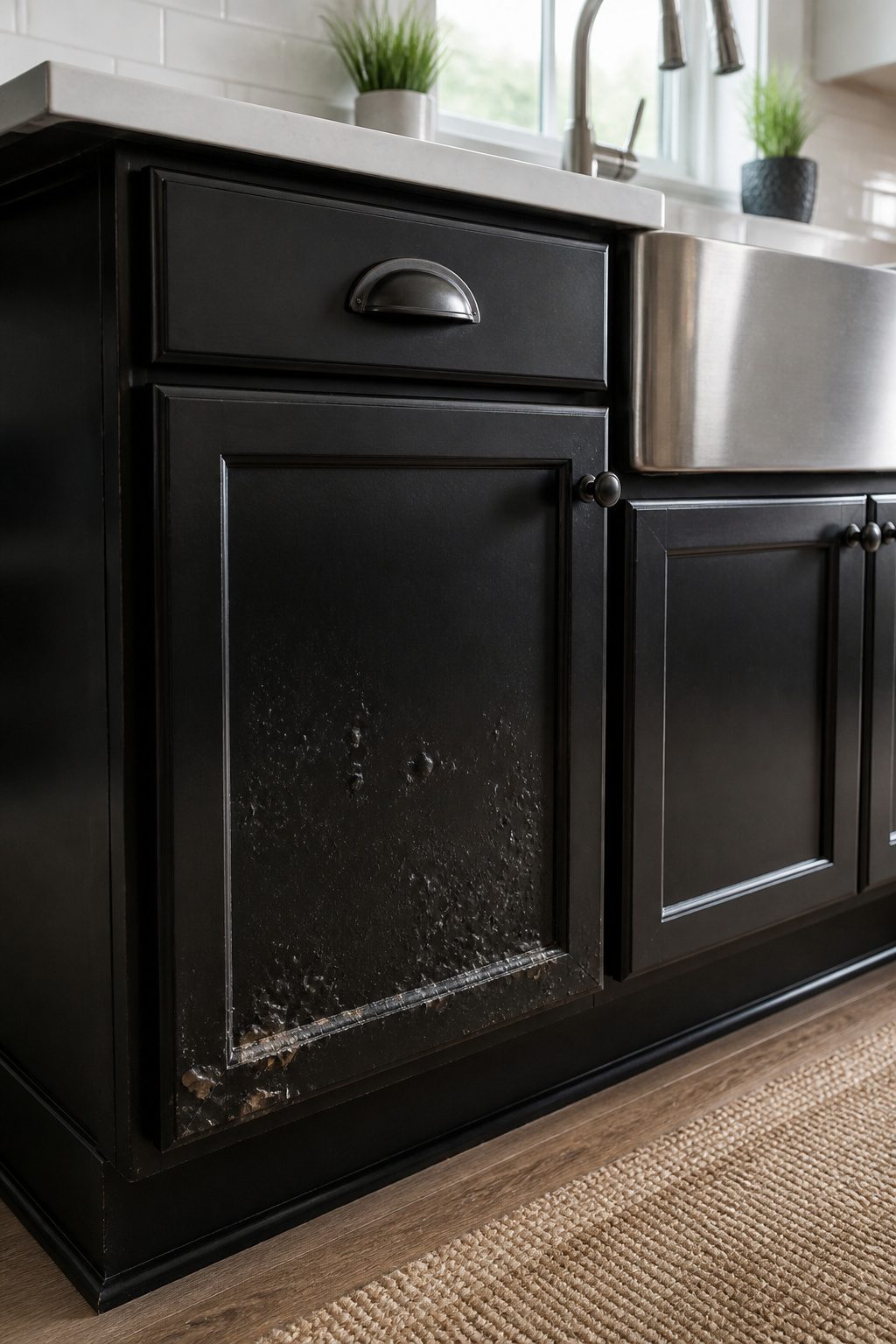
Moisture finds the seams first. On black kitchen cabinets, film finishes lift in pale bubbles that the dark paint turns into spotlights, so a dime-sized flaw reads like a palm print from across the room.
The damage clusters where steam rises and water splashes: the sink base, the dishwasher front, the cabinets flanking the range.
Heat accelerates it; the cooktop sends repeated pulses of damp air upward, and over months the adhesive under the finish softens and lets go.
Dark colors do not forgive the way white or cream might. The same bubble on a pale cabinet catches light and sometimes hides; on black, the lifted edge casts its own tiny shadow.
The risk is placement, not the color itself, but the color decides whether you notice in time to dry the surface or only after the repair needs sanding, filling, and a touch-up that rarely matches.
If you are set on black, the cabinets closest to your sink and range deserve the most water-resistant finish you can specify, or at least the most frequent wipe-down.
Recommended Products

Ample Storage Space: The buffet cabinet features 3 doors and 2 drawers to meet your various needs. The spacious top offers easy access to items, the convenient drawers help keep cutlery neatly organized, and the cabinet interior includes a shelf, providing generous space for storing mugs, spare tableware, and other essentials.
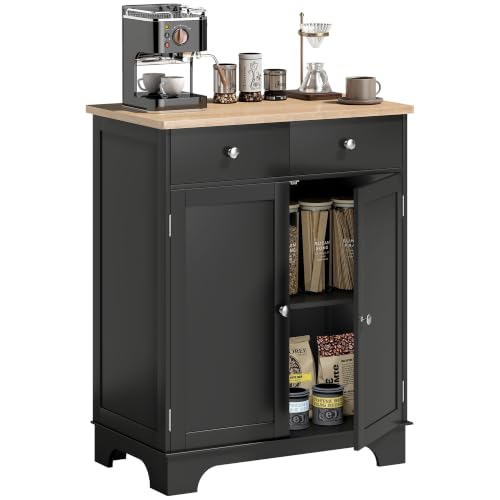
Roomy Storage: This buffet cabinet utilizes 2 large drawers for utensils or napkins and 2-tiers offering storage space for plates, plastic containers, pots, or pans. Keep organized behind doors so your items stay safe and dust-free. The shelf inside is 3-level adjustable to meet various storage needs.
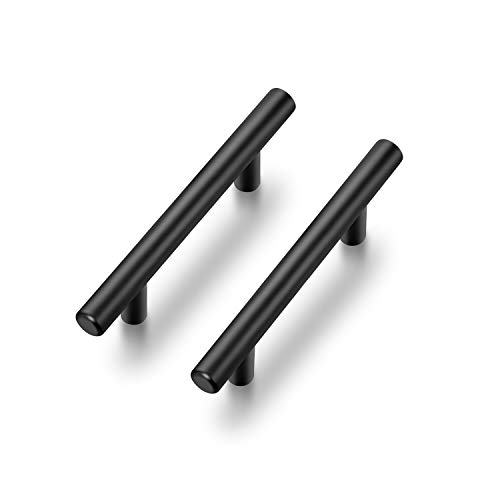
365-Day Evaluation: We believe you'll find value in your Ravinte handles. Use them for a full year, and if they don't meet your needs, we're here to help
Black-Stained Wood as Alternative
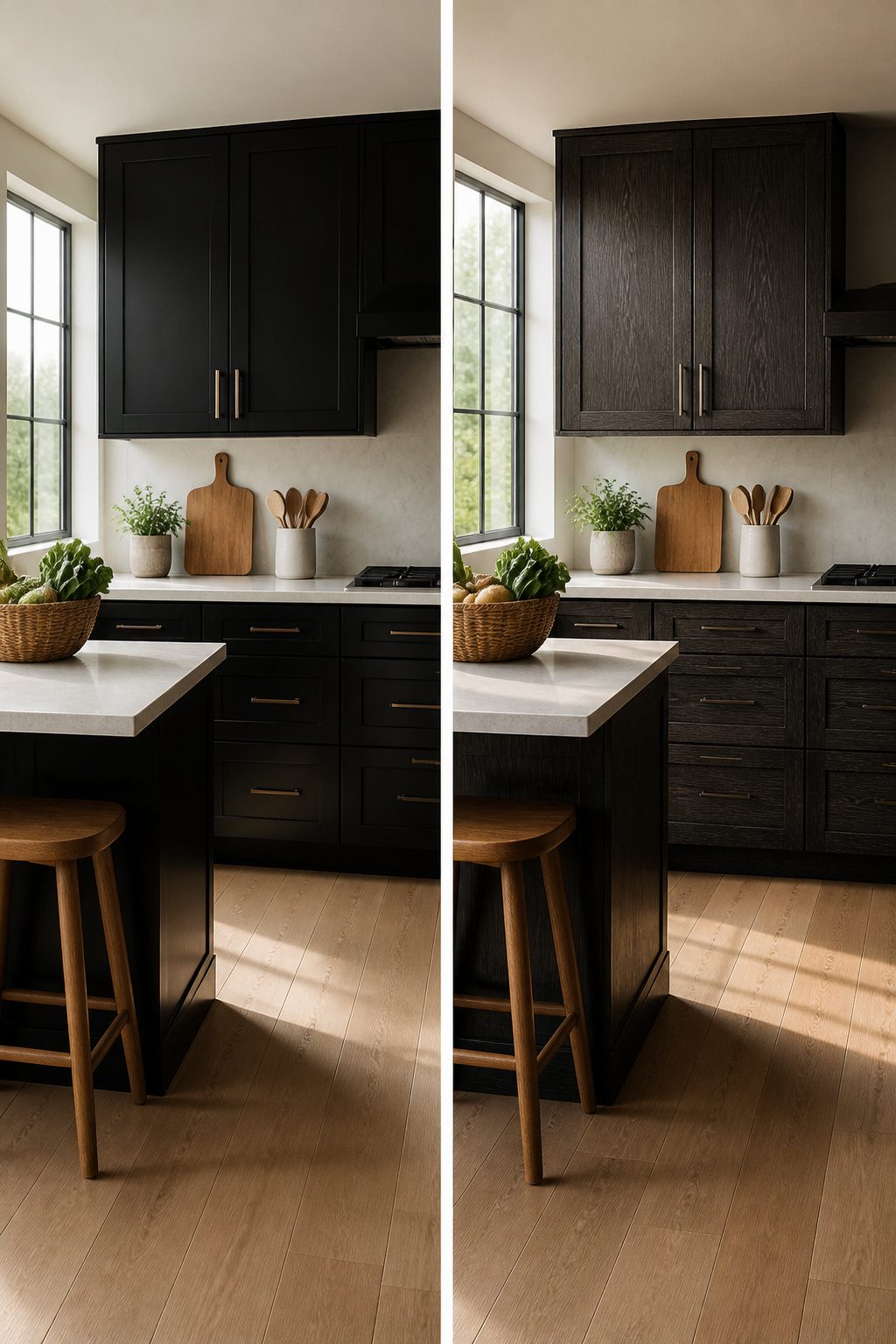
Black stain on wood cabinetry gives you most of the drama of black kitchen cabinets while keeping something paint strips away entirely: the grain.
That texture catches light unevenly, which breaks up the surface and hides the small scuffs and grease marks that read as spotlights on a solid painted finish. The wear you accumulate in a high-traffic kitchen simply disappears into the pattern.
Oak, ash, and walnut all take black stain well. Oak and ash carry pronounced open grain that stays visible even at a deep tone, giving you the strongest texture.
Walnut starts darker and denser, so the effect reads more subtly, closer to a soft matte black from a few feet away.
The practical difference from paint shows up when you need a touch-up.
Stain penetrates the wood, so a worn edge or corner can be refinished locally without the telltale buildup of a brushed-on paint patch. Over years of use, that matters more than most people predict at the selection stage.
Stain gives you control.
Paint gives you an exact, uniform color. Stain varies with the board, the grain density, and the number of coats.
If you need the kitchen to read as a single deliberate block of color, paint wins. If you want the space to stay warm and forgiving, stain is the smarter route.
Recommended Products
Exclusive design: This color blocked handle comes in two options: black gold and black silver. You will be surprised to find that small changes like these handles can change the atmosphere of your house.
Exclusive design: This color blocked handle comes in two options: black gold and black silver. You will be surprised to find that small changes like these handles can change the atmosphere of your house.

[Responsive Customer Support]: Our aftersales will respond to all product inquiries within 24 hours, ensuring a worry-free service.
Design Ideas That Balance Black
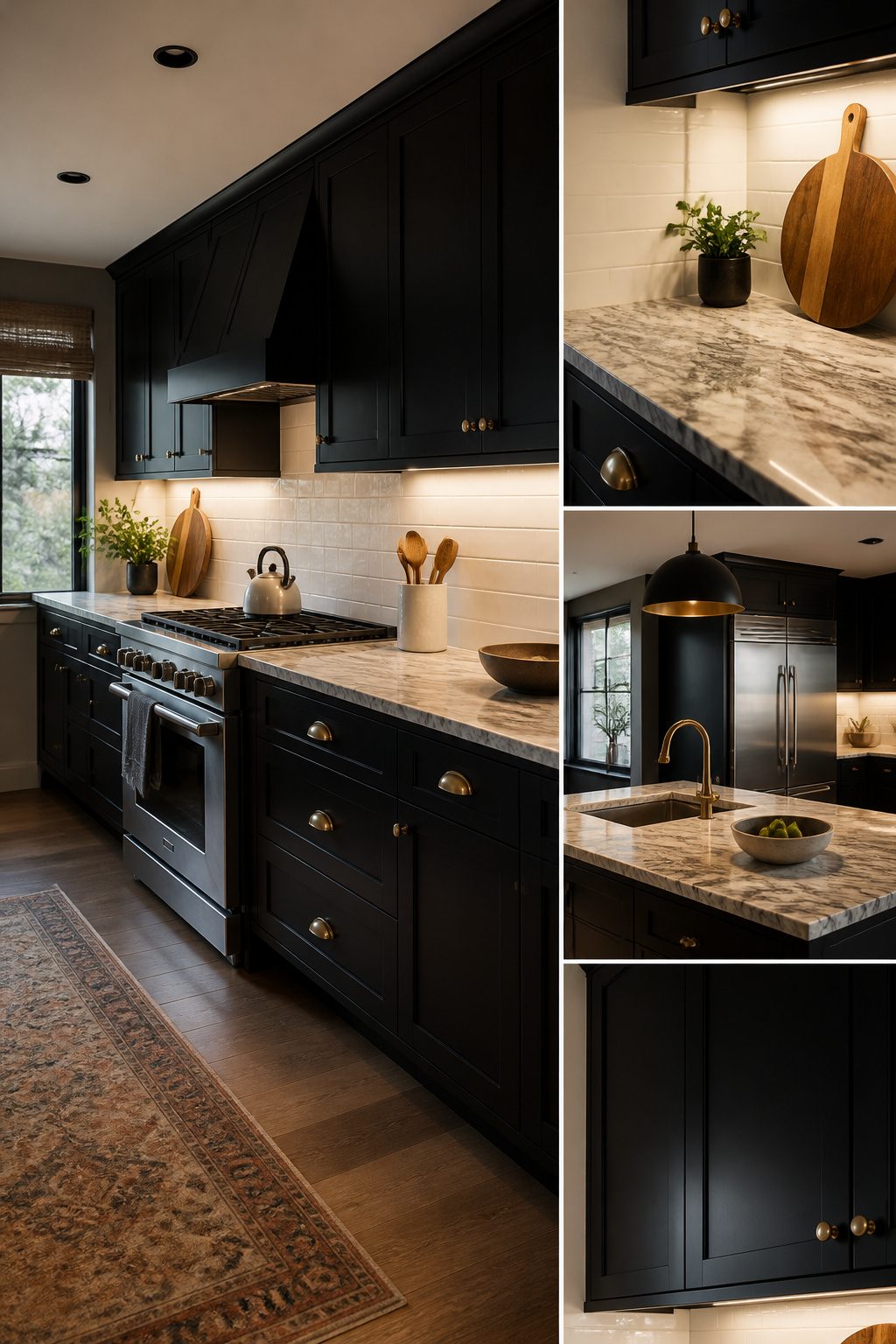
Black kitchen cabinets swallow light, so the room needs a deliberate strategy to stay usable. Task lighting under the cabinets is non-negotiable; without it, the lower counters read as a dark slot even at noon.
Pair that with a backsplash that reflects rather than competes. Glossy subway tile or a pale stone with subtle veining bounces light back up into the space, and the contrast keeps the black from flattening into a solid wall.
A matte black backsplash against black cabinets is a combination I would skip; it reads as sophisticated in photographs and as a cave in daily use.
Countertops should complete the lift, not add to the weight. White quartz or a light natural stone with movement gives the eye somewhere to rest.
I prefer a surface with some variation; a single-tone white can feel clinical against the drama of the cabinets, but anything mid-tone or darker starts to close the room in.
Hardware finishes are where I let the black do the work.
Brushed brass or unlacquered copper catches light and warms the whole composition, whereas matte black hardware on black cabinets disappears entirely and costs you the dimensional detail that makes the choice look intentional rather than default.
If the upkeep of solid black paint gives you pause, black-stained wood offers the same visual weight with a softer edge.
The stain keeps the grain visible and adds texture that helps the finish read as warm rather than severe, and minor wear blends in more forgivingly than it would on a solid painted surface.
Recommended Products

【Product Size】:Center-to-Center=5 inch(128mm); Length=6.4inch(164mm);Projection=0.7 inch(18mm),Diameter:0.7inch(18mm)

Material: FULGENTE cabinet pulls combine a zinc alloy base with a stainless steel tube core, finished in matte black or brushed brass. High grade materials and finish make it sturdy, durable and rust resistant, ensuring long service life

RASIYA ART KNOBS: Visit our storefront, by clicking on "Visit the Rasiya Art Store" below the title to have a glimpse of our collection
Maintenance Routine
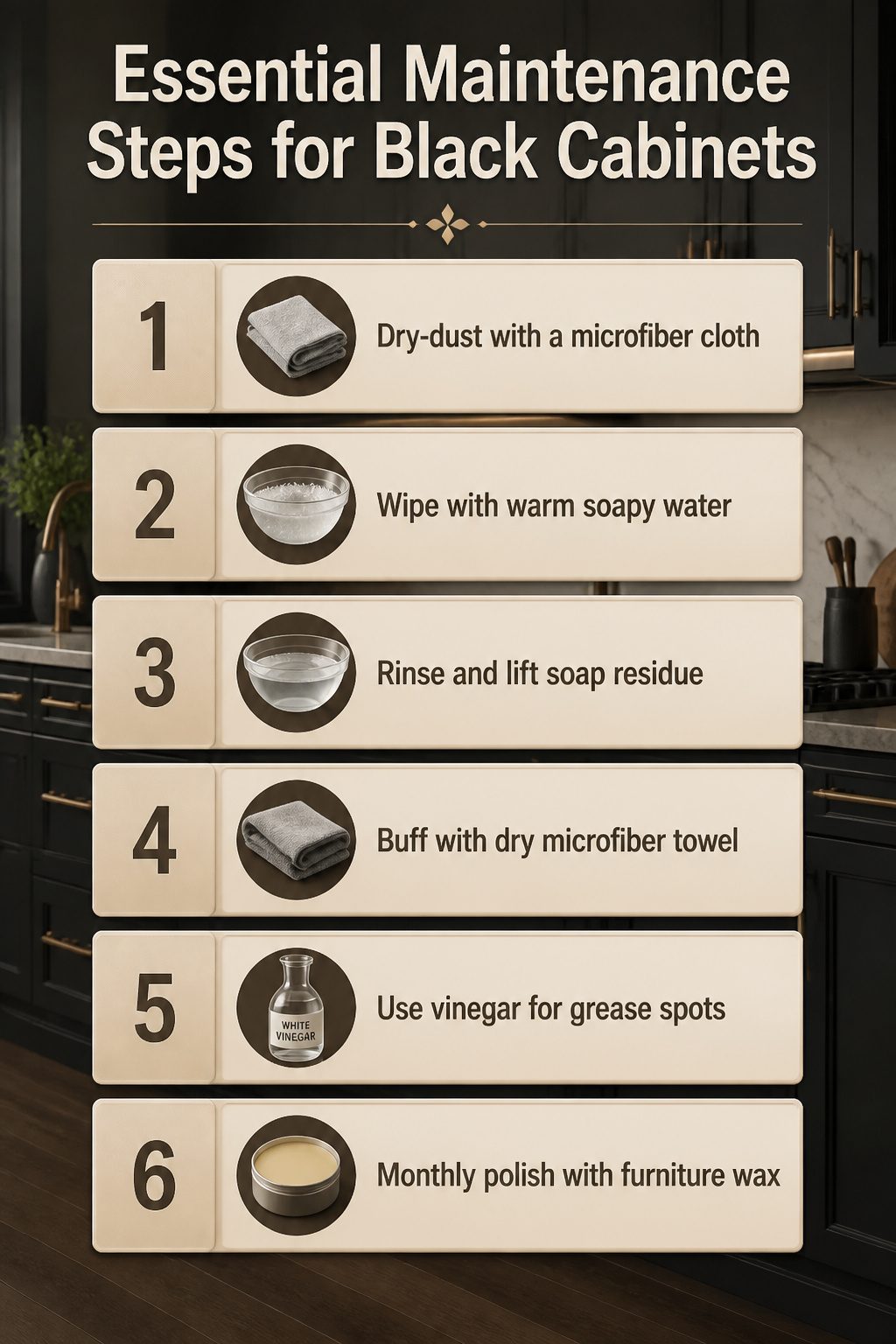
- Dry-dust the fronts and frames with a clean microfiber cloth every few days. Black paint shows lint fast, and skipping this step pushes debris into the finish when you wipe it wet.
- Mix a drop of mild dish soap into warm water. Dip a fresh microfiber cloth, wring it until it is barely damp, and wipe with the grain of the door, not in circles. Circles catch light and read as streaks on dark paint.
- Rinse the cloth, wring again, and go over the same area once to lift the soap. Left-behind film turns greasy within a week on black.
- Buff immediately with a dry microfiber towel. Standing water swells seams and leaves water marks that read as pale half-moons under overhead lighting.
- For grease near the range, add a small splash of white vinegar to the damp cloth. It cuts oil without the ammonia that degrades cabinet coatings over time. Rinse and dry after.
- Polish monthly with a thin layer of furniture wax on a soft cloth, then buff off. This fills micro-scratches before they collect grime and dull the black to charcoal.
Recommended Products

Versatile Storage Solution: This storage cabinet, available in black and white, features two doors and offers ample space for organizing various items. It is suitable for office supplies, non-perishable food, and miscellaneous belongings

All-Inclusive Track Package: This sliding door track system includes 2 upper tracks (13/16" W x 11/16" H x 36" L) and 2 lower tracks (13/16" W x 5/16" H x 36" L). With this complete set, you can easily set up your sliding door system without the hassle of sourcing extra parts.
All-Inclusive Track Package: This sliding door track system includes 2 upper tracks (13/16" W x 11/16" H x 48" L) and 2 lower tracks (13/16" W x 5/16" H x 48" L). With this complete set, you can easily set up your sliding door system without the hassle of sourcing extra parts.
Frequently Asked Questions
Recommended Products

THICKNESS AND COVERAGE: The NEROLI HOME roll is designed with a durable, Thick vinyl construction, measuring 17.3 inches wide x 118 inches long. This generous size is ideal for comprehensive DIY projects, simplifying installation and providing ample coverage. Features handy Trimming Gridlines on the backing for accurate, error-free cutting.

Set of 2 Sizes Kitchen Utensils Holder: Our utensil crock set includes two size for your kitchen accessories. The larger holder, measuring H7.08" x D4.72", is designed to comfortably store around 12 spatulas or utensils. In contrast, the smaller holder, at H6.49" x D4.13" is suited for organizing 12 sets of silverware.

【Ample Storage Space】This spacious pantry storage cabinet offers organized storage with its upper cabinets for dinner plates and dishes, a 41.5" bar for small appliances or decorative items, and lower drawers and cabinets for snacks, tableware, and alcohol, ensuring a neat space and easy access to your essentials.
Are black kitchen cabinets still in style?
Yes. Black functions as a true neutral rather than a trend color, so cabinets installed in 2015 still read as current in 2025.
The finish signals custom work and an upscale eye, and it photographs well for resale listings because cameras pick up the contrast and depth without styled vignettes.
What are the cons of having black cabinets?
They show every mark: skin oils, water spots, flour dust, and fingerprints all stand out against the dark surface.
Any chip or scratch opens to a light-colored substrate that screams against the black, and touch-up paint rarely matches the original sheen. Steam and water damage also show as pale bubbles that read as spotlights on the dark surface.
How do I maintain black kitchen cabinets?
Dry-dust every few days with a clean microfiber cloth. Wipe with a barely damp cloth in straight lines with the grain, not circles, then rinse and buff dry immediately.
For grease near the range, add white vinegar to the damp cloth. Polish monthly with furniture wax to fill micro-scratches before they collect grime.
Are black kitchen cabinets a good idea?
They work well if you value dramatic aesthetic impact and can commit to regular cleaning.
Black grounds a room and pairs effectively with brass hardware, white countertops, and natural wood accents. The choice falters in households that let mess accumulate, since the color turns every smudge into a visible announcement.
What kitchen cabinet colors will look outdated in 2026?
Gray kitchens already signal their era; the warm gray of 2012 and the cool gray of 2018 both read as fixed to their moments.
Oak with golden honey tones carries the same problem from the 1990s. Black avoids this because it functions as a true neutral that does not clash when hardware, walls, or accessories change.
What makes a kitchen look cheap?
Black cabinets expose cheap countertops and careless hardware choices because the finish demands the rest of the kitchen keep up.
The color itself reads as upscale, but pairing it with low-quality companions undercuts the effect. Builder-grade defaults settle for safe choices; black reads as intentional only when the surrounding materials match that level of deliberation.