
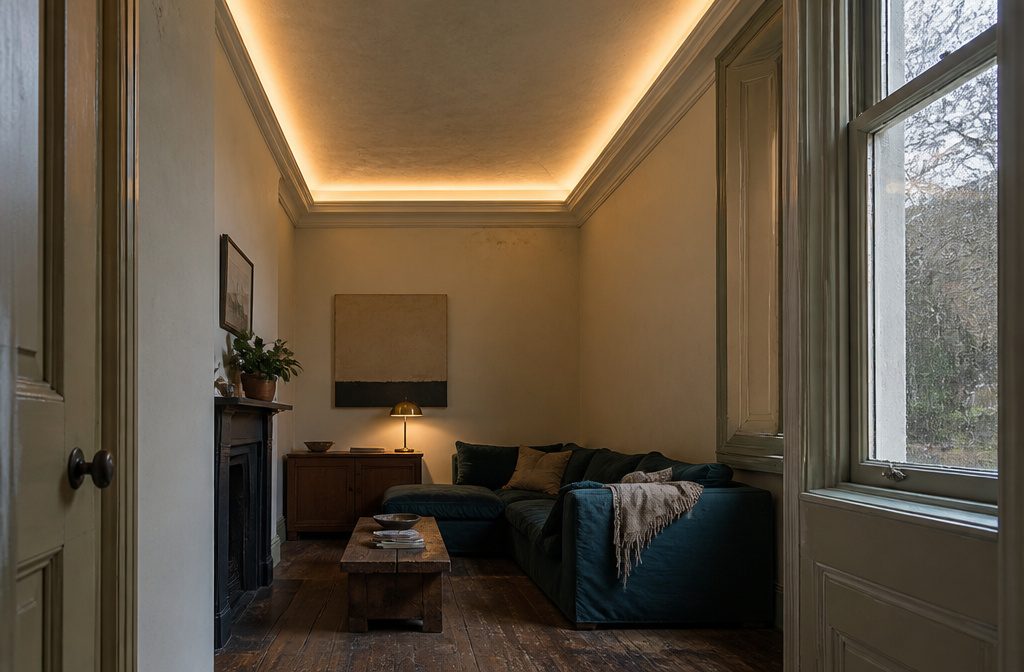
A coffered ceiling needs 8 feet of height to avoid compressing the room, while fabric draped from a medallion reverses in an afternoon if you’re renting.
The choice sits between permanent structure and temporary softness, and ceiling height decides which track is open before you pick a style.
Recessed LED strips along a tray ceiling want warm white to avoid reading clinical.
Metallic leaf needs 30 to 60 minutes of tack time before you lay the sheets, and a skylight is a structural project that requires an engineer before you cut into the roof.
1. Coffered Ceiling
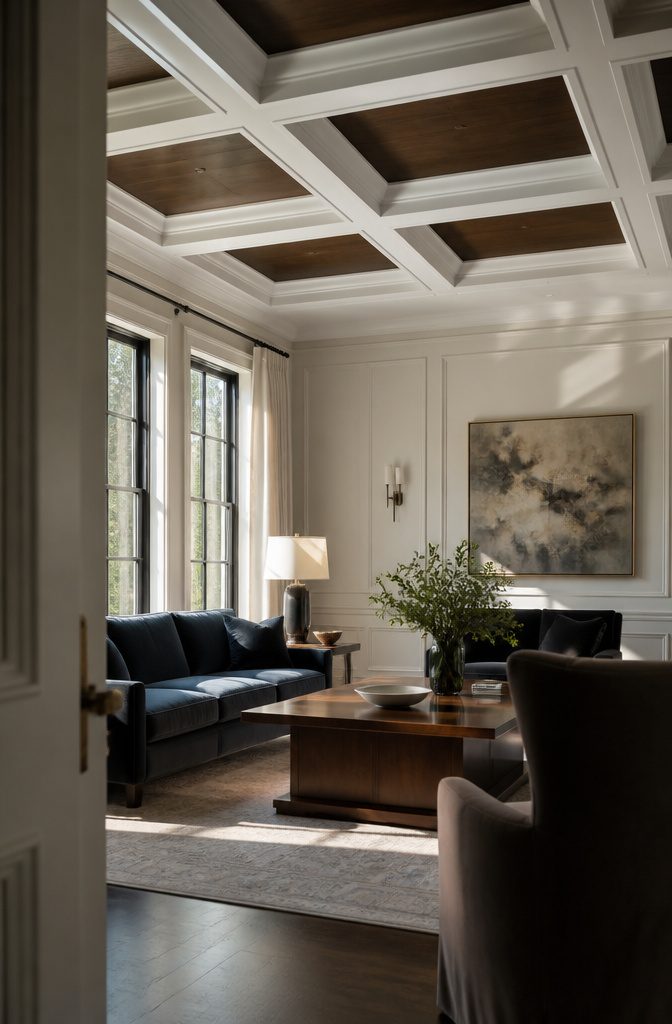
A grid of recessed panels adds architectural depth the moment you walk in.
Coffered ceilings work by creating shadow — beams frame sunken squares or rectangles, and the play of light throughout the day gives a flat plane structure it didn’t have before.
The look is formal and structured, which suits traditional and transitional rooms that lean into symmetry.
Crisp white grids with contrasting interiors — deeper paint or wood finishes like walnut or cherry — anchor the formality. Pair that with velvet upholstery and polished furniture, and the room reads refined without needing much else.
Ceiling height decides whether this works. Coffers need at least 8 feet to avoid making the room feel compressed.
High ceilings handle the grid easily and turn it into a focal point. Anything lower, and the recessed structure pushes down rather than lifting the space.
2. Tray Ceiling
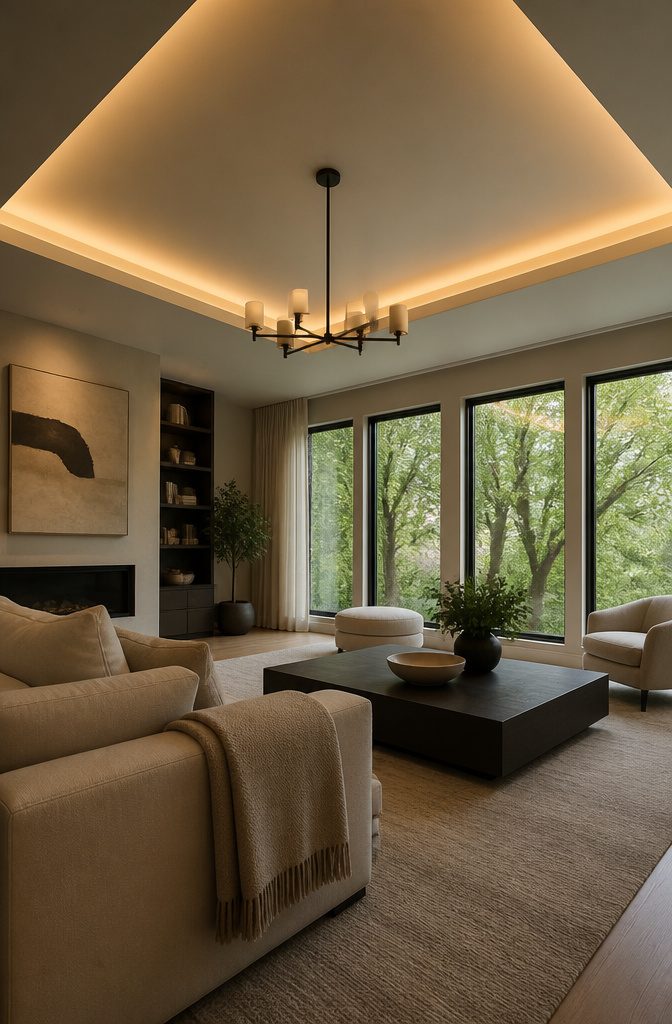
A raised center panel adds vertical volume without touching the floor plan. The step up—typically eight to twelve inches—creates a frame that you light from behind rather than inside, and the room reads taller than its actual height.
The layered edge is what shifts the mood: mount warm white LED strips along the inner lip of the recess, and the ceiling glows without a visible source.
Warm white matters here. Cool LEDs turn the effect clinical, more dropped-tile office than living room.
The recessed panel can stay the same color as the outer ceiling or go a shade darker to deepen the contrast. Darker reads more dramatic; same-color keeps it quieter.
Either way, the architecture does the work before you hang a single fixture, and the ambient wash from the hidden strips means you can dim overhead lights without losing the room’s sense of space.
3. Vaulted Ceiling
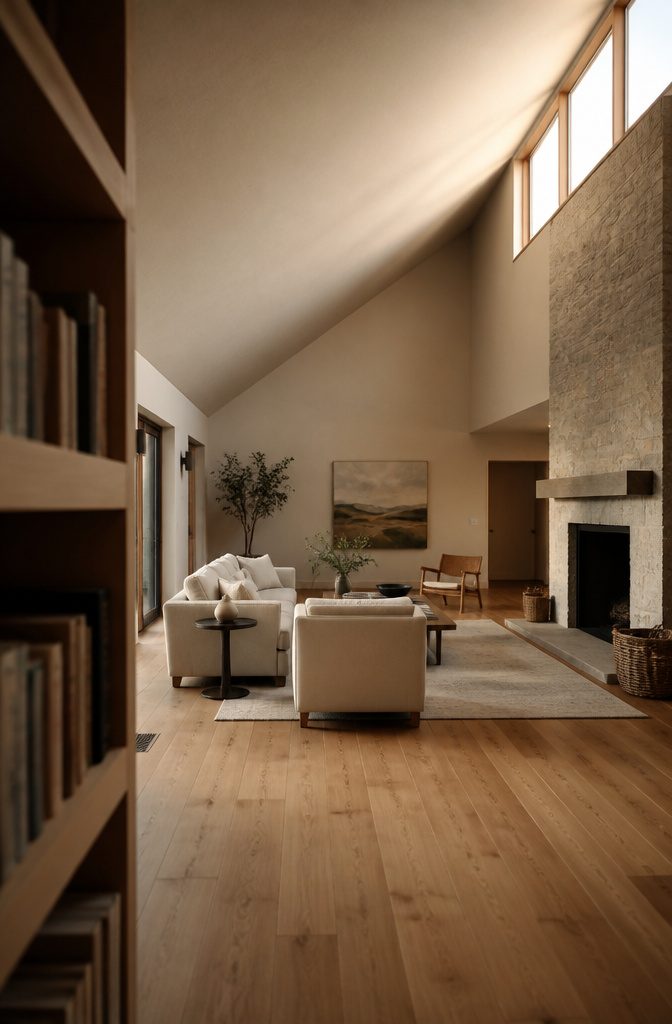
A vaulted ceiling pulls the eye up along a slope or arch, and that lift changes how the whole room reads.
The upward line opens vertical space most living rooms never use, so a sixteen-foot room suddenly feels twice as tall as the flat-ceiling version next door.
The arc itself softens the geometry—less boxed-in than a standard ceiling, more cathedral than suburban.
The shape you pick depends on what the room already has. A symmetrical barrel vault works in a square or near-square living room, centering the curve over a fireplace or seating area.
Asymmetrical vaults and shed ceilings suit rectangular layouts, running the slope along the long axis so the room stretches rather than just rises.
Groin vaults—two barrel vaults crossing—need width in both directions, or the intersecting arches crowd each other and the drama turns claustrophobic.
4. Exposed Wood Beams
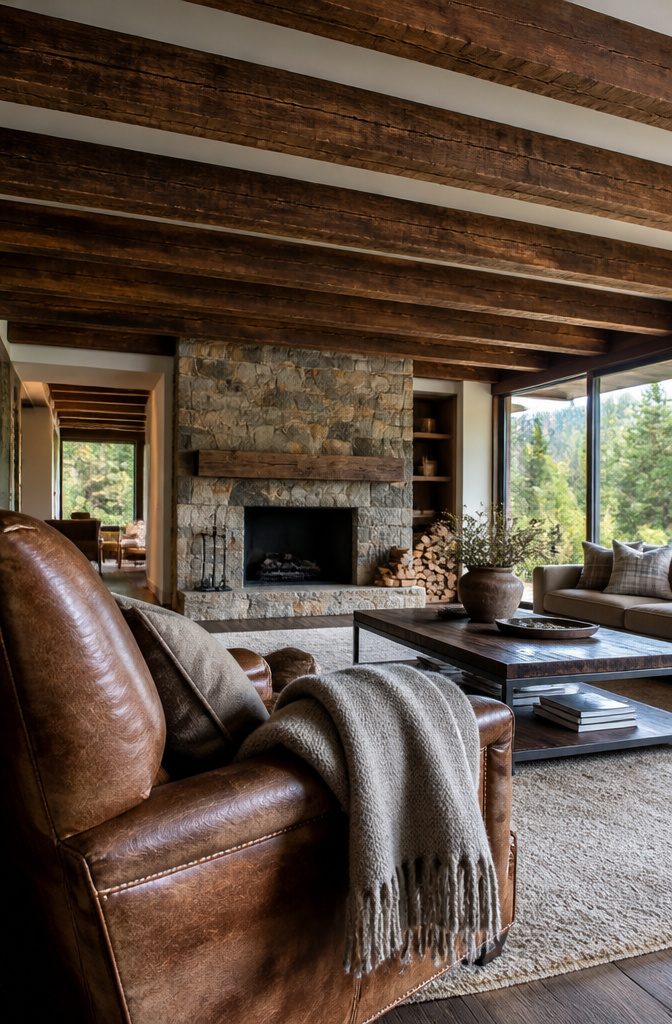
Exposed beams bring a grounded, organic feel that balances out polished finishes elsewhere in the room.
Reclaimed timber carries the most character—nail holes, saw marks, and color variation from decades of weathering—but it also costs more and takes longer to source.
New beams stained in dark walnut or rich cherry give you the same visual weight without the hunt, and they install faster since the dimensions are predictable.
Installation usually runs two to three days for a standard living room, depending on ceiling height and whether the beams are structural or decorative box beams.
Box beams go up lighter and quicker, but solid timber reads as more substantial when you’re standing underneath it. The choice comes down to whether you want the room to feel like a restored barn or a tailored lodge.
5. Painted Ceiling
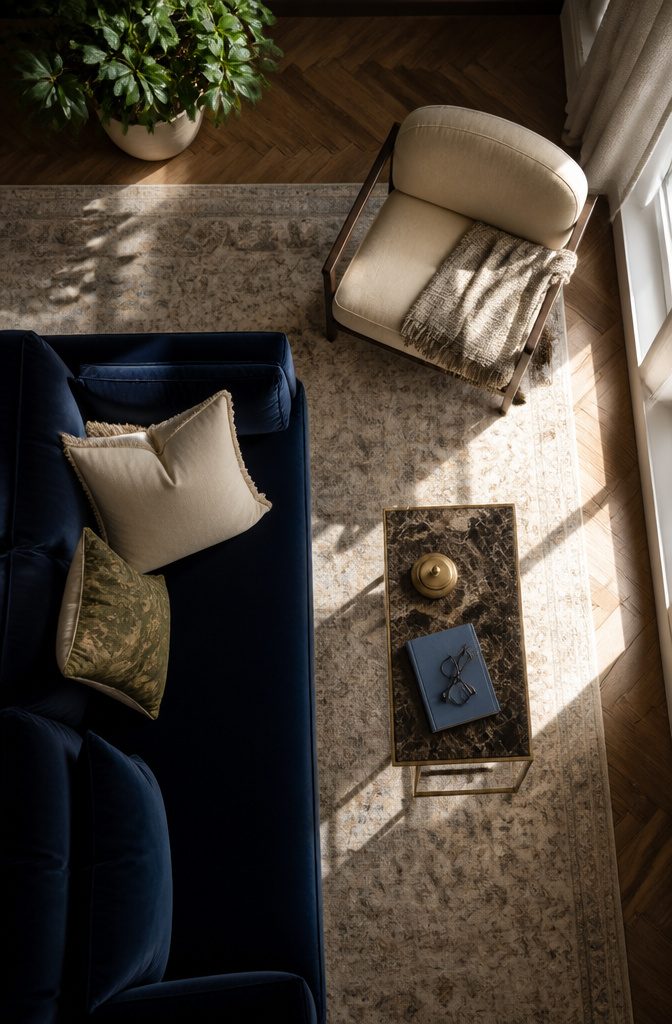
A deep color overhead—forest green, charcoal, ink blue—pulls the room into a different register. Navy, emerald, and sapphire sit at the luxury end, because the depth reads as deliberate rather than safe.
The color changes how tall the room feels.
A dark ceiling lowers the perceived height and makes a large room feel more intimate, which works when you want enclosure rather than airiness. Light walls against a dark ceiling keep the effect from turning heavy.
This wins in rooms with good natural light. A dim room with a dark ceiling can feel closed in instead of cozy, so run the approach past the daylight the space actually gets before committing to the paint.
Bring the color partway down the crown molding instead of stopping it flat at the ceiling line.
The wrap effect makes the treatment feel finished rather than abandoned mid-thought. A brass or metallic fixture overhead catches light against the dark backdrop and gives you a second focal point without fighting the ceiling for attention.
6. Ceiling Mural
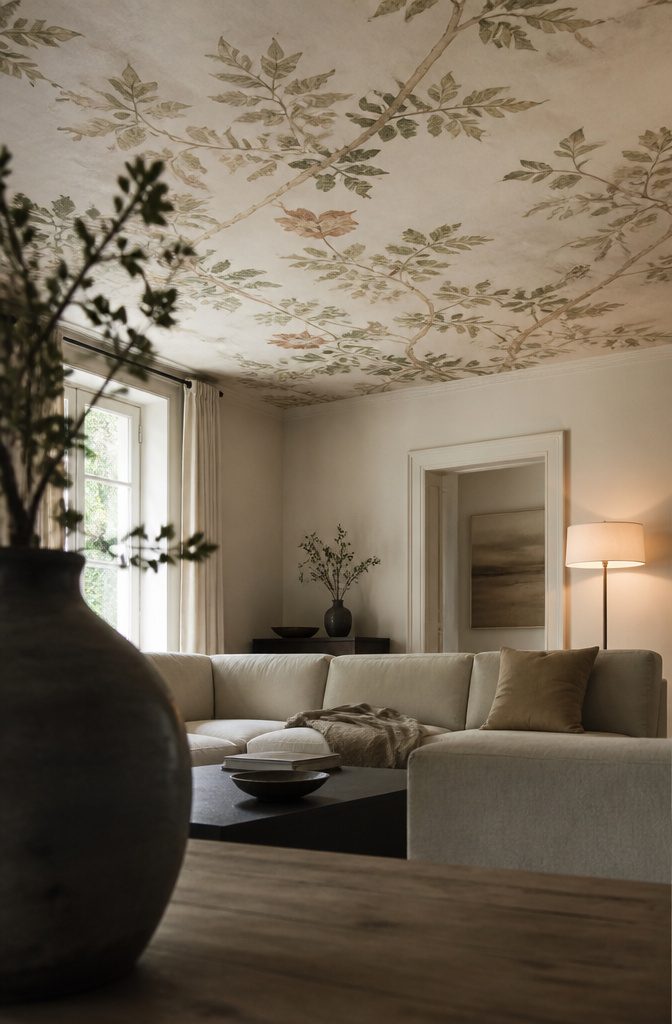
A painted mural overhead is the closest thing to wearing art. It’s slow to plan, slower to execute, and the kind of detail that guests notice on their second visit, not their first, once they finally look up mid-conversation.
Clouds and sky scenes work in almost any room. Botanical patterns suit contemporary spaces, and abstract designs bring drama without locking you into a particular style.
The subject matter sets the tone: celestial skies read tranquil, intricate botanicals feel collected, and bold abstracts command attention the moment someone walks in.
Scale matters more than most people expect. A mural should echo the room’s existing palette, pulling colors from your rug or art rather than introducing a competing scheme.
Keep the rest of the room subdued—plush seating, soft lighting—so the ceiling stays the focal point instead of fighting for it.
7. Wallpapered Ceiling
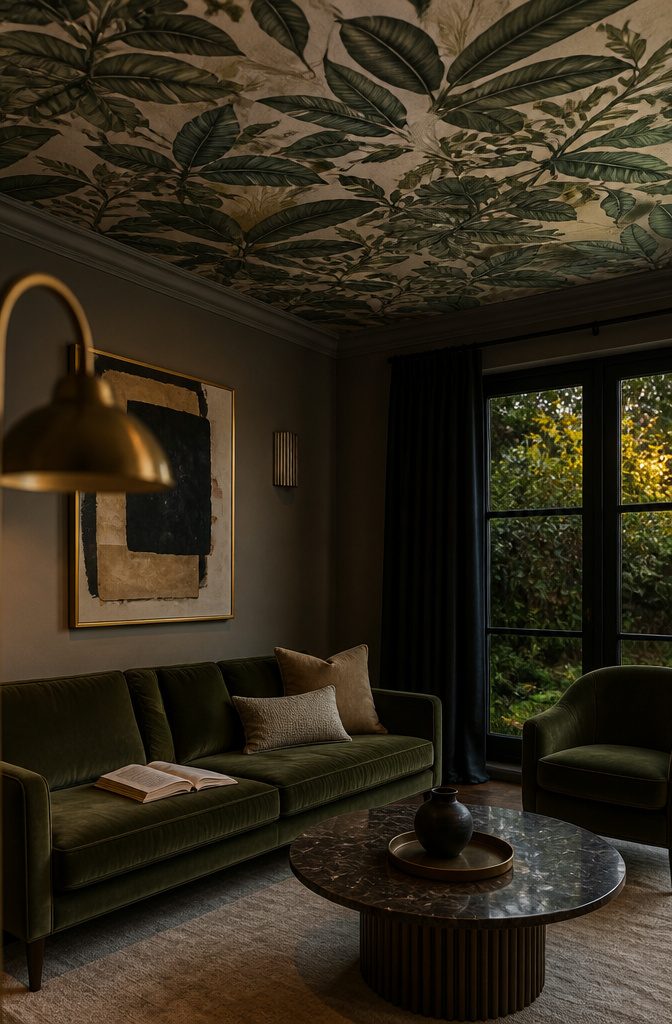
Wallpaper overhead changes the room’s character in ways paint cannot.
Grasscloth brings warmth and a natural, understated texture that softens hard edges. A bold botanical print turns the ceiling into a lush, romantic layer—the room feels like a garden room at dusk.
Metallic geometric patterns push the space toward formal and evening, the kind of ceiling that reads as glamorous under low light.
Pattern scale decides whether the ceiling recedes or demands attention. A small, tight repeat keeps the eye moving; a large-scale pattern anchors the room and drops the ceiling visually, which works when you want intimacy rather than height.
Material texture matters as much as the print.
Grasscloth has a woven, dimensional surface that catches light differently than flat paper. Metallic-flecked wallpaper reflects light and adds a subtle shimmer that shifts as you move through the room.
Hang it with a helper. A ceiling roll wants to fold on itself the second you look away.
8. Mirrored Ceiling Panels
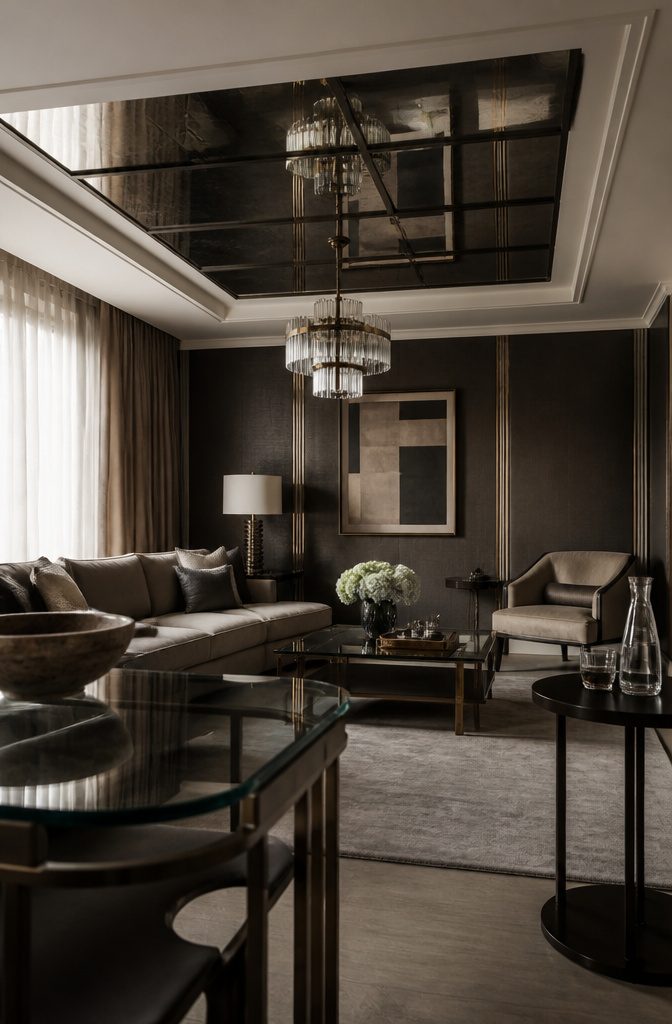
Mirrored panels work in careful doses. A fully reflective ceiling overwhelms most rooms, but panels set into a coffered grid or a single central feature bring the drama without turning the space into a funhouse.
Antiqued mirror reads especially rich—less showroom, more inherited apartment—and the smoky finish softens what could otherwise feel cold.
Reflection changes how a room reads.
Light bounces back down, which helps in darker spaces, and the ceiling height appears to double. That lift works best in contemporary or Art Deco layouts where sleek furniture and glass surfaces already play with shine.
Installation is not a weekend project.
The ceiling structure has to carry the weight, panels need overhead ratings rather than wall-mount specs, and the hardware should be installed by a professional. Skip the DIY tutorials on this one.
9. Fabric-Draped Ceiling
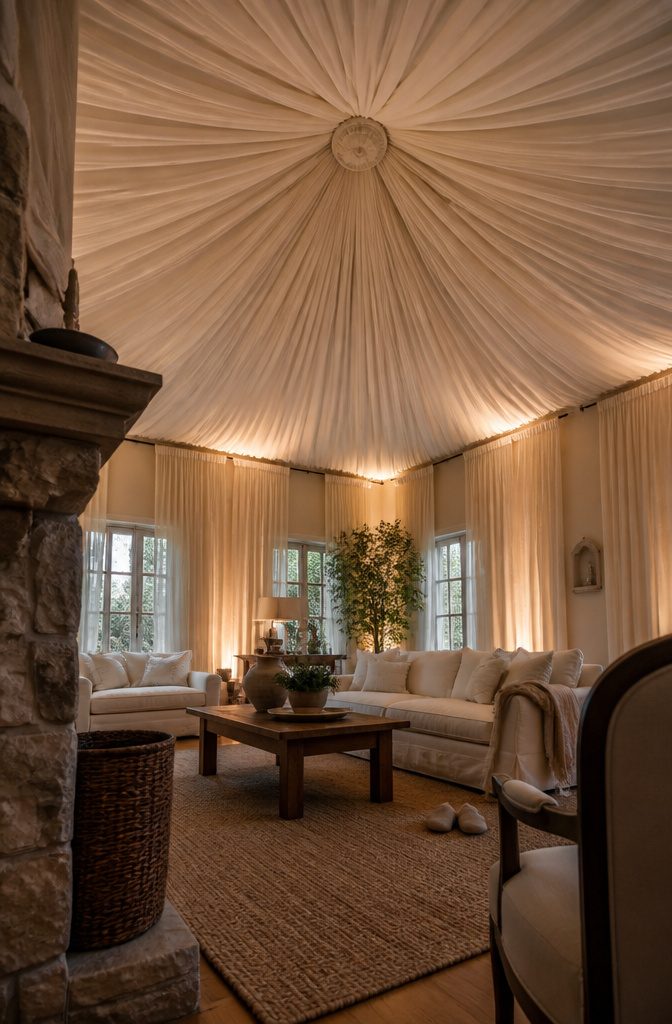
Fabric draped overhead pulls the hard edges off a room faster than anything else you can do in an afternoon.
Sheer fabrics like voile or silk blend read as ethereal when they catch light, while heavier linen or chiffon adds tent-like intimacy that brings the ceiling down without actually lowering it.
The effect skews romantic or bohemian depending on how you anchor it — panels radiating from a center medallion feel old Hollywood, loose swags pinned at intervals look more global and relaxed.
The acoustic change is real. Fabric absorbs sound where drywall bounces it back, so a draped ceiling takes the echo out of a room with too much glass or stone.
It also softens the mood in a way paint alone never does; texture overhead makes people look up less and settle in faster.
This works for renters because it’s reversible.
Anchor at a medallion, run the panels outward to picture-rail height, and steam the wrinkles out after hanging. Uplighting from the floor makes the fabric glow and hides the seams where panels meet.
10. Geometric or 3D Ceiling Panels
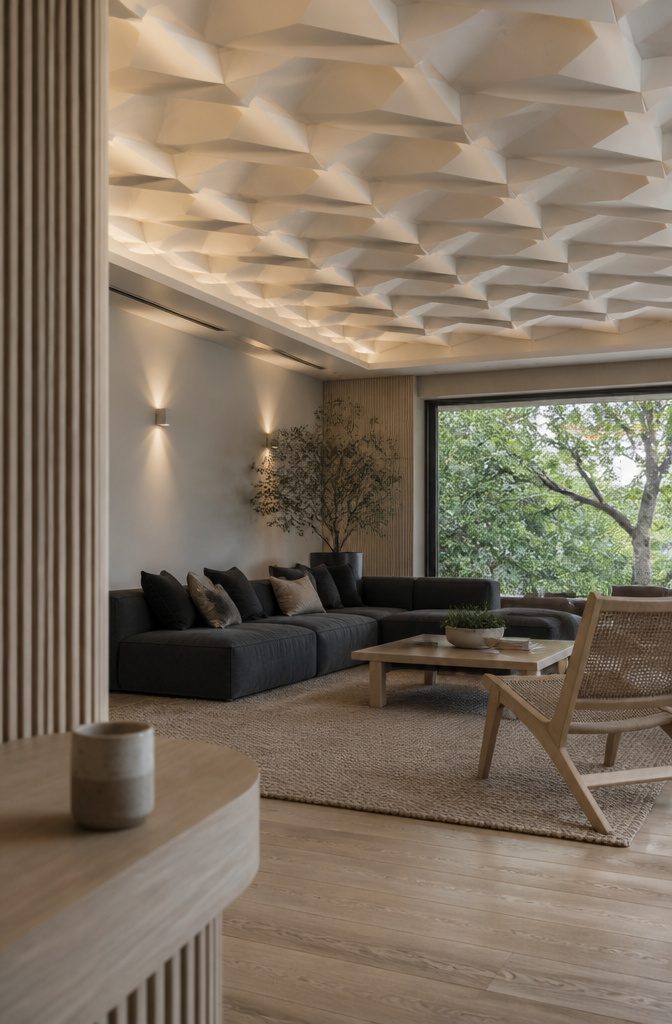
Geometric panels build a contemporary pattern overhead, creating depth through shadow rather than color. Wood, MDF, and metal are the usual materials, installed piece by piece in repeating shapes that read differently depending on where light hits them.
The depth of each panel controls how much shadow forms, and a shallow relief disappears under direct downlighting while a deeper profile holds its lines even in bright rooms.
Layout matters as much as depth.
Alternating panel orientations or mixing materials within the grid breaks up visual monotony without adding clutter, and the rhythm you set—tight versus loose spacing—changes whether the ceiling reads as busy or as calm.
Side lighting from wall-mounted fixtures brings out the three-dimensional effect; straight-down recessed lights flatten it.
Paintable versions exist if you want the texture without introducing a new color, and they take finish coats the same way trim does.
The style fits modern and industrial rooms best, where minimalist furniture keeps the focus overhead instead of competing with it.
11. Metallic or Decorative Ceiling Panels and Tiles
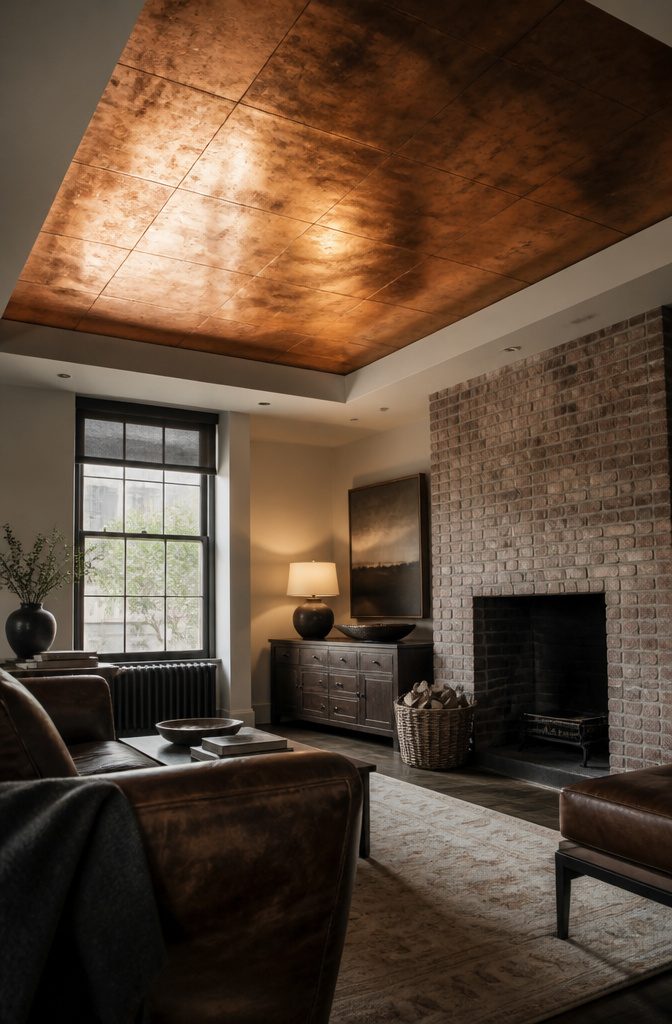
Metallic panels catch light in a way flat paint can’t match, and covering the whole ceiling isn’t necessary to get the effect.
One recessed panel or a single tray ceiling section gives you the shimmer without the cost of leafing an entire room. Copper leaf warms the space; silver leaf cools it—the difference in color temperature is immediate under lamplight.
If you’re applying leaf yourself, brush adhesive size onto the panel and wait 30 to 60 minutes until it goes tacky.
Lay the sheets down with a slight overlap at each edge, brush off the excess, and seal with clear varnish. Tin tiles work the same way but arrive prepressed with ornate patterns.
Polished silver reads industrial, antique copper adds warmth, and painted white keeps the detail without the metallic shine. Pressed tin pairs well with exposed brick or distressed leather if you’re leaning into vintage or loft aesthetics.
Textured panels without any metallic finish still add depth—they create shadow lines that shift with the light angle in the room, especially when lit from the side rather than straight overhead.
12. Integrated, Hidden, or Recessed Lighting
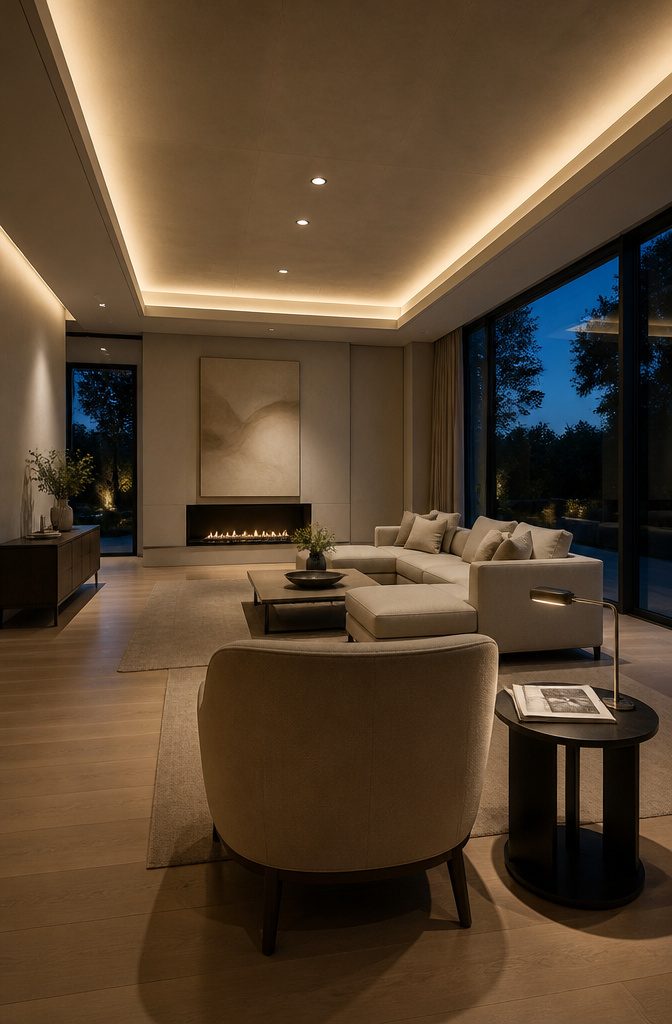
Recessed lights dropped into a grid or arc across the ceiling read modern by default, but their real work is controlling how the room reads after dark.
Dimmable LEDs let you shift from full brightness for cleaning to a low glow that softens every surface, and that range matters more than the fixture itself.
Place them to graze textured panels or coffers and the ceiling gains depth it doesn’t show under flat overhead light.
Hidden strip lighting along a tray ceiling or behind crown molding creates ambient wash without a visible source, which works when you want the architecture to stay quiet.
Warm white LEDs hold up better in a living room than cool white, which tends to flatten the space and feel institutional.
Backlit panels take the idea further—programmable color shifts if you want them, though most people set one tone and leave it.
The effect is soft luminescence rather than directed light, and it pairs cleanly with low-profile furniture that doesn’t compete for attention.
13. Plasterwork and Molding
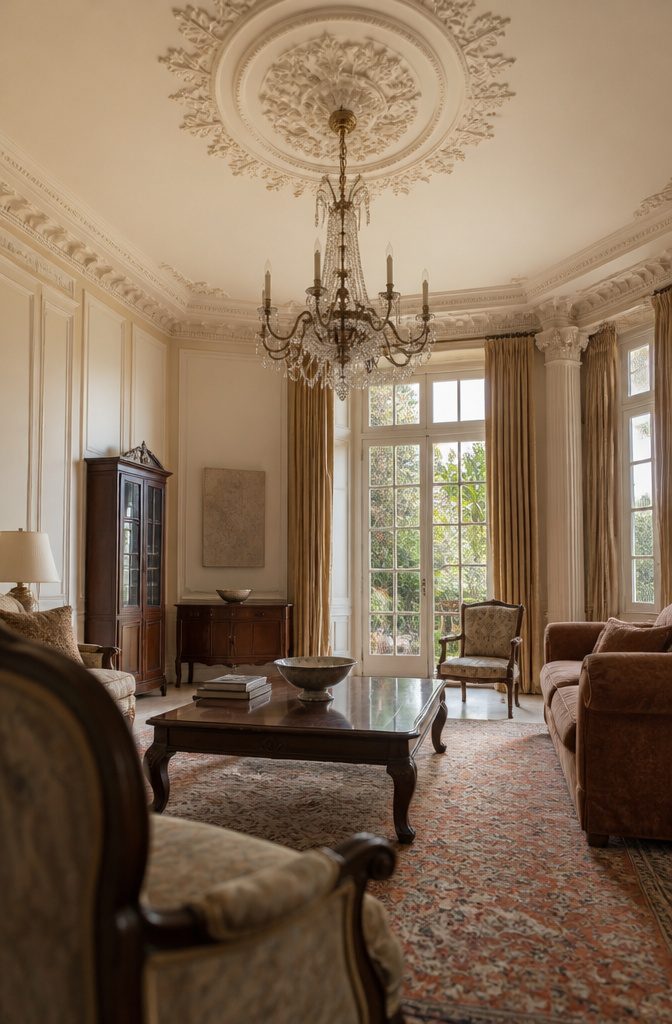
Plasterwork brings the kind of relief depth you notice from across the room—a ceiling rose around the chandelier, cornices running the perimeter, or friezes that frame out a section.
The sculpted detail reads classical, and the formality scales with how much pattern you commit to.
A single medallion around a light fixture keeps things restrained; cover the ceiling in repeated motifs and you’ve landed in Georgian or French Provincial territory.
Paint it white or ivory to let the shadows do the work. Contrasting the plasterwork against a darker ceiling makes it pop harder, but that move tips the room formal fast.
Scale the medallion to the chandelier and the room—oversized in a small space looks like you ordered wrong, and an undersized rose disappears under a statement fixture.
This pairs best with antique furniture, carved wood, and fabrics heavy enough to match the ceiling’s weight. Victorian and neoclassical styles welcome the ornament; modern rooms don’t.
14. Faux Finishes
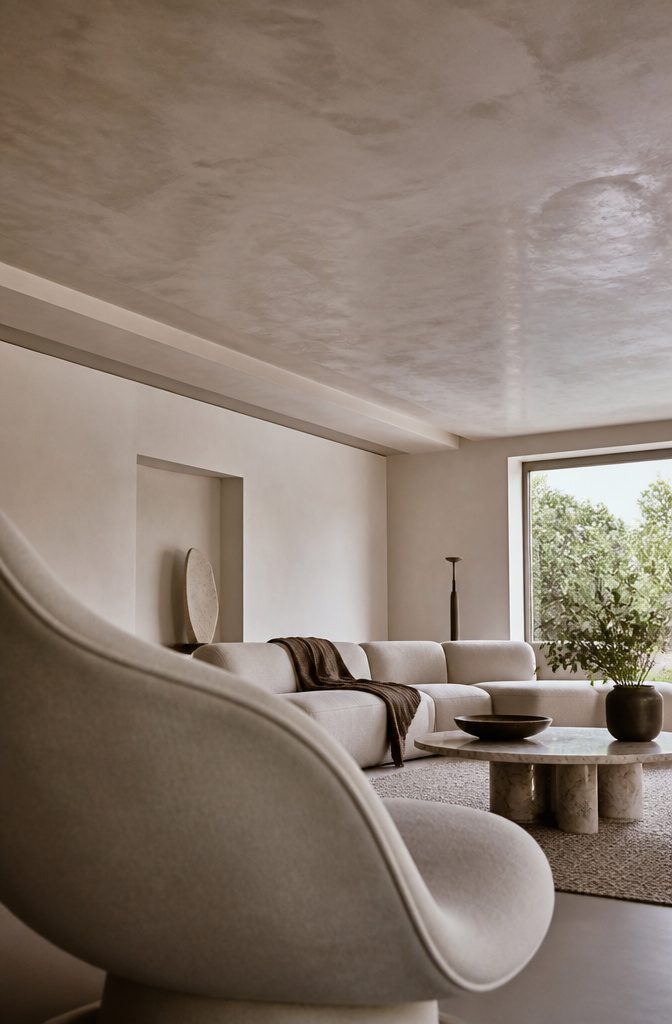
Venetian plaster delivers a marble-like sheen without the weight or the invoice that comes with slabbing real stone overhead. The technique builds up thin layers of plaster, then burnishes them to catch light the way polished travertine does.
You get the depth and the subtle color shift of natural material, and the ceiling stays light enough that no one needs to reinforce the joists.
Faux finishes work when mimicking a material costs less than installing the real thing—wood-grain panels instead of milled planks, metallic paint instead of hammered copper.
The look holds up best in rooms where you are not close enough to touch the surface and notice the difference. Pair them with sculptural furniture or pieces in unexpected materials so the room reads as deliberate, not budget-patched.
A cloud-painted ceiling opens the space vertically without cutting a skylight, and an aged-patina finish adds character to new construction that would otherwise read flat.
The risk is landing somewhere between convincing and obviously fake; soft lighting helps by keeping the surface in partial shadow where texture matters more than perfect realism.
15. Skylights or Light Tunnels
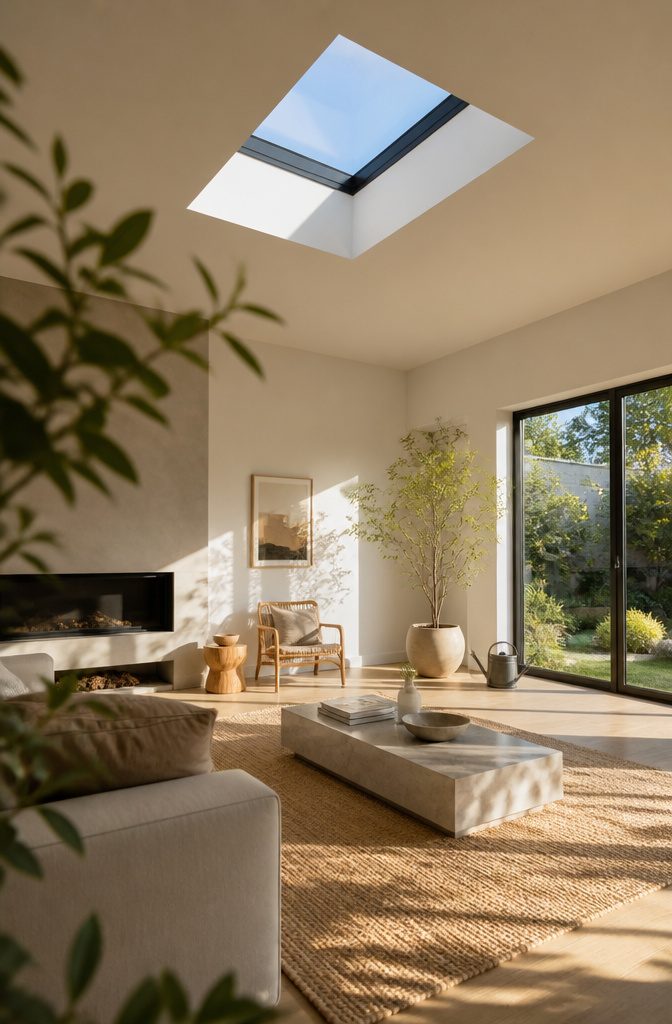
A skylight or light tunnel brings actual sky into the room, and the light moves across the ceiling and walls the way no lamp can replicate.
The room brightens through the morning, peaks midday, and softens into evening without touching a switch. That daily arc makes even a moderate-sized living room feel less enclosed.
This is a structural project. Have a structural engineer assess the roof before committing—not every roof line can support the opening, and learning that after the fact is expensive.
If cutting into the structure is off the table, a mock skylight with integrated LED lighting gives some of the upward glow without the permit process, though it won’t shift through the day.
Light tunnels work in rooms where the roof sits too far above the ceiling for a direct skylight.
They channel daylight down through a reflective tube, flooding the space with natural light and creating moving patterns of sun and shadow as the day progresses.
Pair either option with lighter materials and plants to reinforce the connection to the outdoors.
Frequently Asked Questions
What are some elegant ceiling design ideas for a living room?
Coffered ceilings with recessed panels, tray ceilings with hidden LED lighting, exposed wood beams in reclaimed timber or stained finishes, and painted ceilings in deep colors like navy or emerald all bring architectural presence.
Vaulted ceilings add height and openness, while wallpapered or fabric-draped ceilings introduce texture and pattern overhead.
How do I make my living room look luxury?
A ceiling treatment sets the tone before you add furniture.
Deep paint colors, metallic or antiqued mirror panels, plasterwork medallions, or a tray ceiling with warm LED backlighting all read as high-end. Pair any of these with restrained furniture and soft lighting so the ceiling stays the focal point.
What is the new trend for ceilings?
Geometric 3D panels and hidden LED lighting are gaining traction in contemporary spaces, creating depth through shadow and programmable ambient glow. Fabric-draped ceilings are also appearing in bohemian and global-inspired rooms for their acoustic benefits and soft, textured look.
What are the trendy ceiling designs for 2026?
Textured panels in wood or MDF, painted ceilings in saturated jewel tones, and integrated lighting systems that shift from bright task light to low ambient wash are all current.
Antiqued mirror insets in coffered grids and wallpapered ceilings in oversized botanical or metallic geometric prints are also appearing in high-end residential projects.