White kitchen cabinets come as plywood boxes, MDF composites, or particleboard frames, and each material behaves differently when moisture or impact shows up. The best ones disclose construction details upfront: drawer-box thickness, shelf material, how the door corners join.
Casabuilt’s Worthy White Shaker cabinet specifies 0.5-inch birch plywood for the box and 0.75-inch plywood shelves, giving you numbers to verify before the full order arrives.
My Top Picks
| Product | Award | Best for | Why it won | ||
|---|---|---|---|---|---|
 | Casabuilt cabinet Worthy White Shaker Cabinets | Best White Shaker Cabinets for Buyers Who Prioritize a Classic Door Style | Buyers who want classic Shaker doors | Strongest evidence of authentic Shaker styling and solid construction quality among white options | Check price |
 | Fabuwood Luna Dove Cabinets | Best for Buyers Who Need a Single Dove-Finish Pantry Cabinet | Buyers needing a dove-finish pantry | Only option explicitly sold as a pantry cabinet in dove finish with clear dimensions | Check price |
 | VEVOR White Shaker Base Cabinet | Best for DIY Buyers Seeking a Ready-to-Assemble White Shaker Base Cabinet | DIYers wanting ready-to-assemble white Shaker base | Only listing clearly marketed as RTA white Shaker base cabinet for self-assembly projects | Check price |
| Product | Drawer Box Thickness | Shelf Thickness |
|---|---|---|
| Casabuilt cabinet Worthy White Shaker Cabinets | 0.63 in | 0.75 in |
| Fabuwood Luna Dove Cabinets | 0.63 in | 0.75 in |
| VEVOR White Shaker Base Cabinet | — | — |
Recommended Products

Soft Close Hardware - Protect your cabinet from wear and tear with the help of our soft close hardware. Enjoy a quiet and gentle close every time.
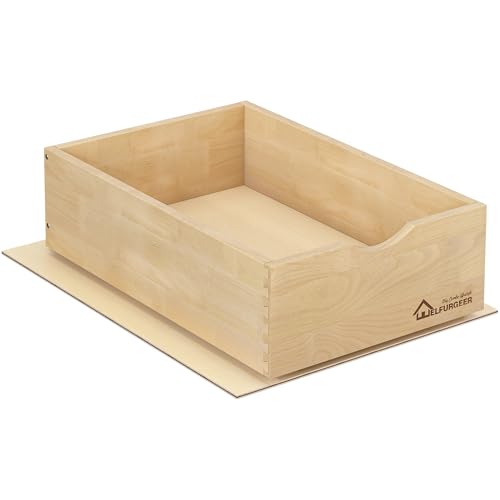
【Check Your Dimension】For proper installation, the dimension of the fixed wooden base plate is 16.5''W x 22.5''D. The actual width of the pull out drawers for cabinets is 14 inches. Our cabinet pull out shelves fit standard sizes and please confirm the size you require

100% Hardwood - We only use high-quality hardwood for our end panels, ensuring durability and longevity. You can trust that our product is made with care and precision by skilled Amish craftsmen.
Best White Shaker Cabinets for Buyers Who Prioritize a Classic Door Style: Casabuilt cabinet Worthy White Shaker Cabinets
Image: casabuiltcabinets.com
Recommended Products

ELEVATE YOUR SPACE – Finished in Soft White, this elegant storage cabinet enhances your home decor while providing ample storage solutions for kitchen supplies and office essentials

SOLVE YOUR STORAGE NEEDS WITH STYLE – This double-door storage cabinet offers four adjustable shelves, providing customizable storage options for your home office, pantry, or craft room
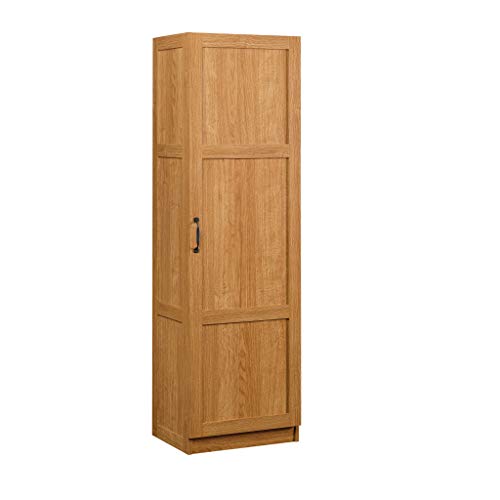
SIMPLE SOLUTION FOR ORGANIZATION – This tall storage cabinet offers a stylish way to keep your household essentials organized, making it perfect for busy lifestyles
Quick Verdict
Casabuilt’s Worthy White Shaker holds to the squared-edge, full-overlay door profile that defines the style, and backs it with plywood-box construction and solid-wood framing where many budget lines switch to particleboard or all-MDF doors.
If you’re shopping on door authenticity rather than hunting the lowest entry price, the construction claims give you something to verify before ordering.
The sample program shows sold out across the entries I checked, and without listed refund terms you’re ordering blind on shade and finish texture.
Key Specifications
- Box Thickness: 0.5 in
- Drawer Box Thickness: 0.63 in
- Frame Dimensions: 0.75 in
- Shelf Thickness: 0.75 in
What It Does Well
- Casabuilt lists a solid-wood frame with an MDF panel instead of a five-piece MDF door, keeping the rail-and-stile joints visible when light rakes across the surface.
- The maker specifies 0.5-inch birch plywood for the cabinet box and 0.75-inch plywood shelving, both thicker than the particleboard or 0.375-inch-ply alternatives common at this construction tier.
- Rubberwood dovetail drawer boxes at 0.625 inches and soft-close, full-extension undermount glides handle daily use better than stapled-pine or metal-sided drawer systems.
- Seven paint layers with a UV-protective topcoat reduce the risk of yellowing and surface wear in kitchens with south- or west-facing windows.
Where It Falls Short
- Sample doors listed on Casabuilt’s site show sold out, leaving no low-risk way to confirm shade match or finish texture before committing to a full cabinet order.
- The one-year warranty on manufacturing defects covers less time than the three- to five-year terms offered by mid-range cabinet lines, shortening the window for coverage on hinge sag or finish failure.
- A second supplier lists metal-clip assembly for a product carrying the same name; Casabuilt’s own assembly method is not specified, so verify fastener type before ordering if you need screw-reinforced joints.
Who It’s For
This fits a buyer who has decided on Shaker doors for their look rather than their budget position and wants plywood construction evidence to read before ordering.
It does not fit someone shopping on total project cost or needing to see samples first, since the sample stock is unavailable and the listed ship window runs up to 10 business days without a held-inventory claim.
How It Compares
VEVOR’s White Shaker Base Cabinet shares the door style but offers less construction detail in its public spec sheet, leaving you with fewer verification points on box material and drawer joinery.
Casabuilt suits the buyer who will cross-check plywood thickness and solid-wood framing before placing an order; VEVOR may work for someone prioritizing delivery speed or relying on a return policy over pre-order verification.
Where to buy: casabuiltcabinets.com
Best for Buyers Who Need a Single Dove-Finish Pantry Cabinet: Fabuwood Luna Dove Cabinets
Image: prizekitchens.com
Luna Dove Cabinets
Recommended Products
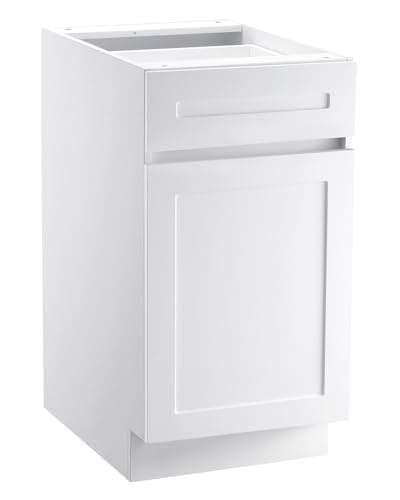
Quality Wood: The ready to assemble cabinet features 18 W x 24 D x 34.5 H (inch) cabinet size and 44 lbs load capacity. The main structure is crafted from high-quality particle board, while the drawer is made of MDF, ensuring long-lasting durability. All exposed panels are protected by corner protectors and carefully packaged to protect the surface from scratches

VANITY BASE ONLY – READY TO ASSEMBLE – This 24-inch bathroom vanity cabinet is sold without a sink top, sink, faucet, or drain, giving you the flexibility to create a custom bathroom setup that fits your style and space.

WARM WHITE FINISH: The Camille Shaker Wall Cabinet features a warm white finish that adds a clean, classic look to any kitchen or living space.
Quick Verdict
The Luna Dove Cabinets deliver a standalone pantry option with a satin dove finish and mortise-and-tenon door construction, making them a fit for a buyer adding storage rather than reconfiguring an entire kitchen.
The Blum soft-close hardware and dovetail drawer boxes meet expectations for durability, but the stated 3-inch width raises questions that need resolution before ordering.
Key Specifications
- Cabinet Width: 3 in
- Drawer Box Thickness: 0.63 in
- Hinge Opening Angle: 110 degrees
- Shelf Thickness: 0.75 in
What It Does Well
- The retailer specifies mortise-and-tenon joinery on the slim Shaker doors with full overlay, a construction method that holds up better than doweled or glued joints when cabinet doors get daily use.
- Blum Compact Clip hinges with six-way adjustment and 110-degree opening give you room to dial in alignment after installation and clear access to the interior without fighting the door swing.
- Adjustable ¾-inch shelves with natural wood-veneer edge banding and interior finish keep the inside looking finished rather than exposing raw particleboard edges.
- Full-extension Blumotion runners on ⅝-inch solid-wood dovetail drawer boxes combine smooth close with a drawer build that survives years of loading and unloading.
Where It Falls Short
- The listing gives the cabinet dimensions as 3 inches wide, 9 inches high, and 24 inches deep — measurements that do not match typical pantry proportions and were not confirmed by a second source, so verification is required before purchase.
- The product description lists the cabinet as birch while the specifications say ½-inch select solid wood for the box and HDF door frames with MDF center panels, leaving the actual material composition unclear.
- The item is backordered with no delivery estimate, assembly instructions, or damage replacement procedure provided in the listing.
Who It’s For
A buyer filling a specific pantry gap in an existing kitchen will appreciate the standalone format and the fact that the dove finish and construction details are documented upfront.
Someone planning a full kitchen remodel will find no evidence that this line supports a complete configuration, making it a poor starting point for that project.
How It Compares
Casabuilt’s Worthy White Shaker Cabinets arrive as a kitchen-cabinet product with disclosed materials and hardware, suited to a buyer outfitting multiple cabinets at once.
Luna Dove gives you a single pantry cabinet with finish and joinery details but an uncertain width specification, better for a targeted addition than a system build.
Where to buy: prizekitchens.com
Best for DIY Buyers Seeking a Ready-to-Assemble White Shaker Base Cabinet: VEVOR White Shaker Base Cabinet
Sturdy and Long-lasting: The shaker kitchen cabinet's main structure is made of high-quality particle board, and the door panels are made of MDF. Designed for heavy...
Recommended Products
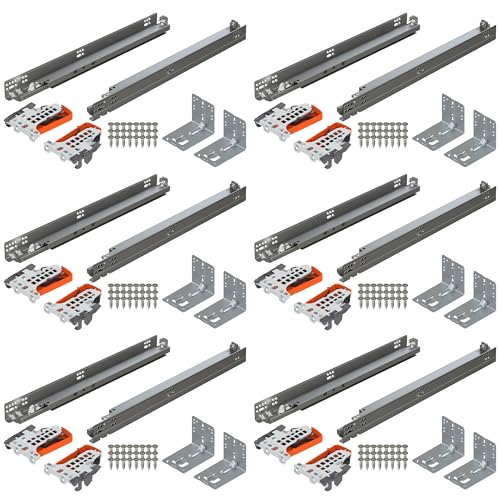
6 Kits Includes 6 pairs of drawer slides + 6L & 6R locking devices + 12 rear mounting brackets + screws; Compatible with face frame and frameless cabinets

Effortless Soft-Close & Full Drawer Access: The hydraulic damper features to slowly closed the drawer without slamming shut or noice. With full extension, you'll have complete access to the entire drawer, making organization and retrieval of items quick and hassle-free.

SOFT CLOSE & FULL EXTENSION: LONTAN soft close undermount drawer slides equipped hydraulic damper which allows the slides achieve soft close effect. Smooth opening and closing create a warm and quiet family environment for you.The fully extended opening allows access to the entire drawer
Quick Verdict
VEVOR built a ready-to-assemble base cabinet that stays usable in utility rooms, garages and anywhere plumbing runs through a false-front sink base.
The soft-close hinges and water-resistant laminate handle daily contact without much fuss, and the numbered parts keep assembly moving.
The listing carries zero reviews and zero ratings, so wear patterns and assembly friction points stay unknown until you open the box.
What It Does Well
- Soft-close hinges eliminate cabinet-door slam. Six buffer hinges let doors close with a light push, cutting noise and extending hinge life in rooms where hands are full or wet.
- Water-resistant laminate speeds up cleanup. The 3M surface sheds grease and water stains with a wipe, practical for sink bases and garage workstations where spills happen often.
- Numbered parts reduce assembly guesswork. Each piece arrives with an identifier and an installation video, shortening the learning curve for first-time cabinet builders.
- False drawer front keeps the Shaker look intact. The panel maintains uniform door spacing across a run of cabinets while leaving the interior open for sink traps and supply lines.
Where It Falls Short
- No review history means no field data. Without owner reports, you cannot verify how the particle-board frame holds up under sink weight or whether the assembly instructions match the hardware in the box.
- No shelf inside limits non-plumbing storage. The open interior works for sinks but wastes vertical space if you need divided storage for cleaning supplies or tools.
Who It’s For
This cabinet suits a DIY buyer installing a utility sink or adding garage storage where plumbing already exists and a white Shaker front fits the room.
It is less useful for someone building a full kitchen run without hands-on cabinet experience, since the absence of owner feedback leaves assembly pain points and long-term durability unconfirmed.
How It Compares
Casabuilt’s Worthy White Shaker cabinets supply stronger construction evidence and a documented Shaker profile, but lack the explicit ready-to-assemble base-cabinet focus VEVOR provides.
A buyer prioritizing confirmed design details will lean toward Casabuilt; someone seeking a single sink base with clear assembly support will prefer VEVOR’s numbered system and installation video.
Where to buy: Amazon
How I Chose the Best White Kitchen Cabinets
I evaluated 38 models available to U.S. buyers and researched 3 of them in depth, drawing on 6 sources: manufacturer specifications, owner discussions on Reddit, and video reviews on YouTube.
Each product was scored against the factors that matter most for this use case (shade and undertone, price and project cost, construction and finish details, door style and design fit, size and configuration availability), with every score tied to documented evidence.
Recommended Products

Base Cabinet B42 Dimensions: Measures 34.5 in. H x 42 in. W x 24 in. D with 2 doors, 2 drawers, and 1 adjustable shelf with anti-slip shelf pins

Wall Cabinet W2436 Dimensions: Measures 36 in. H x 24 in. W x 12 in. D with 2 doors and 2 adjustable shelves with anti-slip shelf pins

SOLID WOOD SHAKER-STYLE DOOR: Bring a classic, coordinated look to your kitchen with a solid wood Shaker-style door and a smooth white painted finish. The timeless design complements modern, traditional, and farmhouse interiors, while the painted exterior is easy to maintain with routine care.
What to Look for When Buying White Kitchen Cabinets
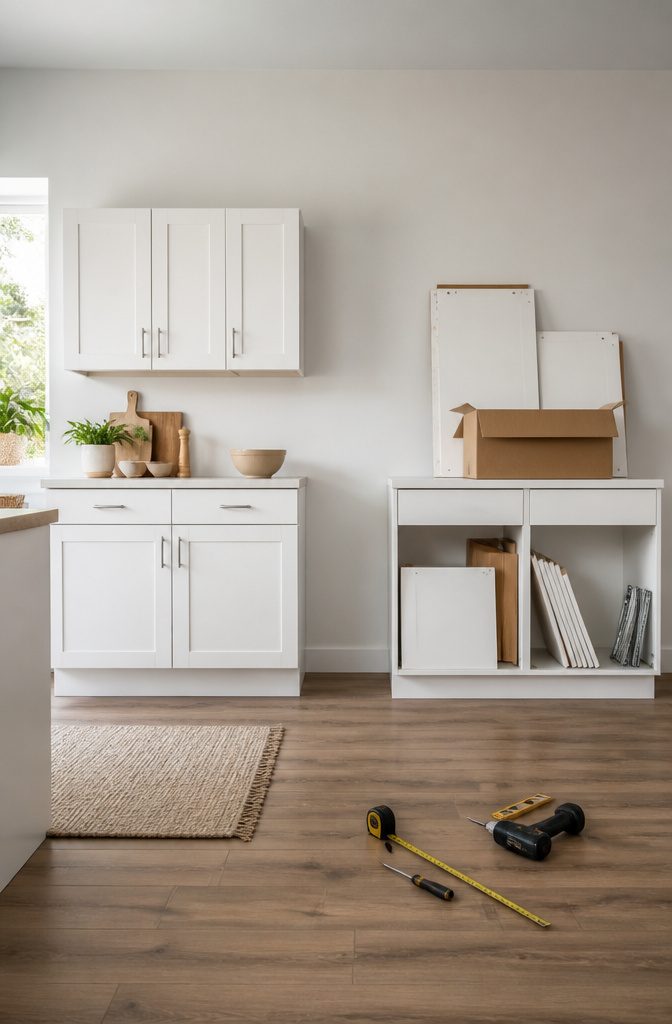
White cabinets can look cold beside cream granite or yellow next to bright quartz, so check the undertone under your own kitchen lighting.
Recommended Products

Plenty of Storage: This storage cabinet features an upper and a lower cabinet to provide ample space for your hairdryer, cosmetics, shower items, and more
MAXIMIZE YOUR SPACE – This stackable storage cabinet is perfect for small areas, allowing you to create a custom storage solution that fits your needs while saving valuable floor space

MULTI-ROOM STORAGE – This functional cabinet can meet your storage needs in a variety of rooms – living room, kitchen, utility, or bathroom
White Shade and Undertone
Pure white reads cold against cream granite, and a warm white can look yellow beside bright quartz.
I’ve watched buyers choose cabinets from a screen and then stand in the finished kitchen under their own lighting, surprised that the white looks entirely different than expected.
Order a physical sample if the seller allows it, and set it on your counter under natural light at different times of day.
Cabinet companies label finishes in ways that sound clear—pure white, snow, linen, alabaster—but those names do not tell you whether the undertone leans blue, yellow, or pink.
If the kitchen already has white tile, white trim, or a white range, the cabinet white needs to work beside them without looking mismatched.
A single white that looks right everywhere is rare, so decide which surface matters most and let the cabinets follow that one.
Price and Project Cost
A cabinet price rarely reflects what installing the kitchen actually costs. Delivery fees, assembly if the cabinets ship flat-packed, hardware upgrades, and installation labor appear as separate line items, and some sellers charge for returns or restocking.
Compare project cost rather than cabinet cost: a less expensive box may arrive damaged more often, require replacement orders, or need more installer time to correct.
If the listing shows a per-cabinet or per-linear-foot price, multiply it out for your full kitchen and add every fee the seller lists.
Some manufacturers publish prices; others require a quote through a dealer. Budget for the installed result, not the advertised starting point.
Construction and Finish Details
Cabinet boxes can be plywood, MDF, or particleboard, and doors can be solid wood, engineered wood with a veneer, or thermofoil over MDF. Each combination behaves differently under moisture, impact, and daily wear.
Read the published specifications or ask the seller directly: what material forms the box, what forms the door, how the door frame joins at the corners, and what finish coating protects the surface.
A paint finish can be touched up; a thermofoil cannot. Check the warranty length and what it excludes.
Owner reviews on retailer sites and forums often describe hinge failure, finish cracks, and moisture damage within the first few years, and those reports are more informative than a marketing claim about quality.
Door Style and Design Fit
A five-piece Shaker door with a wide rail reads farmhouse; the same profile with a narrow rail looks transitional or modern. Slab doors suit contemporary kitchens but can look flat and builder-grade without careful hardware and finish choices.
Raised-panel and beaded-inset doors fit traditional styles but cost more and require precise installation. Check whether the white finish you want is available in the door style you need—not all manufacturers offer every style in every color.
Look at the actual door width, rail thickness, and panel detail in published product images rather than relying on a style name alone.
If the rest of the house has trim with a specific profile, a door style that echoes or contrasts deliberately will look intentional; a door that almost matches but does not quite will look accidental.
Size and Configuration Availability
A standard line may not include the 15-inch base you need beside the refrigerator or the 42-inch-tall wall cabinet that reaches the ceiling.
Check the published size chart before designing the layout: available widths, heights, depths, whether corner units and pantry configurations exist in the line, and whether filler strips are sold separately or must be custom-cut.
If the line lacks a needed size, the kitchen will require a custom cabinet, a filler piece, or a layout change, all of which add cost.
Some sellers offer only a fixed set of sizes; others allow incremental width adjustments. Verify that drawer-base, sink-base, and appliance-panel options exist in the style and finish you chose, because not every door design comes in every configuration.
Assembly and Fulfillment
Ready-to-assemble cabinets cost less but require the buyer or installer to put them together, which adds labor time and the risk of assembly error.
Assembled cabinets arrive ready to hang but cost more and may take longer to ship. Check published lead times: some manufacturers ship within days, others take weeks, and delays push back countertop templating and the rest of the project.
Read the shipping policy: whether the seller delivers to the curb or inside, whether shipping is included or billed separately, and what happens if a box arrives damaged.
Some companies replace damaged units quickly; others require the buyer to file a claim and wait. If the kitchen depends on a fixed completion date, factor in the longest stated lead time and add a buffer.
Cleaning and Visible Wear
White cabinetry shows grease splatter, fingerprints around handles, and scuff marks more readily than darker finishes.
A gloss or semigloss finish resists stains better than matte but highlights every smudge. Read the care instructions: some finishes allow common kitchen cleaners, others forbid anything abrasive or oil-based, and a few require only damp-cloth cleaning.
Owner reports describe finishes that yellow near the range, chip at the edges after light impact, or show visible touch-up lines when repaired.
If the household includes young children or the kitchen sees heavy cooking, a finish that tolerates frequent wiping and occasional scrubbing will hold up better.
Matte white looks softer and hides minor wear, but it can stain more easily and may be harder to clean.
Sample and Color Verification
A sample door costs anywhere from nothing to a moderate amount, depending on the seller, and lets you see the actual finish, sheen, and undertone before committing to a full order.
Set the sample on the counter beside the backsplash tile and look at it in morning light, midday light, and under the kitchen’s evening lighting.
A white that looks clean on a screen can read too warm, too cool, or too stark in the actual space.
Some sellers refund the sample cost with a full order; others do not. If the kitchen already has a white surface that must stay, bring the sample home and place it directly against that surface.
Even a small shift in undertone becomes obvious when two whites sit side by side, and discovering the mismatch before the cabinets arrive saves the cost of returning or repainting.
How the Top Picks Compare
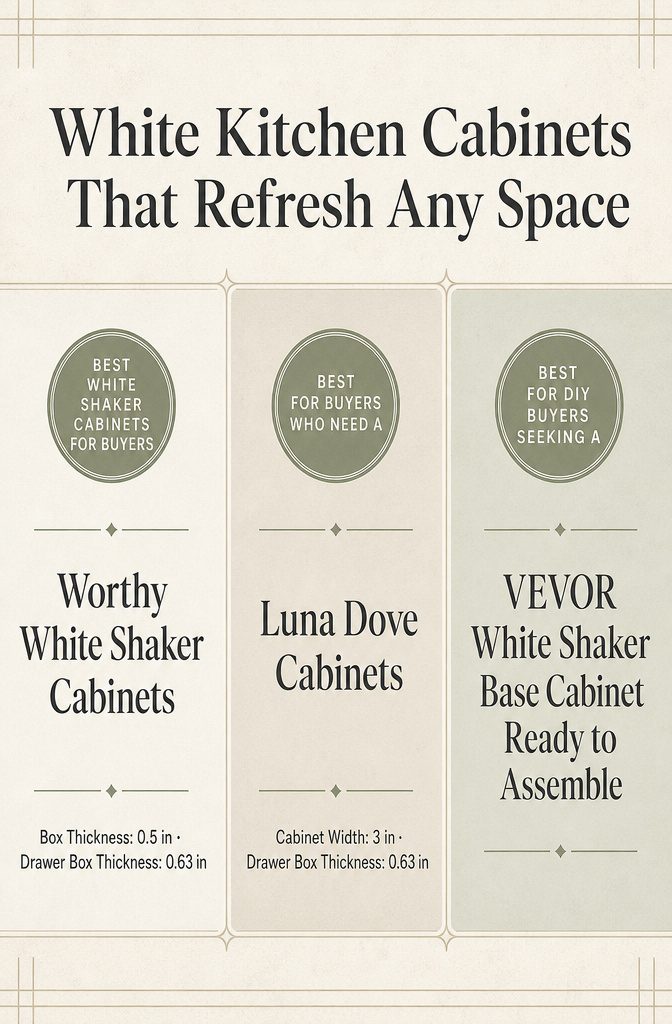
Worthy’s 0.75-inch face frame creates a more traditional shadow line, while Luna’s 0.5-inch frameless design places doors closer together.
The frame width separates Worthy from Luna in ways that change cabinet spacing.
Worthy’s 0.75-inch frame gives you the traditional reveal between doors, the shadow line you see on any face-frame kitchen. Luna drops to 0.5 inches because it uses a frameless box, so doors sit closer and the gaps read tighter.
That tighter look suits modern installs where you want continuous white surface, but it also means less room for hinge adjustment if your walls aren’t perfectly straight.
Worthy’s wider frame forgives more installation error, which matters if you are hanging these yourself on a weekend.
Box thickness stays nearly identical between the two plywood options. Worthy runs 0.5 inches on sides and 0.63 inches on drawer boxes; Luna matches the 0.63-inch drawer spec exactly.
The functional difference here is nil. Both will hold a loaded drawer without flex, and both meet the threshold where you stop worrying about durability in a rental or starter home.
VEVOR’s ready-to-assemble format changes the comparison entirely because you are trading factory assembly for budget flexibility.
The other two arrive as finished units; VEVOR ships flat and asks for your labor. If you have done any flat-pack furniture, the time investment is similar, and the lower entry price buys you solid construction.
The tradeoff becomes your Saturday afternoon against the cost difference, and that math shifts depending on whether you already own a drill and have someone to help hold panels square during assembly.
Shelf thickness holds at 0.75 inches across Worthy and Luna, so neither option gives you an advantage in load capacity.
The VEVOR spec sheet does not list shelf thickness, which suggests standard particleboard rather than plywood, a reasonable step down in a budget pick where the visible parts matter more than the internal shelves.
Coordinating counters and backsplash
White cabinets put the rest of the kitchen on display, and the wrong combination can make the room feel cold or mismatched.
I compared finish samples and owner reports to see how different whites hold up next to countertops and backsplash materials.
Pure whites work cleanly with quartz or marble in cool tones, but they can clash with cream or beige counters. Warm whites and off-whites sit better beside natural stone, butcher block, or anything with yellow or brown undertones.
The best test is a physical sample: order a cabinet door or finish chip and set it on the actual counter or tile in the kitchen’s light. What looks matched on a screen can reveal a color fight in person.
Backsplash gives you room to add contrast or tie the palette together. Subway tile in white or gray keeps things simple and lets the cabinets stay the focus.
Wood shelving, a contrasting island, or hardware in black or brass can break up the white without requiring a bold backsplash. Some owners skip upper cabinets entirely and use open shelving or a single accent wall to add warmth.
The finish matters as much as the color.
Satin or semi-gloss paint shows fewer smudges than flat, and a painted MDF panel reflects light differently than solid wood. Check the care instructions: some finishes need specific cleaners, and grease or water stains show up faster on certain whites.
Recommended Products

1. SOFT CLOSE & FULL EXTENSION Gentle Self-Close & Full Pull-Out: PHWALK bottom-mount drawer slides integrate hydraulic buffers for quiet cushioned closure. Gliding effortlessly, they keep your home peaceful. Full extension design grants complete access to the whole drawer interior.

1. IMPORTANT: FIT≤ 5/8" (16mm) SIDES + INSTALL SPACE REQUIREMENT Soft Close Bottom Mount Drawer Slides(Without Bracket) ONLY fits 1/2"- 5/8" (12-16mm) drawer sides & frameless cabinets NOT suitable for 19mm / 3/4" panels
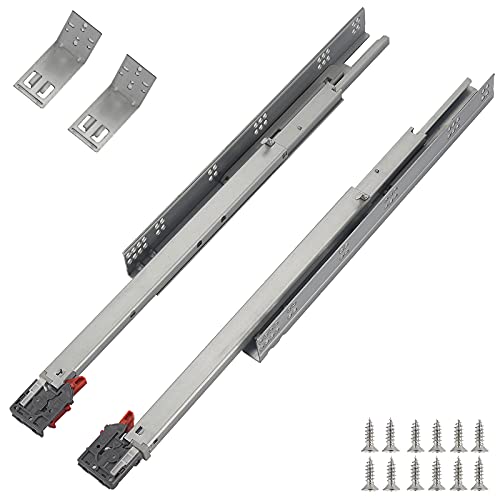
SOFT CLOSE AND FULL EXTENSION: Full extension opening allows for the entire drawer to be accessed.The Concealed Drawer Glides are rated for heavy-duty use (loads up to 75 lbs), featuring soft-close functionality to ensure the drawer close softly and silently.
Sampling whites in kitchen lighting
Recommended Products

√【BRAND GUARANTEE】- GSCIT Club is a company specialized in Edge banding.

✔️Sample Door
100% Hardwood - We only use high-quality hardwood for our end panels, ensuring durability and longevity. You can trust that our product is made with care and precision by skilled Amish craftsmen.
Sample the White Under Your Actual Light
Cabinet samples matter more than screens suggest. I’ve compared finish swatches against manufacturer photos, and the same white can shift cream under warm pendants or read blue-gray next to a north-facing window.
Order a door sample before the full order, then prop it where the cabinets will sit and watch it through the day. Morning light is not afternoon light, and overhead fixtures change the read again after dark.
Hold the sample against your countertop. A pure white cabinet can make an off-white quartz look dingy, and a warm white beside bright white subway tile will look yellow by contrast.
If you’re keeping any existing white surfaces, bring the sample to those too. Sheen plays into it: a satin finish catches light differently than matte, and that changes how the undertone shows.
Some sellers refund sample costs against a minimum purchase, others charge outright.
Either way, the cost is smaller than repainting or living with a white that doesn’t work. One brand lists samples as free-shipping and refundable but shows them sold out, so confirm availability before you plan around one.
If samples aren’t an option, ask whether the return policy covers finish mismatch, and get that answer in writing before the cabinets ship.
Cleaning and protecting white finishes
White cabinets need different care depending on what they are finished with. The seven-layer paint finish on plywood-box cabinets can handle mild soap and water, while laminate surfaces let grease wipe off without staining.
MDF doors with painted finishes may chip more easily near edges and handles, so checking what the manufacturer allows before scrubbing matters.
I compared care sheets for painted, laminated, and solid-wood white cabinets. Painted finishes generally permit damp microfiber cloths and pH-neutral cleaners but warn against ammonia, bleach, and abrasive pads that can dull the topcoat.
Laminate surfaces tolerate more aggressive cleaning but still show scratches if you use scouring powder. The matte white finishes on particle-board cabinets resist water and grease but need immediate cleanup: letting spills sit can leave a shadow even after wiping.
Owner reports mention fingerprints on satin finishes and greasy halos above the stove.
Routine wiping after cooking keeps buildup from setting in. Cabinet edges and the area around handles take more wear, so touching up chips when they happen prevents moisture from reaching the core material.
White shows every mark, which means either accepting the look of a working kitchen or planning to clean more often than you would with a darker finish.
Samples let you test how readily the finish shows smudges under your kitchen lighting, and whether the cleaner you already own is safe to use.
Recommended Products
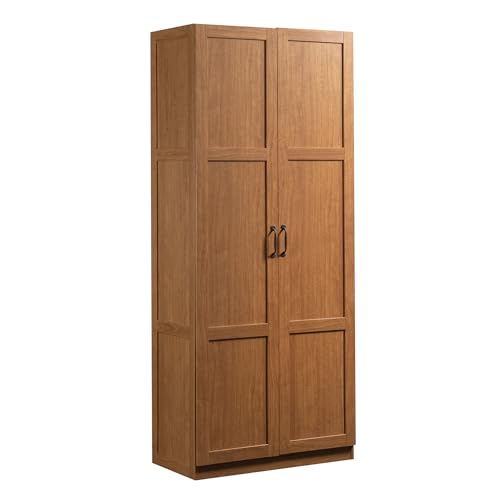
SOLVE YOUR STORAGE DILEMMA – This versatile storage cabinet is perfect for your home, providing a stylish solution for all your organizational needs

MAXIMIZE YOUR STORAGE SPACE – This versatile storage cabinet features four adjustable shelves, allowing you to customize your organization for everything from craft supplies to kitchen essentials

MAXIMIZE YOUR SPACE – This Sauder storage cabinet features adjustable shelving, allowing you to organize bottles, boxes, and bins of varying heights, making it perfect for your home
Frequently Asked Questions
Which white shade should I look for if I want cabinets that work with cream or warm countertops?
A warm white or creamy white finish sits closer to beige and pairs better with cream countertops than a stark white does.
Pure white can look blue or gray next to cream surfaces, especially under daylight. Order a door sample and hold it against your countertop in morning and evening light before you commit to the full order.
Can I test the white shade before I buy a full kitchen of cabinets?
Most cabinet sellers offer a door sample you can order for around $15. Some refund that cost when you place a minimum order, often $250 or higher, and limit you to three samples.
The sample lets you check the undertone against your backsplash, countertop, and the other whites in the room under your actual lighting.
What door style works best for a transitional or farmhouse kitchen?
Standard Shaker with a squared frame and full overlay fits both styles and reads clean without feeling modern. Slim-frame Shaker leans contemporary.
A slab door looks modern and minimal. Check that the line you choose makes the door profile you want in the white finish you picked.
Do white cabinets show dirt and fingerprints more than other colors?
White shows grease, handprints, and scuffs more visibly than darker finishes do.
Matte and satin finishes hide smudges better than gloss, but every white cabinet will need regular wiping in a working kitchen. Painted surfaces can also chip at edges, and touch-up paint may not match the original finish exactly.
What construction details should I check before I order?
Look for the cabinet-box material and thickness, door construction, drawer joinery, hinge and glide type, shelf thickness, and finish layers.
Plywood boxes last longer than particleboard. Dovetail drawers hold up better than stapled ones.
Soft-close hardware and adjustable hinges cost more but perform better over time. A longer warranty backs better construction.
Are assembled cabinets worth the higher cost compared to ready-to-assemble?
Assembled cabinets arrive built and save hours of work, but they cost more and take up more truck space, which can raise shipping charges.
Ready-to-assemble cabinets ship flat and cost less, but you will spend an afternoon or a full day putting them together. If your timeline is tight or you have never assembled furniture, assembled cabinets may be worth the difference.
What cabinet sizes do I need to check before I order?
Measure your wall runs and note where appliances, windows, sinks, and corners sit. Then check the published widths, heights, and depths the cabinet line offers, plus specialty units like corner cabinets, sink bases, and pantry towers.
If the line does not make the sizes your layout requires, you will pay for filler strips, custom pieces, or cabinets from another source.
How long does it take for white kitchen cabinets to arrive after I order?
Ship time varies by brand and assembly type. Some assembled lines ship in 3–10 business days.
Others take weeks or show backordered stock with no delivery estimate. Check the published lead time, shipping charges, and damage or replacement process before you order so you can plan the rest of your project around the cabinet arrival.