
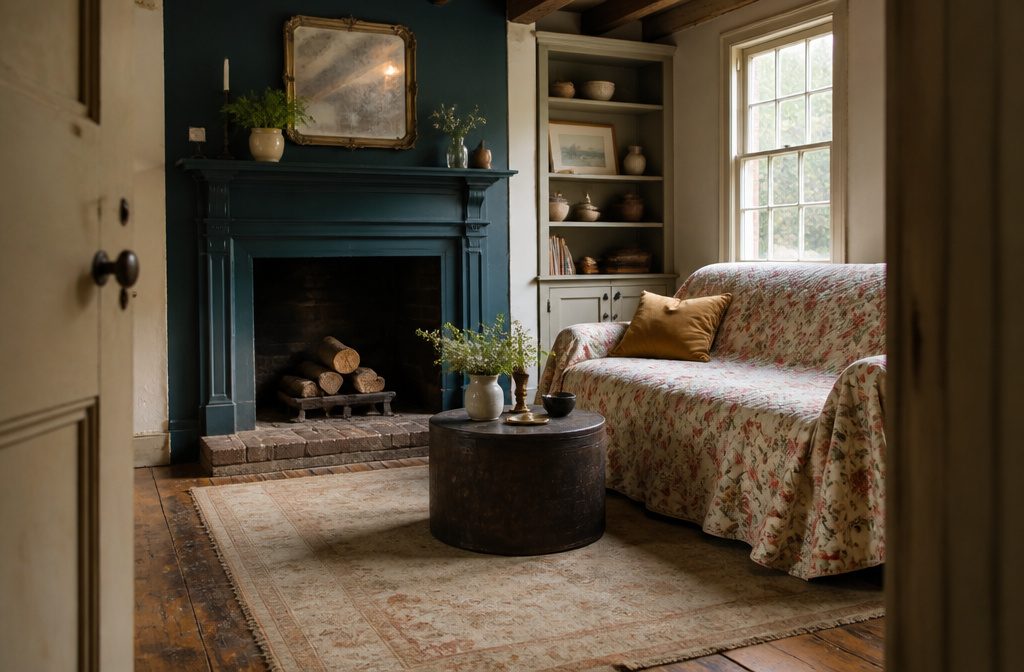
Cottage living rooms range from pale neutrals anchored by one bold accent to layered floral patterns across every surface.
The choice depends on how much pattern you can live with daily and whether the room has architectural weight—beams, stone, original floors—to balance soft textiles.
Most of the character comes from what you already own or can find secondhand.
A $15 drum table from Facebook Marketplace, a matelassé coverlet thrifted for $10 and used as a slipcover, or an antique mirror that cost less than a new one all bring in the collected-over-time feel that makes a cottage living room read as personal rather than staged.
1. Choose a soft or muted color scheme, then add selected bold accents
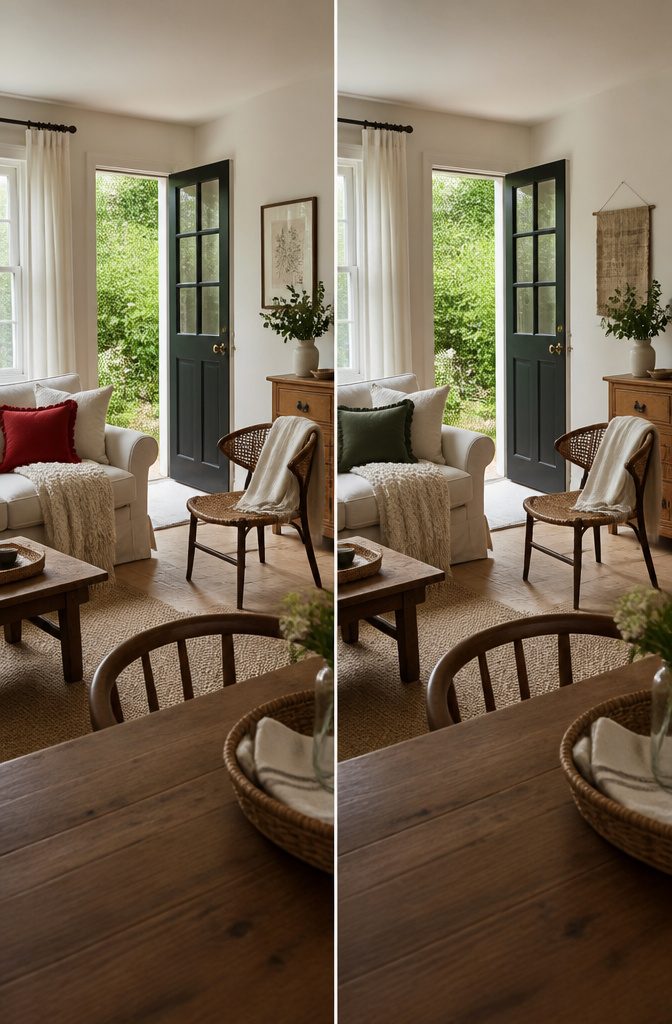
Pale walls brighten the space and let you layer personality on top.
White Dove by Benjamin Moore and Swiss Coffee by Behr both work—creamy whites that looked nearly yellow going on next to primer but read as clean neutrals once the whole room was finished.
The muted base keeps the room calm enough to add pattern and texture without the space feeling chaotic.
Bold color belongs somewhere deliberate. Tricorn Black by Sherwin Williams on a front door pulls focus and gives the room a backbone; an unexpected pop of red or navy in fabric does the same work indoors.
Cottage style is not all soft—it uses bright, saturated color as punctuation.
Texture keeps a neutral room from going flat.
Vary the materials: linen against wood against wicker, a chunky knit throw next to a ruffled pillow. A pale room that is only one material—mostly linen or mostly wood—feels incomplete.
2. Layer textiles, patterns, and accessories
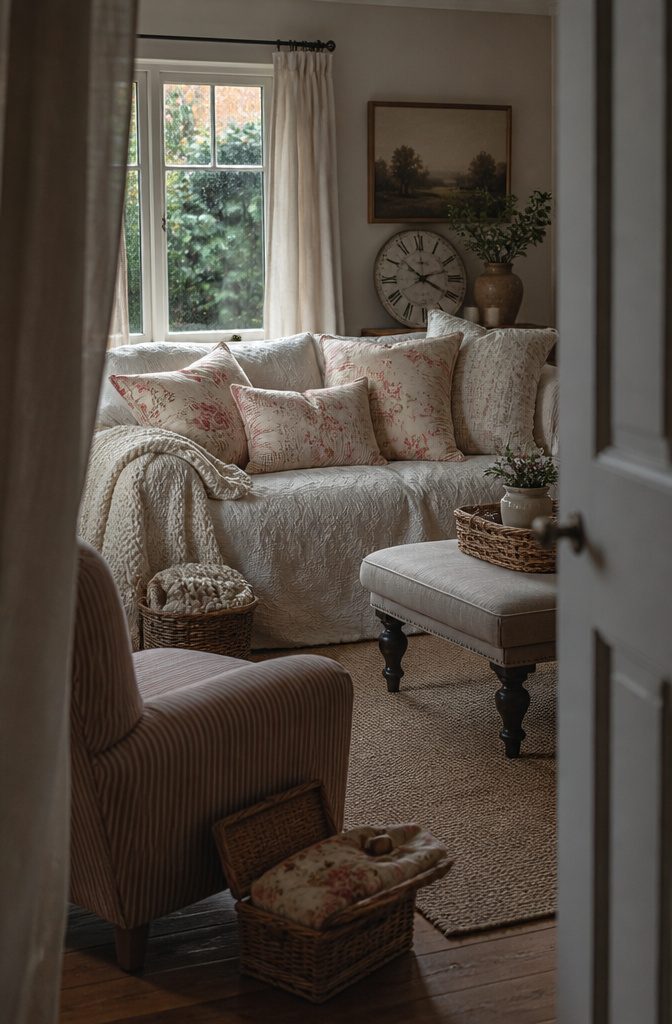
Throws folded over chair arms, cushions stacked on sofas, rugs under ottomans—layering makes a room feel gathered rather than arranged.
I look for ways to place things over each other: a clock in front of a painting, curtains behind an upholstered chair, patterned pillows against a striped quilt.
The mix of soft florals, ticking stripes, and block prints keeps a neutral palette from reading flat, and it gives the room that collected-over-time feel staging never quite reaches.
Texture does the rest.
Chunky knit throws, woven baskets, distressed wood, and linen all add weight without color. A matelassé coverlet draped over a sofa as a slipcover cost $10 thrifted and looked better than anything ordered new.
Tartans and checks work for cushions; a thick wool blanket paired with faux fur adds warmth. Build a room that invites you to sit down, not one that asks you to admire it first.
3. Bring in natural materials and architectural features
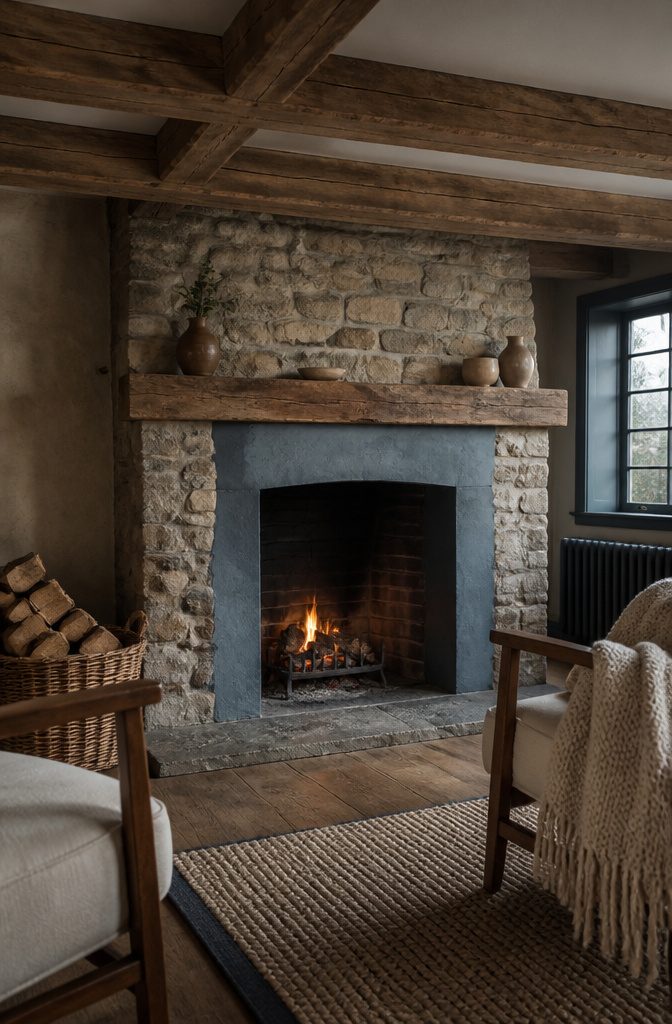
Wood beams across the ceiling and a stacked-stone fireplace give a cottage living room most of its character before you buy a single piece of furniture.
Exposed architectural features like these anchor the room and let you keep the rest simple—pale walls, a couple of chairs, maybe a knit throw. The materials do the work.
If you don’t have beams or stone already, board and batten or beadboard on one wall gets you partway there.
Vertical shiplap works too, painted or left natural depending on how much wood the room can hold before it tips dark.
Even crown molding helps, especially in an older house where caulking the gaps between molding and ceiling makes crooked walls look intentional instead of settling.
A fireplace becomes the focal point without effort, but only if you let it. Painting the surround a soft color—dusty blue, buttercream, warm gray like Revere Pewter—sets it apart without competing with the fire itself.
4. Choose comfortable, classic furniture suited to the room
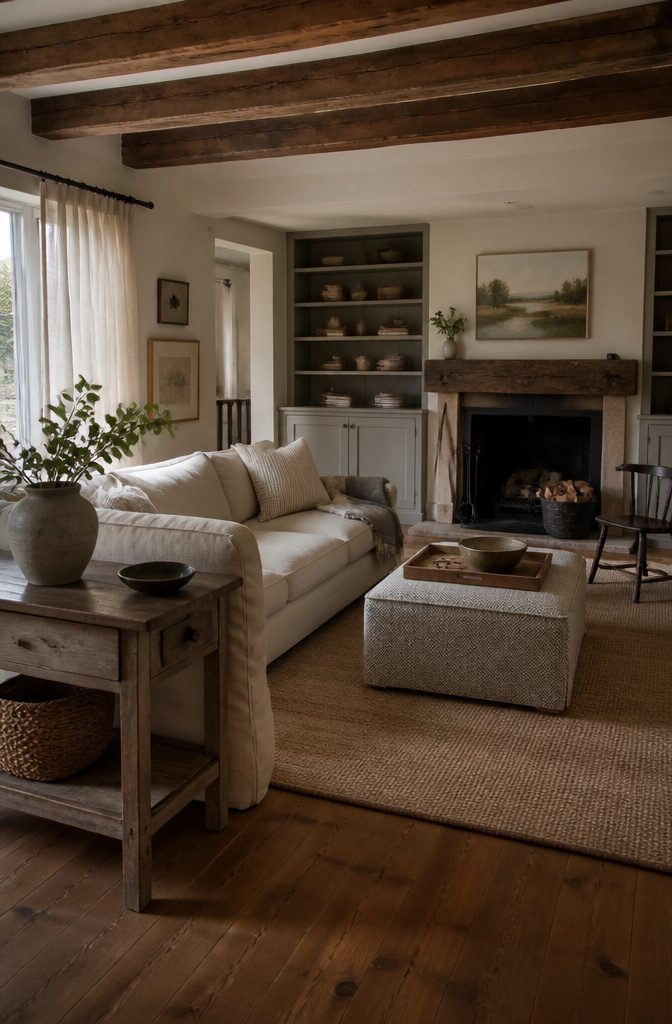
Traditional seating anchors cottage living rooms because it reads personal rather than trendy.
Loveseats work in tighter spaces — most fit two people comfortably — and the Country Living Arundel Cuddler at DFS gives you a deep seat and low arms that make up for the smaller footprint.
For rooms with an extra bedroom’s worth of guests, a sofa bed in a classic shape does both jobs without looking temporary.
Look for pieces upholstered in soft tweeds, warm wools, checks, linen, or ticking. The Alwinton sofa from Sofas & Stuff takes cues from antique Howard models and manages to feel both structured and lived-in.
In small rooms, furniture that stores something earns its spot twice: a cushioned ottoman stands in for a coffee table and hides remotes and chargers, and a tray on top keeps smaller objects contained.
Angle seating toward a shared focal point — a fireplace, a window — rather than lining it against the walls, and the room feels less like a waiting area.
5. Use vintage, antique, thrifted, or meaningful pieces
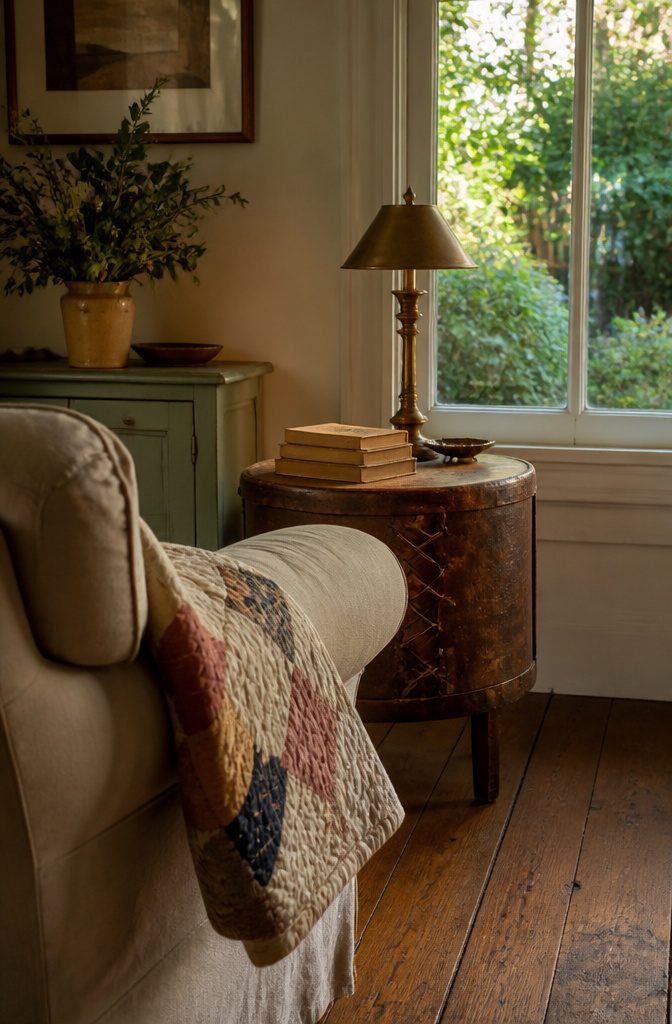
A $15 antique drum table from Facebook Marketplace can anchor a corner the way nothing from a big-box store will.
Secondhand pieces—estate sale mirrors, thrift store chairs, anything with a decade or two on it—bring history into the room without requiring the budget of a designer showroom.
The finish is worn in the right places, the joinery shows actual craftsmanship, and the room stops looking like it was decorated in one afternoon.
Cottage style builds over time, not all at once.
That means you can pick up one good piece every few months and let the room grow around it. A carved wood frame here, a painted side table there, and eventually the space reads as collected rather than coordinated.
Meaningful objects work the same way: the quilt your grandmother made, the clock you inherited, the lamp you refinished yourself. They make the room feel like yours instead of anyone’s.
Mixing eras keeps things from turning into a museum corner. An antique beside something newer grounds the old piece and keeps the vintage from overwhelming the room.
6. Add floral textiles, botanical prints, or greenery
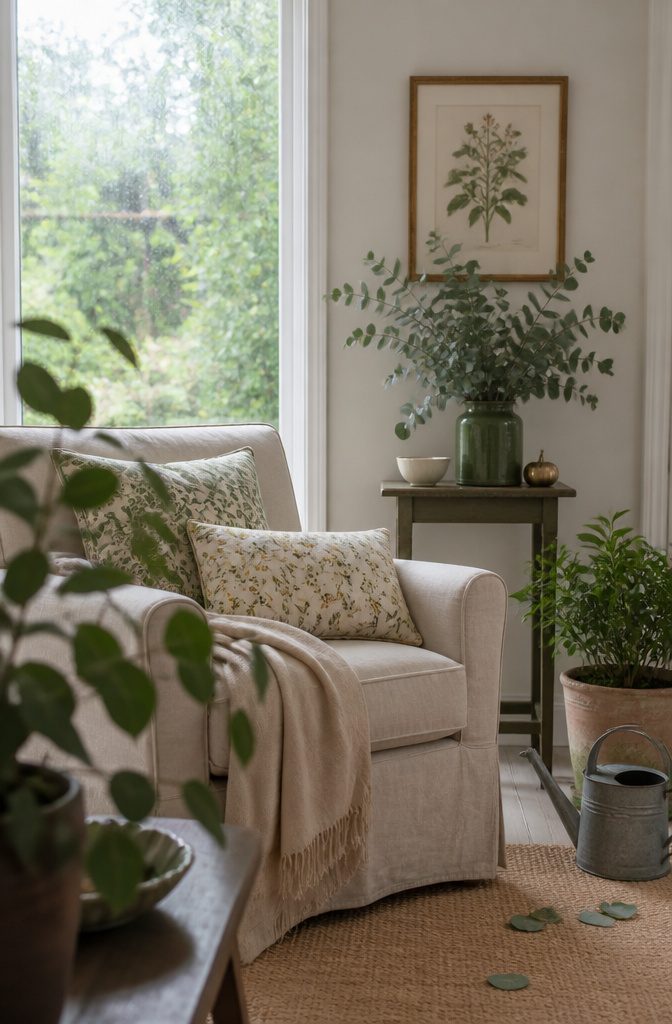
Floral fabrics and botanical prints soften a cottage living room without adding fuss. Delicate wildflower or rosehip patterns work better than large-scale blooms, which can overwhelm a small room.
Sanderson’s Pinecones in Briarwood & Cream fabric runs £49, and their Squirrel & Hedgehog print in Walnut/Linen costs £59—both bring in that countryside feel through subtle pattern rather than bright color.
Use them on cushions first, then commit to curtains or an upholstered chair if the room can handle more.
Real or faux greenery does the same work. Eucalyptus stems, olive branches, and potted plants add an organic layer that makes the space feel less decorated and more lived-in.
A fiddle leaf fig or a few dried florals on a side table bring in just enough green to keep the room from reading too neutral.
7. Use varied lighting for a warm atmosphere
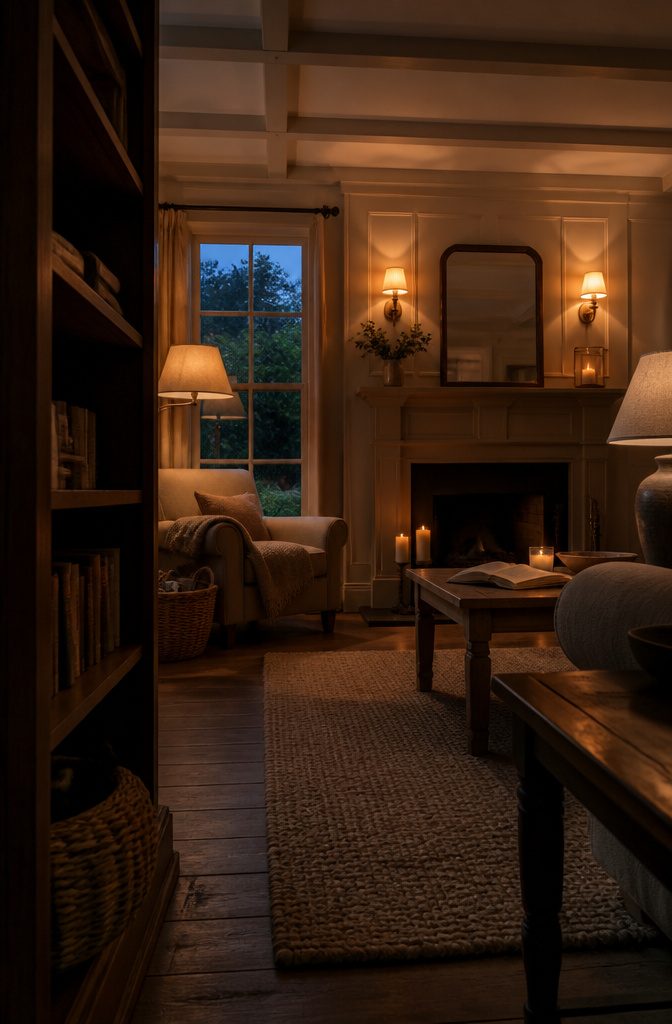
Overhead fixtures light the whole room at once, but they do not make a room feel lived in.
Table lamps on side tables, a floor lamp beside a reading chair, and sconces flanking a mirror or mantel give you control over which parts of the room glow at different hours.
You can read in one corner while the rest of the space stays dim, or light only the perimeter after dark and leave the center soft.
Candles add another layer when you want the room to feel particularly inviting.
A few votives on a coffee table or pillar candles on a mantel catch the eye without overpowering other light sources. The variation in height and intensity is what makes cottage lighting feel warm rather than flat.
8. Display artwork, collections, and personal objects
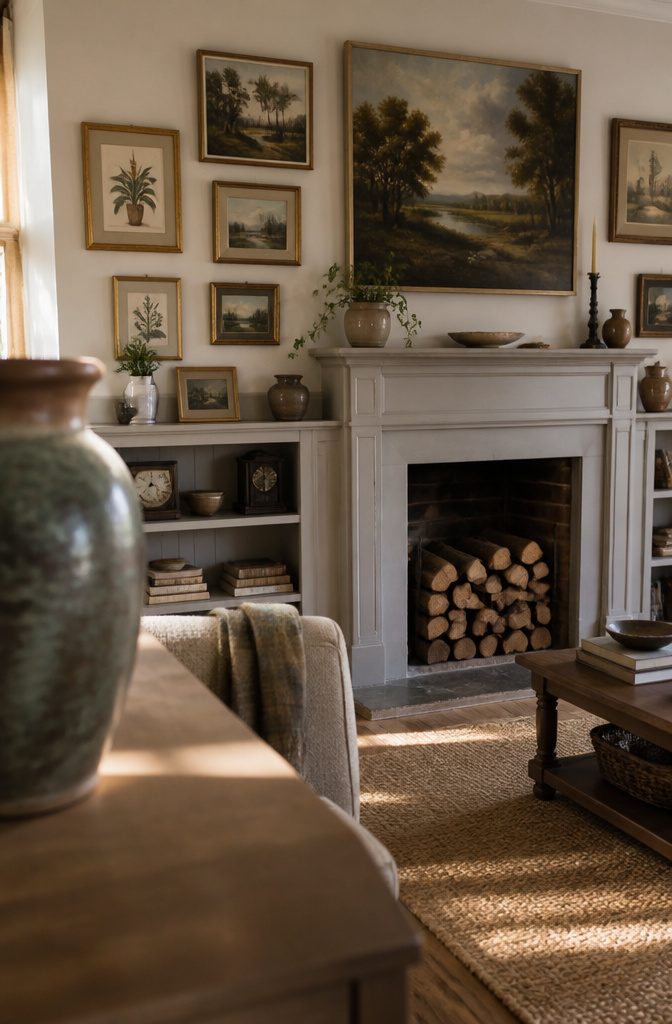
Gallery walls work because they let a room show its history rather than just its budget.
I arrange mine on the floor first—all the frames, paintings, and photos spread out until the grouping feels right, then I hang it to match.
Yes, you’ll end up with holes that need patching when you shift something two inches left, but little nail holes hide under the next frame or disappear with spackle in under a minute.
The formulas people publish are fine if you want symmetry; I’d rather have a wall that looks like it grew over years than one that looks like it was installed in an afternoon.
Books stacked on open shelves, a vintage clock next to framed photos, a mug with a name on it—these make a room read as someone’s actual space.
Built-ins on either side of a fireplace give you the depth to layer: books in back, smaller objects in front, a lamp casting warm light into the alcove. Varying shelf heights helps; uniform cubbies look installed, uneven ones look considered.
A large piece of art does more than six small ones. Oversized work adds color and stops a cottage living room from reading as fussy, and it lets you keep the walls themselves simple.
I’ve seen antique screens used as art behind a sofa, large botanical prints over a mantel, anything big enough that it doesn’t compete with the molding or the beams for attention.
9. Add rugs to hard floors
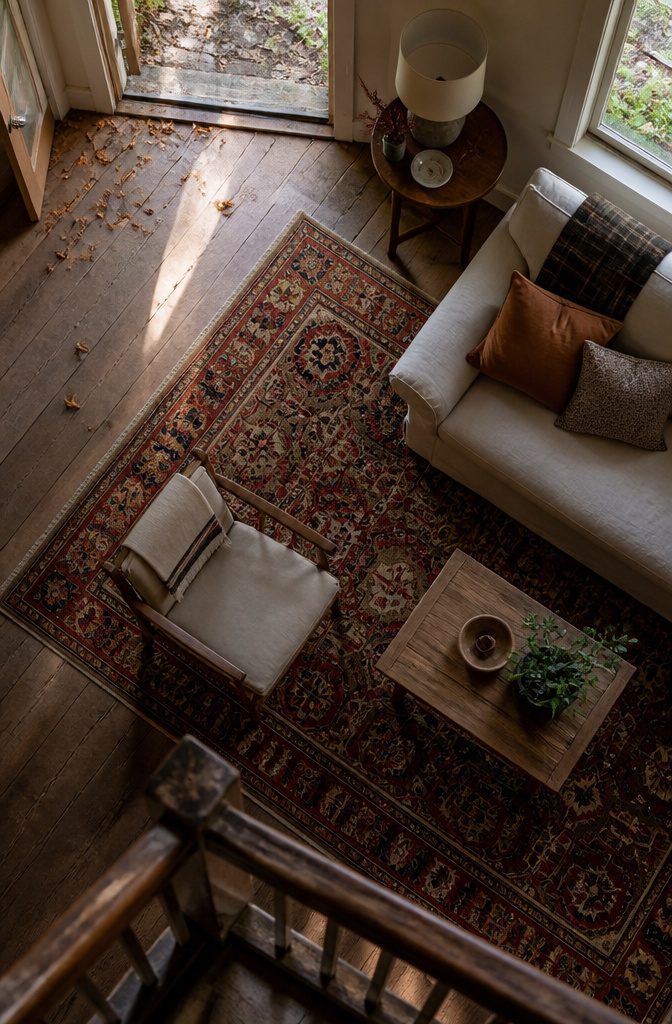
A rug softens stone, slate, or aged wood floors and brings pattern and texture into the room at ground level.
Choose one with rich, warm tones—deep reds, golds, or terracottas—and a detailed pattern that hides the kind of wear a living room gets.
The pattern does two things: it adds visual weight that balances heavier furniture, and it holds up better than a plain field when feet, chair legs, and the dog cross it daily.
A rug also protects original floors from furniture dents without covering the whole surface.
I’d keep the rug large enough to anchor the seating area but stop short of wall-to-wall, so the floor material still shows at the edges and the room reads as layered rather than carpeted.
10. Use mirrors to reflect light and add character
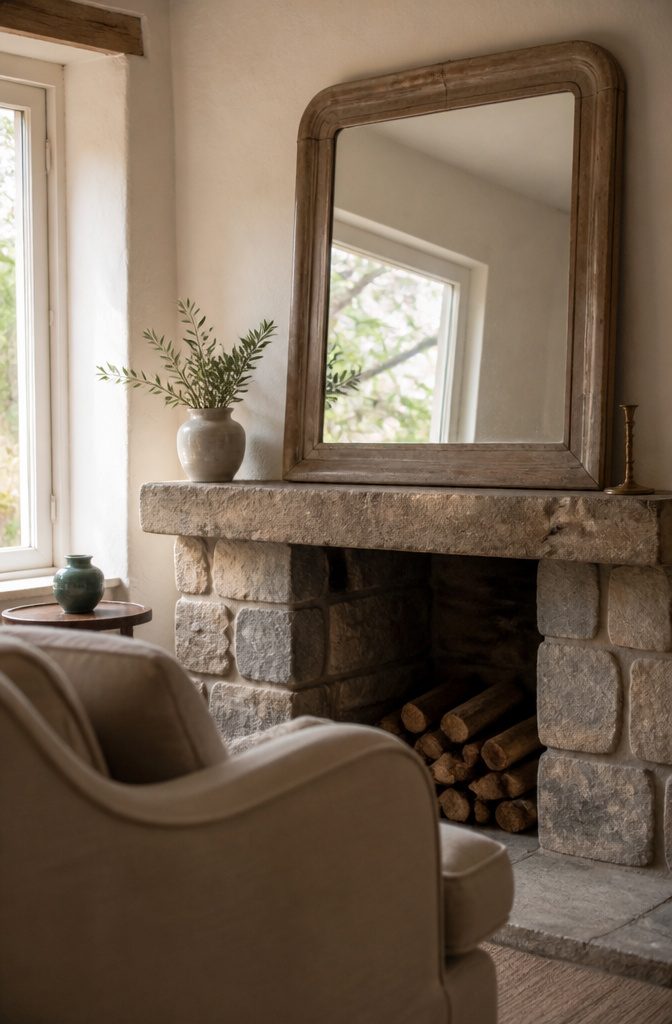
Mirrors bounce light around the room and make tight cottage spaces feel more open—hang one above the mantel or lean an oversized mirror in a corner to catch whatever natural light you have.
Vintage-inspired frames with aged finishes fit the cottage look better than anything new and sleek, and you can find them at thrift stores for less than you’d spend on a plain one at a big-box store.
Pale walls help too: cream, seashell, and ivory all reflect light instead of absorbing it, so the room reads brighter without changing the windows.
Pair a mirror with exposed brick or a stone fireplace and you get double benefit—the light reflects, and the contrast makes the architectural detail stand out more than it would on its own.
11. Add storage that also contributes to the room’s look
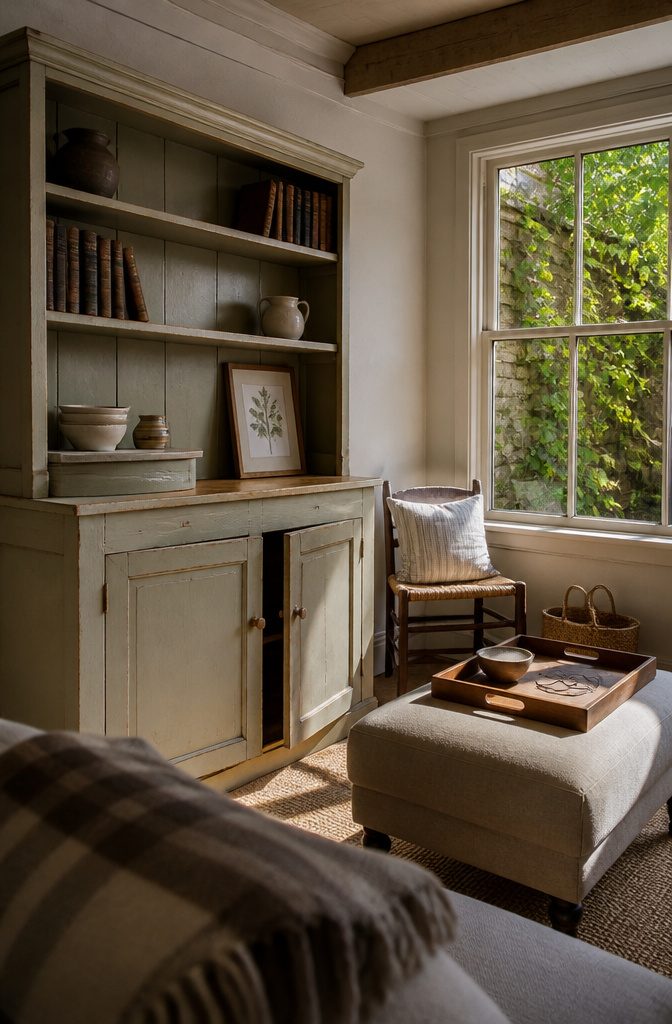
Furniture with hidden compartments keeps clutter out of sight without sacrificing surface area.
An ottoman that opens for storage holds remotes and chargers while doubling as a coffee table or extra seating—top it with a tray so it still displays a few pieces you want seen.
The contained spot means the room stays tidy without looking too styled.
Built-in shelving or a bespoke display unit fits the room’s exact dimensions and lets you control how deep each shelf runs.
Varying the height across shelves rather than keeping everything uniform makes the unit more interesting to look at, and a single framed print or object taking up its own cubby adds breathing room between grouped items.
A freestanding Welsh dresser or vintage display cabinet works as both storage and focal point.
Open shelves let you rotate what’s on view—antique books one month, a collection of plates the next—so the room changes slightly over time without requiring new furniture.
12. Make small rooms work harder
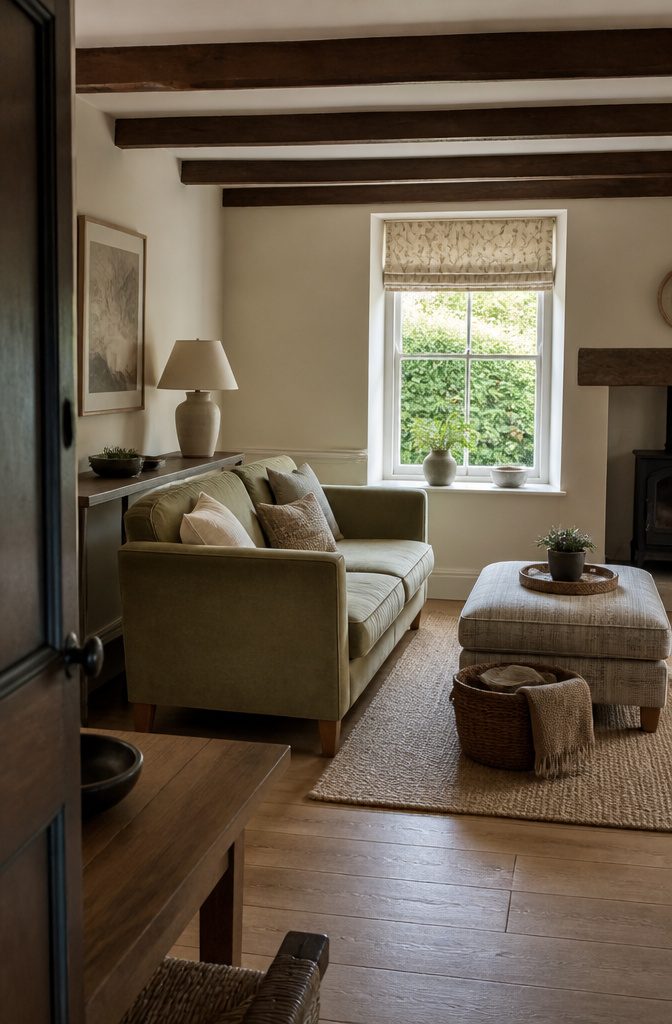
Dual-purpose furniture stretches what a small room can do.
A storage ottoman gives you a footrest and somewhere to toss throws; a sofa table behind the seating holds lamps without eating floor space. In a room that measures tight, every piece needs a second job.
Pale walls and ceilings bounce light around instead of absorbing it. Cream, ivory, and seashell shades make cramped dimensions feel less closed in, and painting the ceiling white between dark beams keeps the room from pressing down on you.
Light upholstery helps too—an olive or beige sofa under heavy timber reads airier than anything dark.
Window treatments should filter light, not block it.
A lightweight patterned blind or sheer panel lets sun through while still giving you privacy. Café curtains do the same without dropping the ceiling line.
Scale the furniture to the room, and angle seating toward one focal point so the layout feels intentional rather than squeezed. A low coffee table won’t crowd knees, and an L-shaped arrangement uses corners that would otherwise sit empty.
13. Use cottage details such as scallops, ruffles, or decorative trim
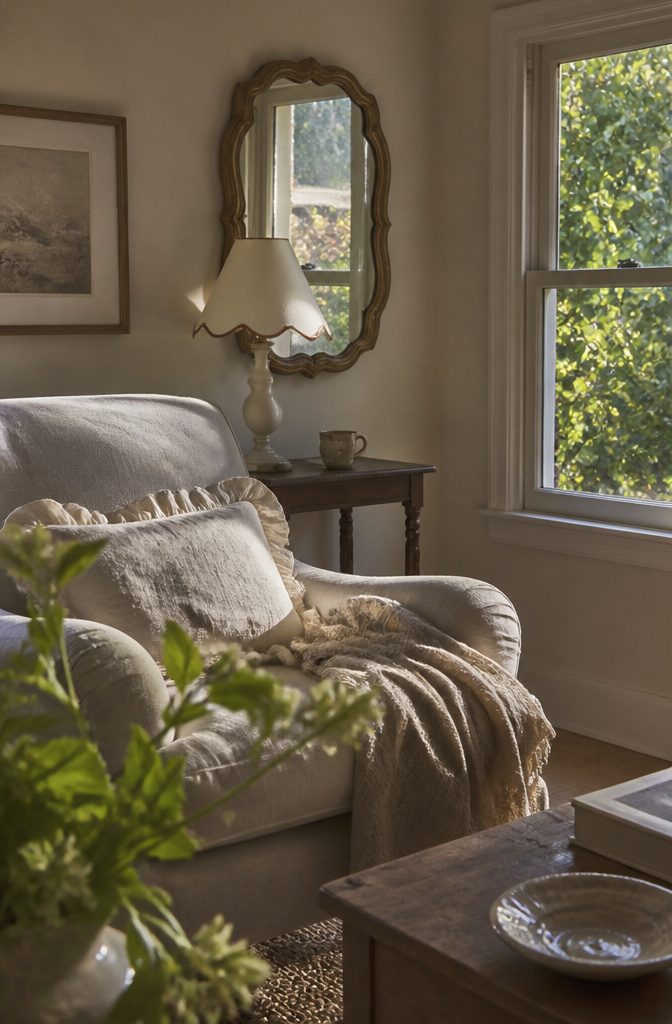
Scalloped edges soften a mantel or mirror frame in a way a straight line never will.
The curve reads as hand-finished even when it isn’t, and a scalloped lampshade or tray brings that same gentle detail to a side table without taking up more room.
Ruffled linen on a pillow or throw adds movement — the fabric folds catch light differently as you shift in your seat, which is part of why a ruffled edge makes a space feel layered rather than flat.
Decorative trim works the same way: a little goes further than covering every surface.
One scalloped mirror in a room full of plain frames stands out as intentional; five scalloped pieces in the same sightline start to look like a theme rather than a detail.
I keep these touches small and spread them across the room so each one registers as a considered choice instead of pattern for its own sake.
Budget-friendly updates that make a difference
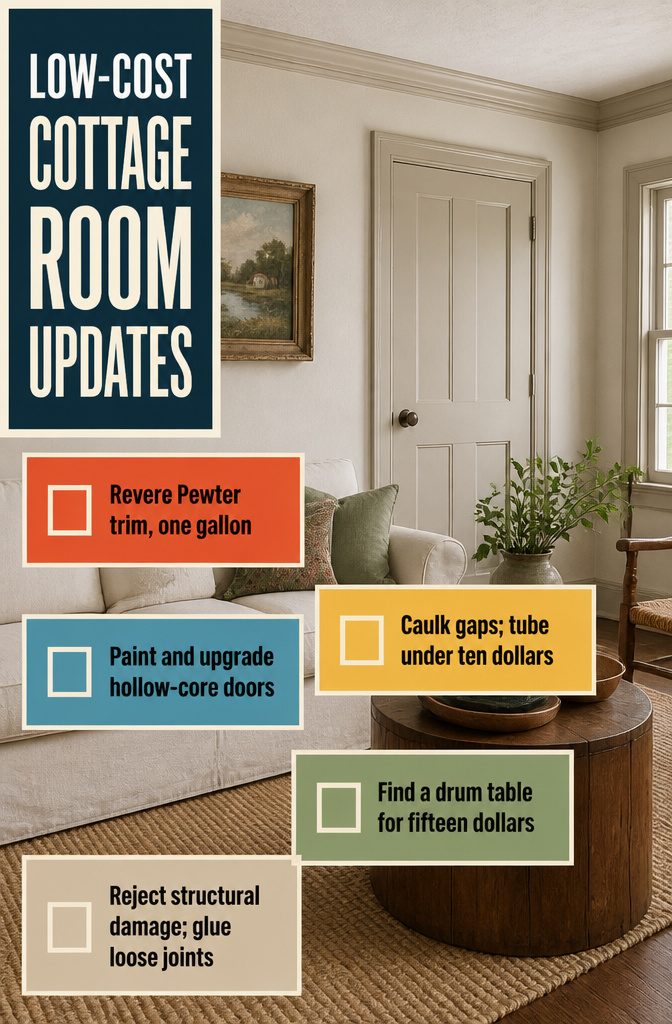
Paint and caulk cover most of the work.
Revere Pewter or Stingray by Benjamin Moore on trim pulls a room together for the cost of a gallon and a weekend, and if you have leftover paint from another project, use it.
Caulking gaps between crown molding and the ceiling or wall hides uneven surfaces in older houses — the result looks deliberate instead of settled — and a tube runs under ten dollars.
Beyond paint:
- Adapt what you already own. A hollow-core door gets a better look with paint and new hardware rather than replacement.
- Hunt thrift stores, estate sales, and Facebook Marketplace for furniture and accessories. A drum table for fifteen dollars or a mirror frame for five stretches the budget further than retail.
- Check pieces carefully before you buy — a broken leg or loose joint is fixable with wood glue and clamps, but structural damage is not.
Fireplaces and wood stoves as functional focal points
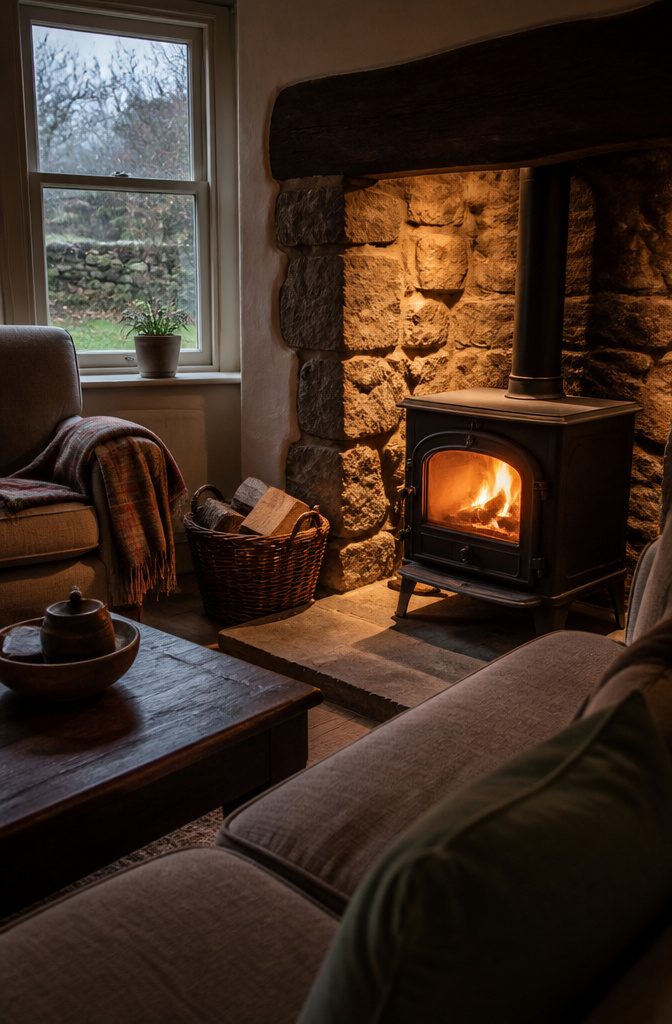
An open fire loses 90 percent of its heat up the chimney, so the romance of flames comes at a real heating cost.
A cast-iron wood stove solves that by radiating heat into the room while still giving you the visual pull of fire behind glass.
It fits inside an existing fireplace opening or stands free if you have the clearance and a proper flue connection, and it becomes the natural anchor for seating.
Angling your seating toward a shared focal point – a fireplace, table or view – relaxes the geometry and makes the room feel more conversational.
Turn chairs and sofas toward the stove rather than lining them up on opposite walls. The slight angle breaks the formality and pulls people toward the warmth, which is where they want to sit anyway once the stove is lit.
Frequently Asked Questions
How do I make my living room look like a cottage?
Start with a soft or muted color scheme on the walls, then layer in natural materials like wood beams and stone.
Add comfortable, classic furniture in soft fabrics, incorporate vintage or thrifted pieces, and use varied lighting with table lamps and sconces instead of relying on overhead fixtures.
Bring in floral textiles or greenery, display personal collections, and add rugs to soften hard floors.
What is a modern cottage style living room?
A modern cottage living room blends traditional cottage elements like natural materials and soft textiles with a cleaner, less fussy approach.
It keeps the warmth and layered comfort of cottage style but uses more restrained pattern mixing and fewer decorative details. The room still feels collected over time rather than decorated all at once, but with more breathing room between objects.
What to put on cottage walls?
Board and batten, beadboard, or vertical shiplap work as architectural treatments, especially in rooms without existing character.
Once the walls are up, add artwork in a gallery wall arrangement, vintage mirrors to reflect light, open shelves for displaying collections, or wall sconces for layered lighting.
Pale paint in cream or ivory helps all of these stand out while keeping the room bright.