

Coastal bedrooms range from salvage-yard weathered wood to crisp white linens fresh from the store, and the right choice depends on whether you own the walls or rent them.
A gallon of quality white paint runs $35–$50, but renters should negotiate with the landlord before committing, since that deposit is larger than the paint cost.
White Dove by Benjamin Moore carries enough warmth for afternoon sun without drifting yellow, and it is the sample I would grab first.
1. Soft Neutral Base
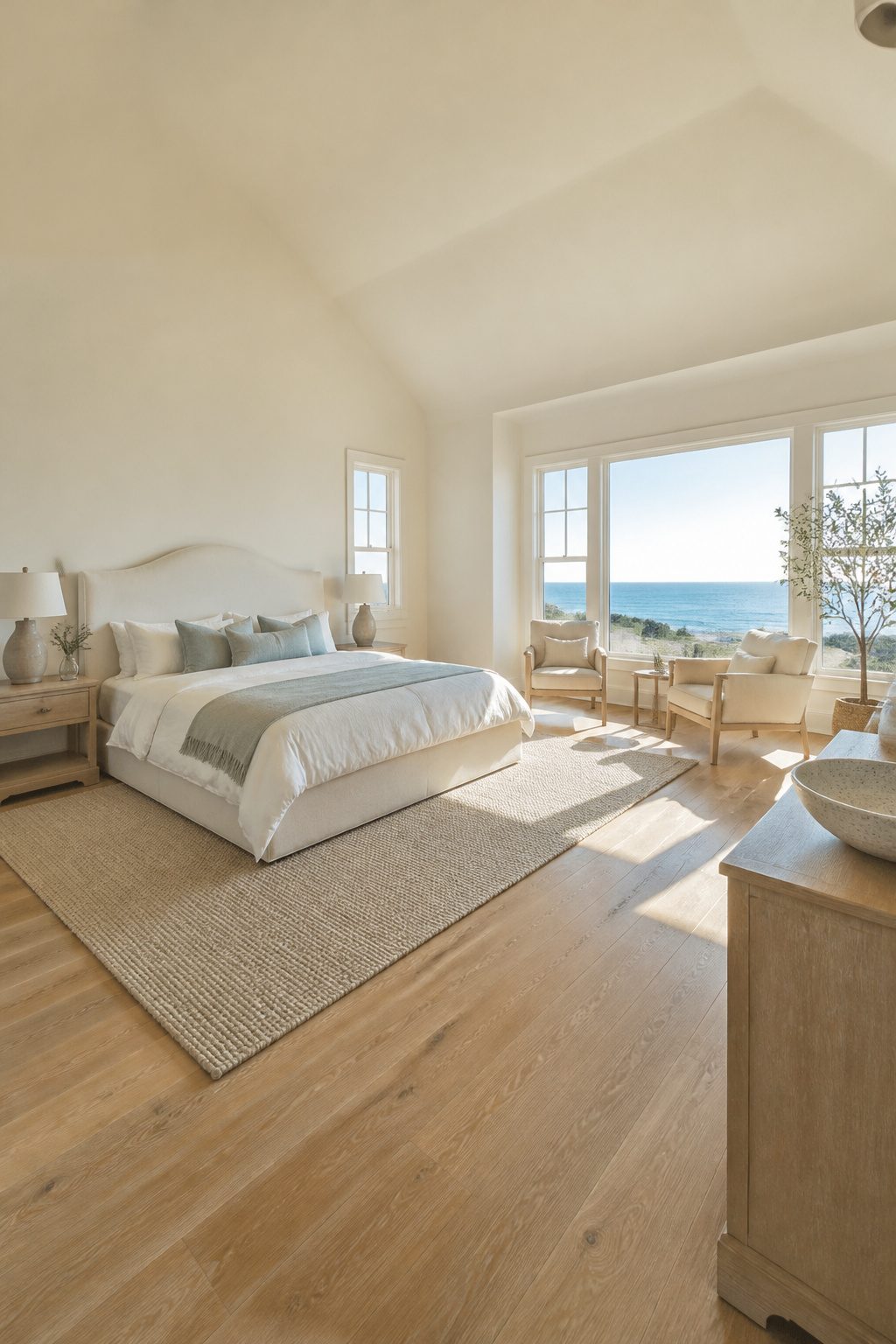
White, ivory, and soft gray on walls and large furniture pieces create the open, airy backbone that makes a coastal bedroom feel like a bedroom and not just a room with shells on the dresser.
Five sources treating this as foundational advice all point to the same reason: light neutrals reflect natural light, which is the entire point of the beach-house mood.
Without that bounce, you lose the calm before you even hang the first piece of art.
For paint, renters should stick to removable solutions or negotiate with the landlord rather than assuming a repaint before move-out is mandatory.
A gallon of quality white runs $35–$50, but your deposit is larger. Owners can commit to the full job.
White Dove by Benjamin Moore, Simply White, Swiss Coffee, Chantilly Lace, and Sherwin-Williams Pure White are the names that come up repeatedly for this look; I would grab a sample of White Dove first if the room gets strong afternoon sun, since it carries enough warmth to keep things from feeling sterile without drifting yellow.
A soft gray like Agreeable Gray works if you want slightly more color, though I would keep it to one wall and run pure white on trim and ceiling to preserve the lift.
Gray reads as shadow in low light, so skip it in a north-facing room.
2. Ocean-Inspired Colors
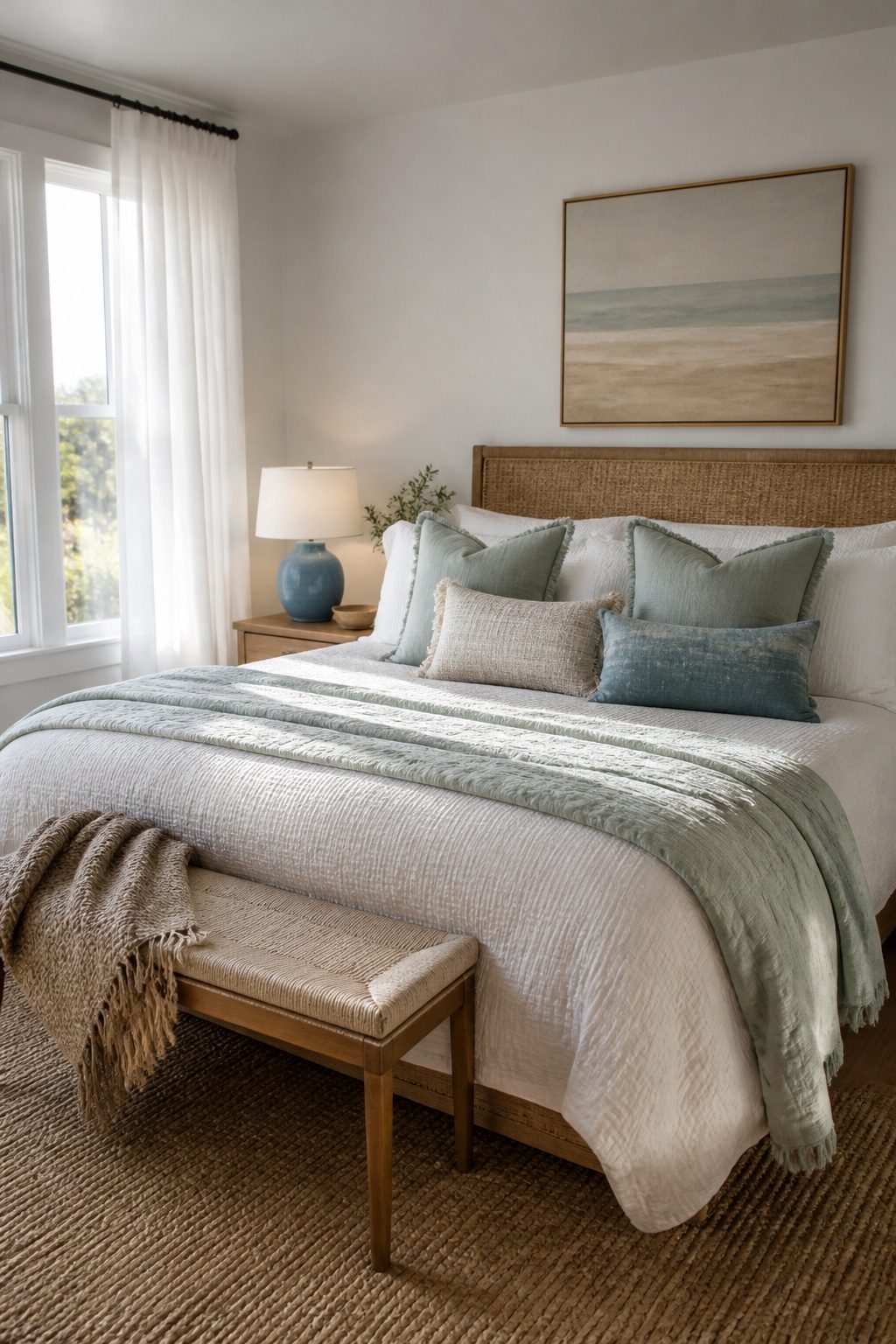
The right ocean palette starts with muted greens, sandy beige, and shades of blue borrowed from beach glass and wet sand, not from a souvenir shop.
I would keep the walls in crisp white or a warm off-white like White Dove or Simply White by Benjamin Moore, then layer the color through accents that move: pillows, a throw at the foot of the bed, a small table lamp.
Seafoam, dusty blue, or a soft navy in a velvet pillow reads coastal because the texture is relaxed, not because the shape is a shell or an anchor.
Two or three colors is enough. I would skip coral or sunny yellow unless the room already feels flat, and even then I would use it in one place, not scattered across every surface.
Aim for a room that feels like morning near the water, not one that announces a theme.
3. Natural Materials
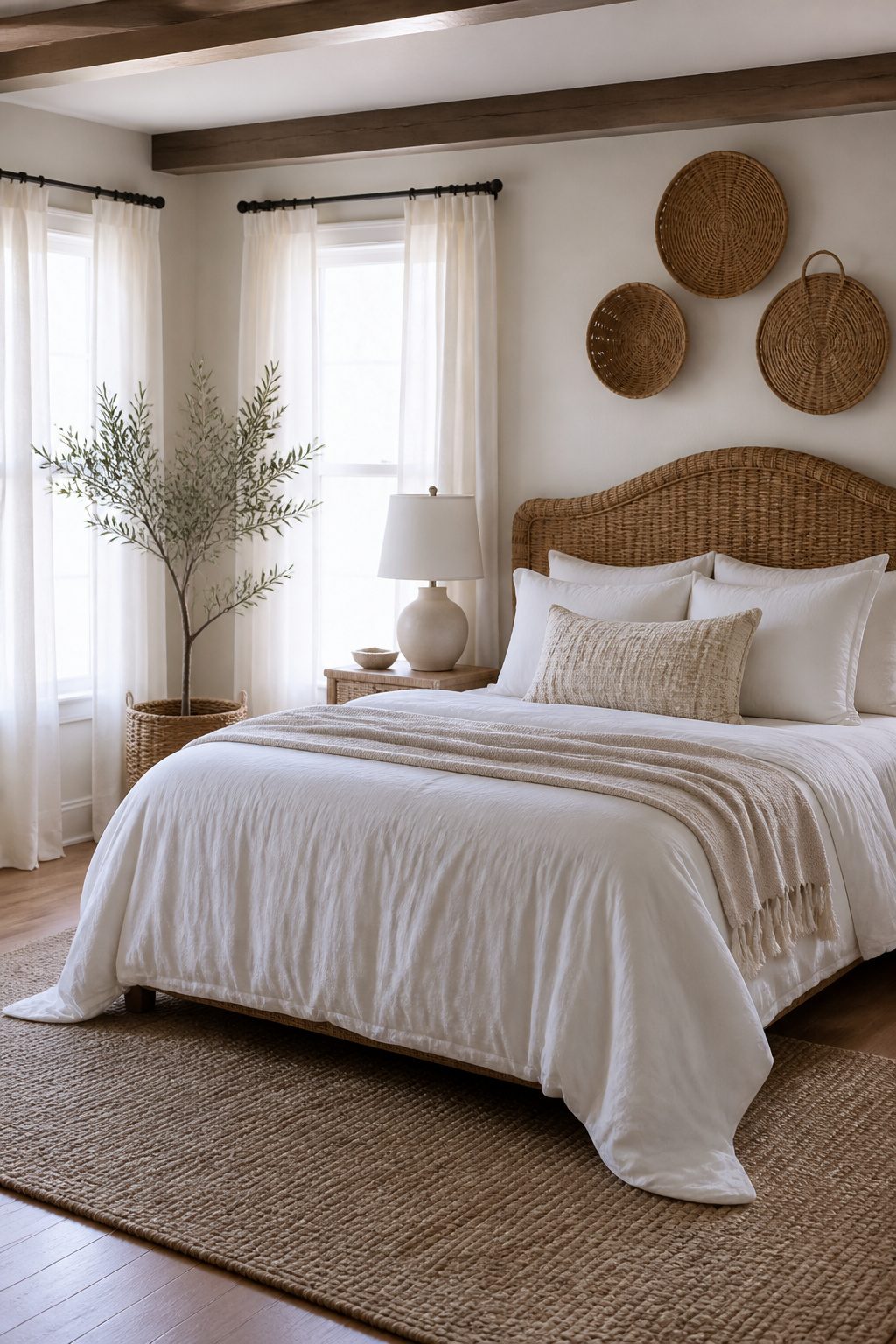
Rattan and wicker carry the coastal look further than painted wood ever could, but the difference is in the weave, not the price.
A woven headboard or a set of wall-mounted baskets gives you that sun-bleached texture without the cost of solid driftwood furniture.
I would put the money into a jute or sisal rug first; it anchors the room and takes the wear, whereas a rattan mirror frame is easy to find secondhand and paint if the tone is off.
Driftwood accents work best in small doses. A single piece on a nightstand reads intentional; a driftwood headboard starts to feel like theme-park decor.
I would skip the seagrass rug in a bedroom, actually. It is softer underfoot than jute but stains faster, and for a room you walk barefoot into every morning, sisal holds up better for the same cost bracket.
The mix I would aim for: one large woven texture on the floor, one smaller on the wall or in a light fixture, and linen bedding against both so the room does not turn into a basket shop.
Keep the rest smooth. The contrast is what makes the natural materials read as calm rather than cluttered.
4. Light and Breezy Bedding
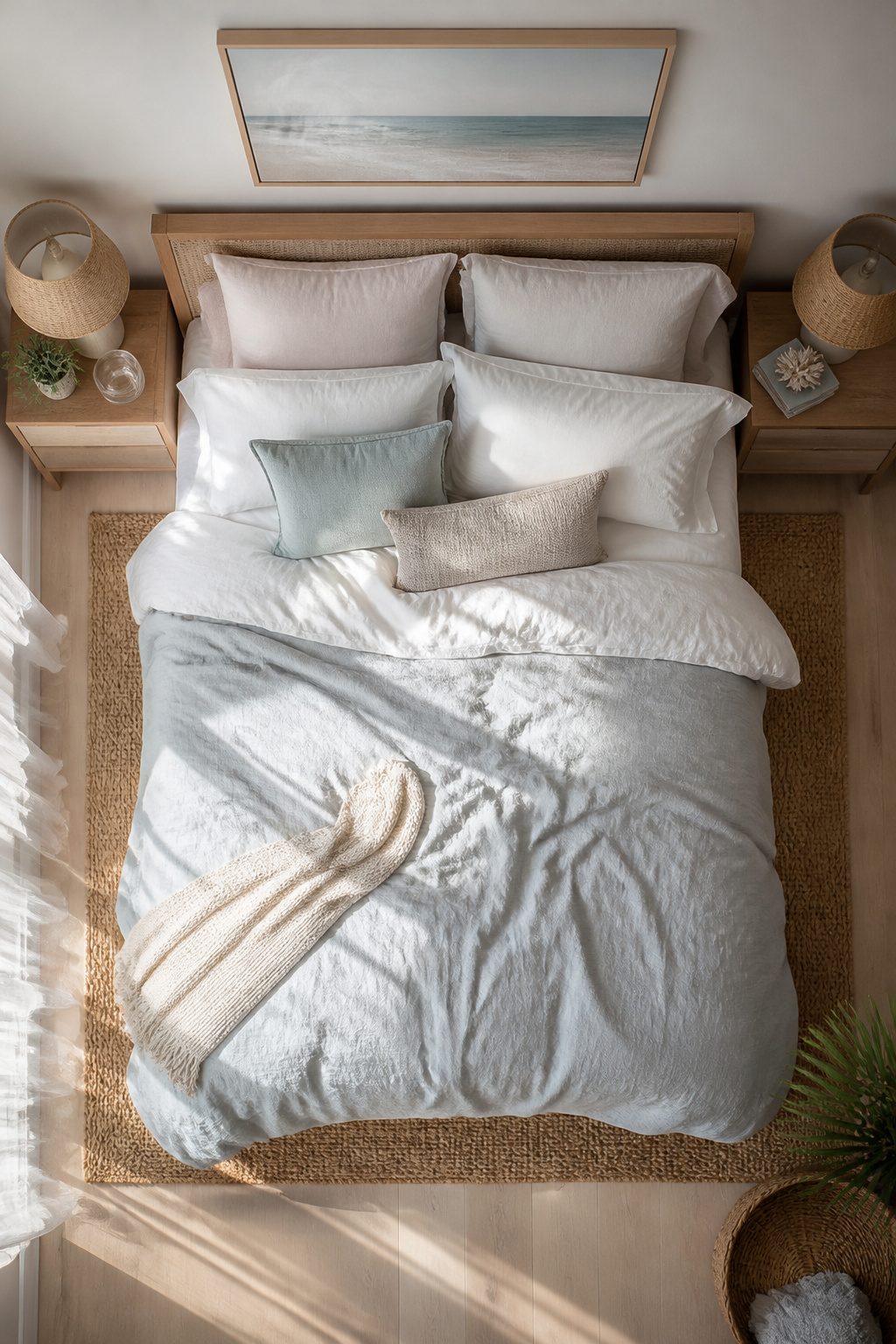
Linen and cotton both earn their place in a coastal bedroom, but they win on different budgets and timelines. Linen starts out rougher and costs more, yet it softens with each wash and holds that rumpled, just-off-the-sand look without trying.
Cotton lands softer from day one and runs cheaper, though it takes a little more effort to look relaxed rather than slept-in.
For a weekend project with a few hundred dollars, cotton sheets in crisp white give you the breezy layer you want now; linen pays off if you are building a set you will reach for across years.
Either way, skip heavy comforters. A lightweight quilt or a linen duvet cover layered over breathable sheets mimics the effortless comfort of a seaside escape without the bulk that traps heat.
White bedding with little-to-no pattern keeps the bed feeling open even when you pile on the pillows.
If you are layering window treatments too, the same logic holds: woven shades behind curtains add depth without weight, and you control how much morning light filters through.
5. Coastal Artwork
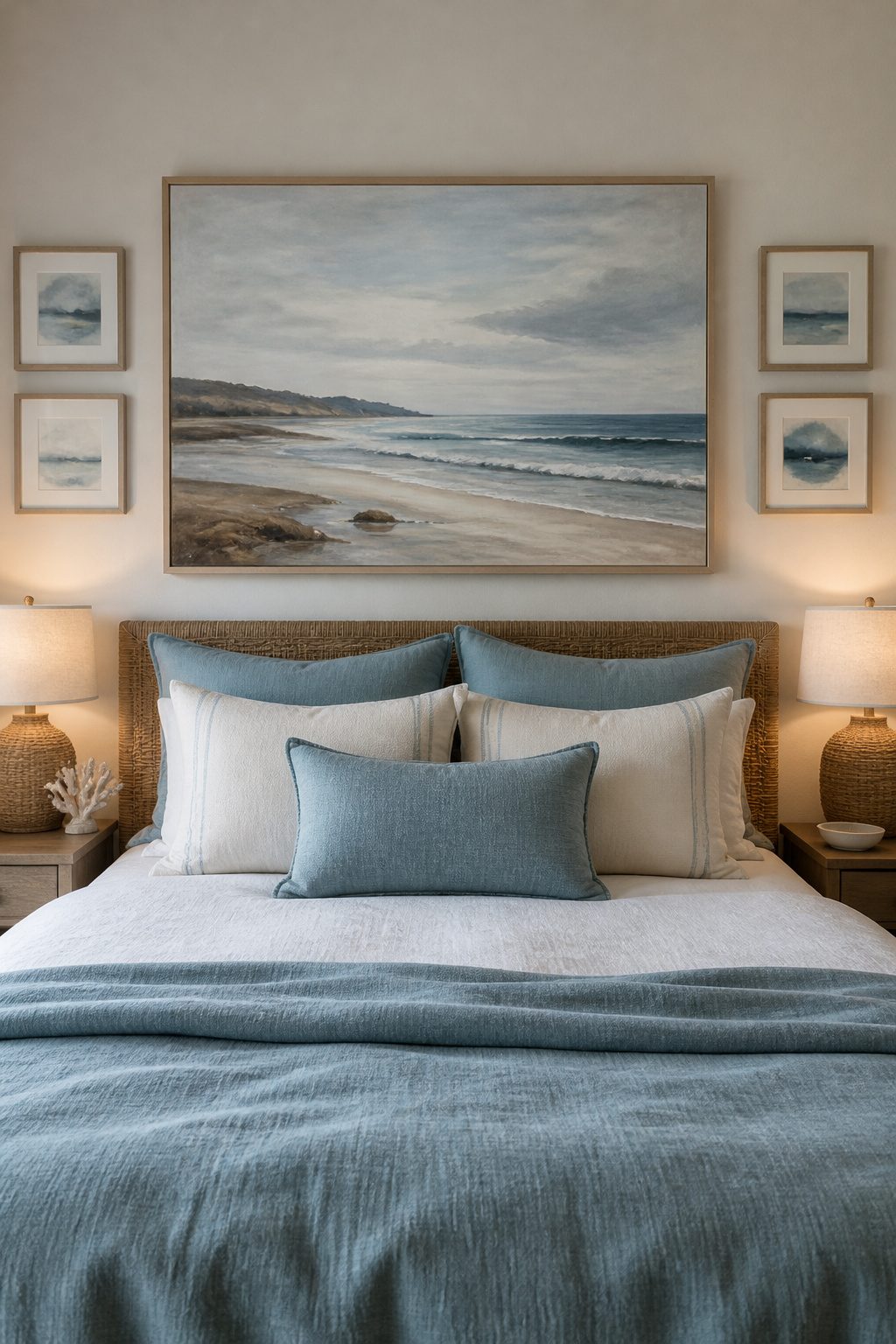
Beach landscapes and watercolor ocean prints set the tone faster than any throw pillow can, but the line between calm and cliché is thinner than most people realize.
I look for pieces that feel like a specific place rather than a generic "beach" sign from a hotel gift shop.
A framed vintage map of a coastal town, or black-and-white photography of an actual shoreline, reads collected. Overtly beach-themed signs or mass-produced sailboat prints read rented-by-the-week.
Prints run roughly $30–$80 for standard sizes, while original photography or paintings start around $200 and climb quickly.
For a bedroom you refresh every few years, I would put money into one larger statement piece above the bed and fill smaller walls with affordable prints.
The $50 print in the right frame beats the $300 original hung crooked in a plastic clip.
The frame is where I would not cut corners; a thin white wood or natural maple frame keeps the look grounded, while ornate gold or black fights the airy mood the art is supposed to create.
Abstract ocean art works if the color palette ties back to your bedding, but I skip anything with a lighthouse unless I have personal history with the specific one pictured.
The best coastal bedrooms feel like someone actually walks those beaches, not like they ordered the whole room from a "coastal" dropdown menu.
6. Coastal Patterns
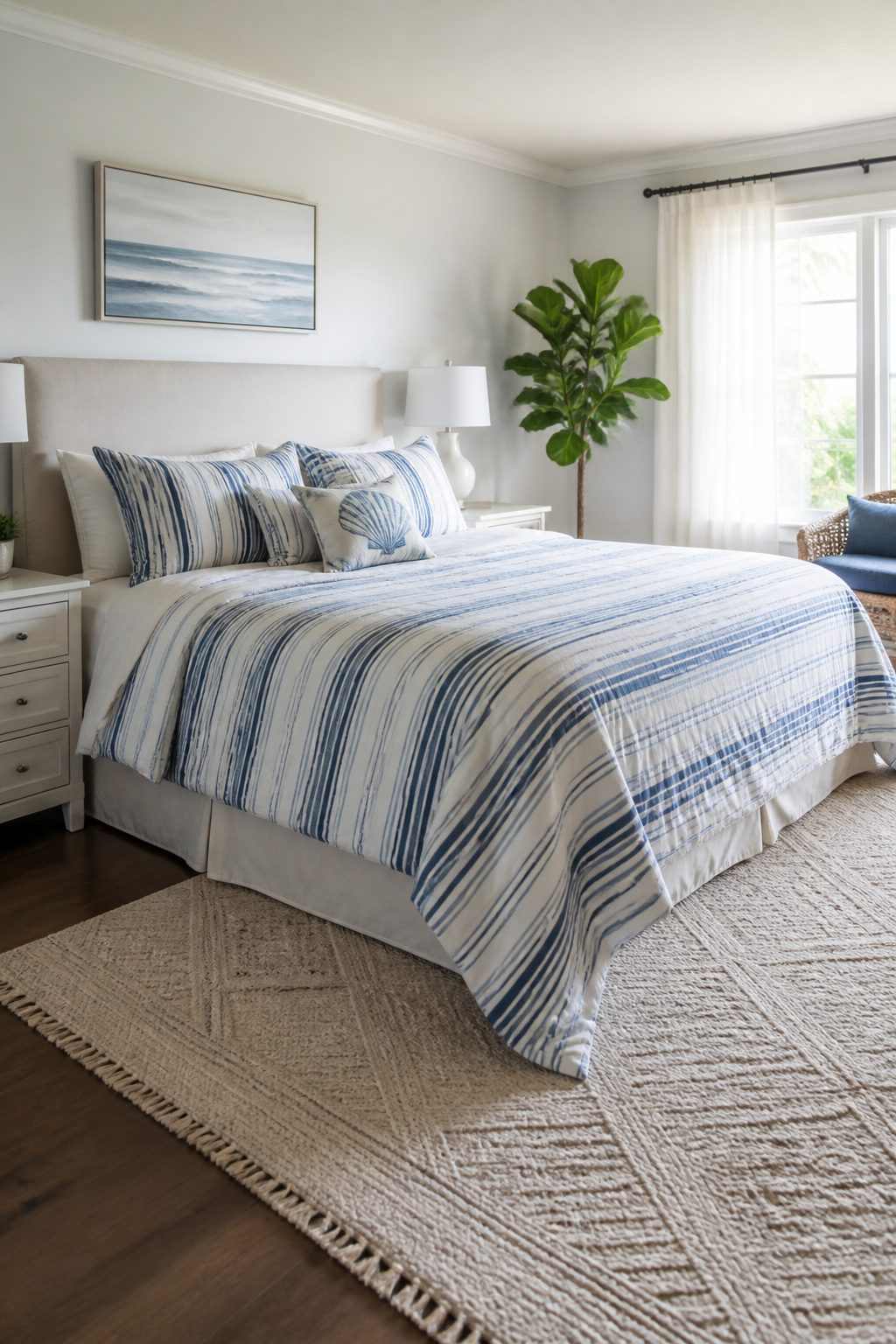
Stripes carry coastal bedrooms because they read as structure, not theme. A blue-and-white striped duvet or rug nods to sailing gear without shouting it, and that restraint is what keeps the room livable.
I would put stripes on the largest textile in the room, the bedding or a 5×7 foot rug, and stop there.
Shell motifs and coral prints are where coastal turns costume.
Use coastal patterns on curtains or throw pillows, and even then keep to one shell-patterned item. My rule: one literal motif per room, and never on the bed itself.
The bed is too big a surface; a seashell duvet becomes a theme park fast. If you want shells, set a single real one on the nightstand and let the stripes do the rest of the work.
7. Maximize Natural Light
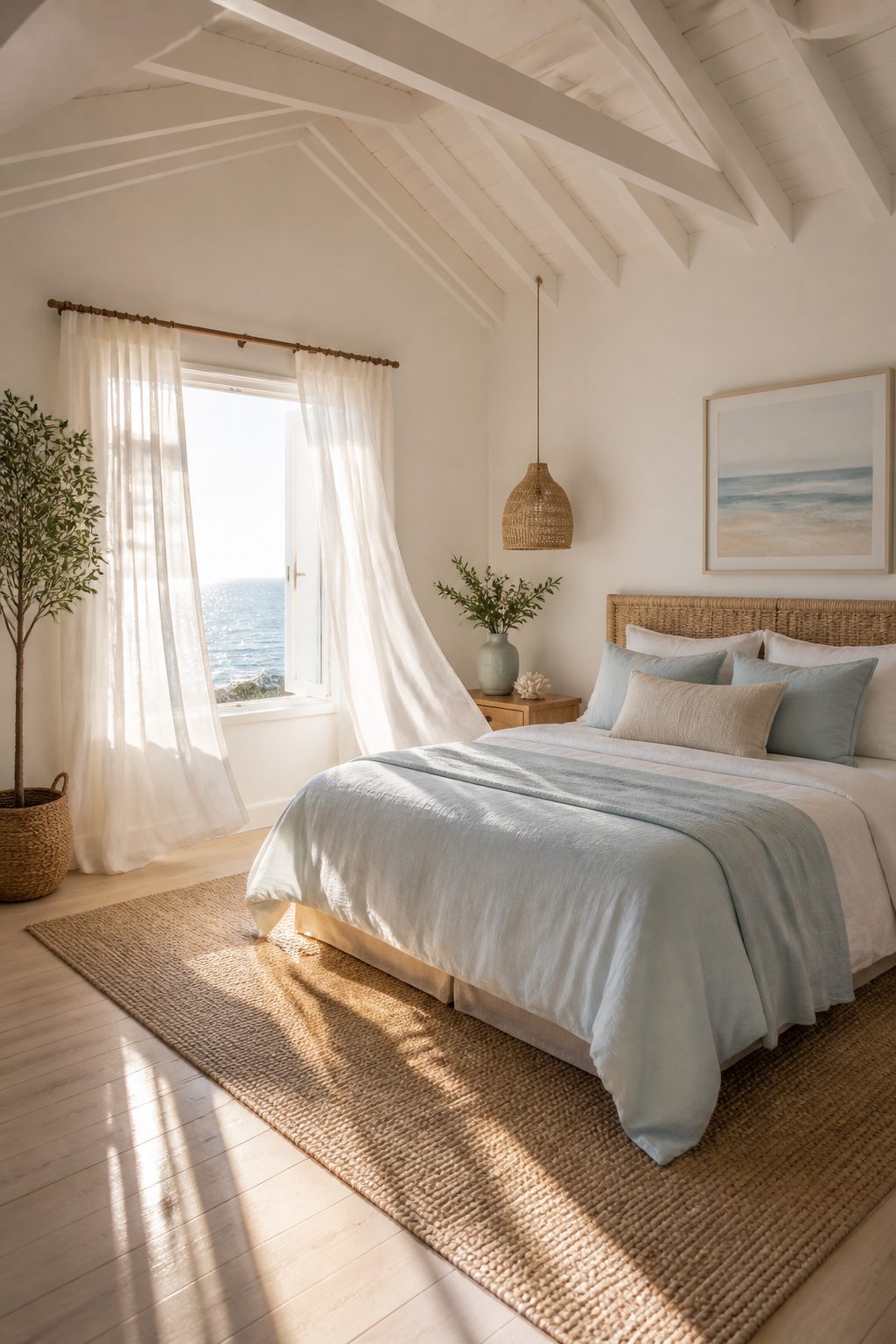
Sheer curtains or light-filtering treatments make the single biggest difference in a coastal bedroom, and the material matters more than the color.
Linen diffuses sunlight without darkening the room, and white linen billowing at an open window does more for the beach feel than any shade of blue paint.
Bamboo shades work the same way if privacy is not a concern, filtering light through their weave rather than blocking it.
For renters stuck with existing rods or hardware, tension rods inside the window frame hold sheer panels without drilling, and clip rings let you swap fabrics in minutes when you move out.
Command hooks on the window casing can suspend a lightweight sheer if the rod itself is the problem.
A north-facing room with little direct sun needs a different approach. I would skip heavy treatments entirely and use the lightest sheer I could find, maybe even unlined white panels, so every scrap of daylight gets through.
The coastal look depends on brightness, not warmth, so a cool northern light still reads as airy if you do not fight it with fabric weight.
8. Coastal Accents
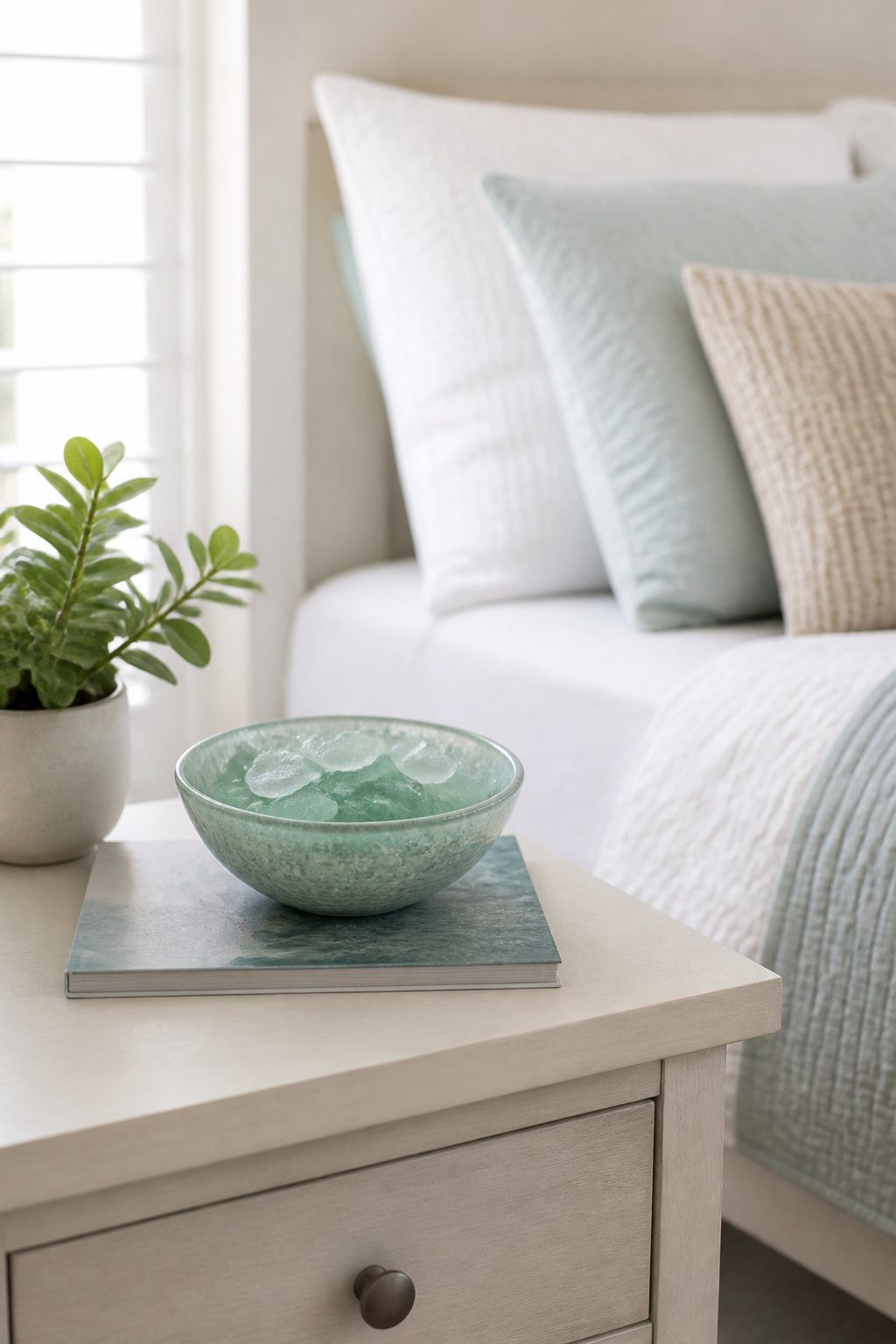
A bowl of seashells on the dresser or a stack of ocean-colored books on the nightstand gives a coastal bedroom its personality, but fewer and larger items keep the surface from sliding into clutter.
I have seen rooms where every shell from a decade of vacations ends up on display, and the result feels closer to a gift shop than a bedroom.
The line between collected and cluttered sits at about three objects per surface, maybe four if one of them is a lamp.
Found objects carry more weight than store-bought ones.
A piece of driftwood from an actual walk on the beach means something in a way a resin replica does not. That said, I would skip the ship wheels and anchors entirely.
Nautical accents turn subtle quickly into themed, and a bedroom that reads "sailor" rather than "shore" is hard to sleep in. If you want the reference, a black-and-white photograph of the beach keeps the mood quiet.
Glass jars work for smaller shells or coral, though I prefer leaving coral to artwork rather than the real thing.
A single large coffee table book, a dish for rings or earrings, and one living or faux plant on each nightstand is enough.
The nightstand itself should seem to blend into the wall so that what sits on it becomes the statement, not the storage race beneath it.
9. Weathered Furniture
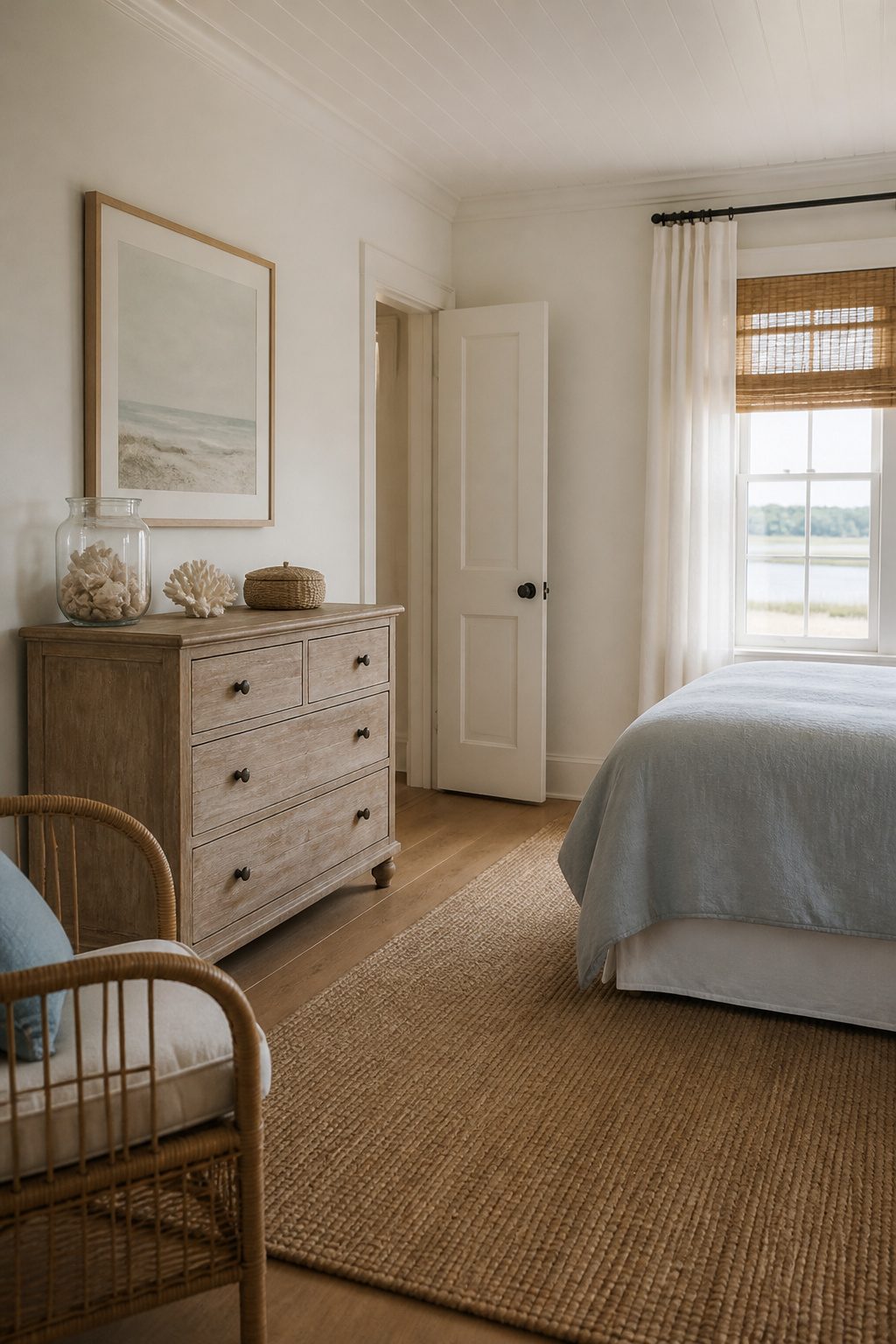
Weathered furniture sets the tone in a coastal bedroom more reliably than any accessory you add later.
A slightly worn 1920s American chest of drawers, like the kind now repurposed as nightstands in Amagansett beach houses, carries a history that factory distressing only imitates. The question is whether you need the real thing or just the look.
For authentic weathered pieces, I would start at estate sales and salvage yards in old coastal towns.
The paint is already gone, the corners are genuinely soft, and you are not paying a premium for someone to beat a new dresser with chains.
Expect to spend a few hundred dollars for a solid piece, sometimes less if the finish is rough enough that mainstream buyers pass. The risk is structural: check that drawers still slide and legs are not rotted through.
Buying new with a distressed finish is faster and the piece will be square. Light pine or oak with a driftwood finish brightens the room and fits the airy theme most coastal bedrooms need.
I would put my money here for the bed frame or a large dresser, where consistent dimensions matter for linens and storage.
Do not pay extra for "hand-rubbed" wear on a nightstand; that is where an authentic scuffed piece, even a small one, does more for the room than a factory-aged twin.
The pieces that matter most are the ones you touch daily.
The nightstand and the dresser top are at eye level when you wake and when you wind down. A true weathered surface there reads as collected over time.
A bench at the foot of the bed in rustic wood adds the same note without the same scrutiny. I would get the bedside right first, then build outward.
10. Greenery
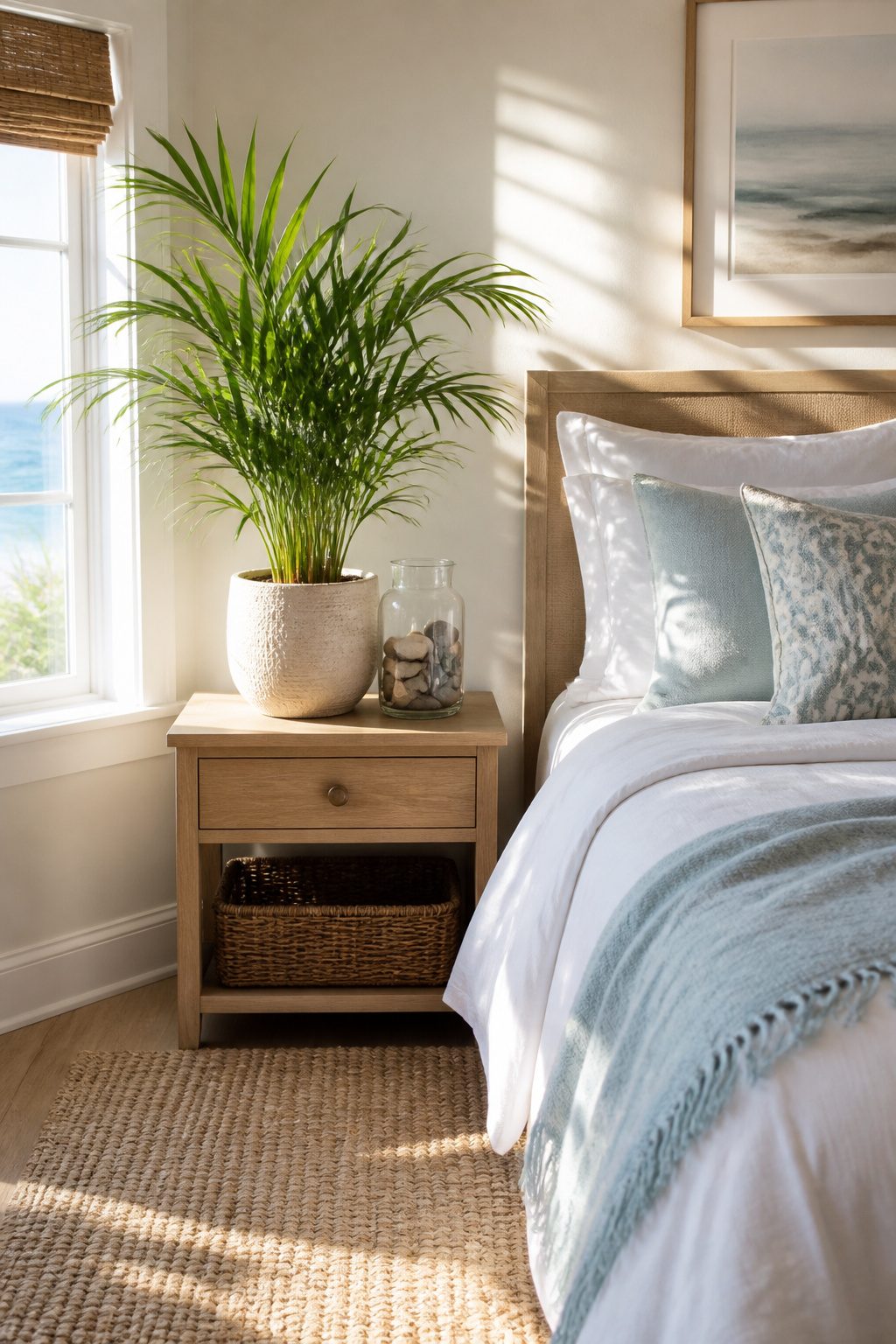
A coastal bedroom needs something alive, and a potted palm or a small fern does more for the room than another throw pillow.
Palms and ferns fit the look, though most bedrooms do not have the light these plants want. I have killed enough maidenhair ferns to know that a north-facing wall is a death sentence for anything delicate.
What survives in a bedroom’s lower light is the tougher stuff, like a parlor palm or a snake plant, and if even those struggle, clipped saw palm stems in a vase give the same look with zero care.
That is the swap I would make for anyone doing weekend projects: real plants where the window allows, cut stems where it does not.
The care level is honest either way, water the living ones when the top inch of soil dries, toss the stems when they fade. No humidity trays, no grow lights, no project that stretches past Sunday afternoon.
Color Palette for Modern Coastal
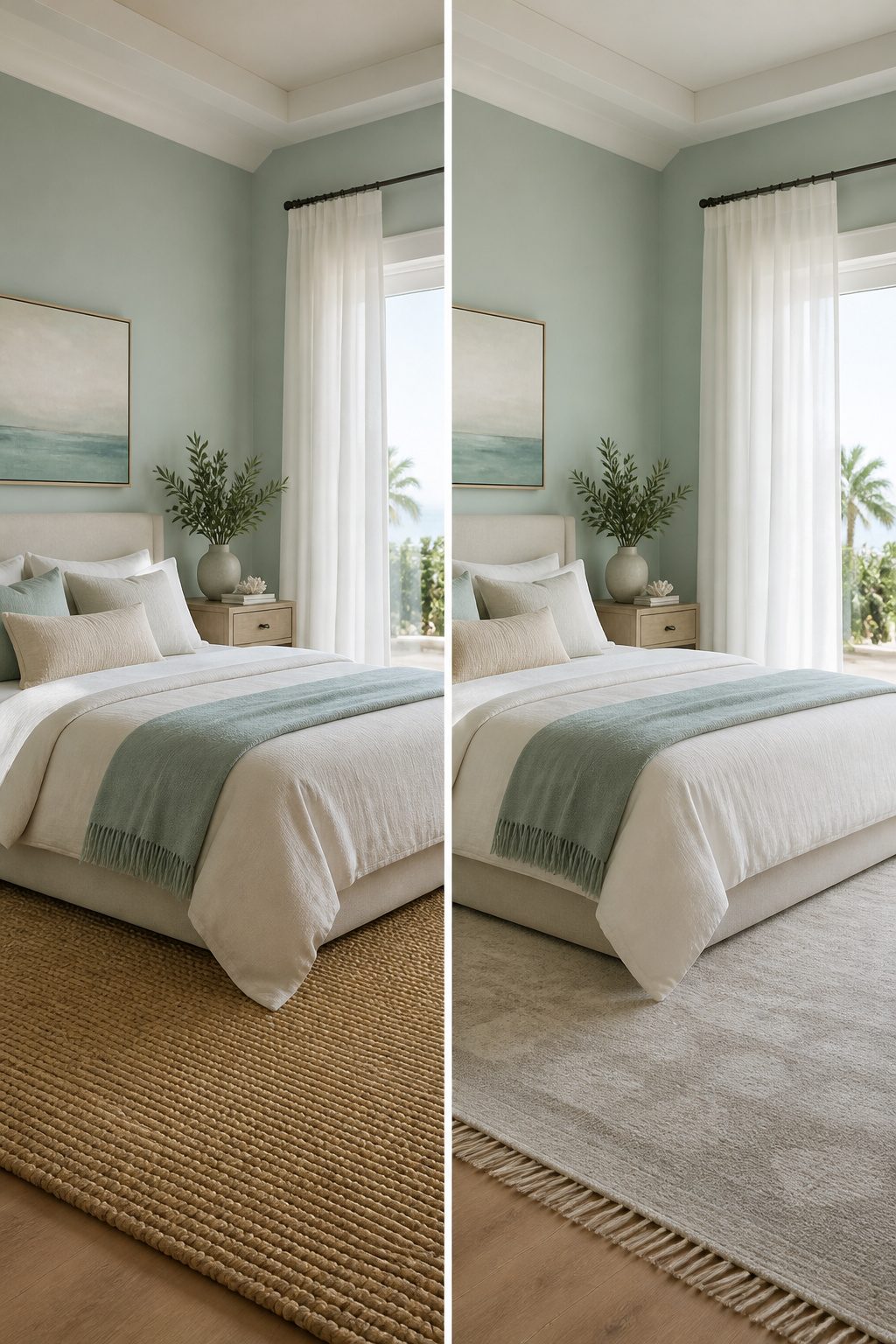
Modern coastal style strips away the surfboard signs and seashell collections that read "beach cottage," trading them for the quiet palette of a resort room with the windows open.
The difference is restraint: the same sand, driftwood, and water tones, but muted until they feel like weather, not theme.
Sherwin-Williams Sea Salt is the paint color that gets this right.
It reads as a true sea green in most light, though some rooms pull it toward blue depending on exposure, so a sample can is worth the small cost before you commit.
The alternative contender I would look at is Topsail, slightly softer if Sea Salt turns too cool in your space.
Where traditional coastal piles on bright coral and navy, modern coastal keeps the base neutral and builds interest through texture instead: a nubby linen pillow, a natural fiber rug, white curtains that move with the air.
The color does less work so the materials can do more.
I would skip any accent that needs to scream "beach" to be recognized; if it reads coastal only because it is blue, it is not modern enough for this look.
What to Skip and What to Swap
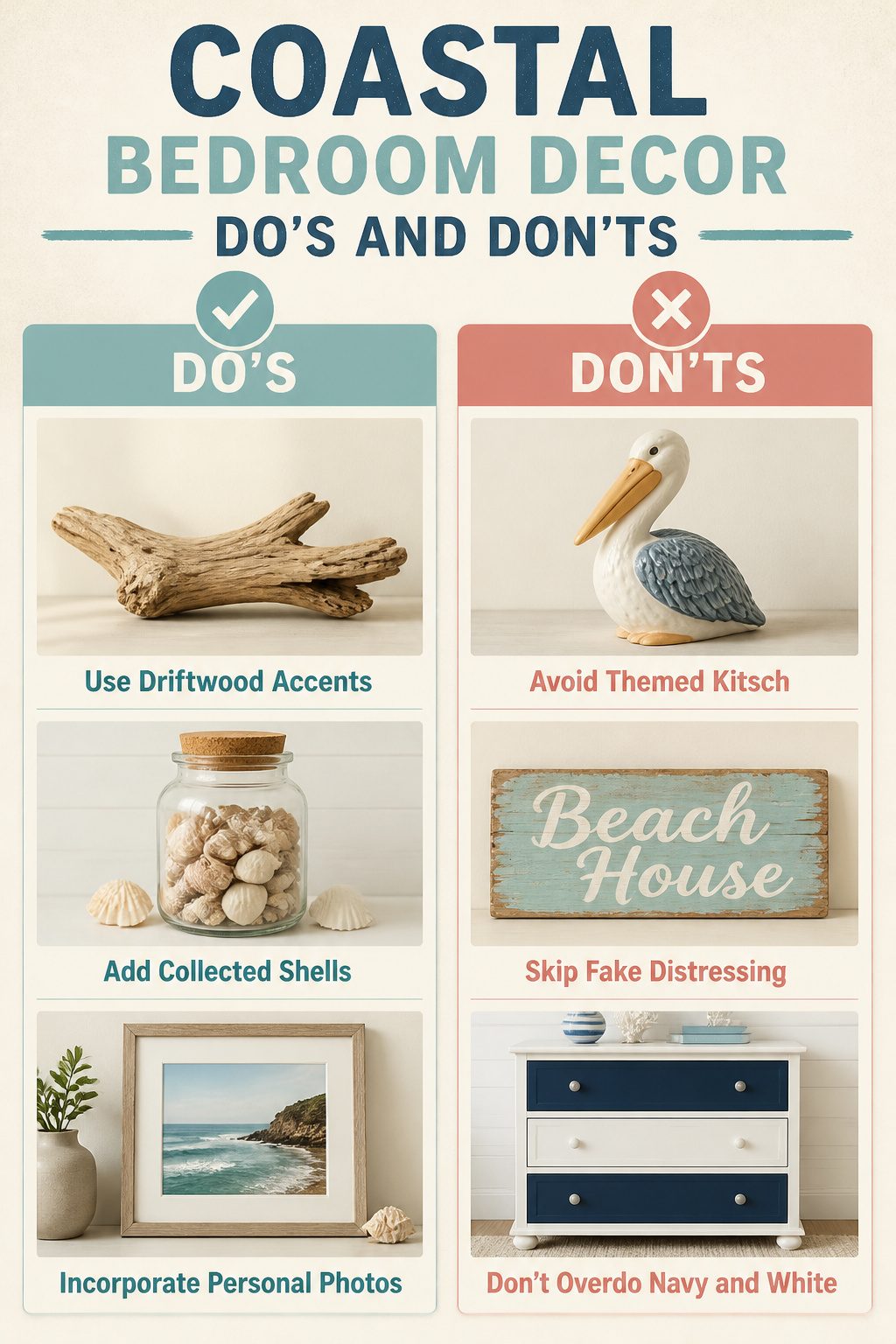
Themed kitsch is the first thing that sinks a coastal bedroom. A ceramic pelican on the nightstand or a "Beach House" sign in distressed script doesn’t read as coastal; it reads as a gift shop.
I would skip anything that announces the theme directly and swap it for an object that earned its place.
A piece of driftwood found on an actual walk, a jar of collected shells, a framed photograph you took yourself: these carry the feeling without the label.
Navy and white is the default palette for a reason, but pushed too far it turns every bedroom into the same rental listing.
I would keep the ratio closer to 60/40 neutral to blue, and pull the blue toward something softer: a faded denim, a grayed teal, a washed-out slate. The eye needs somewhere to rest that isn’t maritime.
Fake distressing is harder to spot in photos than in person, and in person it never holds up.
Machine-scraped edges and printed wood grain patterns catch light the wrong way. If you want weathered, buy solid wood that has actually aged, or use paint techniques that wear naturally at handles and corners where hands actually touch.
The difference is $40 of real wear versus $200 of furniture that looks tired instead of loved.
That swap costs you time.
Authentic patina takes years, or a lucky salvage find, or a willingness to sand and paint something yourself over a Saturday. The shortcut always costs more and looks like exactly what it is.
Weekend Budget Breakdown

A coastal bedroom refresh on a real weekend budget means spending first on what you touch every day.
I would put the money toward bedding and paint before anything else. A $25 gallon of soft white or pale blue-gray paint covers the walls and does more for the room’s mood than a new nightstand ever could.
After that, a cotton or linen duvet cover in a solid sandy tone, bought on sale or from a home goods clearance rack, gives you the texture that reads coastal without the markup of a "collection."
Furniture moves come last, and only if cash remains. A rattan headboard or a painted wood frame from a secondhand shop beats ordering new, but I would skip it entirely if the walls and bed look right already.
The same $80 can either buy one mediocre piece or two gallons of paint plus a set of washed cotton sheets. I know which change I would notice when I walk in at night.
Frequently Asked Questions
What colors work best for a coastal bedroom?
White, ivory, soft gray, and muted ocean tones like seafoam, dusty blue, and sandy beige work best.
Keep walls in crisp white or warm off-white such as White Dove or Simply White by Benjamin Moore, then layer color through pillows, throws, and lamps.
Two or three colors total is enough; skip coral or sunny yellow unless the room feels flat.
How do you decorate a coastal bedroom?
Start with a soft neutral base on walls and large furniture, add natural materials like rattan, wicker, or jute, and choose light, breezy bedding in linen or cotton.
Maximize natural light with sheer curtains, add one statement piece of coastal artwork, and keep accents minimal and meaningful rather than themed. Aim for morning near the water, not a room that announces a theme.
What rug works best in a beach house bedroom?
Jute or sisal rugs anchor the room best because they take daily wear and add sun-bleached texture.
Sisal holds up better than seagrass for barefoot mornings, since seagrass stains faster despite being softer underfoot. A 5×7 foot rug in natural fiber sets the scale for most bedrooms.
What is modern coastal style?
Modern coastal style strips away surfboard signs and seashell collections, trading them for a quiet palette of sand, driftwood, and water tones muted until they feel like weather, not theme.
Sherwin-Williams Sea Salt captures this as a true sea green that shifts toward blue depending on light exposure.
Interest comes from texture, nubby linen, natural fiber rugs, and white curtains that move with air, rather than from bright coral or navy accents.
What is the best color for a coastal bedroom?
White Dove by Benjamin Moore is the most reliable starting point, especially in rooms with strong afternoon sun, since its subtle warmth prevents sterility without drifting yellow.
Simply White, Swiss Coffee, Chantilly Lace, and Sherwin-Williams Pure White are also frequent choices.
For slightly more color, Agreeable Gray works on one wall with pure white trim and ceiling, though it reads as shadow in low light so skip it in north-facing rooms.
What are some common mistakes to avoid when decorating a coastal living room?
The same mistakes that sink coastal bedrooms apply to living rooms: themed kitsch like ceramic pelicans or "Beach House" signs, pushing navy and white too far, and fake distressing that catches light wrong.
Keep the ratio closer to 60/40 neutral to blue, pull blue toward faded denim or grayed teal, and buy solid wood that has actually aged or use paint techniques that wear naturally at handles and corners.
What are some coastal bedroom ideas for 2026?
The direction points further into modern coastal restraint, fewer literal motifs, and more emphasis on texture over color.
One literal motif per room maximum, never on the bed itself, stripes on the largest textile only, and found objects like actual driftwood or personally collected shells instead of resin replicas.
The bed should blend into the wall so what sits on it becomes the statement.
What is the difference between coastal and beachy decor?
Coastal decor reads as calm, collected, and connected to a specific place, while beachy decor leans toward the theme park version with ropes, buoys, surfboards, fish, and bold stripes.
Modern coastal specifically avoids the nautical or theme-y feel that beachy often embraces. The distinction is restraint: a room that feels like someone actually walks those beaches versus one ordered from a "coastal" dropdown menu.