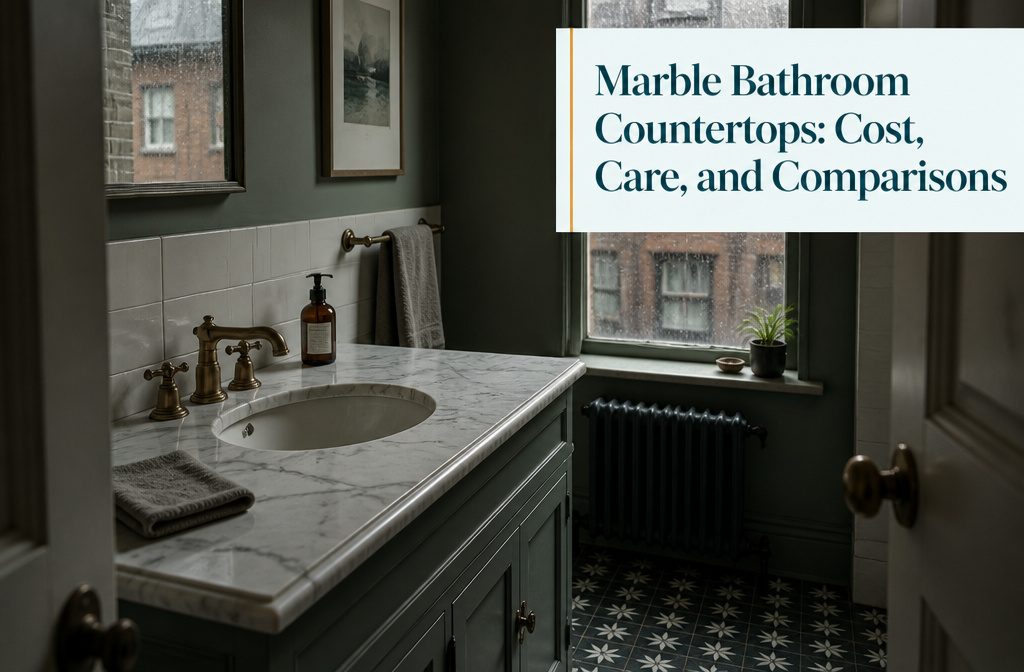
A marble counter bathroom brings the stone’s signature veining and heat resistance to a surface that sees daily contact with acidic products and standing water.
Marble etches on contact with toothpaste, hairspray, and most bathroom cleaners, and it absorbs spills faster than granite or quartzite, so the look depends on wiping the counter dry after every use and resealing it every six to twelve months.
Installed cost runs $40 to $200 per square foot depending on the marble grade, with Carrara at the lower end and rare Italian stones like Statuario above $200.
Why Marble Works in a Bathroom and Where It Doesn’t
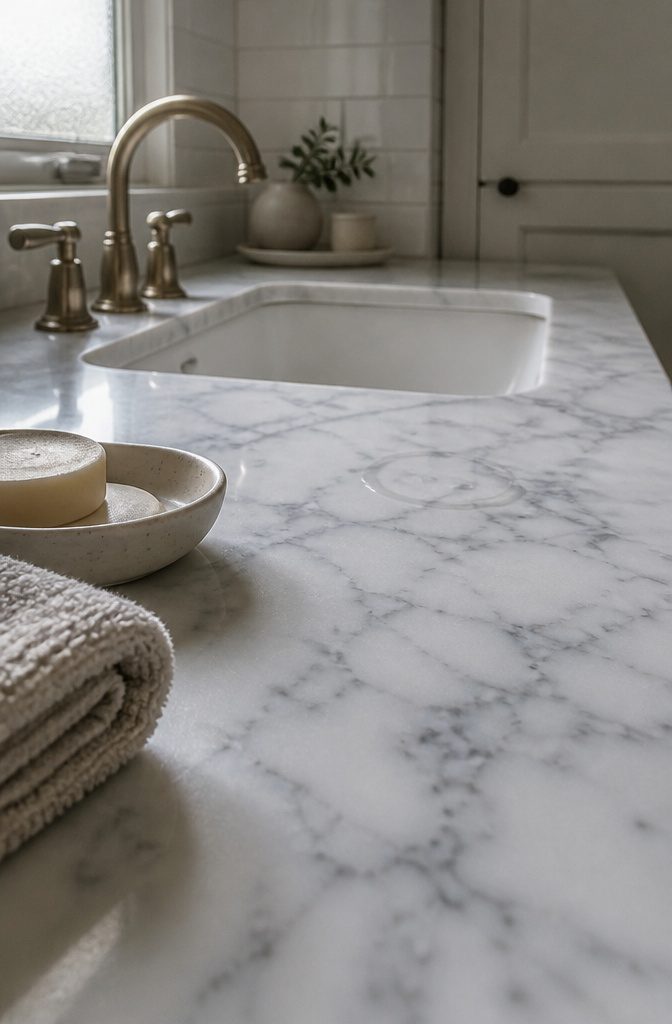
Marble brings two things bathrooms want: veining that reads as luxury even in a small space, and heat resistance that matters when a flat iron lands on the counter between passes.
It lasts decades when sealed and maintained, and the look holds value at resale in a way few synthetic surfaces do.
The porosity is the catch.
Marble absorbs liquids faster than granite or quartzite, so spilled mouthwash or perfume can stain if left to sit. It etches on contact with anything acidic—toothpaste, certain soaps, hairspray—leaving dull spots where the calcium carbonate surface dissolves slightly.
The stone is softer than granite, which means it chips more easily at edges and scratches show up faster under daily use. It also traps bacteria in its pores more readily than denser stones, so cleaning matters.
A guest bath that sees occasional use handles marble well.
A primary bath where two people get ready for work every morning, or a kids’ bath with toothpaste everywhere, will show wear unless you’re prepared to wipe the counter dry after every use and reseal it twice a year.
Marble Types and Finishes for Bathroom Countertops
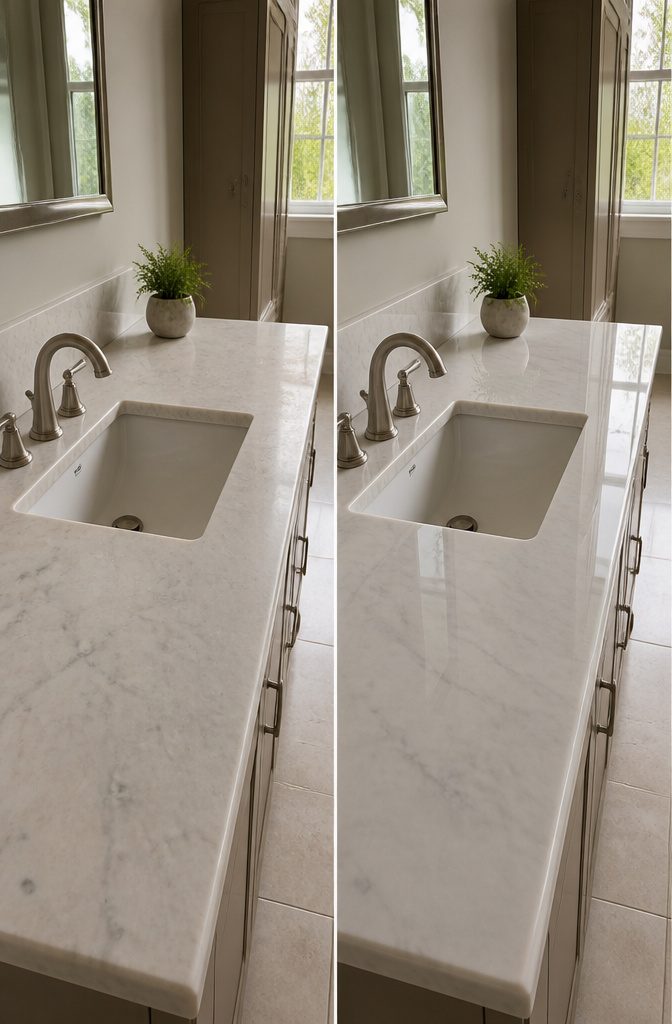
Carrara is the workhorse choice. The grey veining on white forgives minor etching and water spots better than brighter stones, and fabricators stock it widely enough that you can often find remnant slabs.
Calacatta runs whiter with bolder veining, which photographs beautifully but shows every etch mark unless you commit to coasters and fast cleanup. Statuario sits above both in price and rarity, with linear veining that spreads across the slab.
Crema Marfil brings warmth—a cream background with soft veining, technically limestone but priced near or below Carrara.
Black Marquina flips the palette: deep black crossed by white veins, dramatic in contemporary bathrooms but unforgiving with water spots. Fantasy Brown leans grey with high-contrast veining, while Emperador Light stays in warmer, golden territory.
Finish matters more than variety.
Honed marble hides etching because there is no sheen for the dull spot to break; polished stone shows every mark but resists fingerprints better. Honed is slightly more porous and needs sealing more often.
How Design Choices Affect the Countertop
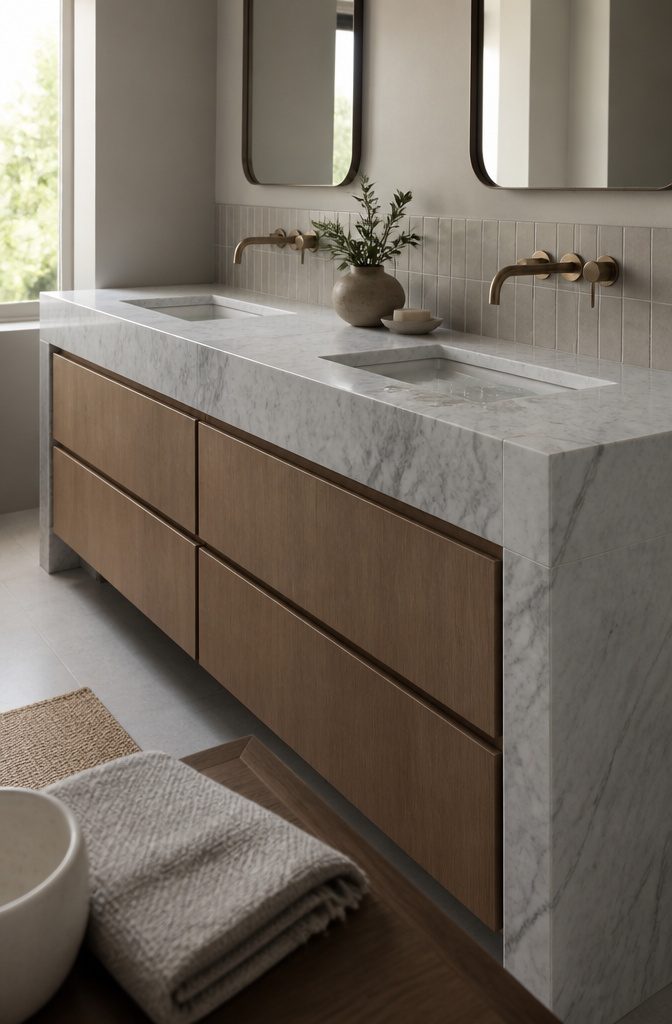
Marble countertop design starts with the slab itself, since bathroom vanities seldom exceed 72 inches and a single piece covers most layouts without a seam.
A double vanity longer than that may need one, and placement matters: run it where the sink divides the surface rather than through open counter space, and you’ll barely see it.
Thickness runs three-quarters of an inch to one and a quarter inches—the industry calls them 2 cm and 3 cm slabs.
The thicker option looks more substantial and costs more, both for the stone itself and for the extra weight your cabinet has to carry. Most bathrooms land on 3 cm when the budget allows it.
Edge profile changes the whole read of the countertop. A straight edge holds a clean, modern line.
Rounded or profiled edges—bullnose, bevel, ogee—pull toward traditional, and fabrication runs $35 to $50 per linear foot depending on how much hand-finishing the shape requires. Waterfall edges, where the stone continues down the side of the cabinet, cost more again.
Sink cutouts add $100 to $200 per hole for an undermount installation, which most marble vanities use to keep the edge clean and the counter easy to wipe.
What Marble Bathroom Countertops Cost
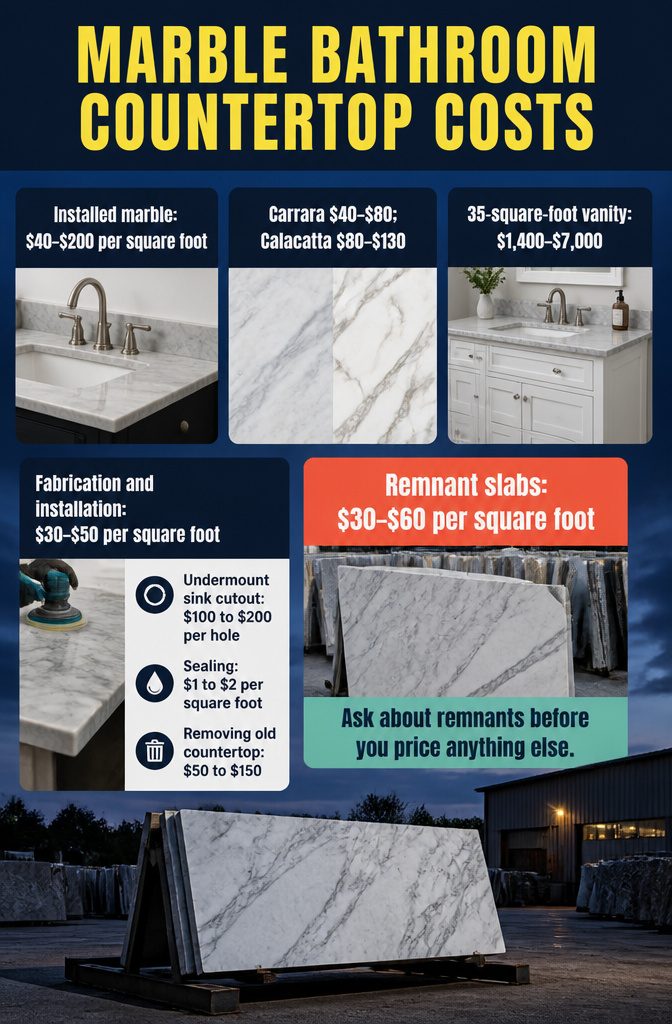
Installed cost runs $40 to $200 per square foot depending on marble grade, edge profile, and where you live.
Carrara, the white-and-grey marble you see most often, sits at $40 to $80 installed. Calacatta, with bolder veining and a brighter white base, runs $80 to $130.
Rare Italian stones like Statuario push past $200. A typical 35-square-foot vanity costs $1,400 to $7,000 all in.
Fabrication and installation add $30 to $50 per square foot. An undermount sink cutout runs $100 to $200 per hole.
Sealing adds $1 to $2 per square foot. Removing your old countertop costs $50 to $150.
One way to save real money: bathroom vanity tops are small, so you can often use a remnant slab from a fabricator’s yard and get a gorgeous stone at $30 to $60 per square foot.
Ask about remnants before you price anything else.
Cleaning and Sealing Marble in a Bathroom
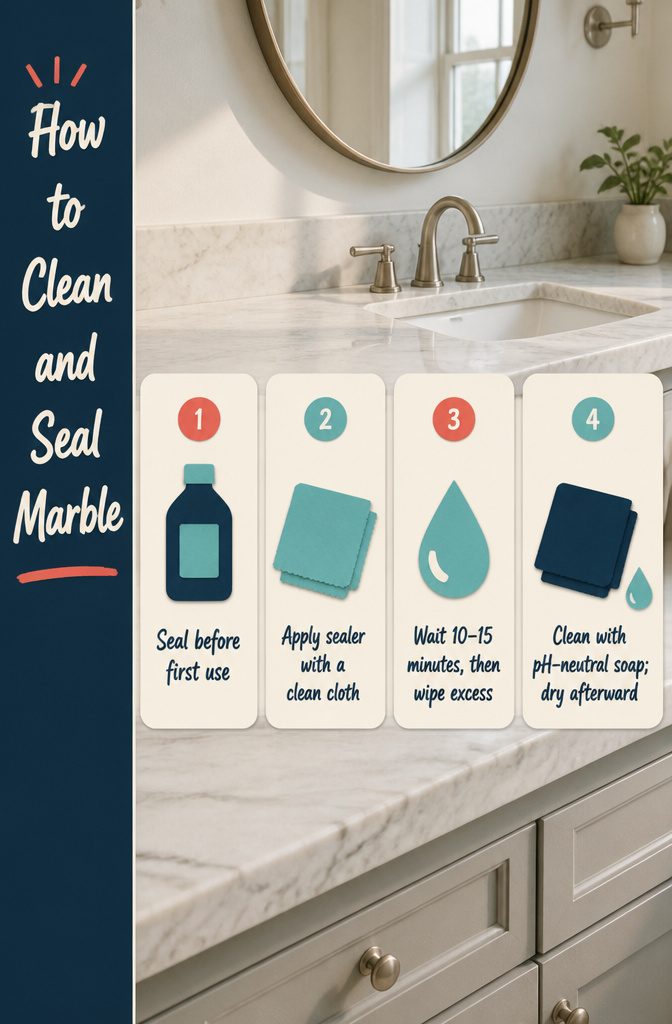
Seal marble before you use it the first time, then reseal every 6–12 months for most bathroom counters. In a shower, plan on every 3–6 months.
Some premium sealers claim protection for 3–5 years, but the water bead test matters more than the label. Drop a little water on the surface.
If it beads up, you’re fine. If it soaks in within a few minutes, reseal.
Use a penetrating sealer from Miracle Sealants, Aqua Mix, or Stone Tech.
Wipe it on with a clean cloth, let it sit 10–15 minutes, then wipe off the excess before it hazes. The whole job takes about 20 minutes.
For daily cleaning, warm water and a few drops of pH-neutral dish soap work. Use a soft cloth and dry the surface afterward.
Skip vinegar, citrus cleaners, abrasive powders, and bathroom disinfectants unless the label says safe for natural stone. Toothpaste, mouthwash, cologne, and hairspray all etch marble, so wipe spills right away.
Marble Against Granite, Quartz, and Quartzite
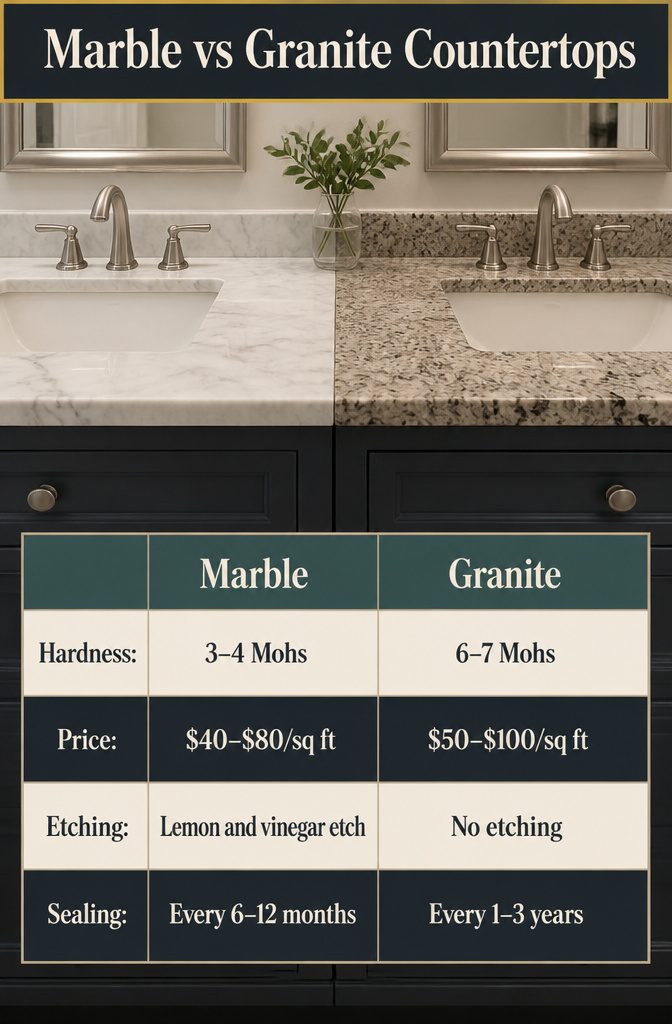
Marble sits at 3–4 on the Mohs hardness scale, which puts it softer than granite at 6–7 and quartzite at 7. That softness is why marble etches when lemon juice or vinegar hits it and granite doesn’t.
Granite costs about the same—$50–$100 per square foot against marble’s $40–$80—but it skips the etching problem entirely and needs sealing only every one to three years instead of every six to twelve months.
The grain reads differently, though. Some people find granite too busy or too casual next to marble’s cleaner veining.
Quartzite runs harder than granite, etches rarely, and gives you natural stone that holds up better than marble. It costs more at $60–$130 per square foot, so you’re paying for that durability.
Engineered quartz like Cambria mimics marble in photos and never etches or needs sealing. In person, the pattern repeats across the slab in a way real stone doesn’t, and that repetition is what gives it away.
Solid surface like Corian is the other direction: it repairs easily, costs $45–$85, and looks like solid surface rather than stone.
Custom Fabrication and Installation
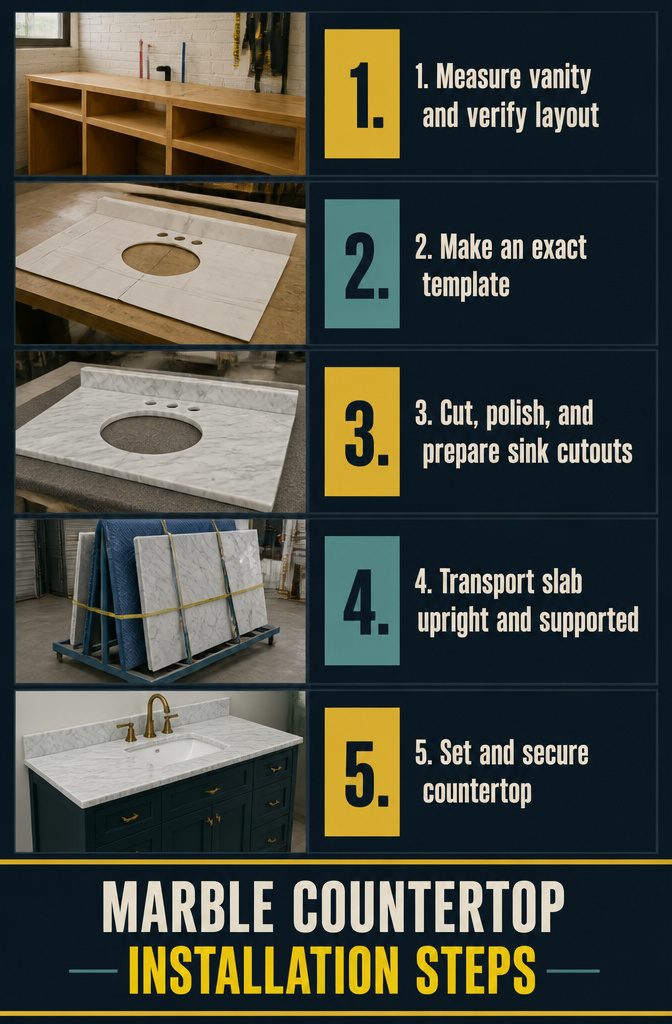
- Measure the vanity and verify the layout. Check for wall irregularities, uneven floors, and the exact position of drains and supply lines. Minor discrepancies create visible gaps or put stress on the slab, so use professional tools and measure carefully. Marble doesn’t forgive corrections after the cut.
- Make a template. Fabricators use paper, cardboard, or a laser device to capture the exact shape. Discuss seams now if the vanity is over 72 inches—most single-sink setups need none, but a double vanity may require one. Ask where it will fall and whether a book-match is possible.
- Cut and polish the slab at the shop. The fabricator cuts to the template, finishes the edges, and prepares sink cutouts. Edge profiles matter for chip resistance, so ask what they recommend for your bathroom’s use.
- Transport the slab. Marble travels worse than granite. Long spans of 2 cm stone can crack on a bumpy ride if not supported properly. A good shop uses A-frame racks and soft blankets and never lays marble flat.
- Set and secure the countertop. Silicone adhesive bonds the stone to the cabinet. Undermount sinks get epoxied and clipped from below. Thicker slabs or longer spans need plywood support depending on your cabinet construction and whether the vanity is freestanding or wall-mounted.
What to Ask a Fabricator Before Ordering
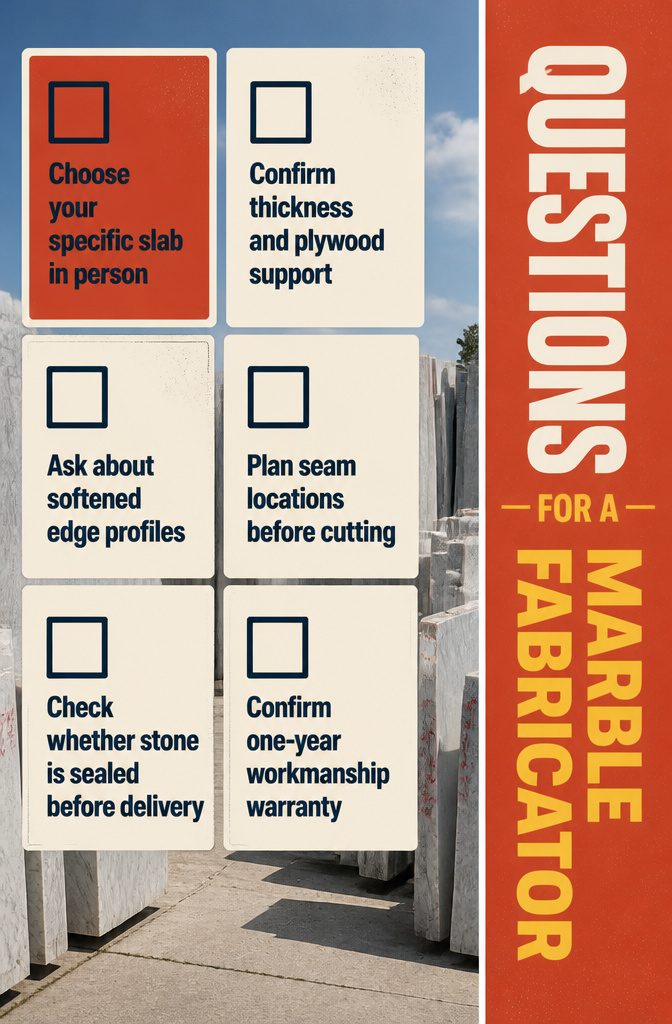
Ask whether you can select your specific slab in person at the yard—not from a photo, not from a sample chip.
Slabs vary wildly in veining density and background brightness, even within the same marble type. Chalk-mark the one you choose so the fabricator knows exactly which piece you picked.
Other questions that matter:
- What thickness do you recommend for my cabinet setup, and do I need plywood support? The answer depends on your vanity construction and whether it’s freestanding or wall-mounted.
- What edge profile do you recommend given how we’ll use this bathroom? A good fabricator weighs chip risk honestly. Marble chips on sharp edges, so a softened eased or bullnose edge holds up better than a crisp ogee in a family bathroom.
- Will there be seams, and where? Most single-sink vanities don’t need one. Double vanities or odd layouts may.
- Do you seal the stone before delivery? Some shops include a sealer application. Many don’t. Find out which and plan the first sealing yourself if needed.
- What’s your warranty on fabrication and installation? Industry standard is typically one year on workmanship.
- Can you show me photos of finished marble bathroom jobs? Not to judge taste, but to see edge work and seam placement on real installs.
Skip the sealer before first use and water rings show up within weeks. Choose polished marble for heavy use and etching shows every spill.
Pick a sharp edge and small chips collect fast. If you won’t wipe spills and reseal once a year, marble will let you down.
Frequently Asked Questions
Can you put marble countertops in a bathroom?
Yes, marble works well in guest bathrooms or low-use spaces, but primary bathrooms with daily traffic will show etching and wear unless you wipe spills immediately and reseal twice a year.
The stone etches on contact with toothpaste, hairspray, and most bathroom products, and its porosity traps bacteria more readily than denser stones like granite.
How much does a marble bathroom countertop cost?
Installed cost runs $40 to $200 per square foot depending on marble grade and edge work.
Carrara sits at $40 to $80 installed, Calacatta runs $80 to $130, and rare stones like Statuario push past $200. A typical 35-square-foot vanity costs $1,400 to $7,000 all in.
How often does marble need to be sealed?
Seal marble before first use, then reseal every 6 to 12 months for most bathroom counters.
Use a penetrating sealer from Miracle Sealants, Aqua Mix, or Stone Tech. Drop water on the surface; if it soaks in within a few minutes instead of beading up, reseal.
What are the best marble types for a bathroom vanity?
Carrara is the most practical choice, with grey veining on white that forgives minor etching and water spots better than brighter stones.
Calacatta runs whiter with bolder veining but shows every etch mark, while Crema Marfil brings warmth at a price near or below Carrara. Black Marquina and Statuario work for specific looks but demand more maintenance.
Which is better for a bathroom, quartz or marble?
Engineered quartz never etches or needs sealing and mimics marble in photos, but the pattern repeats across the slab in a way real stone doesn’t.
Marble gives you natural veining that holds resale value, but you’ll wipe spills right away and reseal twice a year. If you won’t maintain it, quartz is the better pick.
What are the disadvantages of a marble countertop?
Marble etches on contact with anything acidic, including toothpaste, hairspray, and most bathroom products, leaving dull spots where the calcium carbonate dissolves.
It absorbs liquids faster than granite, traps bacteria in its pores, and chips more easily at edges. Daily use shows wear unless you wipe the counter dry after every use.
What thickness of marble slab should you use for a bathroom countertop?
Most bathrooms use 3 cm slabs (about one and a quarter inches thick) when the budget allows, since they look more substantial and cost more for both the stone and the extra weight your cabinet carries.
The thinner 2 cm option works for smaller vanities but may need plywood support depending on your cabinet construction.
What should you ask a fabricator before ordering marble bathroom countertops?
Ask whether you can select your specific slab in person at the yard, since slabs vary wildly in veining and background brightness even within the same marble type.
Also ask what thickness and edge profile they recommend for your cabinet and bathroom use, whether there will be seams and where, if they seal before delivery, and what their warranty covers.
Is marble still in style in 2026?
Marble remains a luxury signal in bathrooms and holds value at resale in a way few synthetic surfaces do.
The veining reads as high-end even in small spaces, and the look hasn’t cycled out of favor the way some trending materials do. Honed finishes and understated varieties like Carrara stay current across different design styles.