
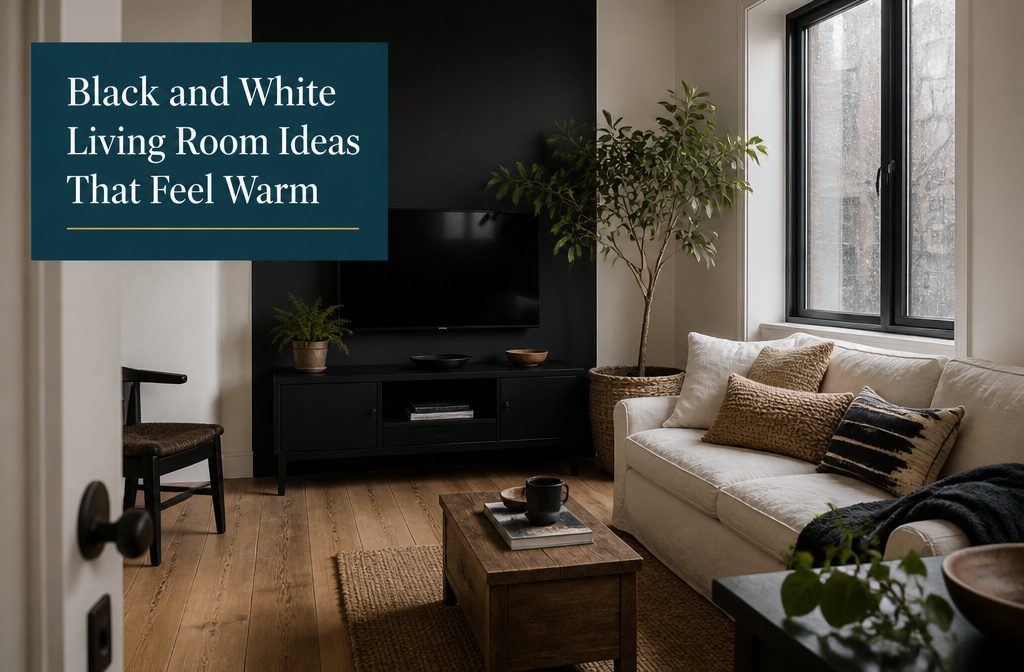
Black and white rooms work across formal, minimal, mid-century and glam styles, but the difference between one that feels stark and one that feels warm sits in the third layer: wood floors, plants, texture in the upholstery, or a single accent color that pulls the palette back from clinical.
A black TV wall can anchor a room or close it in depending on how much white sits around it, and most spaces already hold more black than expected once you count window frames, floors and the TV itself.
1. Use White as the Base and Black as an Accent
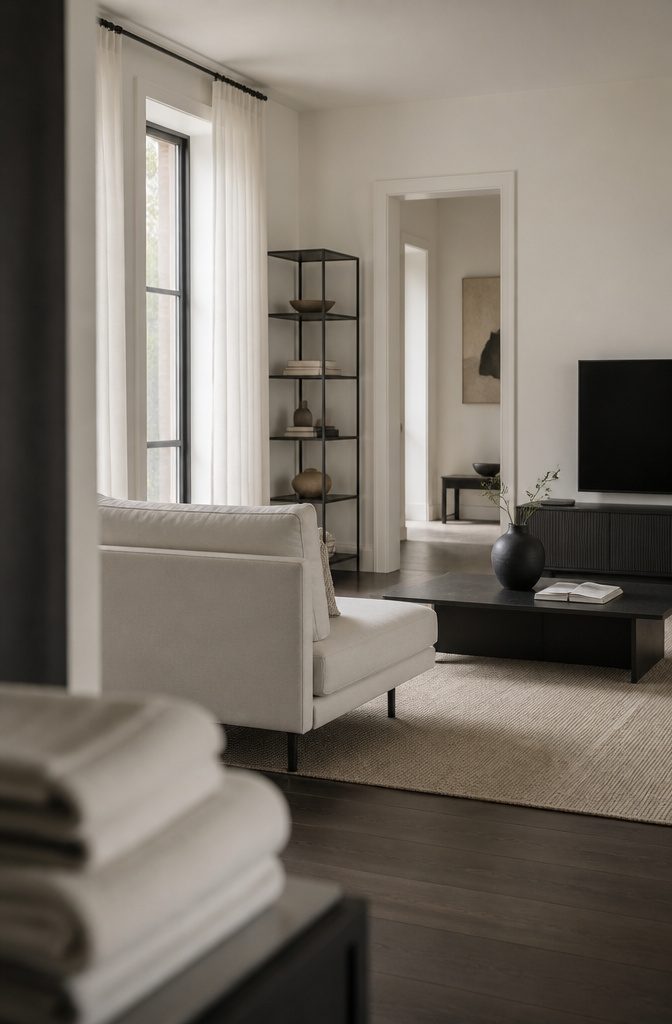
White walls, a light sofa, and pale curtains give you the breathing room to bring in black without shrinking the space.
Black then arrives as the punctuation: a coffee table, a set of picture frames, throw pillows, or shelving that gives the room definition without closing it in.
The formula holds even when you think you haven’t added much black yet, because the TV, dark floors, and window frames already count toward the black layer.
Most rooms need less additional black than expected once you notice what’s already there.
I keep furniture legs visible where I can—a sofa that sits slightly off the floor rather than a skirted one—so more of the white or pale floor shows through.
Seeing that floor line makes the room read as larger, and it keeps the look from feeling too grounded or heavy even after the black accents go in.
2. Use Black Walls or Large Black Areas for Drama
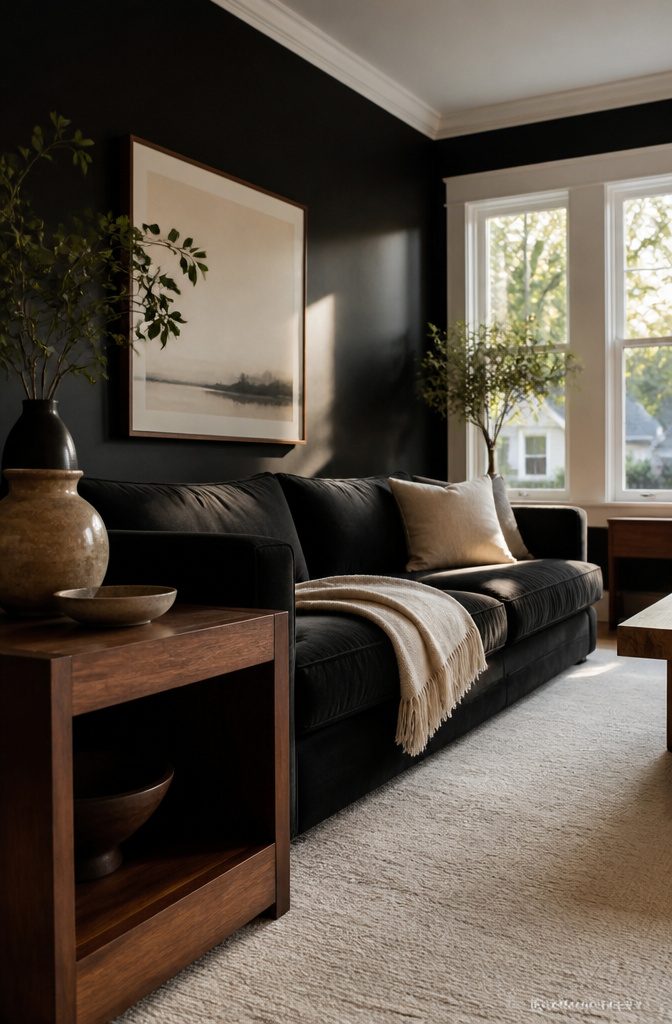
A black wall or a full black accent wall creates a room that feels wrapped rather than lit from all sides.
Balance matters: if the wall goes dark, the rest of the room needs enough white or pale color to keep air in the space.
White crown molding, white window frames, or a few pieces of light upholstery do most of that work without requiring a second paint decision.
Introducing large blocks of black can help anchor the space and make it feel more balanced
That anchoring effect shows up fastest with a black sofa against white walls, where the weight of the piece pulls the room together instead of floating in it.
A black TV wall works the same way—it gives the eye somewhere to land.
The risk with a predominantly black room is that it closes in on itself, but brown wood furniture or a cream rug warms it back up and stops the mood from turning cold.
If painting an entire room black feels like too much commitment, start with one wall and see how the light moves through the day before deciding whether to continue.
3. Soften the Palette with Gray, Cream, or Off-White
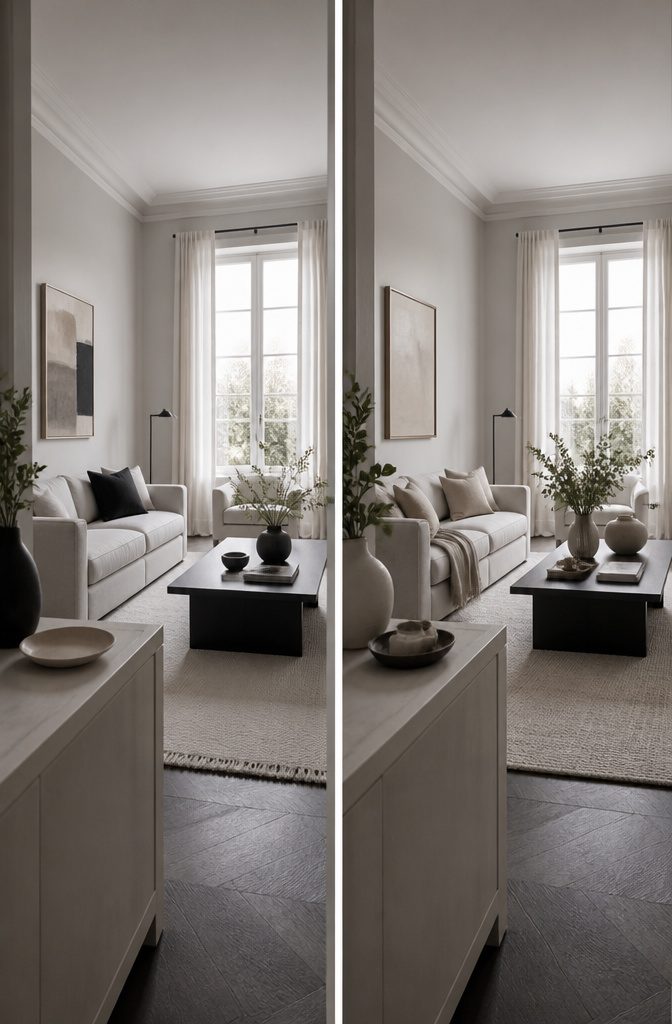
Pure black against stark white can feel clinical, so adding gray, cream, or warm white between them takes the edge off without losing the contrast.
A light greige wall or soft ivory upholstery gives black furniture something to settle against instead of snapping hard against a bright white backdrop. The palette stays monochrome, but the transition gets gentler.
Warm white and pale taupe work the same way. They read as neutrals rather than colors, so the room still registers as black and white from the doorway, but up close the softer middle tones make the space feel livable.
Skip yellow-heavy cream if your sofa, rug, or countertops lean cool — the warmth will clash instead of blending in.
4. Add Wood, Plants, or Other Natural Elements
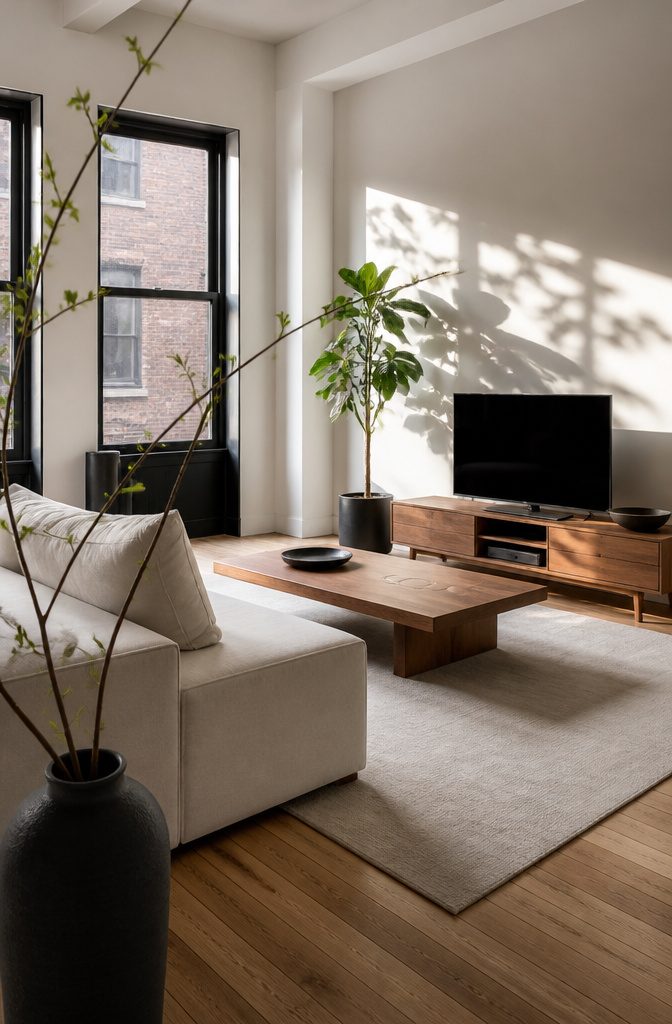
Wood floors or a wood coffee table stop the scheme from feeling clinical.
A wood TV stand works the same way. The warm grain reads as a third tone without breaking the palette, and it gives the eye somewhere softer to land between the contrast.
Plants do the job faster. A potted fiddle-leaf fig or a few stems in a vase bring an organic shape into a room full of straight lines, and the green stands out immediately against monochrome.
If you’re not maintaining a dozen houseplants, one large one in your sight line is enough. Keep the planter simple—nothing ornate—so the plant itself does the work.
Branches in a tall vase near the sofa or on a console add height and texture without upkeep.
The effect is the same: the space feels inhabited rather than staged. Wood and greenery both warm the room and make it comfortable to sit in for longer than ten minutes.
5. Use Texture to Add Comfort and Depth
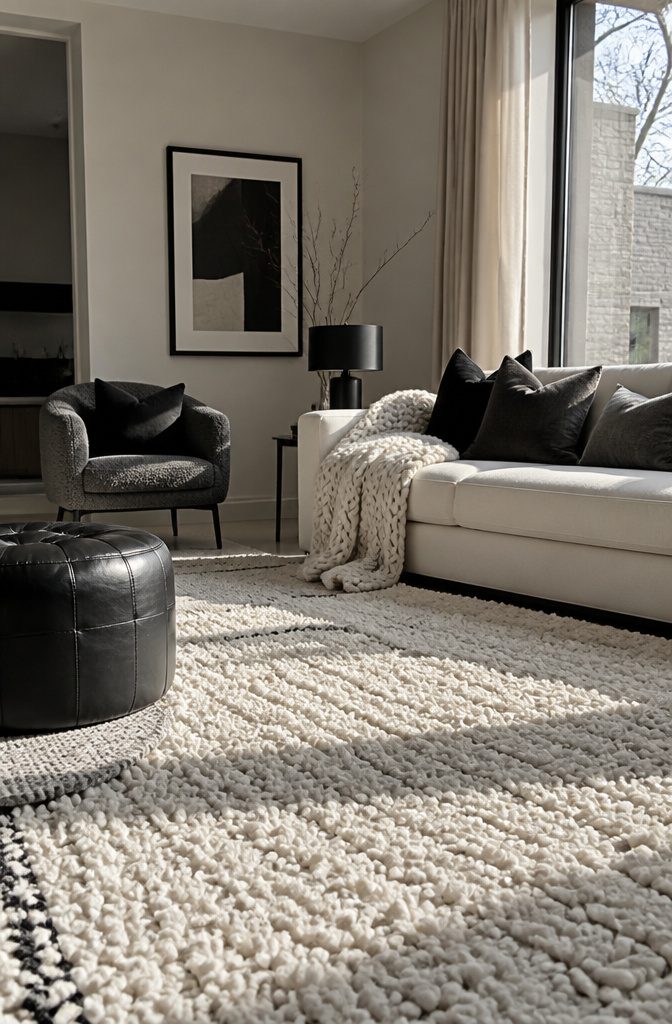
A black and white room risks feeling like a showroom when every surface is smooth and glossy.
Layer different textures — a tufted rug, velvet cushions, a knit throw draped over the arm of the sofa — and the space reads as lived-in rather than staged.
The eye picks up on contrast in finish as much as contrast in color, so a linen rug against a leather ottoman does more work than people expect.
Textured upholstery matters most where you sit. A tweed chair or a velvet sofa feels softer to look at than leather or tight weave, even when the frame and the layout stay the same.
I would add one textured piece before I added another accent color, because it solves the flat problem without complicating the palette. A deep-pile rug grounds the furniture and keeps hard floors from making the room feel cold.
6. Make a Rug the Focal Point
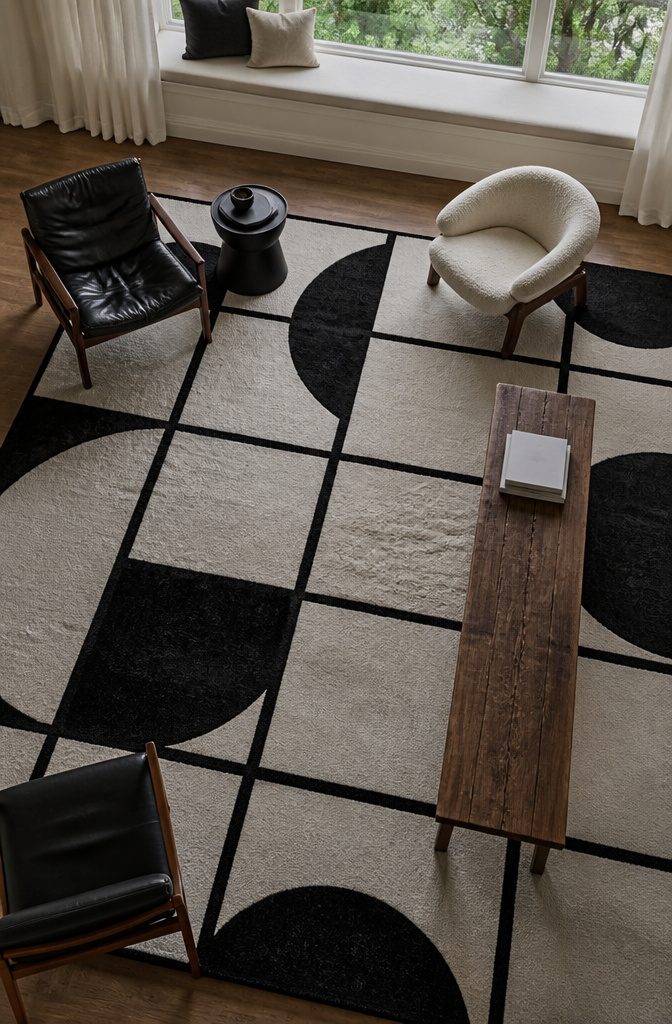
A rug with strong contrast or a bold graphic pattern can anchor the whole room and give you permission to keep everything else simple.
The tufted Swedish rug from Kasthall in Source 4 sets a mid-century tone alongside vintage chairs and a Nelson bench, and the grid pattern holds its own against bright primary colors in the art.
When furnishings are minimal or the room is small, a sculptural or oversized-pattern rug becomes the focal point and lets you scale back everywhere else.
Geometric designs work especially well: half-circles, ellipses, or repeating grids add visual weight without requiring patterned upholstery or busy walls.
The rug grounds the seating area and disguises wear in high-traffic spots, and if your taste shifts, you can roll it up and start over.
Pair it with white curtains against white walls to push the walls back, or add a slender console in a primary color if the space can take one more punch.
7. Use Artwork or a Gallery Wall as a Focal Point
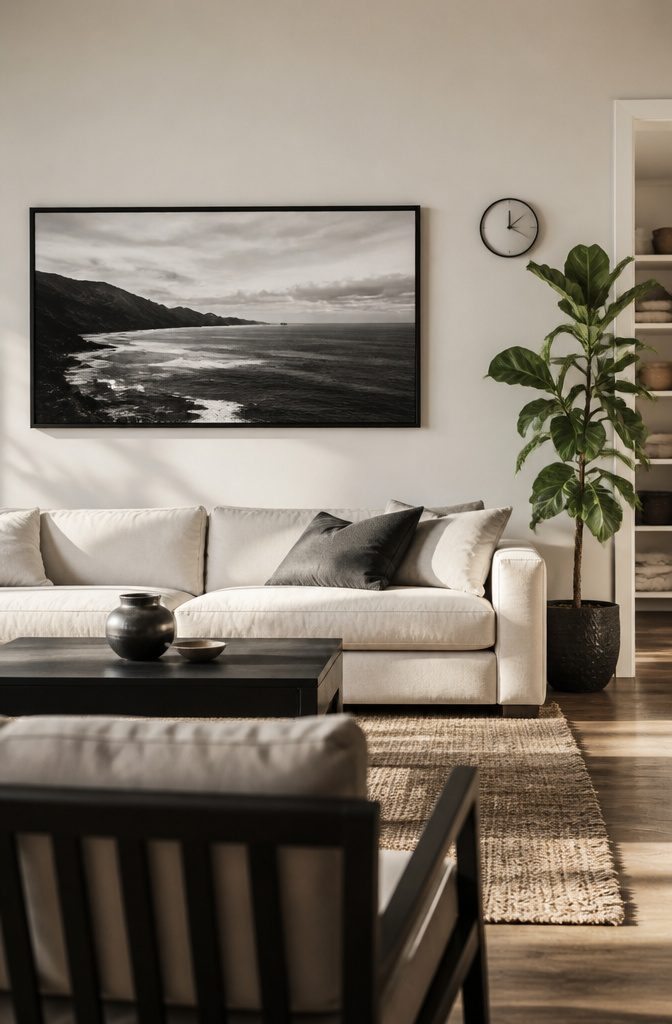
A single large piece works better than a scatter of small frames—the room reads calmer when the eye has one place to land.
If you want a gallery wall instead, keep the frames uniform and leave space between pieces so the arrangement has rhythm rather than clutter.
Aim for art wide enough to visually anchor the furniture below it; too narrow and it floats, too wide and it crowds.
Black-and-white photography in black frames makes the fastest impact.
Abstract figure drawings sit well in a minimal scheme and add personality without introducing color. You can balance a main piece with something functional—a wall clock near the art fills space and keeps the room from feeling staged.
Pair the restraint in the art with one oversized plant in scale with the frame, and let the surrounding furniture stay quiet so the wall stays the focus.
8. Add an Accent Color or Metallic Detail
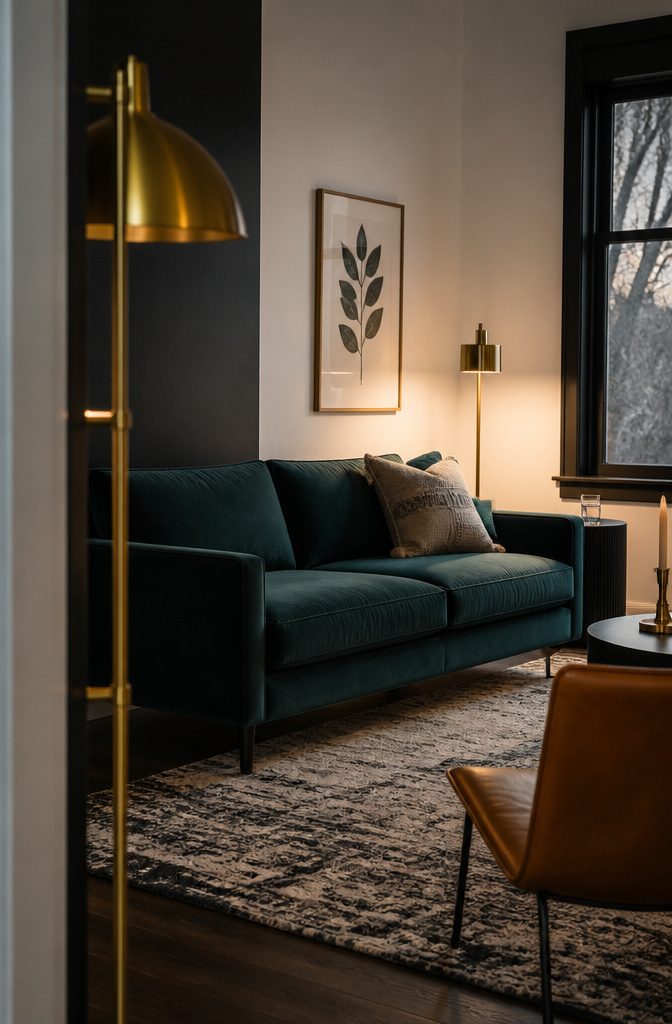
A single color note against the monochrome keeps the room from feeling flat.
Yellow chairs or a mustard sofa give the palette energy without fighting it — primary colors and jewel tones like teal, cobalt, and emerald green work especially well with high-contrast black and white, while softer picks like blush pink or olive calm the scheme down.
When you introduce the color through one large piece like a sofa, let that be the only strong color in the room and repeat it nowhere else.
Metallics warm the palette without adding pigment. Brass light fixtures, a gilt mirror frame, or plain metallic candlesticks lift the look.
Caramel tones in a leather piece echo brass hardware and framed raffia art, and placing the warm accents at different heights moves your eye around the space instead of holding it in one corner.
9. Choose a Style Direction
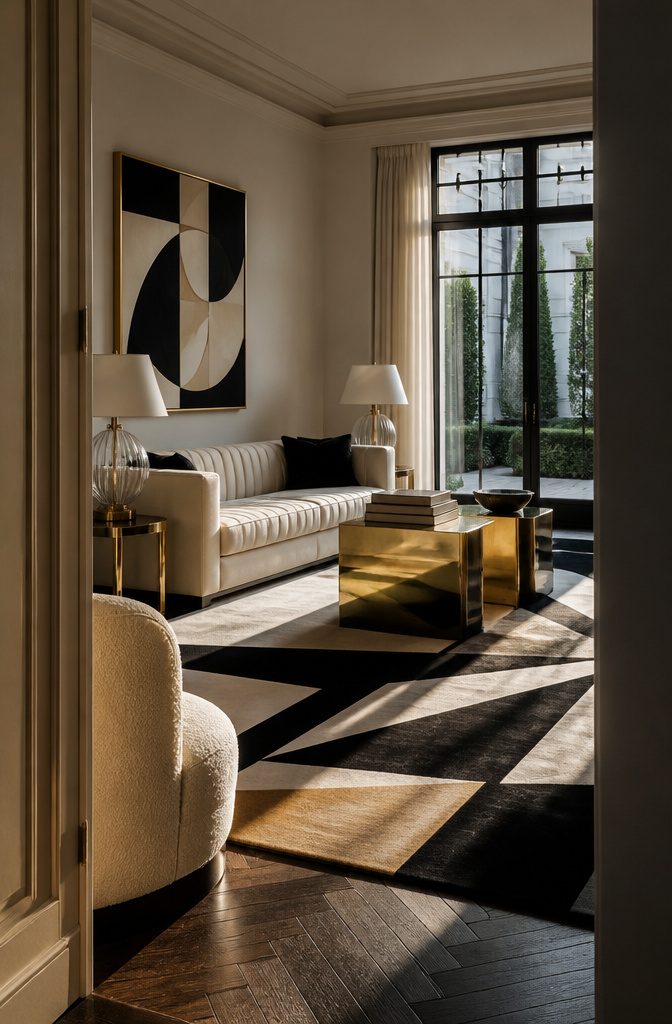
A black-and-white living room can land anywhere from glam to minimal, and naming the style up front keeps the furniture choices coherent.
Mid-century modern uses sculptural pieces with strong lines—the Arne Norell Sirocco chair or George Nelson slat bench against white walls and a black slate floor—and pairs them with bold art in primary colors.
Art Deco leans into geometric patterns, brass finishes, and oversized graphics: an angular rug in black, white, and gold anchors glass lamps on brass tables.
Scandinavian and Japandi keep black to smaller accents like table legs or picture frames, using light wood and soft textiles to hold the calm.
Traditional or glam styles add pattern through upholstery—houndstooth on curved Jaggar armchairs gives the room texture without breaking the monochrome rule—and layer in natural materials like a long-pile wool rug to stop the space feeling sterile.
10. Use Curves and Varied Shapes
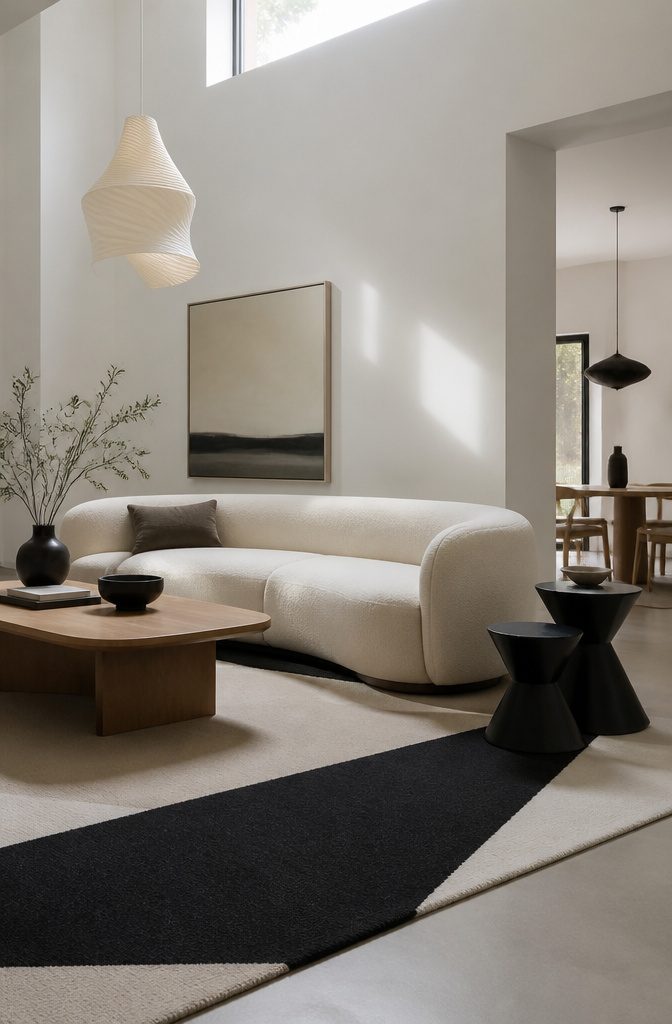
Curves break up the hard edges that come with black and white contrast.
A rounded coffee table, an arched floor lamp, or a chair with a curved back softens the geometry without losing the clean lines that make the scheme work.
In a room where every piece runs rectangular, the eye has nowhere to rest — one curved silhouette changes that.
Pair a sofa with rounded arms or a low curved profile with angular side tables or a geometric rug, and the contrast in shape does what an extra color would: it gives the room dimension.
A sculptural pendant light with sinuous lines serves the same purpose overhead, pulling attention up and making the space feel less flat.
Wood furniture with clean lines adds a mid-tone that keeps the room from feeling two-dimensional, and when those pieces have slight curves — a tapered leg, a rounded edge — they do double duty.
11. Use Pattern Through Rugs, Upholstery, or Wallpaper
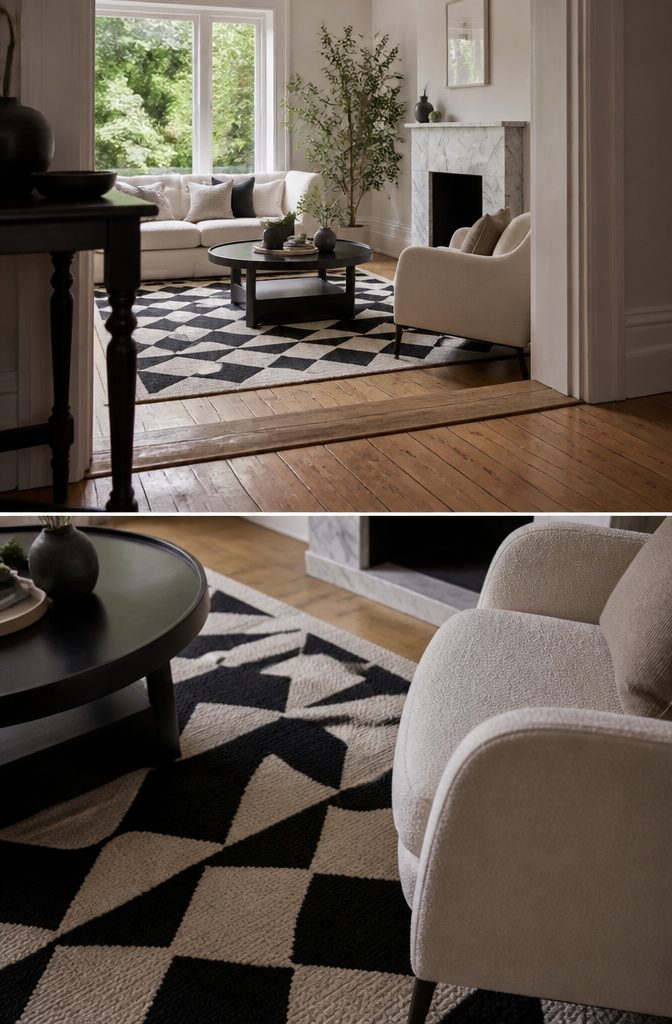
Pattern keeps a monochrome scheme from reading as flat, and a single patterned piece is usually enough to carry it without tipping into busy.
A geometric rug, houndstooth armchair, or wallpaper on one feature wall gives the eye something to track across the room.
Choose where the pattern lands: if the sofa is striped, keep the rug and pillows quieter; if the rug is bold, upholster furniture in solid fabric.
Layering works when each pattern operates at a different scale — a large graphic rug with smaller repeated motifs in the cushions and a marble-effect panel on the chimney breast, for instance — but holding one element back always reads cleaner than filling every surface.
Patterned rugs have a practical edge in high-traffic rooms since they hide wear better than solids, and they roll up if you change direction later.
12. Use Black to Define or Zone a Feature
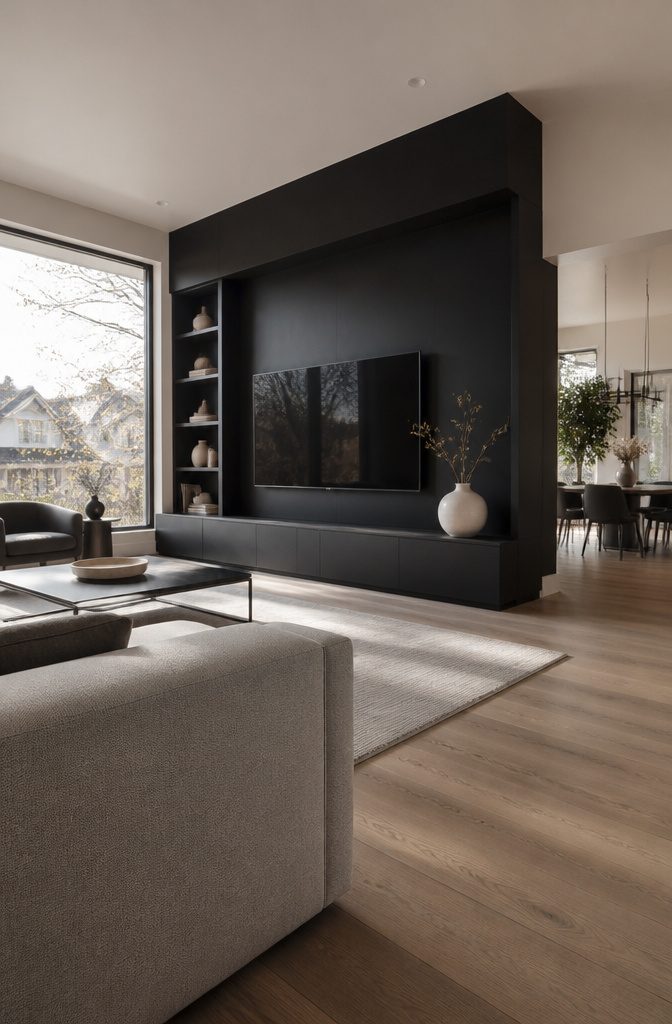
A black feature wall behind a TV or a black shelving unit in an open-plan space pulls the eye to that spot and makes the boundary between living and dining clear without adding a door.
Fanny Abbes painted a TV wall black and then added matching millwork and decorative shelves so the screen disappeared into the wall rather than sitting on it—the black became the design, not just the backdrop.
For separation rather than camouflage, swap the paint for black flooring in one zone while the adjoining area keeps hardwood or a lighter tile.
The floor change marks the shift from lounge to dining more clearly than any furniture arrangement, and the black grounds whichever space gets it without closing it off.
Plan Around the Room Before Buying
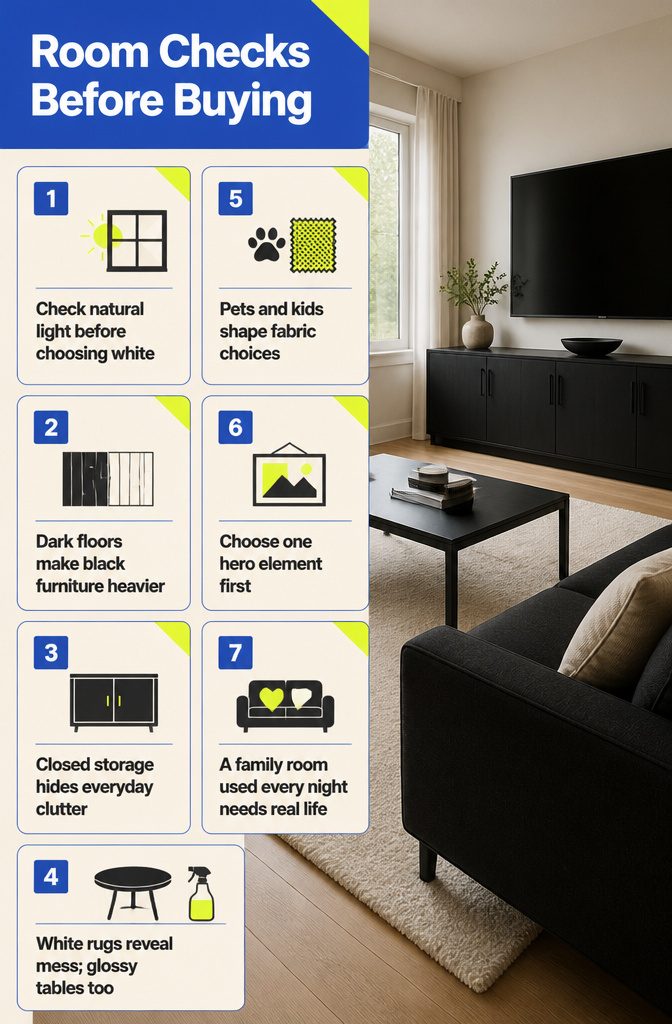
Check the room itself first. A black and white palette behaves differently depending on what is already there, and furniture that looks right in theory can feel wrong once it arrives.
- Natural light: Low-light rooms need more white, cream, mirrors, and warm lamps to avoid feeling dim.
- Floor color: Dark floors make black furniture feel heavier; light wood floors make the palette easier to balance.
- TV size: A large black TV already adds visual weight to the room.
- Storage needs: Closed cabinets keep remotes, cables, toys, and blankets from breaking the clean look.
- Cleaning habits: White rugs and glossy black tables show different kinds of mess.
- Lifestyle: Pets, children, and movie nights should influence fabric and rug choices before you commit to white upholstery.
- Focal point: Choose one hero element—a black sofa, patterned rug, fireplace, or art wall—and let the rest support it.
A family room used every night should not be styled like a photo studio. If the space sees actual use, choose forgiving fabrics and hidden storage before adding more contrast.
Strategies for Small Rooms
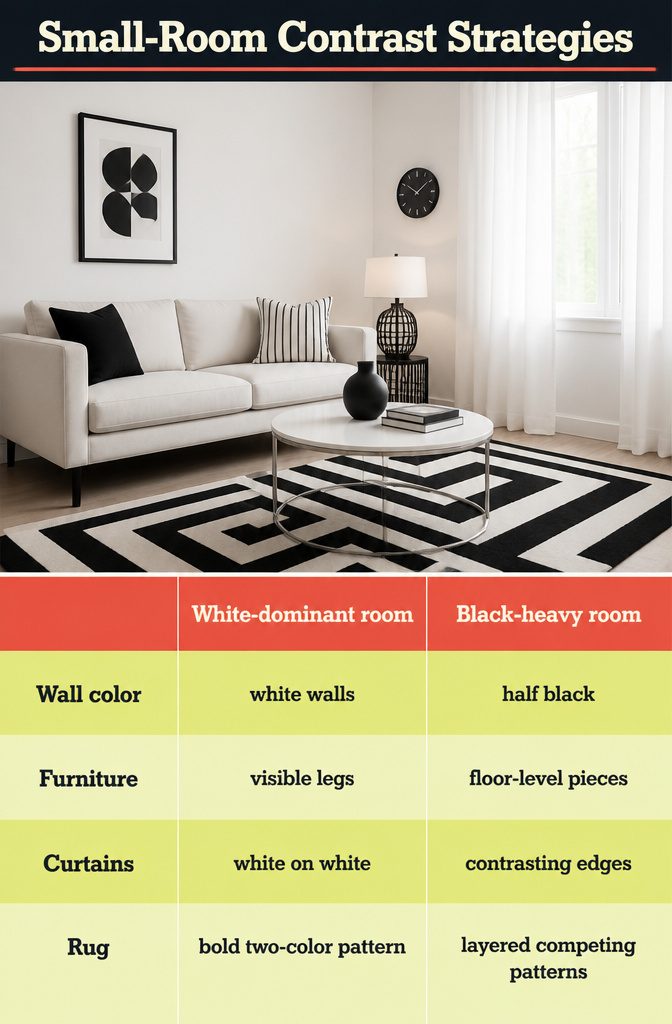
A small black-and-white living room stays open when you let white dominate the walls and ceiling and treat black as an accent rather than half the palette.
Use it in small doses: frames, pillows, a single vase, a clock. The restraint keeps the room breathing.
- Choose furniture with visible legs. A sofa that sits off the floor or a coffee table on thin chrome legs shows more of the floor beneath, which makes the whole room read as larger.
- Leave negative space around objects. The gap around a pedestal table base or through an openwork lamp lets the eye travel farther and creates the illusion of more room.
- Use white curtains against white walls. The boundary between wall and window blurs, pushing the perceived edge of the space outward.
- Let a boldly patterned rug carry the contrast. When you stick to two colors, even a strong pattern stays powerful without feeling crowded.
Frequently Asked Questions
How do you keep black and white from feeling cold?
Use warm whites or cream instead of stark white, add wood furniture or floors, and layer textured fabrics like velvet cushions or a deep-pile rug.
Warm lighting from multiple sources and a few plants or branches bring life into the room. These additions soften the contrast without breaking the palette.
Which black-and-white style fits your home?
Mid-century modern uses sculptural furniture with strong lines and primary color accents. Art Deco leans into geometric patterns, brass finishes, and angular rugs.
Scandinavian and Japandi keep black minimal and rely on light wood and soft textiles. Traditional or glam styles add pattern through upholstery like houndstooth and layer in natural materials.
What mistakes make this look too harsh?
Relying only on pure black and white without softer middle tones, using cool lighting instead of warm, and filling the room with glossy or dark surfaces all push the scheme toward clinical.
Add warm whites, texture, and restraint with pattern to keep the space comfortable rather than sterile.
What should you check before buying?
Check natural light levels (low-light rooms need more white and mirrors), floor color (dark floors make black furniture heavier), TV size (it already adds visual weight), storage needs, cleaning habits, lifestyle with pets or children, and which element will be the focal point.
A room used every night needs forgiving fabrics and hidden storage before you add more contrast.
Can I use patterned furniture in a black and white living room?
Yes.
A single patterned piece carries the room without tipping into busy. If the sofa is striped, keep the rug and pillows quieter.
If the rug is bold, upholster furniture in solid fabric. Layering works when each pattern operates at a different scale.
Is black and white too formal for a family living room?
No. Choose durable fabrics, closed storage for remotes and toys, and furniture scaled for everyday use.
A family room should not be styled like a photo studio. Forgiving materials and practical storage matter more than contrast.
What wall color should I use if pure white feels too cold?
Use warm white, soft ivory, light greige, or pale taupe to take the edge off without losing the contrast. Skip yellow-heavy cream if your sofa, rug, or countertops lean cool, because the warmth will clash instead of blending in.
What lighting works best with black and white decor?
Warm, layered lighting from floor lamps, table lamps, and dimmable ceiling fixtures works better than cool white bulbs.
Black and white surfaces can look flat under harsh lighting. Multiple light sources at different heights make the room feel inhabited rather than stark.
How do I make a black and white room feel less like an office?
Add curves through a rounded coffee table or arched floor lamp, use relaxed fabrics like linen or velvet, and bring in warm wood and personal decor.
A few plants or branches and one textured piece solve the flat problem without complicating the palette.
How do you liven up a black and white living room?
Add a single accent color or metallic detail.
Primary colors like yellow, cobalt, and emerald green suit high-contrast schemes, while blush pink or olive calm the look down. Brass light fixtures or a gilt mirror frame warm the palette without adding pigment.
What is a good accent color for a black and white room?
Primary colors and jewel tones like teal, cobalt, and emerald green work well with high-contrast black and white.
Softer picks like blush pink, mustard, or olive calm the scheme down. Introduce the color through one large piece and repeat it nowhere else.