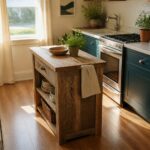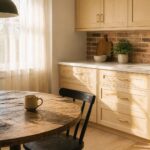
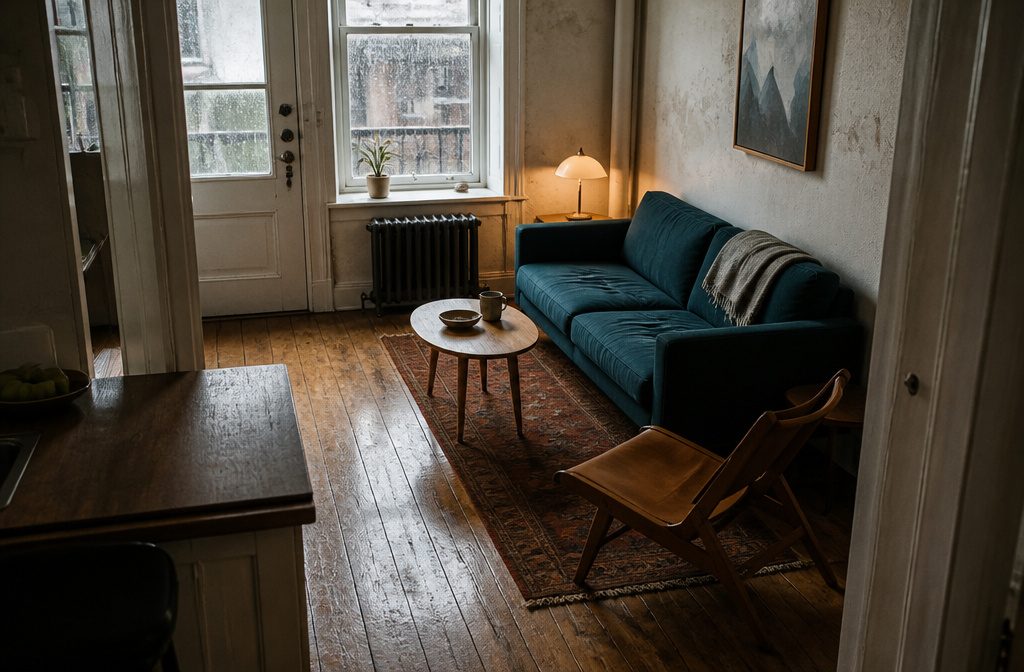
Small living rooms range from awkward rentals to careful open-plan edits, and the setup that works depends on whether the room answers to a front door, a kitchen counter, or nothing but itself.
What changes the approach is not the square footage but the number of jobs the space has to cover at once, and how many of those jobs involve other people.
Pull a sofa two to three inches off the wall and the room feels deeper rather than boxed in; push it flat and you gain an awkward center with nowhere to put your feet.
1. Plan the Layout Around Movement and Use
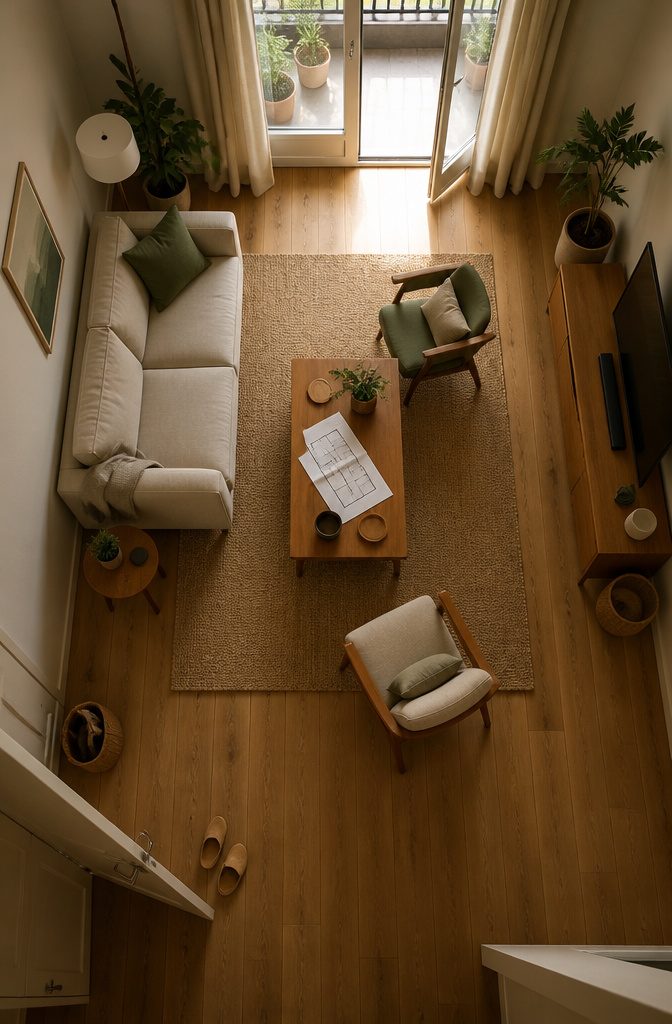
I list what I want the room to do before I measure a single wall.
A small living room usually has to cover more than watching TV — you might need space for guests, a spot to work, room to reach a door or window, or access to storage you actually use.
Writing down the three or four activities that matter most keeps the layout from trying to do everything and ending up cramped.
Once the list is down, I sketch the pathways.
People need about 30 inches of clearance to walk comfortably through a space, and a room that forces you to turn sideways past the coffee table every time you cross it will feel smaller than it is.
I mark the routes on paper first — entry to seating, seating to balcony, sofa to TV — and arrange furniture so those paths stay open. The styling comes after the room works.
Recommended Products

【Comfortable Support for Low Back Sofas】Designed for boneless cloud couches and low-back sofas, this couch headrest extender provides added support for your head, neck, and upper back while reading, watching TV, gaming, or relaxing. It helps improve comfort without replacing the sofa you already enjoy.

【Comfortable Support for Low Back Sofas】Designed for boneless cloud couches and low-back sofas, this couch headrest extender provides added support for your head, neck, and upper back while reading, watching TV, gaming, or relaxing. It helps improve comfort without replacing the sofa you already enjoy.

Multiple Package: Multiple packages may arrive separately. If you have any questions about your cloud couch sectional or need assistance, please reach out to us as soon as possible
2. Use Furniture with a Suitable Visual Scale
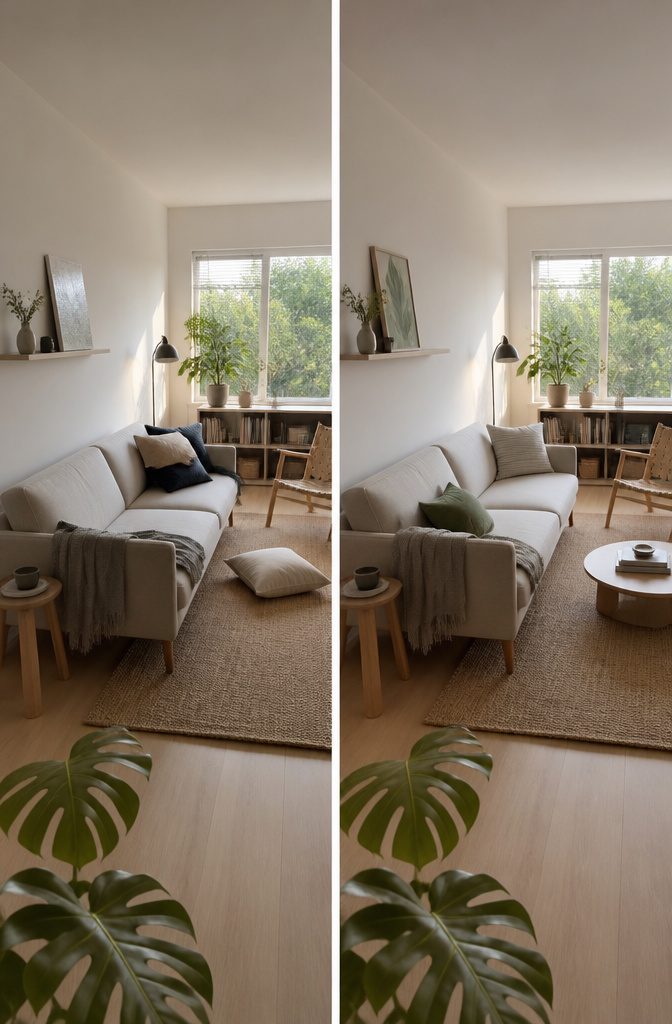
A 72-inch apartment sofa or deep loveseat often works better than an 84-inch standard piece when the room can’t absorb the extra length.
The decision turns on what you can walk past without turning sideways: an oversized sofa gains seating but costs flow, and a room where you bump furniture every time you cross it reads as smaller than it is.
The sectional is rather large at 10 by 10 feet, but the low-back, lounge-style sofa allows the space to feel open and does not interfere with the lines of sight.
Exposed legs and open frames reduce visual weight even when the piece itself isn’t small.
A sofa sitting directly on the floor looks like it owns that footprint; lift it on legs and light passes underneath, which the eye registers as floor you still have.
Lower profiles help the same way: shorter furniture pulls back from the walls and keeps sight lines open, so the room reads taller than it measures.
Recommended Products
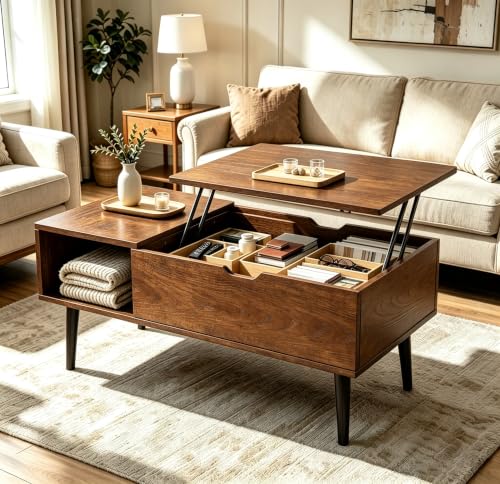
Lift Top Design: The tabletop smoothly lifts to 6.3 inches, transforming this coffee table into a versatile piece for everyday use. Whether you need a temporary dining surface, a convenient computer desk, or a raised workspace, the elevated floating design adapts to your needs while adding modern functionality to your living space

👍𝗦𝗧𝗬𝗟𝗜𝗦𝗛 & 𝗦𝗔𝗙𝗘 𝗥𝗢𝗨𝗡𝗗𝗘𝗗 𝗗𝗘𝗦𝗜𝗚𝗡 — Prioritizing safety and style, this small round end table features smooth, rounded edges to prevent injuries, particularly in homes with children or elderly family members. Its contemporary aesthetic complements any living space while offering peace of mind.

Used Book in Good Condition
3. Float Furniture or Leave Clearance Behind It
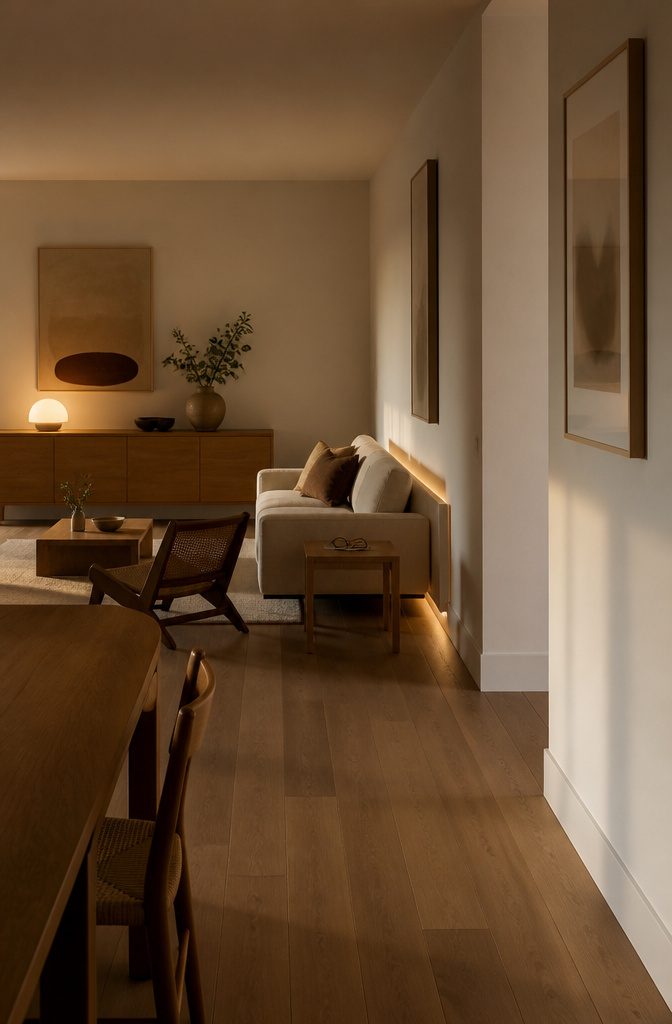
Pulling a sofa two to three inches off the wall creates a shadow line that makes the room feel deeper rather than boxed in.
The myth that everything pushed flat against the perimeter opens up floor space gets it backward: what you gain is an awkward center with nowhere to put your feet, and the layout reads as rigid.
Even an inch of clearance softens that edge.
This works best when the sofa anchors the seating arrangement and faces into the room.
If you are floating it farther out to define a conversation zone, make sure there is still enough clearance behind it to move without turning sideways—about eighteen inches minimum for walking, more if the path sees regular use.
Recommended Products

【Couch Cup Holder Tray Stand】Features a built-in multi-angle rotatable device clamp that securely holds phones, and Kindles from 4.7" to 7". The integrated holder supports devices with cases up to 0.56" thick, providing a stable, hands-free viewing experience on your couch tray.

CONSIDERATE DESIGN. Inflatable pool lounger like a sofa with comfortable big backrest, 2 grip handles and cup holder, beautiful pattern design, mesh in the sitting area, even if you are not good at swimming, you can also enjoy the water play.

【Inflatable Water Hammock】: The inflated hammock lounge can float you on the water well, like sleeping in a hammock, which is soft and comfortable. Even if you are not good at swimming, you can also enjoy the water play.
4. Make Furniture Do More Than One Job
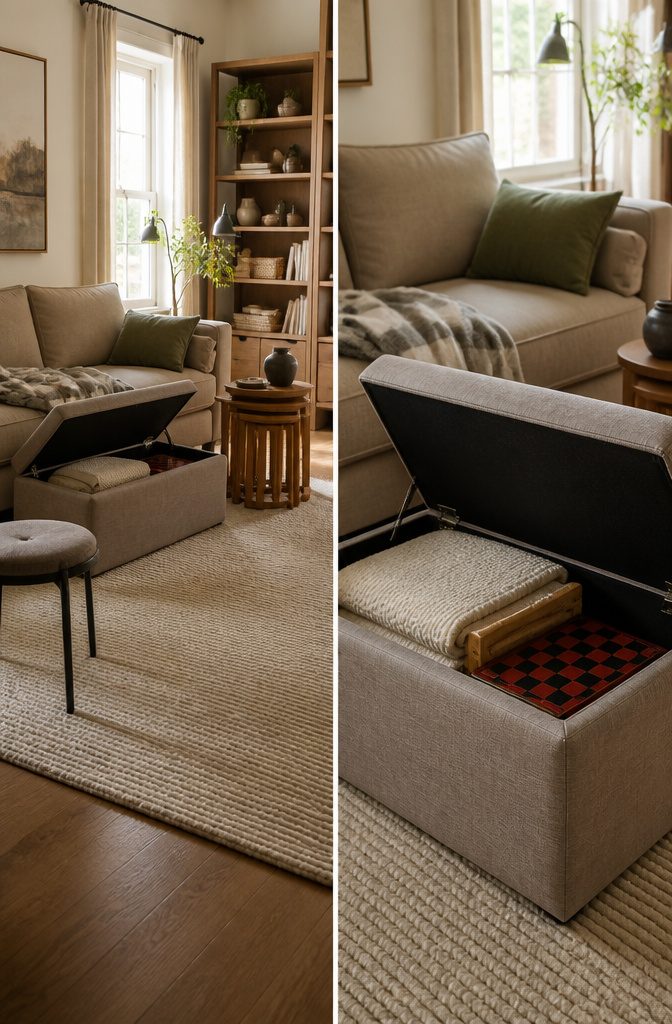
An ottoman that opens for storage handles three jobs at once: somewhere to prop your feet, a place for guests to sit when the couch fills up, and a bin for throws or board games you want close but not visible.
I keep one in front of the sofa, and it gets used in all three ways most weeks.
Poufs work the same way on a smaller footprint — they tuck under a console when you need floor space back, then pull out as a perch or a side table for a drink.
A storage bench along one wall does similar work. It holds what a closet would have held — extra pillows, seasonal decor, anything that doesn’t need a permanent spot — and seats two or three people when you host.
Stools with flat tops replace end tables and move to the dining table when you need an extra chair. Nesting tables stack when not in use, so you’re not committed to the surface area all the time.
Lightweight pieces with open frames or thin legs keep sightlines clear, which matters more in a small room than the storage capacity of any single piece.
Recommended Products

【ottoman】Our ottoman has the better size and Relaxed color,Length 17 x width 13 x height 13 inches and Grey,It is also a comfortable footstool,Proper size and thickened sponge pad can make him a good footrest,Sitting on the sofa and putting your feet on the ottoman can relax your legs, relax your whole body and enjoy the pleasant time

【Perfect Set Design】This round storage ottoman comes in a set of two, with the larger size measuring 15.4" x 15.4" x 17.7" and the smaller size 12.6" x 12.6" x 14.6". These two round storage ottomans can be neatly stacked together, offering a convenient space-saving solution.

【QUICK ASSEMBLY, EASY FOLDAWAY】This storage ottoman from the SONGMICS MAZIE Collection has a foldable design that allows quick setup in seconds by simply inserting the bottom panel. Easily fold and store it under the bed or in a closet when not in use.
5. Create Zones or Boundaries
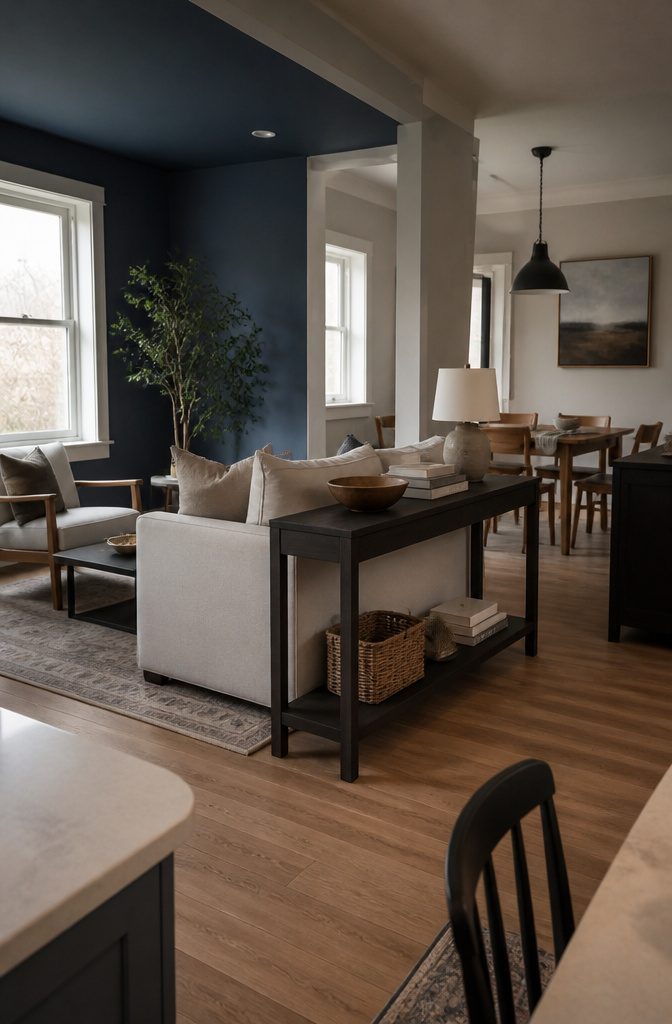
A rug marks where the living room sits when the floor plan runs open from kitchen to dining area.
Place it so the front legs of the sofa and chairs rest on it; the boundary reads clearly without carving the room into squares.
A bookshelf or console behind the sofa does the same work without adding a wall — furniture alone distinguishes one activity from the next.
Paint the ceiling a shade darker than the walls if the space opens to a taller adjoining room.
The color pulls the eye up and stops where the living area stops, the way Suzanne Kasler used deep blue to section off a sitting area in an open plan.
Back-to-back seating works the same way: an accent chair facing away from the sofa preserves floor space while signaling that the seating zone ends there.
Curtains, a tall plant, or a low screen will do it if the layout offers no natural break.
Recommended Products

Luxuriously soft faux sheepskin rug: Ideal for adding comfort and style to hallways, bedrooms, and entryways. Long, narrow design enhances any rooms while providing a warm, cozy surface underfoot during colder months

Luxuriously soft faux sheepskin rug: Ideal for adding comfort and style to hallways, bedrooms, and entryways. Long, narrow design enhances any rooms while providing a warm, cozy surface underfoot during colder months

Smart Layers for Daily Living: From your morning coffee on the tabletop to remotes stored in the middle shelf and favorite reads on the bottom, this end table’s three-tier design ensures every item has a dedicated spot, maintaining a clean, functional space
6. Use Vertical Space for Storage and Display
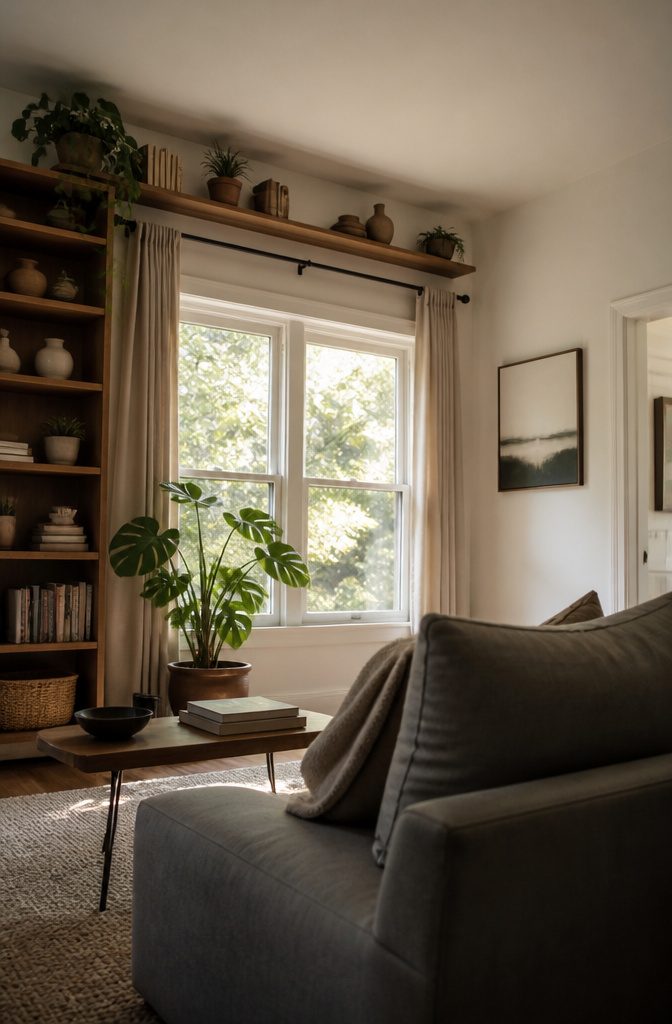
Shelves mounted higher on the wall pull storage off the floor and guide the eye upward, which makes a compressed room feel taller than it measures.
Install floating shelves above door frames, windows, or the sofa to hold books, small plants, or a few ceramic pieces without claiming floor space you need for walking or sitting.
The zone above a window usually sits empty, but a shallow shelf there turns unused wall into working storage and reads as part of the architecture rather than furniture crowding the room.
Tall bookcases do the same work at larger scale: they store more per square foot of floor than a low credenza, and their height stretches the wall.
Hang art slightly higher than you would in a bigger room, and mount curtain rods closer to the ceiling than to the window frame—both moves lengthen the vertical line and open the room without touching the layout.
When light fixtures, shelves, and art exist at different heights, the space gains dimension instead of flattening into a single horizontal band.
Recommended Products

[Comfy Desigh & Higher Back] Nurrizus sectional sofas for living room is with high back to offer you better back support, extra deap seat allows you to sink in to be more comfy. Higher back provides more supoort is more ergonomic and cozy

【16-PIECE OVERSIZED MODULAR SECTIONAL】 Create a complete 10-seat lounge with 2 ottomans, 2 corner modules, 7 low-back seats, and 5 armless modules for a generous U shaped sectional couch layout.
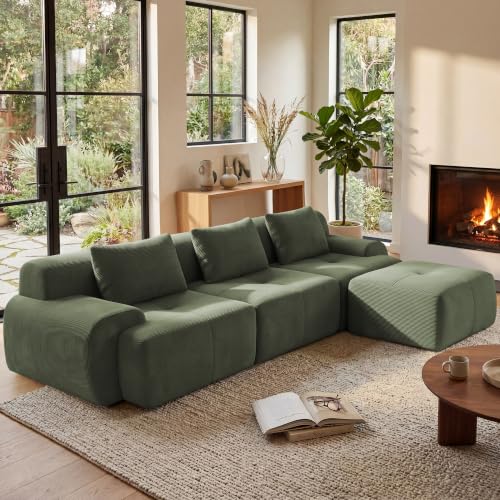
Boneless Comfort and Expert Tufted Craftsmanship: Say goodbye to the discomfort of hard skeletons. Our sectional sofa features a boneless design combined with tufted details, delivering a soft, skin-friendly seating experience. The deep seat design allows your body to fully relax and unwind. The unique tufted craftsmanship creates a naturally contoured surface that better conforms to your body's curves, enhancing support and envelopment.
7. Use Mirrors and Reflective or Transparent Surfaces
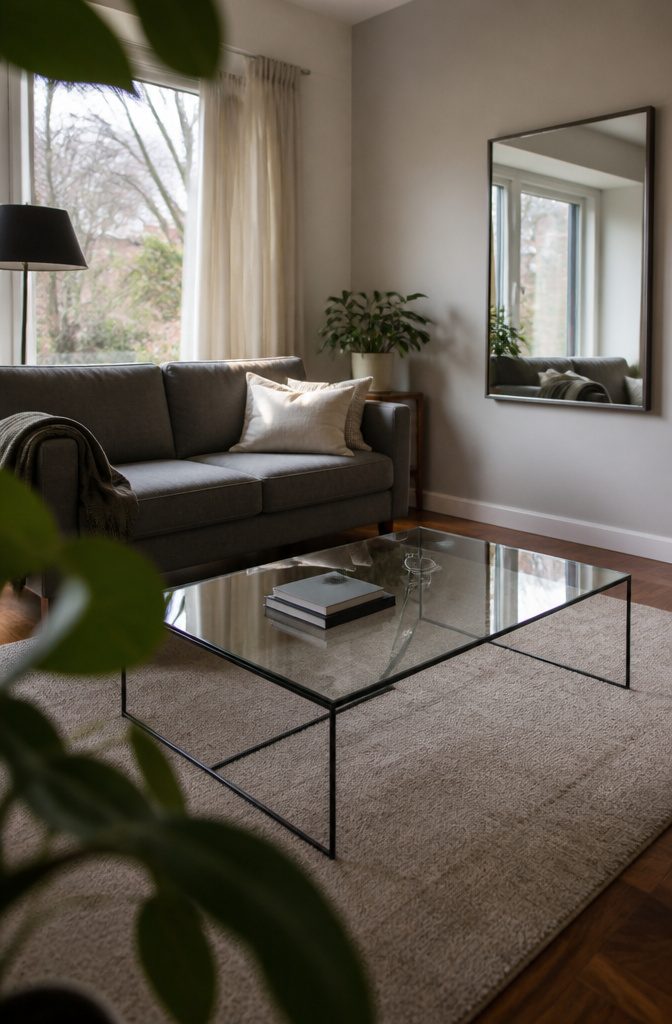
A mirror on the wall opposite your window doubles the light that makes it into the room, and you notice the difference most on overcast afternoons when natural light is already thin.
The effect is immediate: the room reads brighter without adding a single fixture.
Clear acrylic furniture produces the same open feeling by getting out of the way entirely.
A waterfall coffee table or a glass-topped piece with a thin metal frame lets your eye travel straight through to the floor, so the center of the room holds no visual weight.
A solid wood table in the same spot would anchor your sight line and make the space feel smaller by comparison.
Lucite works the same way structurally — it holds books, remotes, a drink — but optically it disappears just enough to let the texture of a rug or the line of a sofa come forward without competing for attention.
Recommended Products

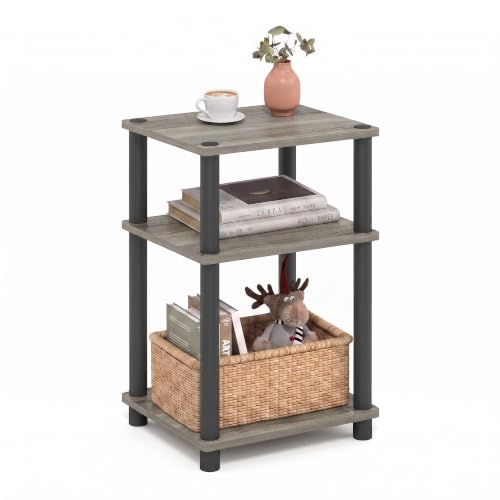
MODERN & COMPACT DESIGN: This side table blends seamlessly into small apartments, bedrooms, or living rooms, offering a simple yet functional piece that fits any corner or bedside space

Premium Authentic Calacatta Natural Marble Material: Made of genuine solid natural calacatta marble with one-of-a-kind natural veining. Every marble tray features unique stone grain, so the texture of the tray you receive will slightly differ from the listing pictures, adding exclusive natural charm to your space.
8. Use Color Deliberately
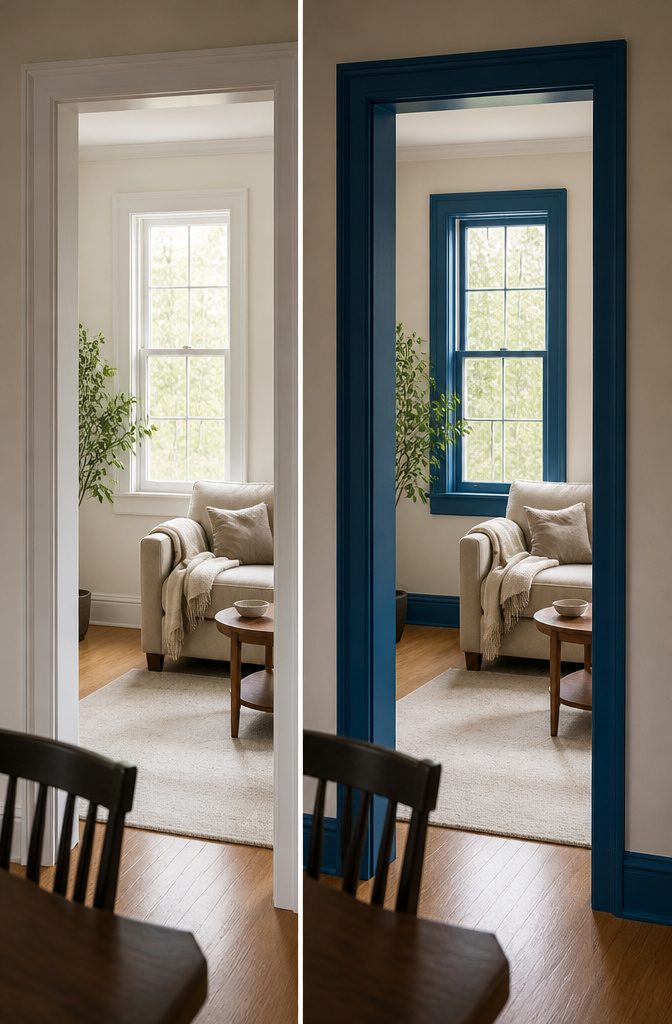
A calm palette keeps the room cohesive, but color used with intention can actually make a small living room feel more dimensional.
Saturated blue paint adds depth by receding against other tones, and a deep blue ceiling draws the eye up without closing the space in.
Dark sage green wraps a room in unexpected warmth. If a full color drench feels like too much, paint the trim in a bold shade to bring personality without committing every wall.
Accent walls work the same way — one strong color defines a zone in an open layout without dividing the room physically.
Soft cream, warm beige, and pale gray work well for calm over contrast, but small spaces can handle stronger choices when the rest of the room stays edited.
Recommended Products

Seats 6-8: Large inflatable floating couch accommodates 6-8 people on a wide, stable platform for group use.


✔EASY INFLATION-No pump required. Just whisk the blow up couch through the air to inflate. The little trick is that you need to trap air by closing the sleeve opening before the end of each movement, and keep the mouth closed until you begin the next movement.
9. Use Window Light and Treatments to Shape the Room
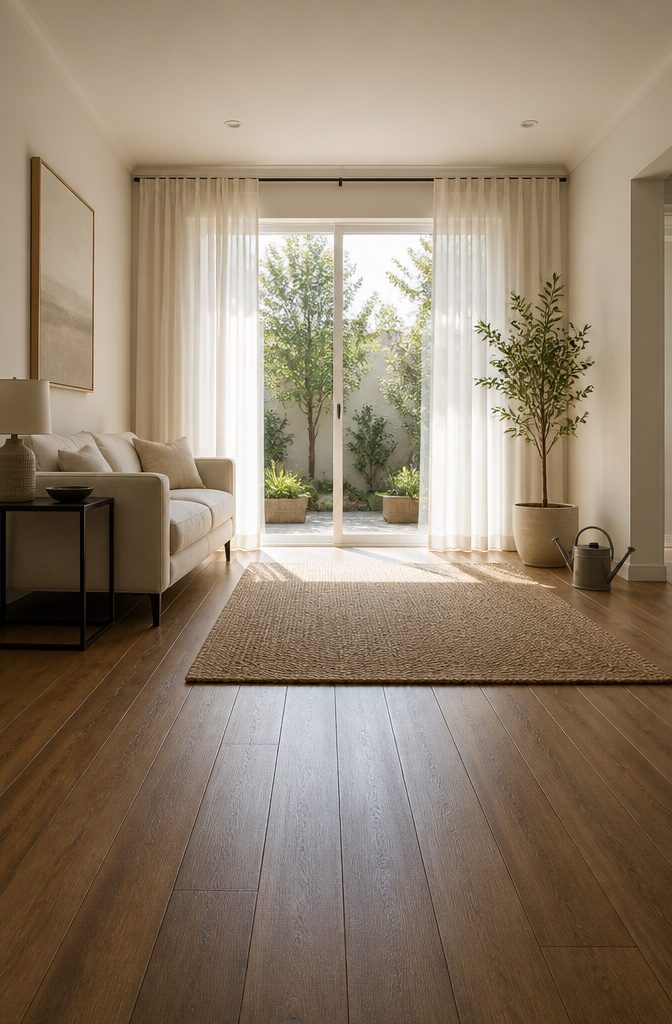
Windows decide how tall and bright a small living room feels, and where you hang the treatment matters more than the fabric itself.
Mount curtains near the ceiling rather than at the window frame to pull the eye up and make the walls read as taller than they are.
Sheer or lightweight panels in neutral tones work better than heavy drapes, which close the room in. The Cotton Sheer Curtain Set from Quince keeps the effect light without blocking what little sun you have.
If one window gets strong natural light, let it anchor the room instead of trying to balance it with decor everywhere else. A pale, cohesive palette around that window doubles down on the brightness without adding furniture.
Ivory curtains that match the wall color disappear into the architecture, and the room breathes. In tight quarters, light defines the mood more than any single piece of furniture does.
Recommended Products

Space-Saving Double-Grid Storage: Perfectly sized at 30" x 13" x 13", this ottoman fits effortlessly at the foot of the bed, by the wardrobe, beside the sofa, or in the entryway—compact but surprisingly spacious for all your daily essentials. Collapsible design folds flat in seconds, tuck it into a cabinet when not in use to keep your space open and organized

Robust Sturdy Construction: Crafted from robust thick‑gauge MDF boards, this storage ottoman delivers outstanding weight‑bearing performance up to 660 lbs. Padded with high‑density foam and wrapped in soft breathable linen fabric, it offers plush comfortable sitting for everyday resting moments

【Perfect Footrest】Length 17 x width 13 x height 13 inches (43 x 33 x 33 cm), a comfortable footrest size with thickened, high quality soft foam for comfortable foot spacing. By reducing pressure on the legs, placing your feet on the footstool helps prevent blood clots associated with deep vein thrombosis, reduces pressure on the lower back, and reduces swelling and varicose veins.
10. Layer Lighting
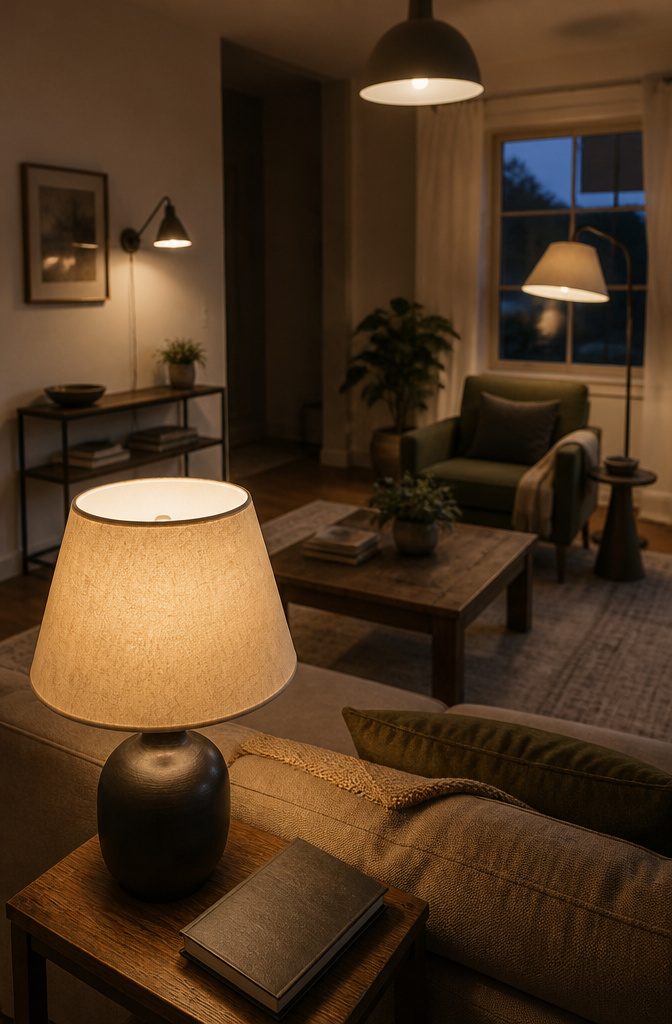
A single overhead fixture leaves a small room flat. Combine light sources at different heights — a table lamp on the end table, a floor lamp in the corner, overhead recessed or pendant light — and the room gains dimension.
Light at multiple layers makes the space feel warmer and larger than one central fixture can.
A statement piece works when overhead options are limited. The Lanai Table Lamp or Delphine Floor Lamp can anchor a side table or reading nook without eating floor space.
In rentals where you cannot install ceiling fixtures, a tall floor lamp behind the sofa or beside an armchair provides the ambient light an overhead would have given.
Plug-in wall sconces save floor area entirely. Mount them flanking a mirror or above a console, and you free up the surface below while still adding that second or third light source the room needs to feel complete.
Recommended Products

【REINFORCEMENT TABLETOP】 Thickening faux marble top shows a stunning abstract texture and smooth surface, perfect for displaying your table decorations beautifully. Measuring 39'' L /47'' L /59'' L , this rectangular console table has enough room to showcase almost all your collectables from sculptures to decorative vases and plants. Maximum weight limit is 120 lbs.

【All Season & All Weather】Built with HIPS material and premium stainless steel hardware, this table withstands everything from intense sun and heavy snow to salt spray and strong winds—no need to bring it indoors or use a cover.
11. Use Art, Wallpaper, or Murals as Focal Points
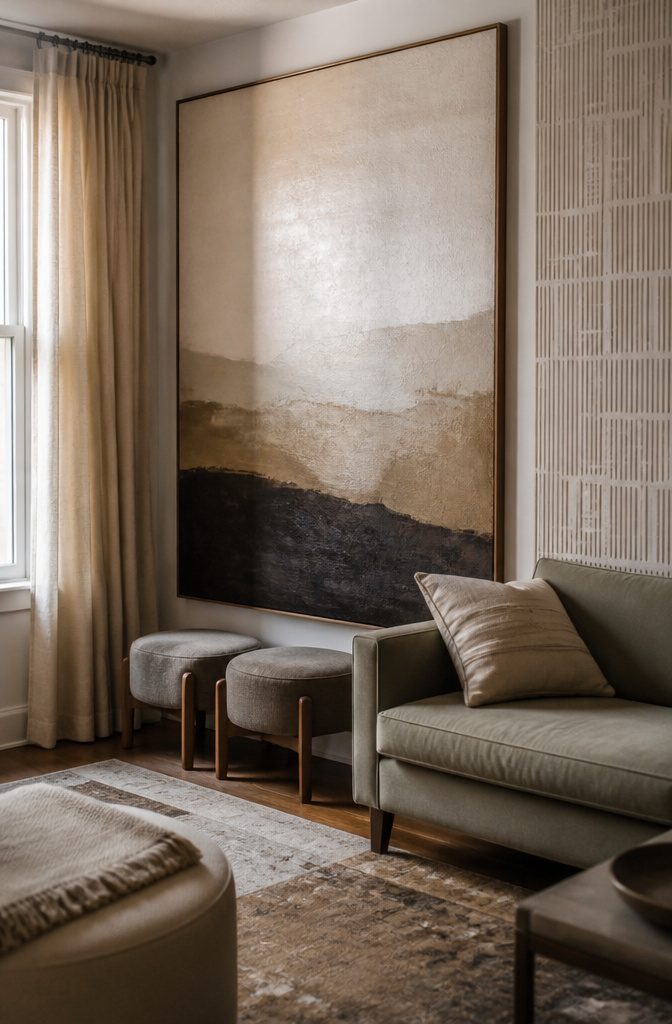
A large piece of art can pull focus in a tight room without claiming any floor.
Designer Kate Hartman put oversized artwork in a corner and paired it with small stools that could be moved when needed, giving the wall drama and the floor breathing room at the same time.
The scale matters more than the subject: a single commanding piece reads faster than a gallery wall and skips the measuring and leveling that comes with hanging six frames in a grid.
Wallpaper and murals work the same way, turning one wall into the room’s anchor.
Sarah Stacey used a mural with cranes in a small living room and layered tall curtains over it, and the pattern held attention without furniture backing it up.
Bold geometric wallpaper brings structure and rhythm to a compact space, and the pattern can make the room feel larger if the lines pull the eye across or up instead of boxing it in.
12. Add Texture and Pattern Selectively
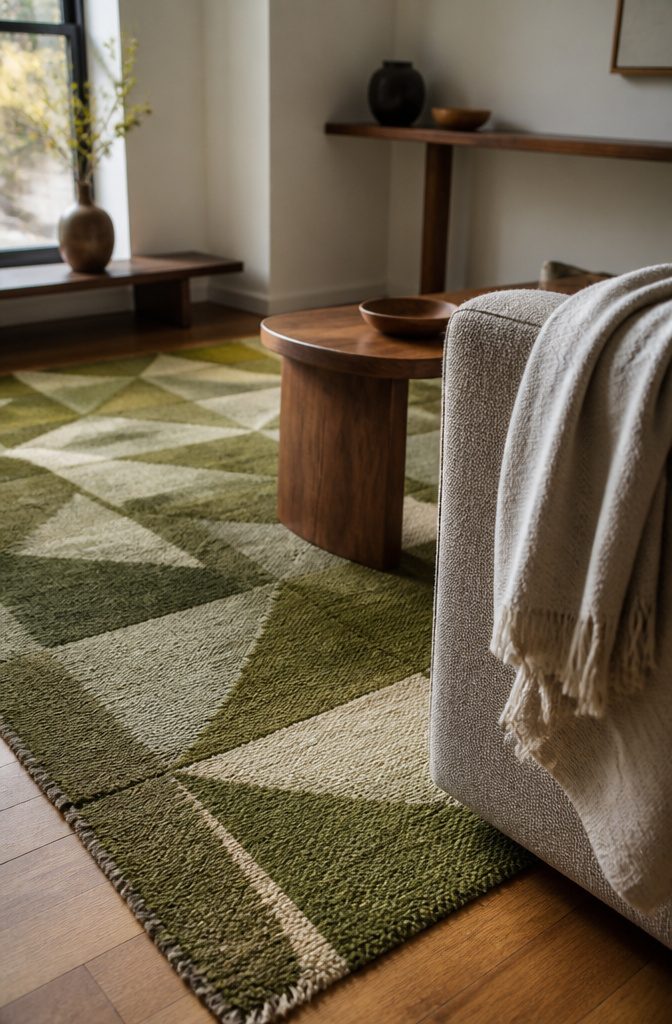
A wool rug or linen throw adds warmth without crowding the room the way small decorative objects do. Texture works when materials contrast—smooth next to rough, woven next to solid—so the space feels layered rather than flat.
One approach pulls color and texture from what is already there: the wood tone of a side table, the weave of the sofa fabric, existing architectural details.
When new pieces echo what is already in the room, the whole space feels calmer.
Pattern can go further than most renters expect. A bold geometric wallpaper or a busy patterned rug turns a small living room into something more deliberate, not less.
The 1940s rug from Finland mentioned in one source was a green geometric color block; another named the Element Arp Natural Wool Hand-Tufted Area Rug.
The risk is scattering pattern across too many surfaces at once. Concentrate it: one wall papered, or the rug doing the work while the walls stay quiet.
13. Choose Storage That Reduces Visible Clutter
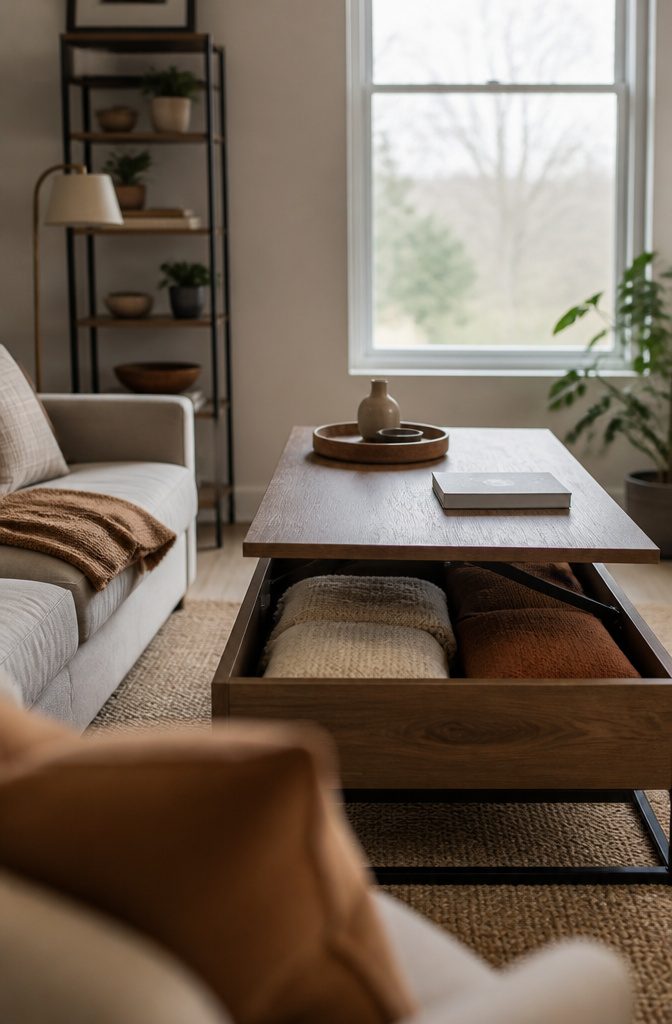
A coffee table that opens turns wasted surface into working storage. Trunks, hollow ottomans, and benches with lift-tops all give you a place to stash throw blankets and pillows without adding a separate cabinet that eats floor space.
In a studio under 300 square feet, a vintage trunk handled both roles and kept the sight lines clean.
Stacking books under a low coffee table or using the shelf built into its frame clears the top and keeps the room from looking overrun.
Lightweight nesting tables and open-frame pieces let the eye travel through instead of stopping at a solid mass. Fewer containers sit out in the open; more tuck into furniture you were going to own anyway.
14. Use a Sofa or Seating Arrangement to Support Conversation
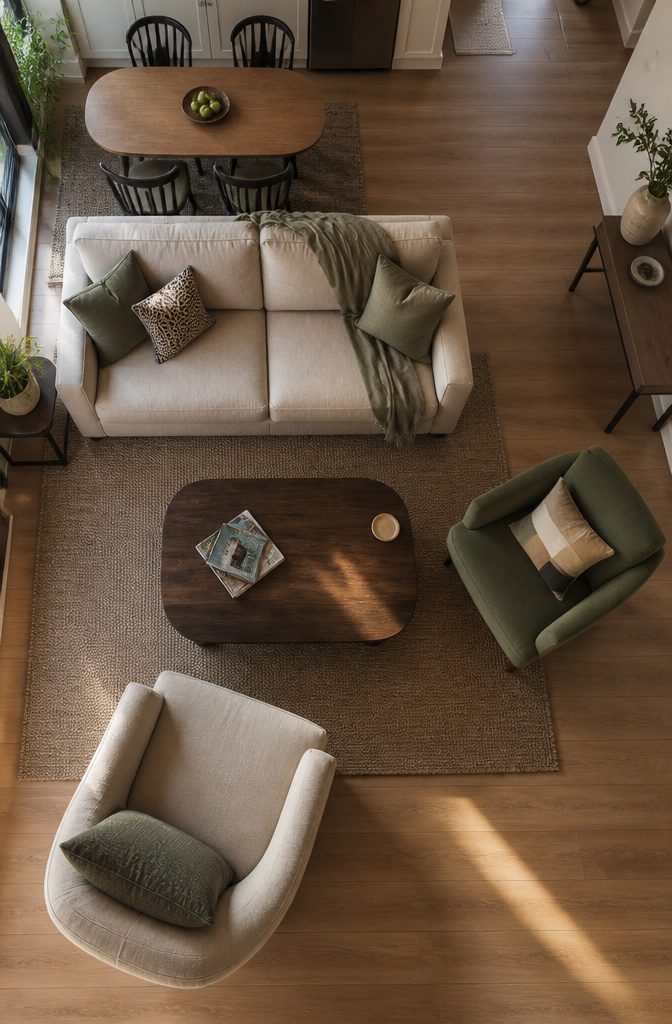
A sofa facing two chairs makes the room work for talking instead of staring at screens.
Designer Amanda Jacobs turned two chairs toward the couch so a family could sit and actually look at each other, and the setup reads warmer than four seats aimed at a wall.
If the room serves more than one purpose, let the sofa back work as the divider—one side becomes the living area, the other opens to the kitchen or a workspace, and you skip buying a room divider that eats floor space.
A Brooklyn apartment ran the sofa between the living zone and a dining table without blocking the kitchen, and the back-to-back layout kept sightlines open.
Guest chairs can sit behind the sofa the same way: they stay out of traffic when it’s just you, flip around when people come over, and the arrangement looks intentional rather than like you ran out of room.
15. Edit the Room to Suit Its Purpose
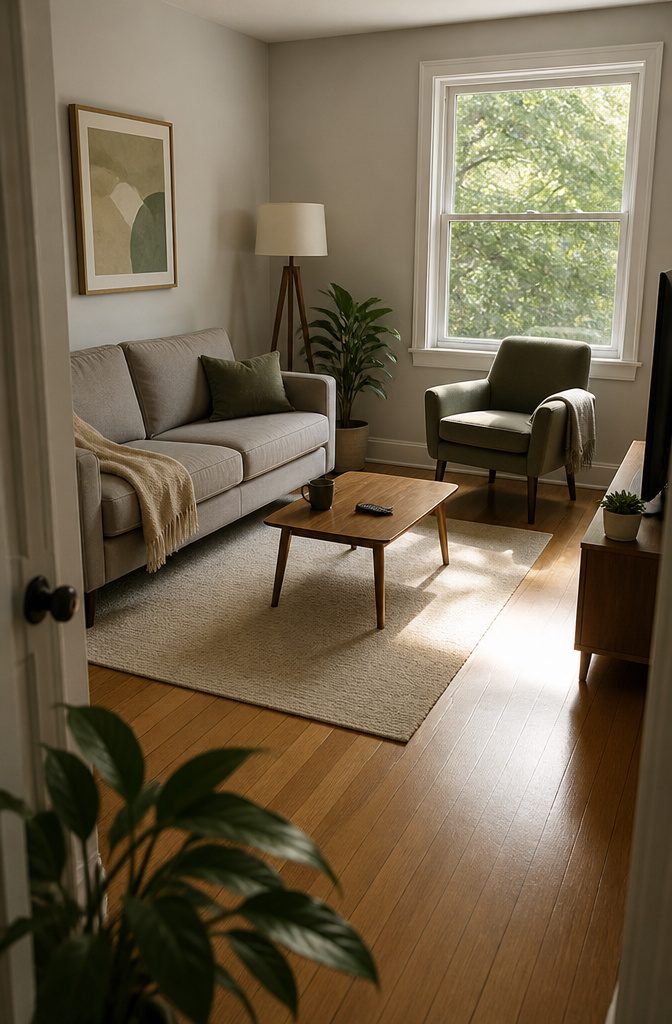
Start by listing the two or three functions that actually get used—sitting down after work, watching something together, keeping a drink and the remote within reach—and set aside the rest.
A small living room that tries to be a reading nook, a home office, a bar cart display, and a full entertainment setup ends up crowded with furniture that sits untouched most of the week.
Limit the list to your top needs and let those drive what stays in the room. If you rarely host more than two or three people at once, a second armchair beats a loveseat you’ll never fill.
If the TV gets an hour of use on weekends, it does not need to anchor the whole layout. The space opens up the moment you stop filling it with pieces that serve a routine you don’t actually keep.
Frequently Asked Questions
How do I arrange furniture in a small living room?
Pull the sofa 2 to 3 inches off the wall instead of pushing it flat against the perimeter.
Mark the main pathways first (entry to seating, seating to balcony) and keep at least 30 inches of clearance for comfortable movement. Float furniture to create shadow lines that make the room feel deeper rather than boxed in.
What size sofa works best in a small living room?
A 72-inch apartment sofa or deep loveseat usually works better than an 84-inch standard piece when the room can’t absorb the extra length.
Choose pieces with exposed legs and open frames to reduce visual weight, and pick lower profiles that keep sight lines open so the room reads taller.
What colors work best for small living rooms?
Soft cream, warm beige, and pale gray create a calm, cohesive base, but small spaces can handle stronger choices when the rest of the room stays edited.
Saturated blue adds depth by receding against other tones, and a deep blue ceiling draws the eye up without closing the space in. Paint the trim in a bold shade if a full color drench feels like too much.
How can I add storage to a small living room?
Use furniture that opens for storage: an ottoman handles seating, a footrest, and a bin for throws or games, while a storage bench holds what a closet would and seats 2 to 3 people when you host.
Install floating shelves above door frames, windows, or the sofa to hold books and small plants without claiming floor space you need for walking.